

About this worksheet
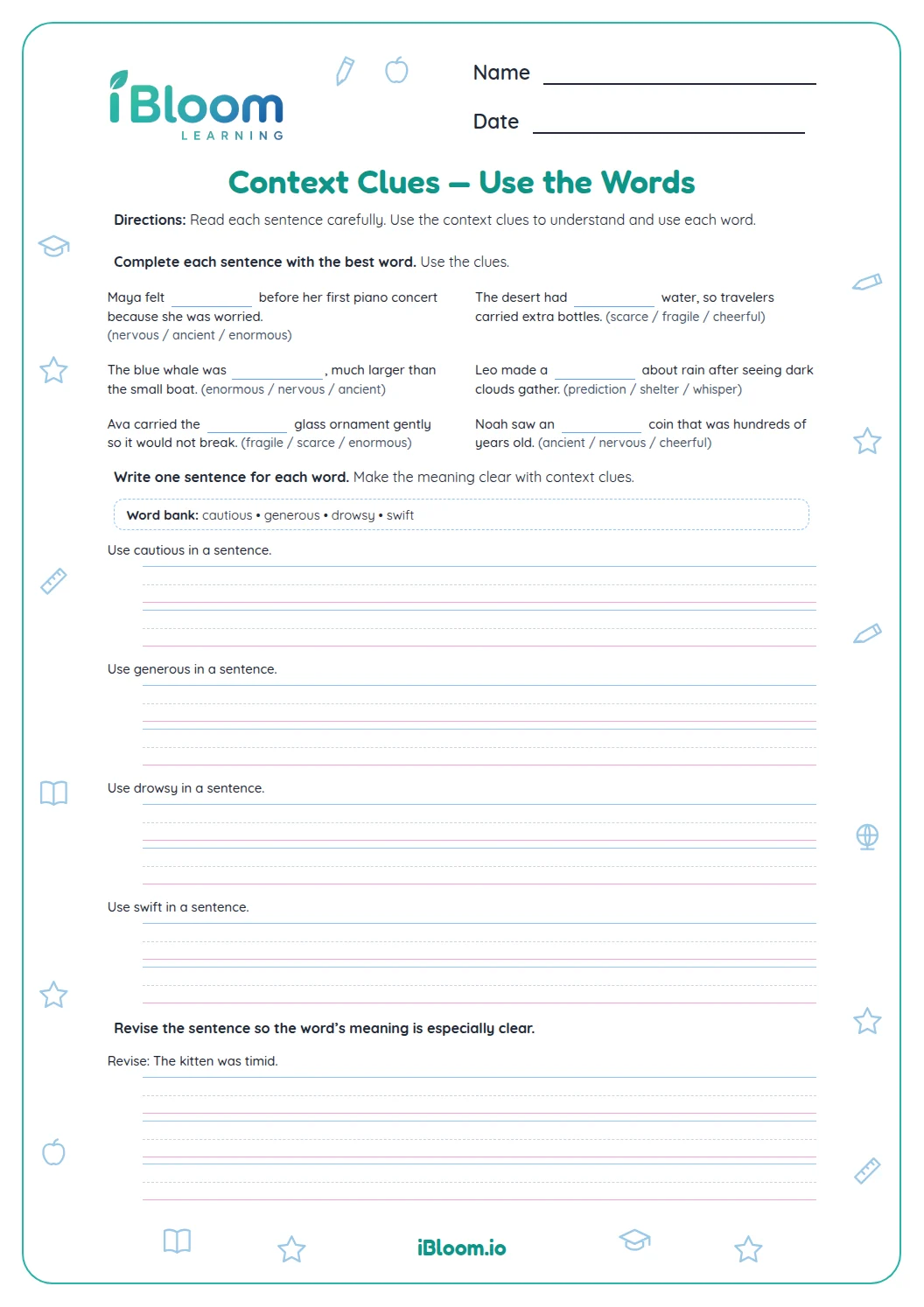
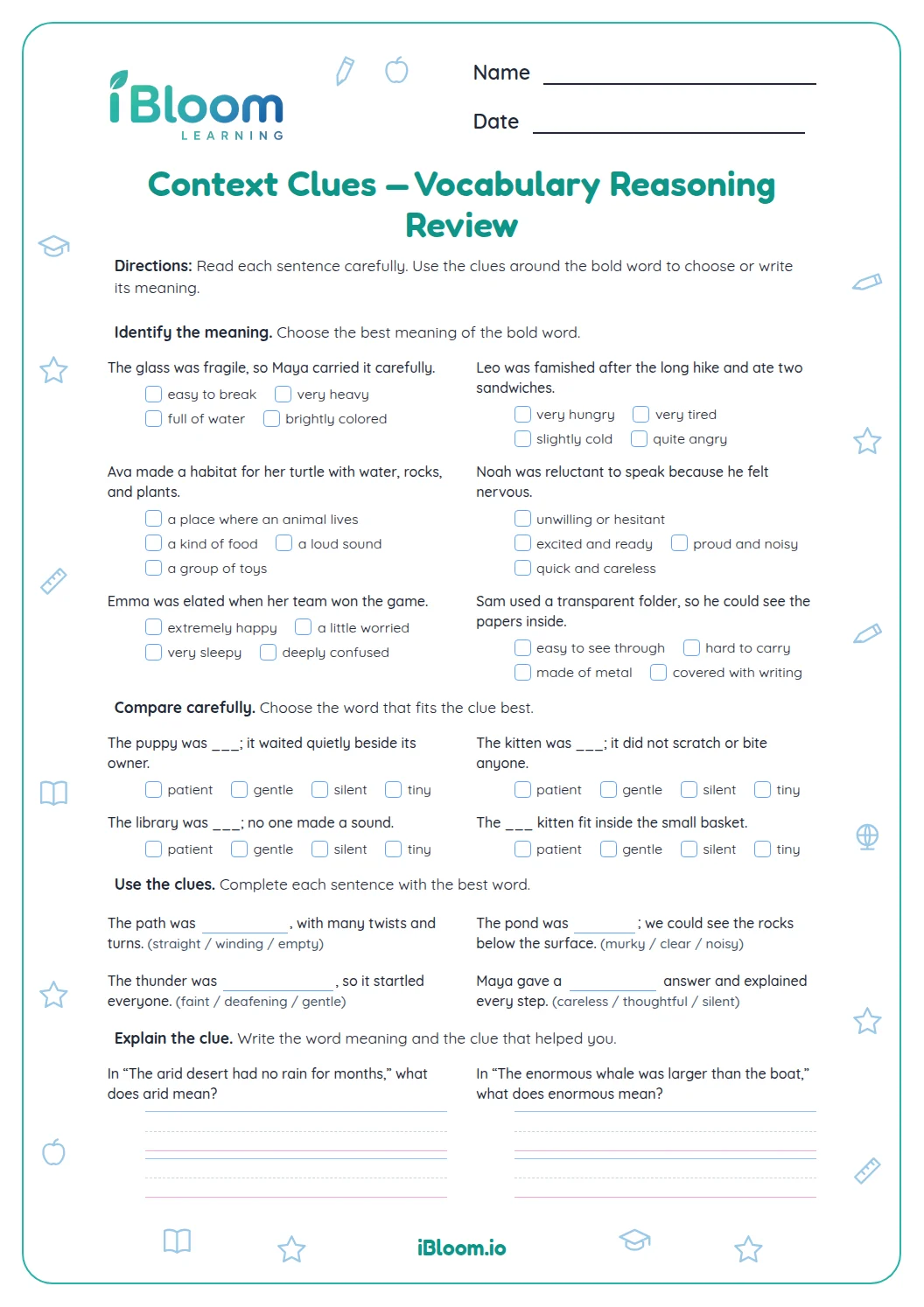
This Grade 4 worksheet practices two context-clue tasks. In Part A, children classify sentences as definition, example, or contrast clues. In Part B, they use surrounding details to choose the meaning of a word. The answer key is included, and the practice aligns with CCSS L.4.4a.
Aligned to L.4.4a
What are the three clue types?
A definition clue explains a word. An example clue names one or more examples. A contrast clue points out a difference, often with words such as unlike, but, or not. These clue types help readers pay attention to how a sentence is built.
Some sentences use a signal word, while others restate an idea in different words. Read the full sentence before choosing a category.
How can a reader connect a clue to meaning?
First identify the unfamiliar word, then find the phrase that explains or illustrates it. Replace the word with a possible meaning and reread the sentence to see whether it still makes sense.
- 1A peninsula is land almost surrounded by water.
- 2The sentence explains what a peninsula is.
- 3That wording gives a definition clue.
- 4Choose “Definition clue.”
What does each part practice?
Part A contains eight sentences for sorting definition, example, and contrast clues. Part B contains eight target words in context and asks for the strongest meaning. The key lists one intended answer for each item.
How to use this worksheet
- 1Read the whole sentence before classifying it.
- 2Look for signal words such as including, unlike, or not.
- 3Find the phrase that gives information about the target word.
- 4Test the possible meaning in the original sentence.
- 5Choose the clue type or meaning that best fits all the details.
Common mistakes and quick fixes
The mistake
Choosing a clue type from one signal word alone
The fix
Read the rest of the sentence to confirm how the information works.
The mistake
Confusing an example with a definition
The fix
Ask whether the sentence explains the category or lists members of it.
The mistake
Guessing from a familiar word part only
The fix
Use the sentence details to verify the target word’s meaning.
Common Core alignment
The questions use nearby sentence information to clarify word meaning.
Use definitions, examples, and restatements in text as meaning clues.
On this sheet: Children classify clue structures and use sentence clues to choose word meanings.
Show the official wordingHide the official wording
Use context (e.g., definitions, examples, or restatements in text) as a clue to the meaning of a word or phrase.
What to practice next
Make more practice
Further reading
Questions parents and teachers ask
What kinds of context clues appear on this sheet?
Part A asks children to classify definition, example, and contrast clues. Part B asks them to infer meanings such as famished or fragile from sentence details. Each question has one best answer in context. Ask the child to point to the context that supports the answer.
How many questions are included?
There are 14 multiple-choice questions: seven classify clue types and seven connect context to a word meaning. The answer key is printed separately. Children can point to the phrase that helped them decide. Ask the child to point to the context that supports the answer.
What is a definition clue?
A definition clue explains a word’s meaning in the sentence. In “A peninsula is land almost surrounded by water,” the words after peninsula explain what the word means, so the sentence uses a definition clue. Ask the child to point to the context that supports the answer.
How is an example clue different?
An example clue names one or more examples that help explain a category. Words such as “including” or “such as” can introduce examples. Read the whole sentence to confirm the examples clarify the unfamiliar word. Ask the child to point to the context that supports the answer.
How can children use a contrast clue?
A contrast clue highlights a difference between ideas. Words such as “unlike” and “not” can signal a contrast, but readers should check the complete sentence to see how the ideas differ. Ask the child to point to the context that supports the answer.
Does the answer key explain each word?
The key lists the intended clue category or word meaning for every question. Encourage the child to find the sentence detail supporting each answer; this makes checking a chance to practice using context. Ask the child to point to the context that supports the answer.