




About this worksheet
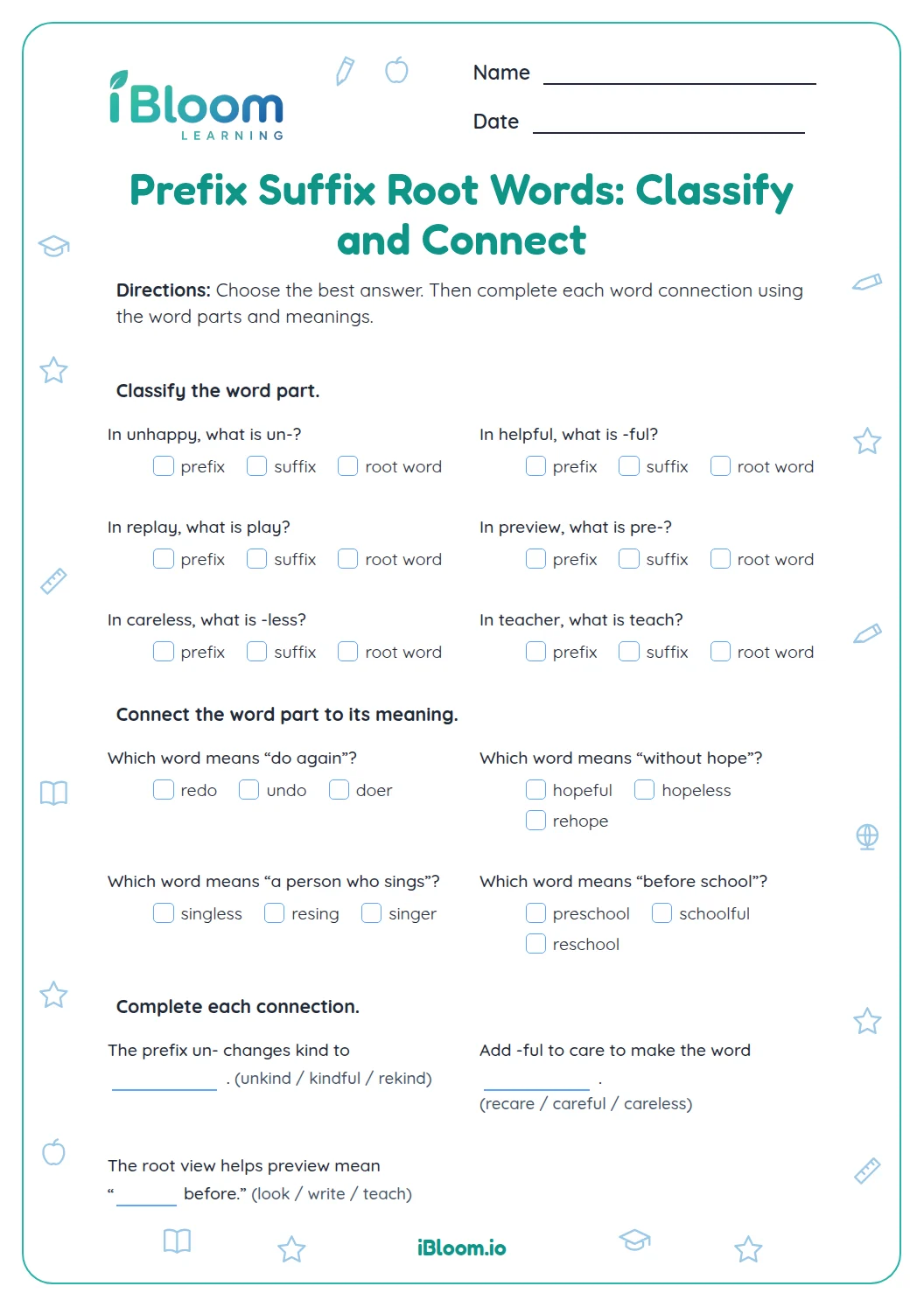
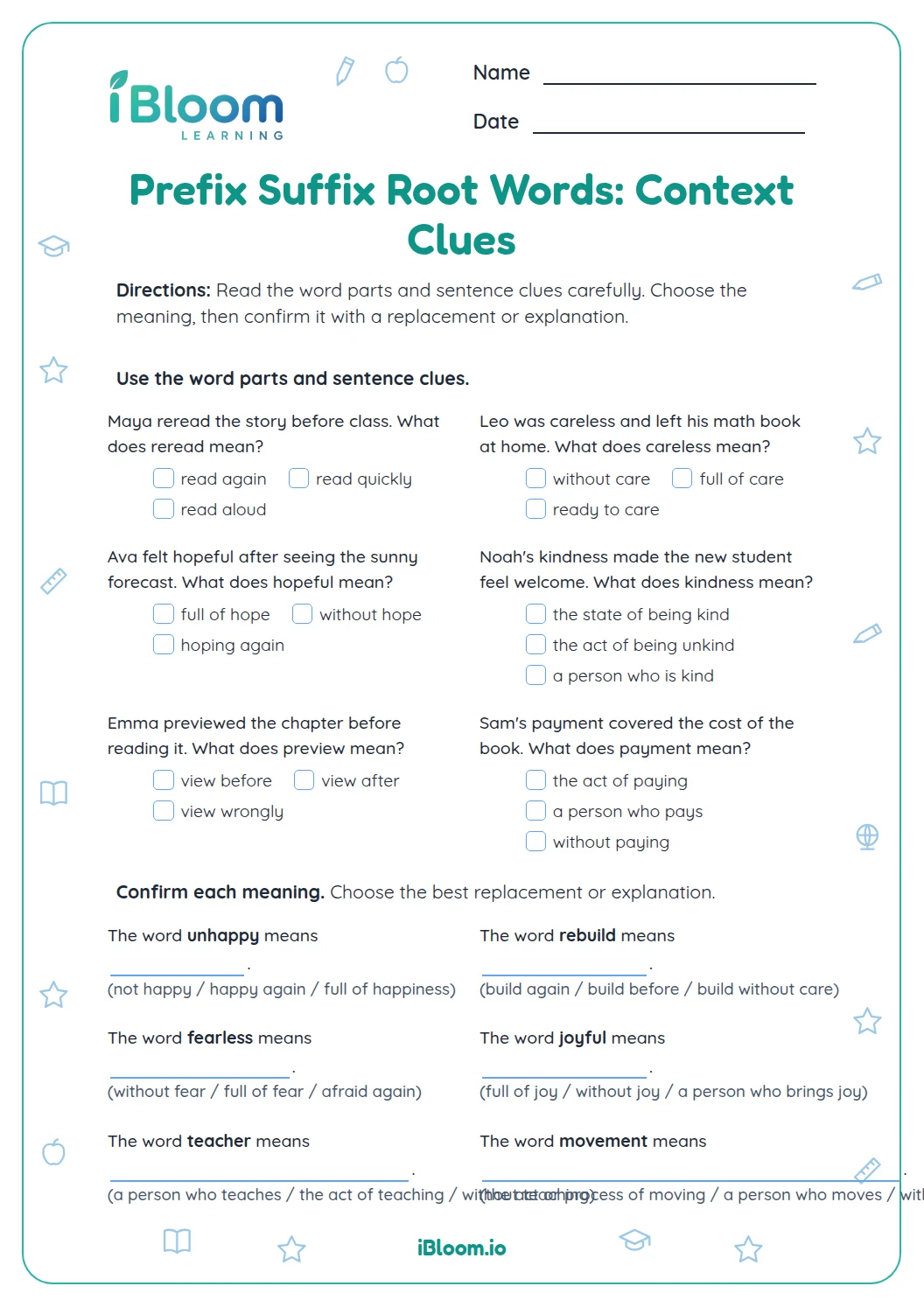
This free printable worksheet is for grade 4 learners practicing prefixes, suffixes, and roots in context. It includes 16 questions for short word-part completions, followed by a separate answer key. Each section gives learners a clear way to apply the skill. It aligns with L.4.4b.
Aligned to L.4.4b
What does prefixes, suffixes, and roots in context practice?
Learners use common prefixes, suffixes, and roots as meaning clues. The items connect word parts such as tele-, re-, un-, -er, -less, and port to a sentence or a clear definition.
How can a learner solve an item?
Read the whole prompt, identify the feature the question asks about, and check that the response fits the sentence or model.
- 1A ___ lets us see far away. (tele = far)
- 2The sentence points to a tool for seeing distant things.
- 3Answer: telescope.
How is the printable organized?
The worksheet has 16 questions across 2 pages, followed by 2 answer-key pages. Its sections move from direct examples to applying the same skill in context.
How to use the worksheet
- 1Read the whole clue or sentence.
- 2Underline the prefix, suffix, or root.
- 3Recall what the word part means.
- 4Complete the word or definition.
- 5Reread the result to check its meaning.
Common mistakes and quick fixes
The mistake
Treating a prefix as the root word.
The fix
Separate the beginning from the base word.
The mistake
Forgetting that a suffix changes a word’s form or meaning.
The fix
Read the whole completed word.
The mistake
Using a word-part meaning that does not fit the sentence.
The fix
Check the clue and completed sentence together.
Common Core alignment
Use common roots and affixes as clues to word meaning.
On this sheet: Learners use meanings of roots, prefixes, and suffixes to complete contextual sentences.
Show the official wordingHide the official wording
Use common, grade-appropriate Greek and Latin affixes and roots as clues to the meaning of a word (e.g., telegraph, photograph, autograph).
What to practice next
Make more practice
Further reading
Questions parents and teachers ask
What does this prefix, suffix, and root words worksheet include?
This printable has 16 questions focused on using word-part meanings to complete short clues and sentences. The prompts use the target skill in short, specific tasks, and the separate answer key lets an adult review responses after the learner finishes.
Can an adult read the directions aloud?
Yes. Read the directions and each prompt aloud if that helps the learner focus on the skill. Keep the printed words or pictures in view, and invite the learner to explain the clue or letter pattern that supports each answer.
When should we use the answer key?
Let the learner complete the questions first, then compare each response with the separate key. For a missed item, return to its sentence or model and identify the part that supports the answer. This gives you a specific point to review together.
Can we split the worksheet into shorter sessions?
Yes. There are 16 questions across 2 worksheet pages, so you can stop after a section and continue later. Keep the answer key nearby, but wait until the learner finishes a section before checking. This makes it easier to review one skill at a time.
How long should this practice take?
Plan for about 15 to 20 minutes, with extra time if the learner talks through choices, traces carefully, or writes slowly. The estimate is a flexible guide rather than a timer. Pause at a section break when the learner needs a rest, then return to the next set of questions.