







About this worksheet
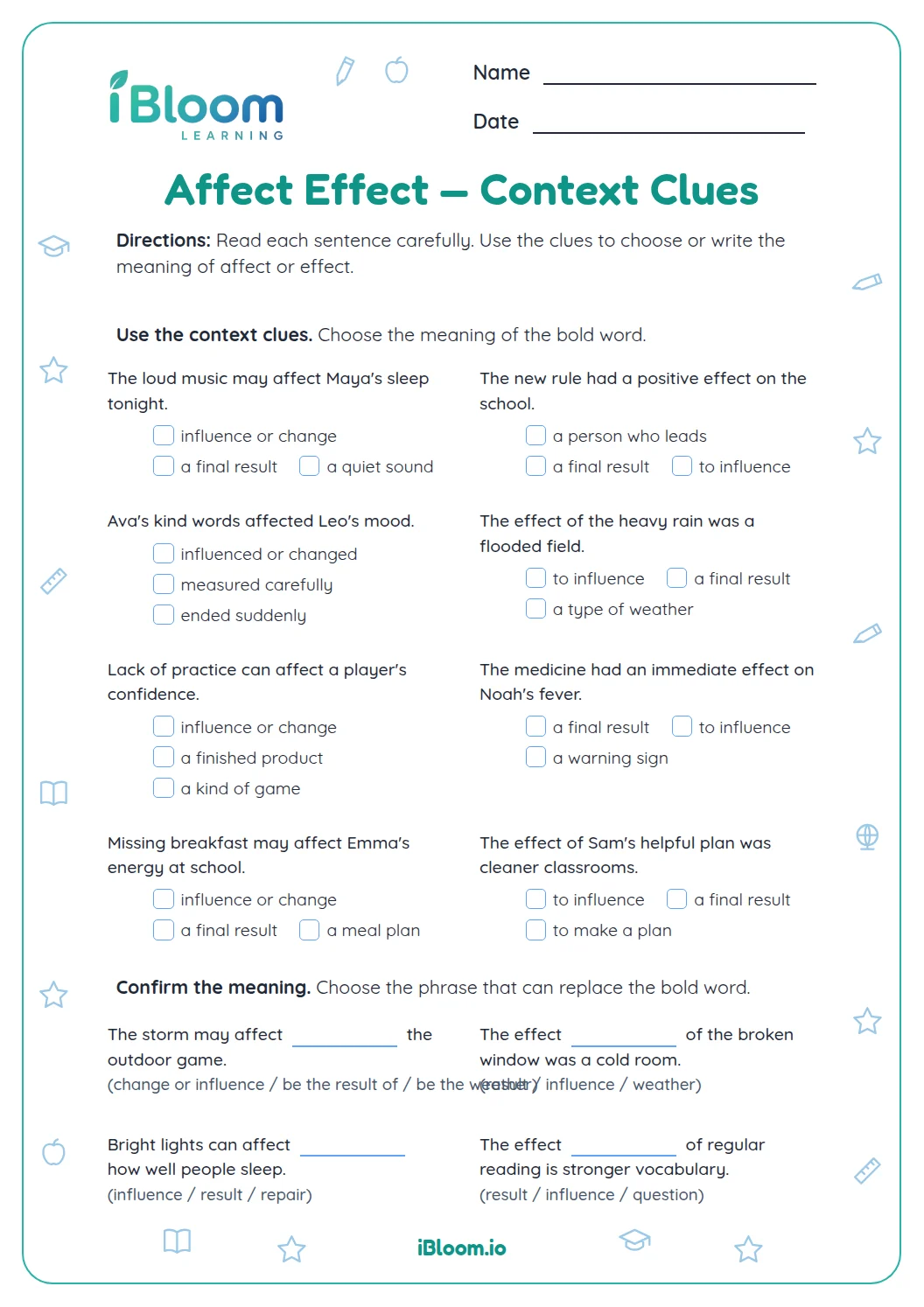
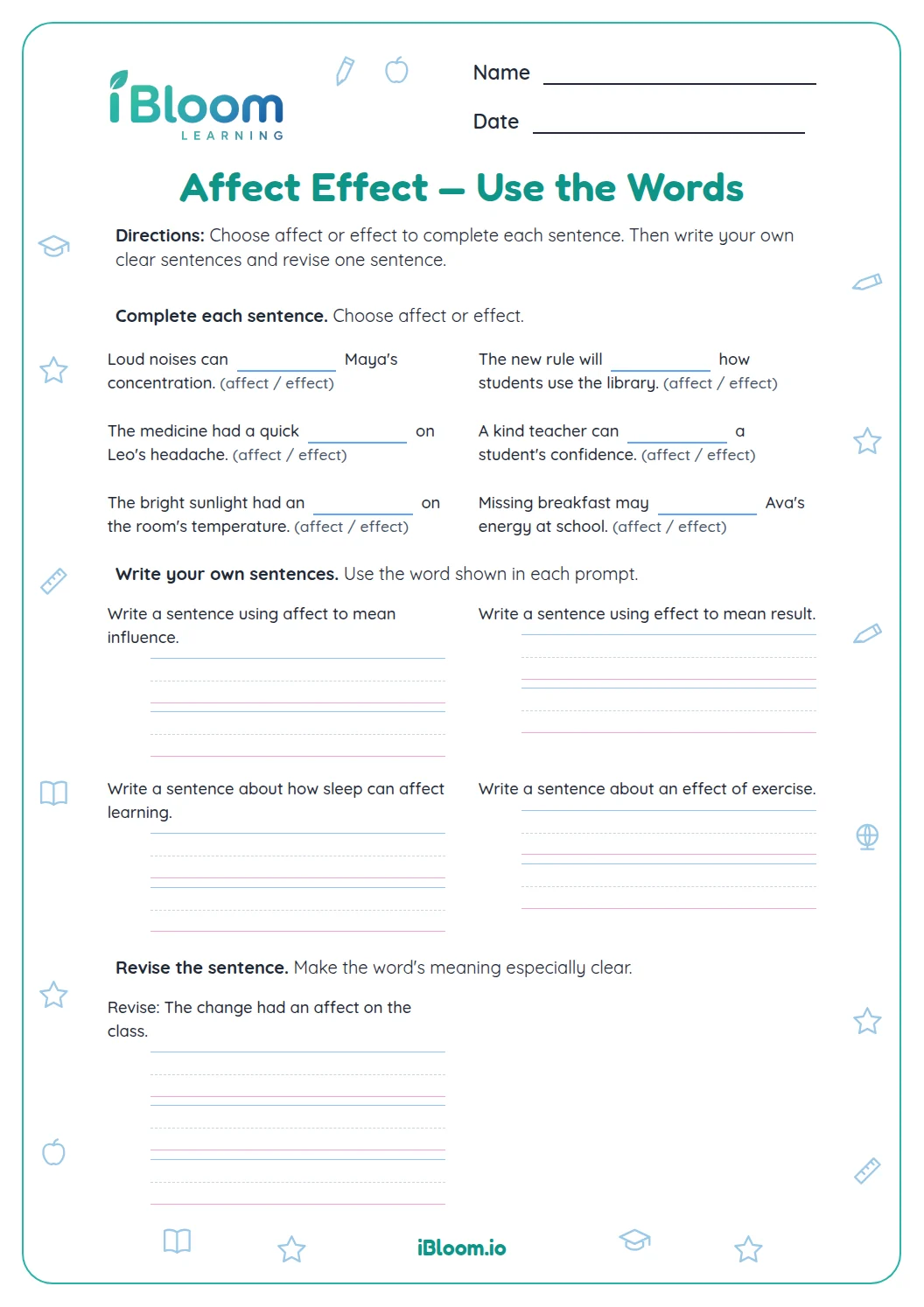
This free Grade 5 printable reviews the commonly confused words affect and effect. Students first identify which word names an action or a result, then complete sentence blanks, and finally choose explanations and correct uses. Fourteen questions appear in four short sections, with a separate answer key. The context practice aligns with CCSS L.5.4a.
Aligned to L.5.4a
What is the usual difference between affect and effect?
Affect is usually a verb meaning to influence. Effect is usually a noun meaning a result. Context can help: a change may affect a plan, and the effect of that change is what happened because of it.
How can context help choose the right word?
Read the whole sentence and ask whether the blank needs an action or a result. In “A late bus can ___ our arrival time,” the blank needs an action, so affect fits. In “The ___ of the wind was a fallen branch,” the blank names a result, so effect fits.
- 1A late bus can ___ our arrival time.
- 2The sentence needs an action word.
- 3Answer: affect
What does each part ask students to do?
Part A reviews the usual meanings. Parts B and C use sentence context to fill blanks. Part D asks students to explain the clue and recognize correct usage. A complete sentence helps show whether the word functions as an action or a result.
Can affect or effect ever work another way?
Yes, but this worksheet practices the common school usage: affect as a verb and effect as a noun. There are less common uses, so for this practice read the sentence and choose the usual form that matches its meaning.
How to use this affect/effect review
- 1Recall the usual meanings: affect influences; an effect is a result.
- 2Read the whole sentence before filling a blank.
- 3Ask whether the blank describes an action or names a result.
- 4In the reasoning section, test the choice in the full sentence.
- 5Check responses with the key and explain one clue aloud.
Affect/effect mix-ups and fixes
The mistake
Choosing effect because a sentence describes something that happened.
The fix
Check whether the blank names the result itself; if so, effect is the noun.
The mistake
Using affect after “an” or “the” when the sentence needs a noun.
The fix
Read the phrase aloud: “an effect” names a result.
The mistake
Selecting a word from memory without rereading the full sentence.
The fix
Use the neighboring words to decide whether the sentence needs an action or a result.
Common Core alignment
Use context to clarify the meaning and use of a word.
On this sheet: Sentences use action and result clues to select affect or effect.
Show the official wordingHide the official wording
Use context (e.g., cause/effect relationships and comparisons in text) as a clue to the meaning of a word or phrase.
What to practice next
Make more practice
Further reading
Questions parents and teachers ask
What is the quick way to remember affect and effect?
Affect is usually an action word: something can affect a person or plan. Effect is usually a result: a change can have an effect. The worksheet uses these common meanings and asks students to read each sentence for clues.
Why does the sheet ask students to read whole sentences?
The surrounding words show whether a sentence describes an action or names a result. In “The medicine had a calm effect,” had and calm point to a noun naming a result. Reading the whole sentence helps students choose by meaning rather than by sound.
What question can help with a blank?
Ask, “Does the sentence need an action or a result?” If something can affect a plan, affect describes the action. If the sentence names the effect of a change, effect is the result. Then reread the sentence with the choice in place.
Are affect and effect always used this way?
These are the common meanings taught in this review: affect as a verb meaning influence and effect as a noun meaning result. English has less common uses too, but the worksheet’s sentences are written to practice the usual distinction with clear context.
What is included in the answer key?
The key gives the selected word or choice for all 14 questions. It can help an adult discuss why a sentence needs an action or a result, especially when a learner chooses the right word but is unsure how the sentence clue supports it.