Free printable practice
Homographs Practice Activities
Grade 5 students practise using context to identify homographs, explain meanings, and choose the correct word sense in sentences.
Free printable worksheet PDFs
Preview every available page, then download the free worksheet PDF for home, homeschool, tutoring, or classroom practice.
Preview the exact activity before downloading it.
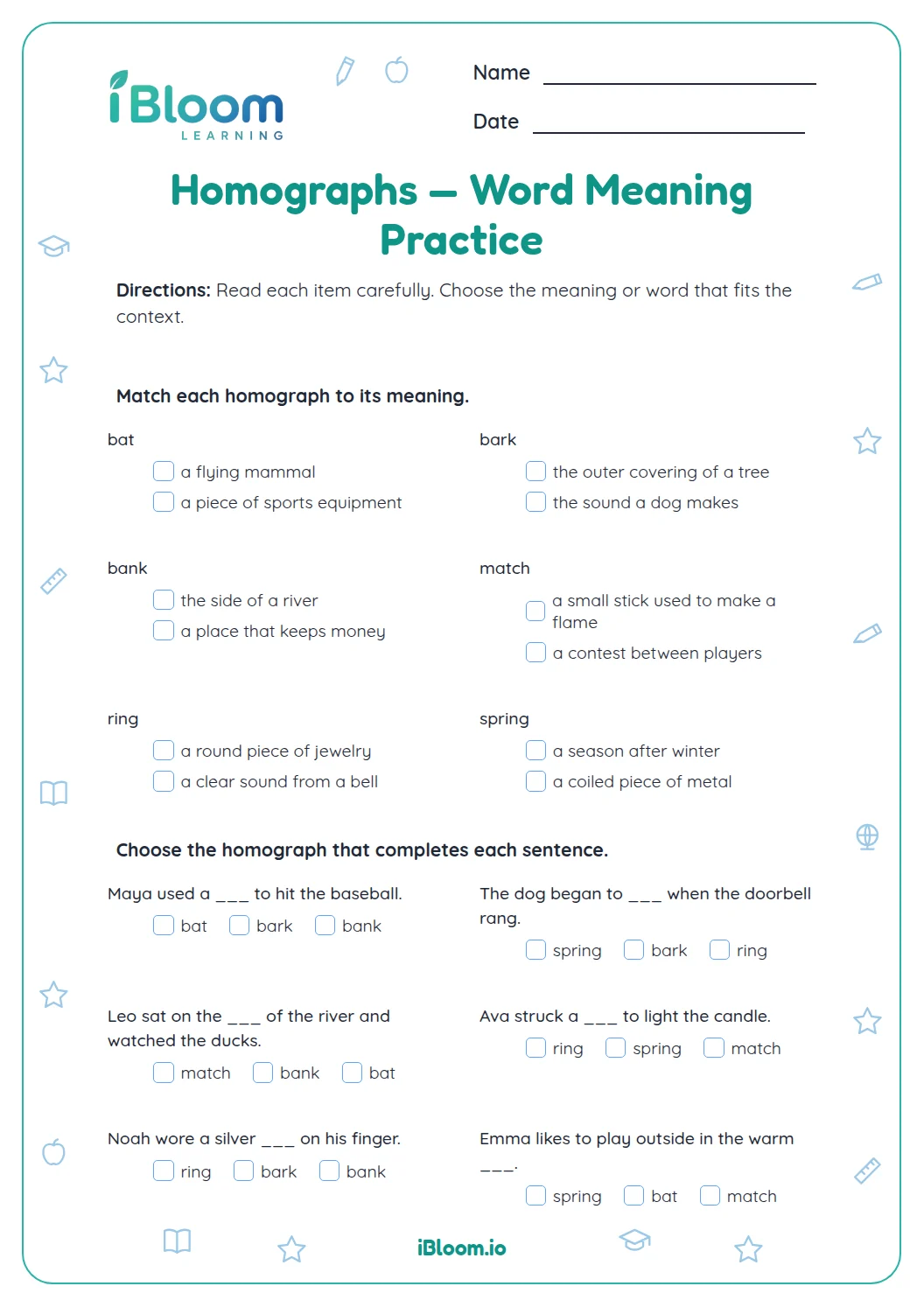 Homographs — Word Meaning PracticeGrade 5 students practise using context to identify homographs, explain meanings, and choose the correct word sense in sentences. This word meaning practice worksheet provides a distinct, age-appropriate way to practise the same lesson.Grade 5Free PDF preview4 pages
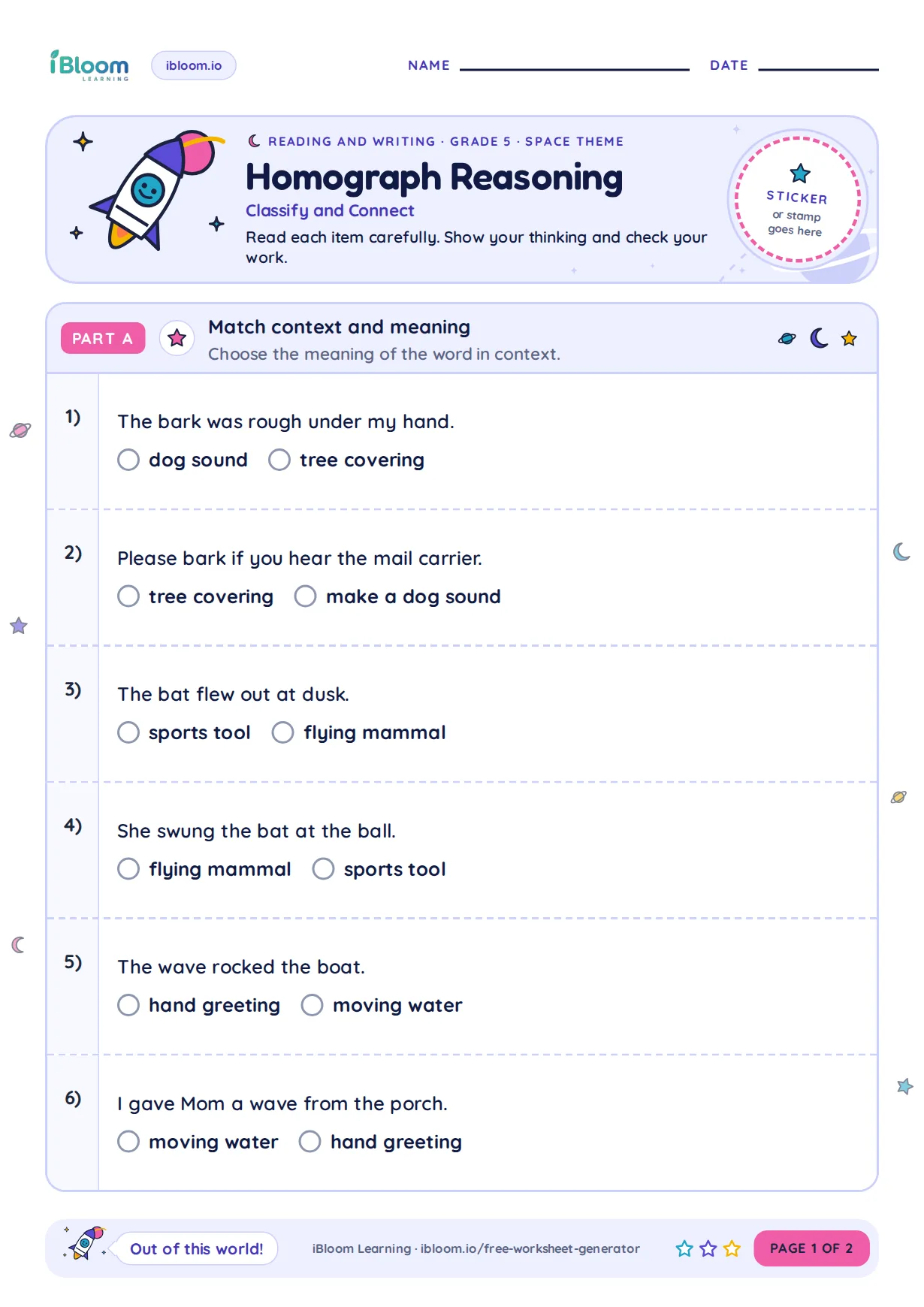 Homographs — Classify and ConnectGrade 5 students practise using context to identify homographs, explain meanings, and choose the correct word sense in sentences. This classify and connect worksheet provides a distinct, age-appropriate way to practise the same lesson.Grade 5Free PDF preview
 Homographs — Context CluesGrade 5 students practise using context to identify homographs, explain meanings, and choose the correct word sense in sentences. This context clues worksheet provides a distinct, age-appropriate way to practise the same lesson.Grade 5Free PDF preview
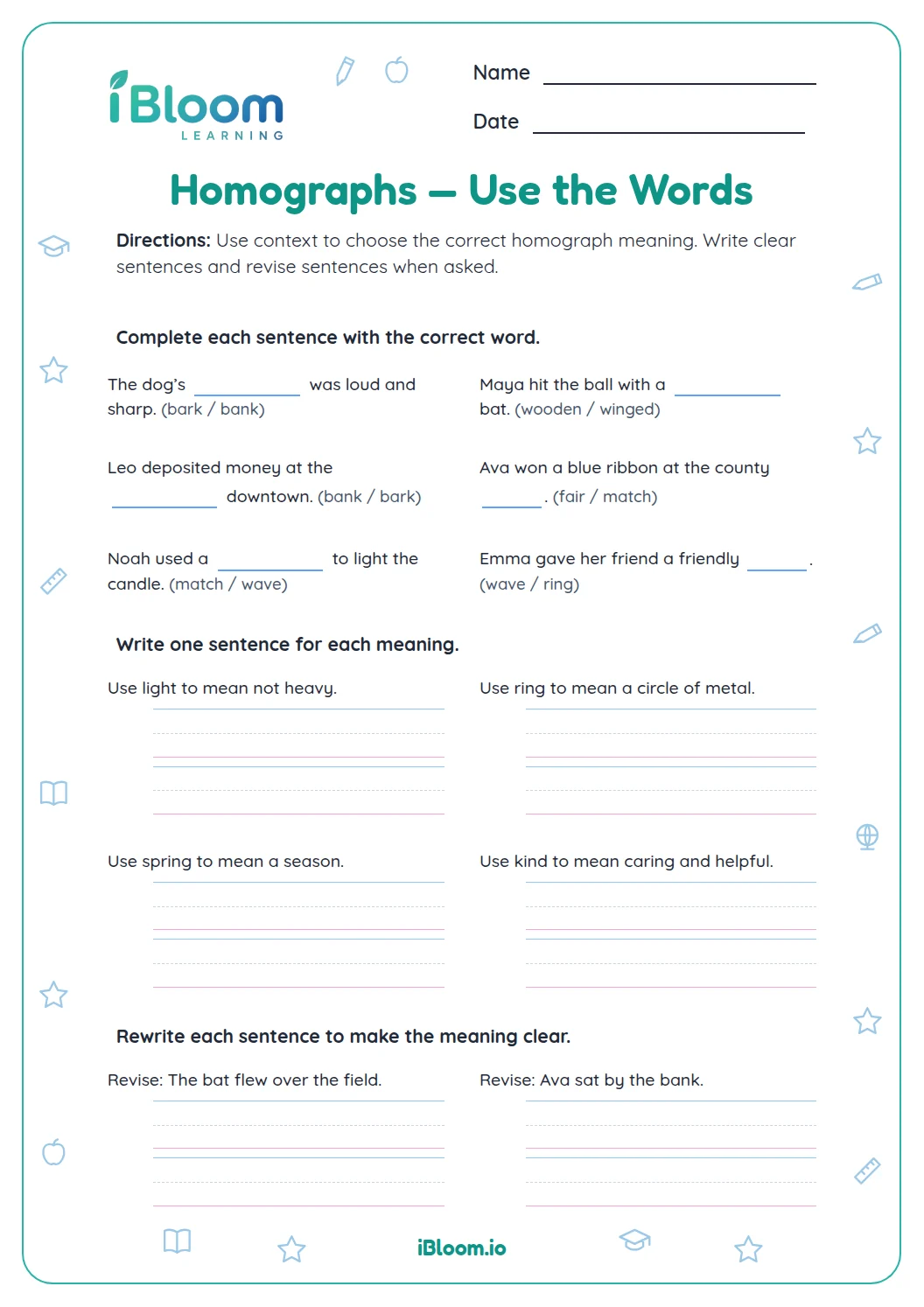 Homographs — Use the WordsGrade 5 students practise using context to identify homographs, explain meanings, and choose the correct word sense in sentences. This use the words worksheet provides a distinct, age-appropriate way to practise the same lesson.Grade 5Free PDF preview
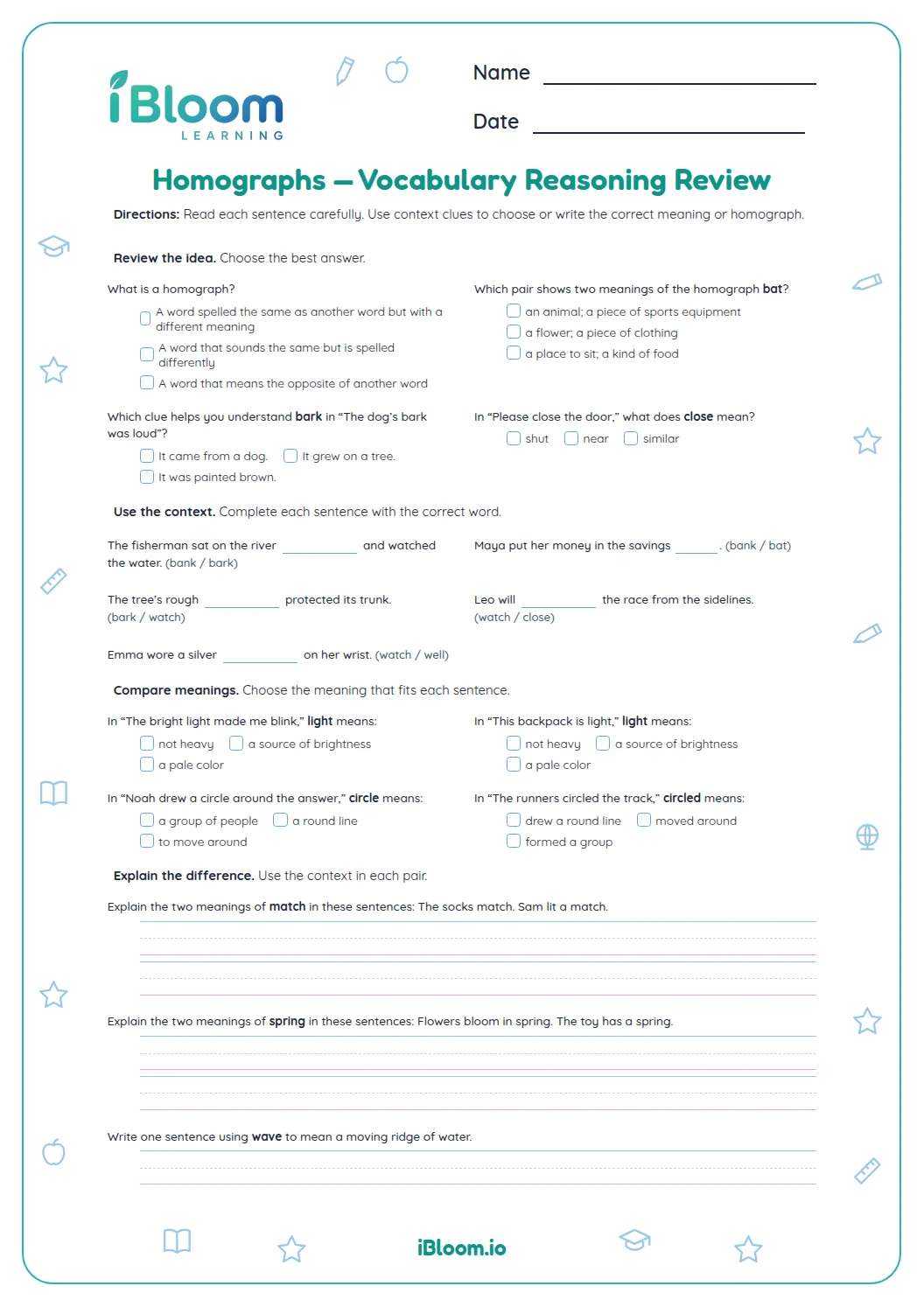 Homographs — Vocabulary Reasoning ReviewGrade 5 students practise using context to identify homographs, explain meanings, and choose the correct word sense in sentences. This vocabulary reasoning review worksheet provides a distinct, age-appropriate way to practise the same lesson.Grade 5Free PDF preview
Practice that builds confidence
What students learn
These Grade 5 homographs worksheets help students notice words that are spelled the same but have different meanings, such as bat, watch, row, or present. Children practise using sentence clues instead of guessing from the word alone.
The printable activities include meaning matching, sentence reading, context-choice tasks, and writing prompts that ask students to use one homograph in two different ways. Each activity builds vocabulary awareness and careful reading.
Homographs can confuse strong readers because the spelling stays the same while the meaning changes. In Grade 5 vocabulary work, students move beyond simply spotting the word and begin explaining how context changes meaning. A sentence about a row of chairs is different from a sentence about a noisy row, and a present in a box is different from being present in class.

Skill progression in the worksheets
The practice usually begins with identifying a homograph in a short sentence. Students then match the word to the correct definition, compare two sentences that use the same spelling differently, and write their own sentence pairs. This progression helps children connect vocabulary, grammar, and comprehension rather than memorising isolated definitions.
A simple parent routine
At home, read one sentence aloud and ask, “What does the word mean here? Which clue helped you?” Have your child underline the clue words, then replace the homograph with a clearer synonym. For example, if watch means “look at,” the sentence should still make sense with observe. If it means a timepiece, the synonym will not fit.

Classroom uses
Teachers can use these printables for vocabulary centers, morning work, partner discussions, or quick comprehension checks after a reading lesson. They also work well for small groups: one student reads the sentence, another explains the meaning, and a third proves the answer with evidence from the sentence.

Common errors to watch for
Some students choose the most familiar meaning every time, even when the sentence points elsewhere. Others confuse homographs with homophones, which sound alike but may be spelled differently. Encourage students to slow down, read the full sentence, and check whether the surrounding words show an action, object, place, or idea.
Free printable PDF download
Use this grade 5 homographs worksheet page to preview the activity, print it, or download it as a PDF for quick practice. It works well for homework, homeschool lessons, tutoring, morning work, revision, and classroom centers.
Answers and answer key support
After the child completes the worksheet independently, parents and teachers can use the answer support or answer key information to check the work, review mistakes, and choose the next practice step.
Why iBloom worksheets help
The activities give repeated, focused practice with real sentence context, not just word lists. A child-friendly strategy is: read the whole sentence, circle the homograph, underline clue words, say the meaning in your own words, then test it with a synonym. This turns a tricky vocabulary skill into a clear reading habit.
Helpful answers
Frequently asked questions
What is a homograph for Grade 5 students?
A homograph is a word that is spelled the same as another word but has a different meaning. Some homographs also have different pronunciations, such as *wind* in “the wind blew” and *wind* in “wind the clock.”
How do these worksheets teach homographs through context?
Students read sentences, identify clue words, choose the correct meaning, and sometimes write two sentences using the same homograph in different ways.
What is the difference between a homograph and a homophone?
A homograph has the same spelling but different meanings. A homophone has the same sound but may have a different spelling, such as *to*, *too*, and *two*.
Are these activities suitable for independent practice?
Yes. Most Grade 5 students can complete the worksheets independently after a short reminder to read the full sentence and use context clues before answering.
How can I support a child who keeps choosing the wrong meaning?
Ask the child to underline clue words, restate the sentence in simpler language, and try replacing the homograph with a synonym that matches the intended meaning.
Is this grade 5 homographs worksheet free?
Yes. You can preview it for free and use the printable worksheet for home or classroom practice.
Can I download this grade 5 homographs worksheet as a PDF?
Yes. Use the worksheet download option to save a printable PDF, or print the worksheet directly from the page.
Does this grade 5 homographs worksheet include answers or an answer key?
When the activity has fixed answers, iBloom includes answer support so parents and teachers can check the completed worksheet.