




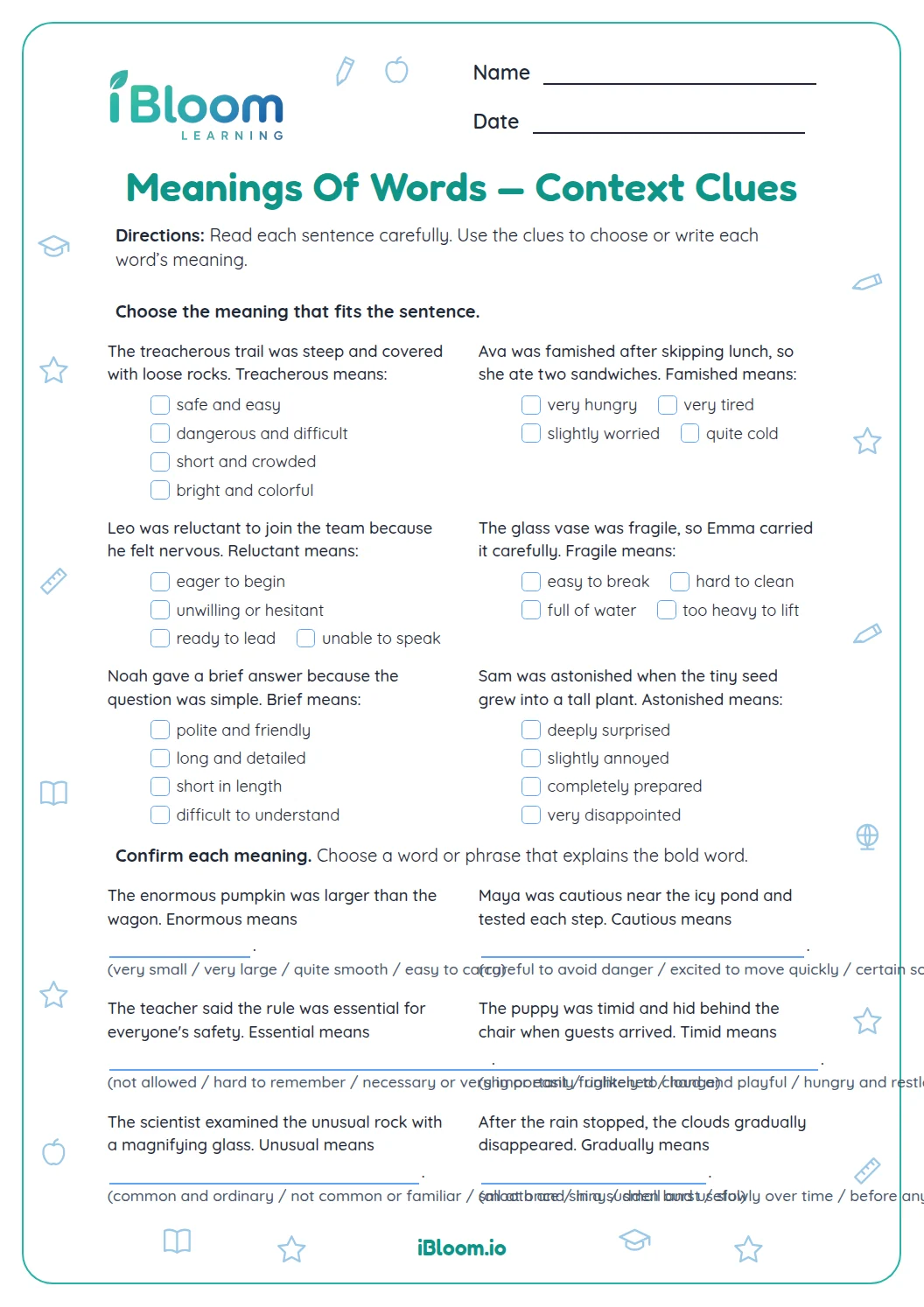
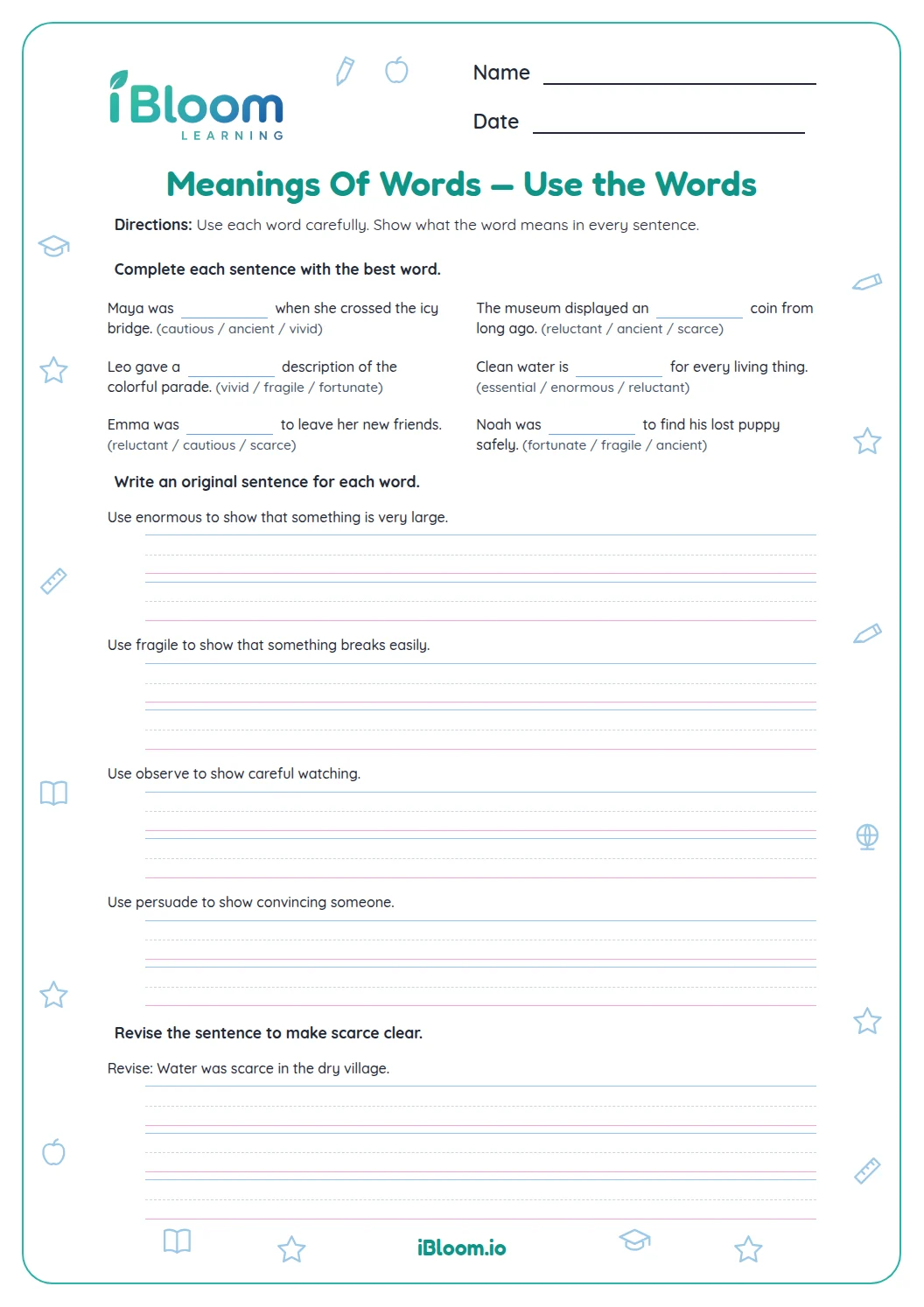

About this worksheet
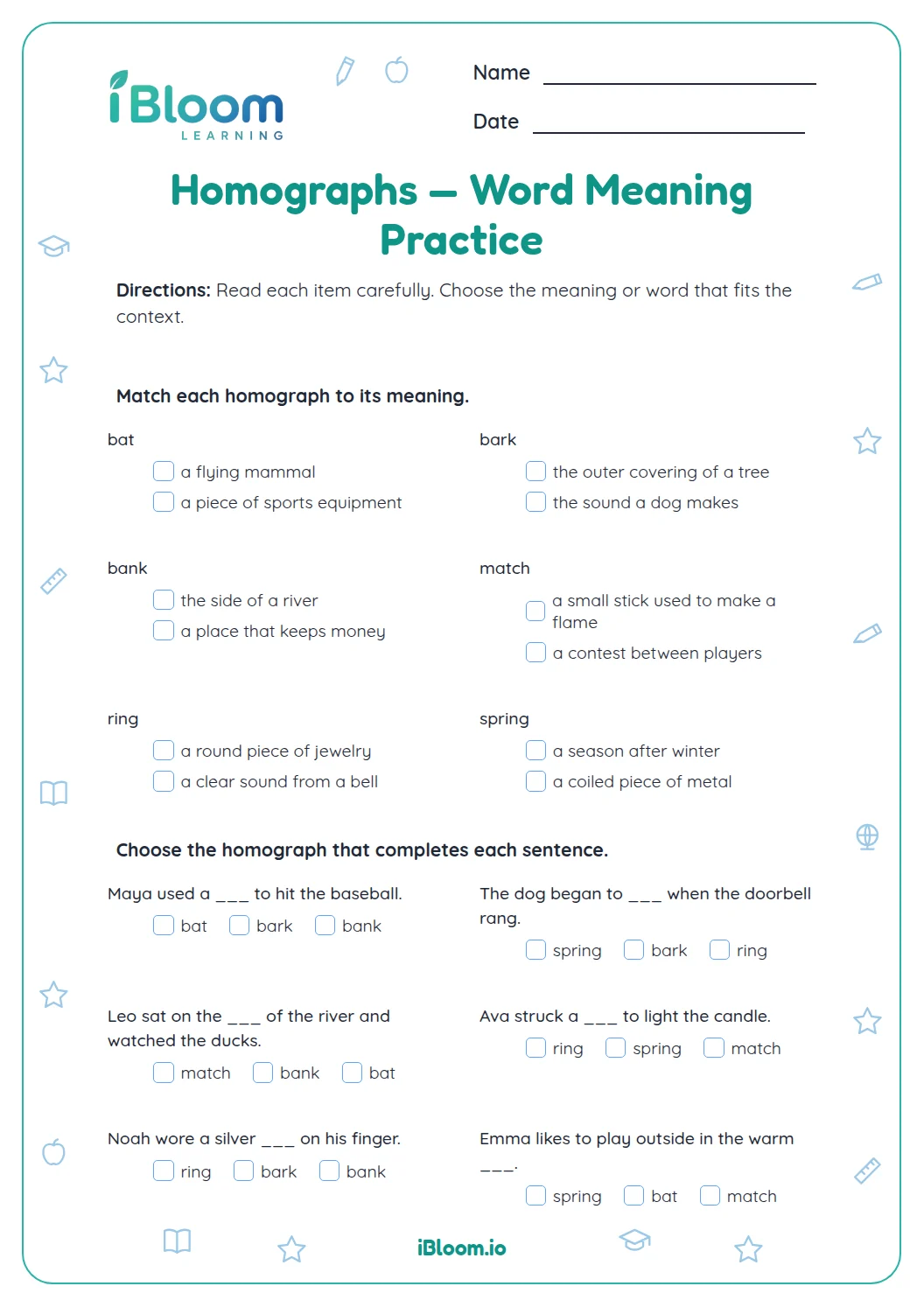
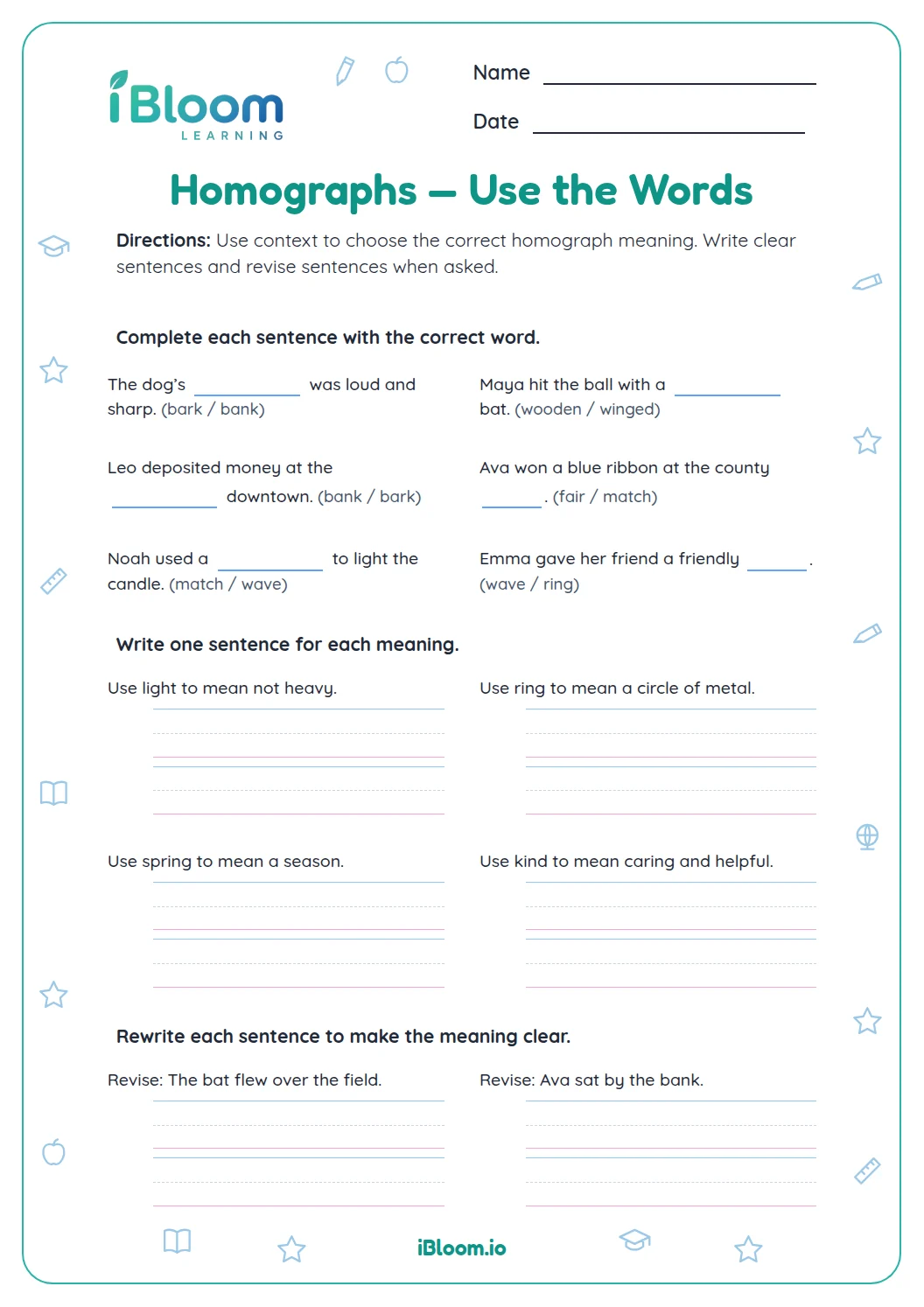
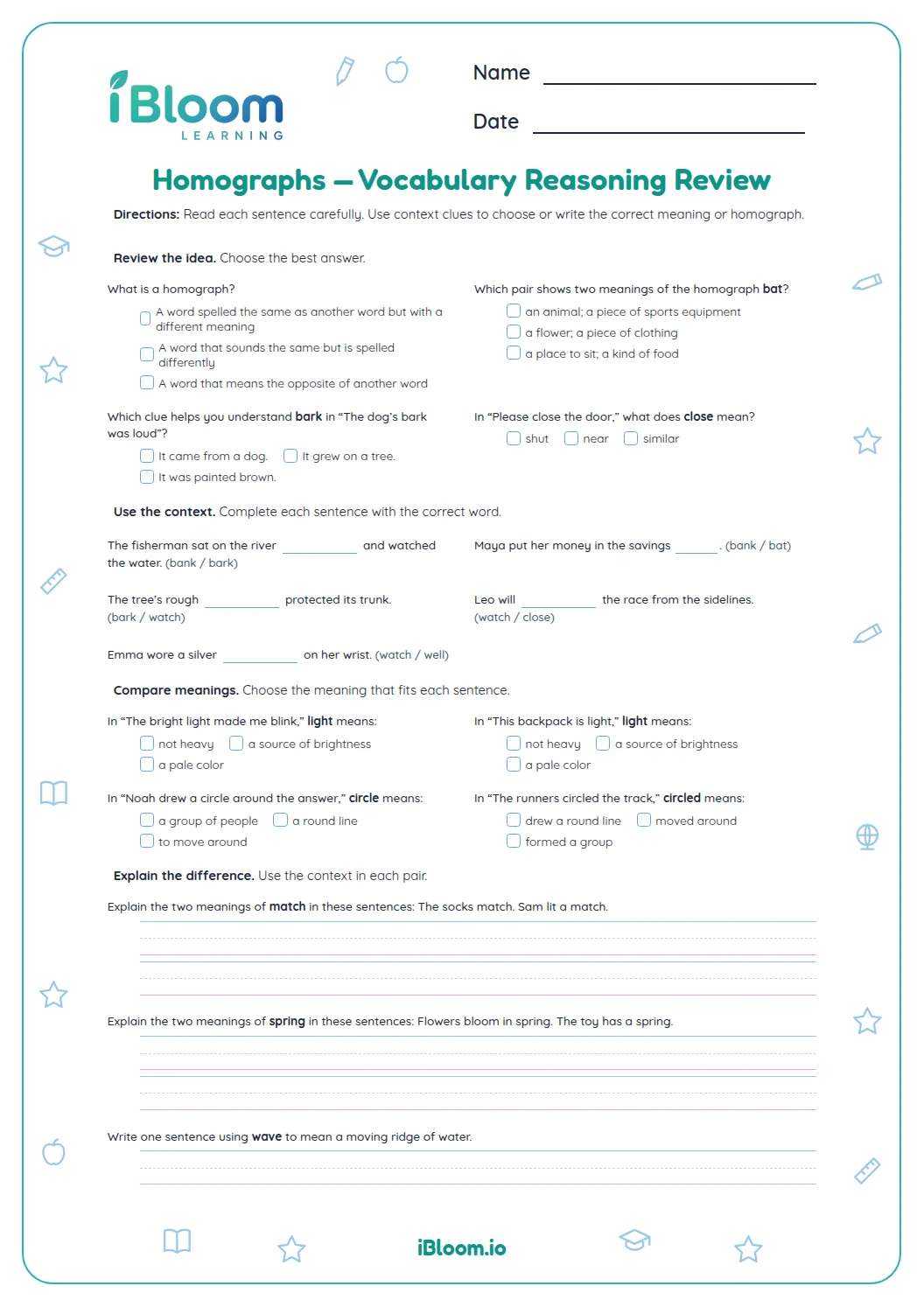
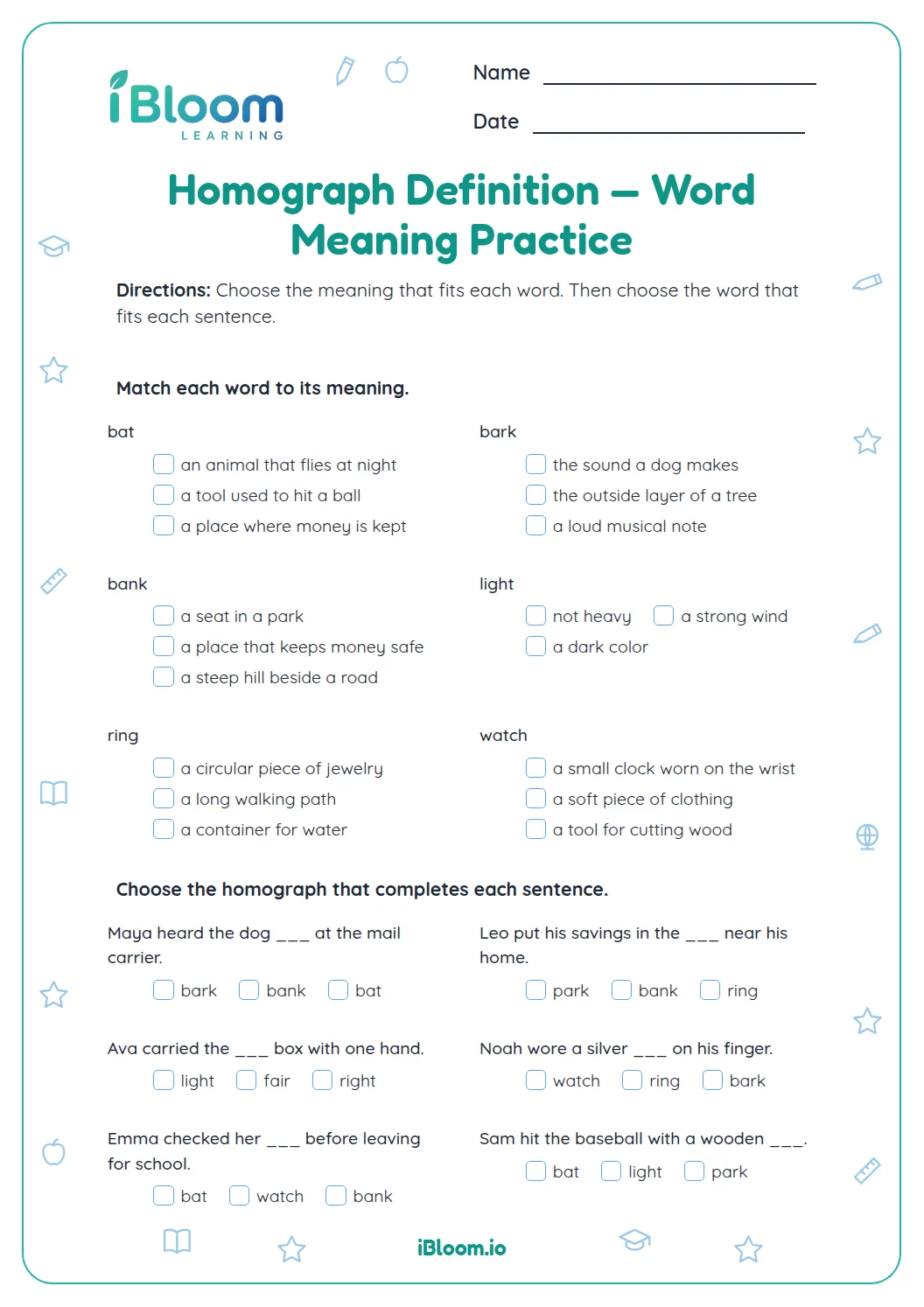
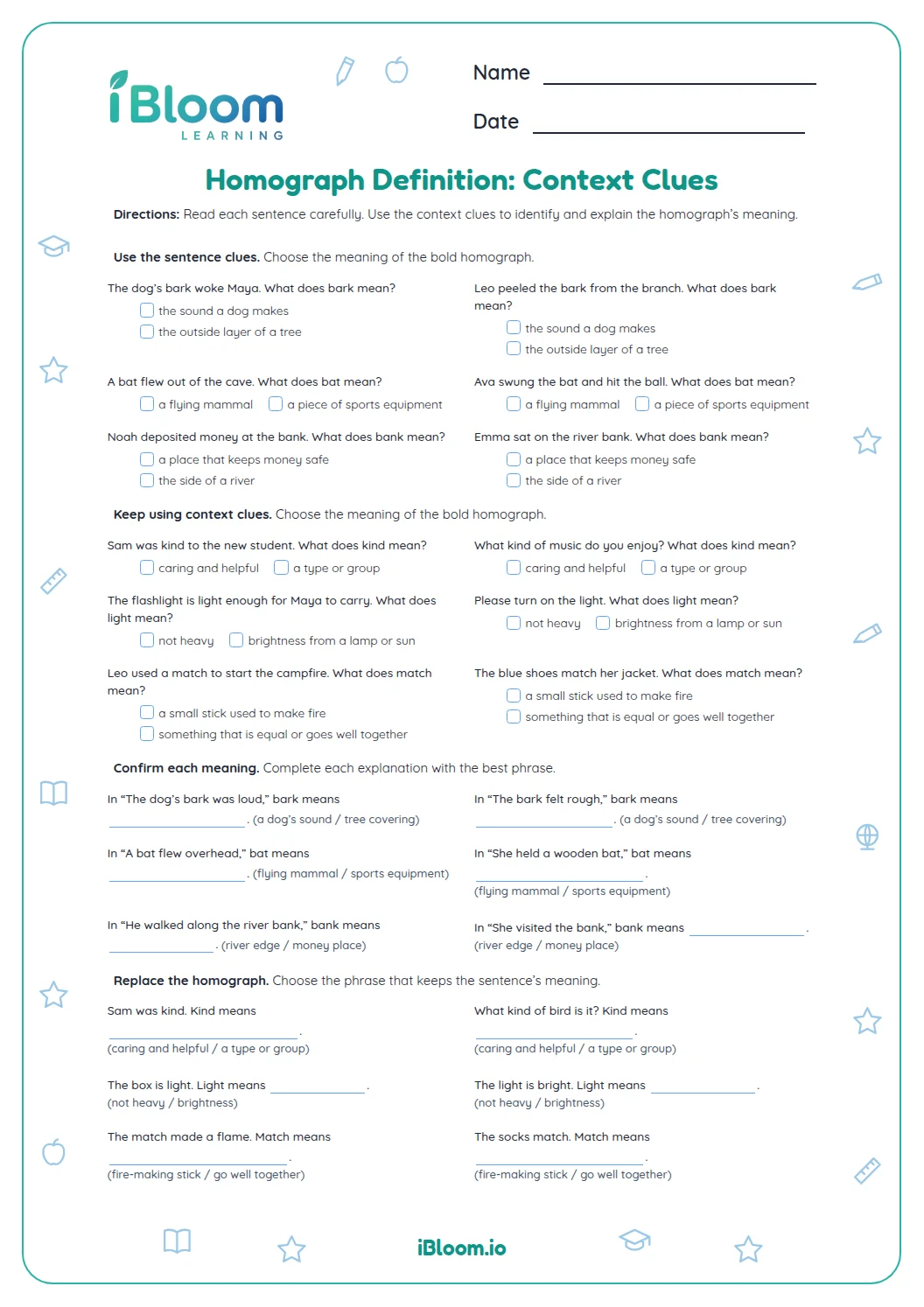
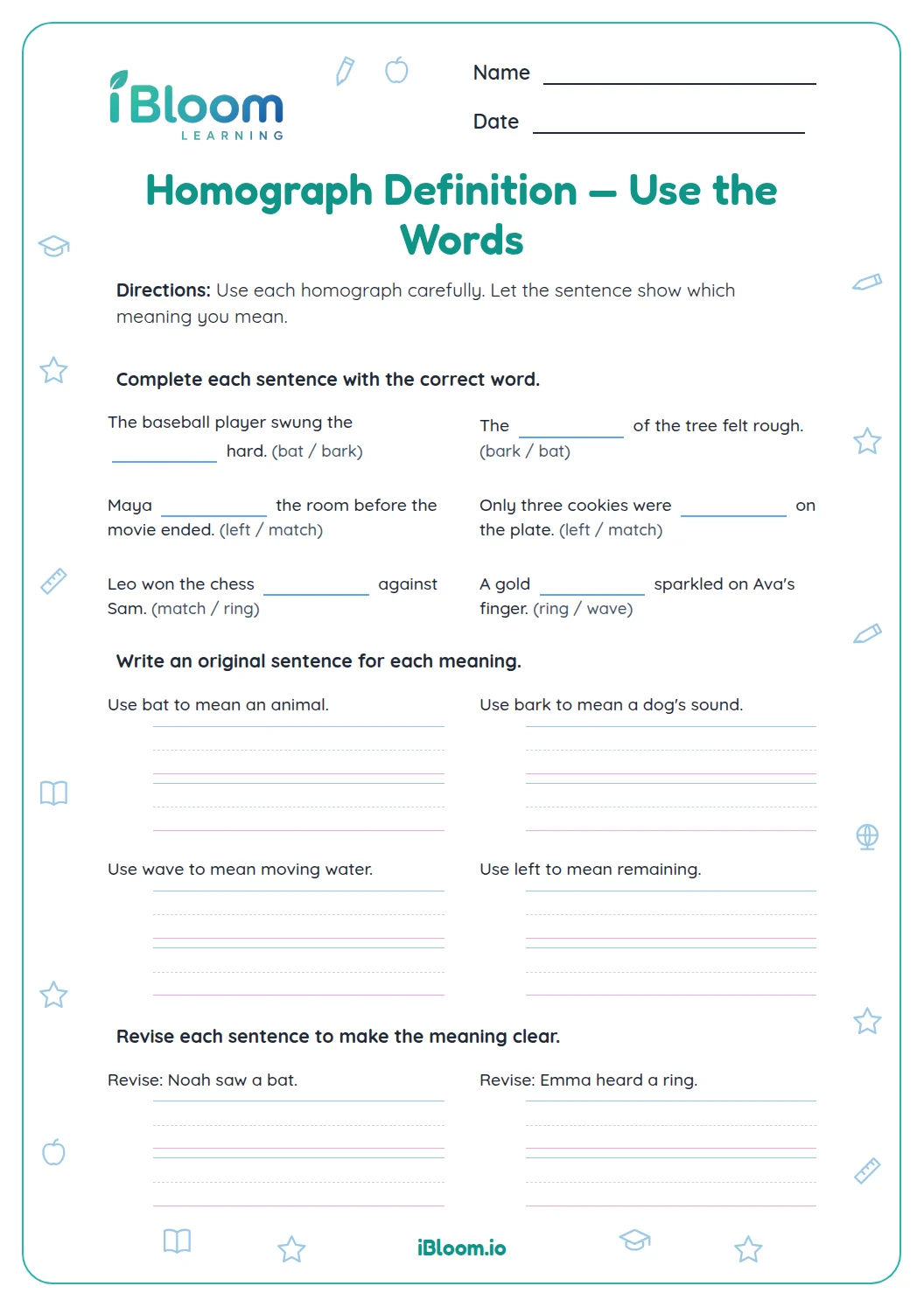
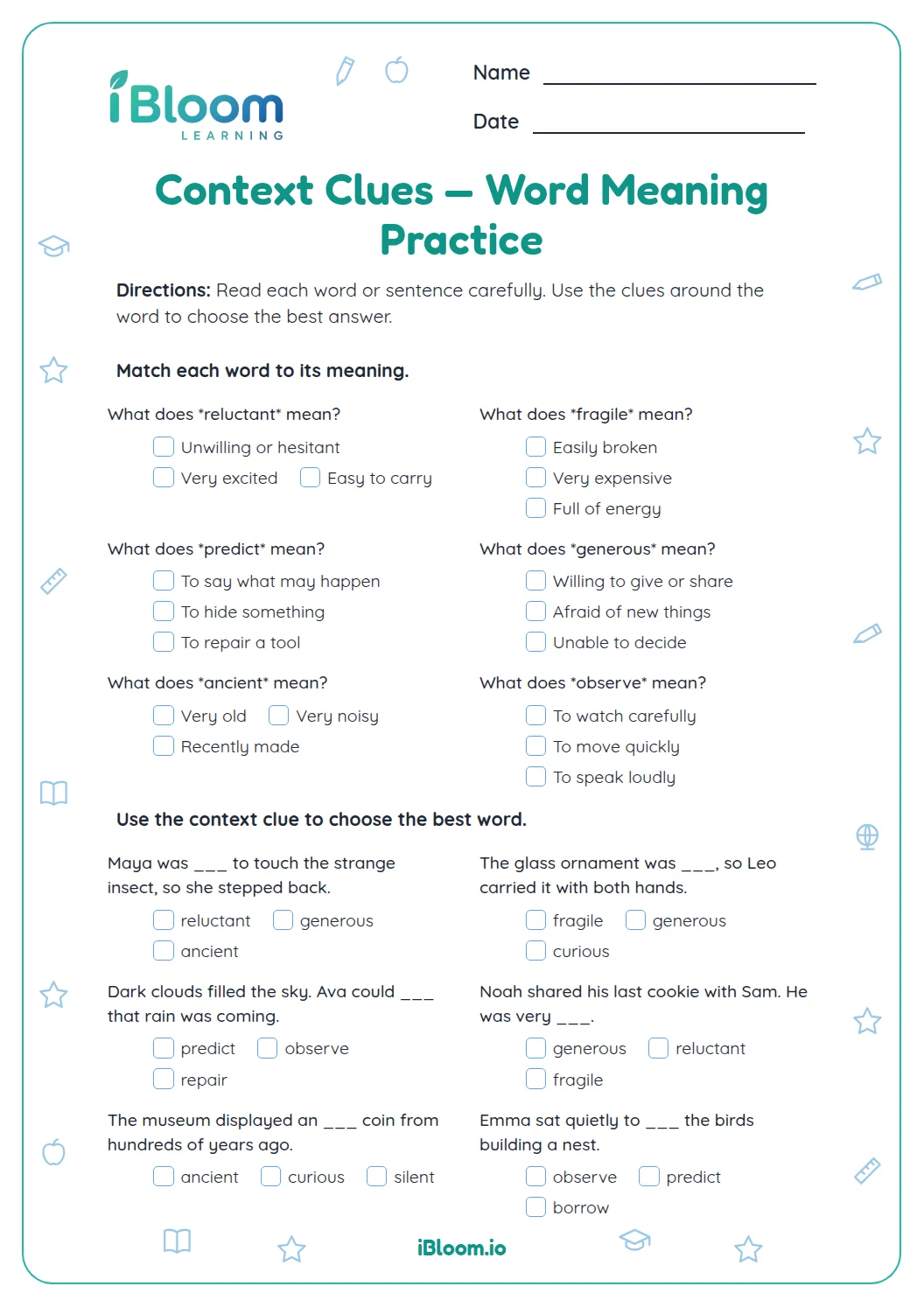
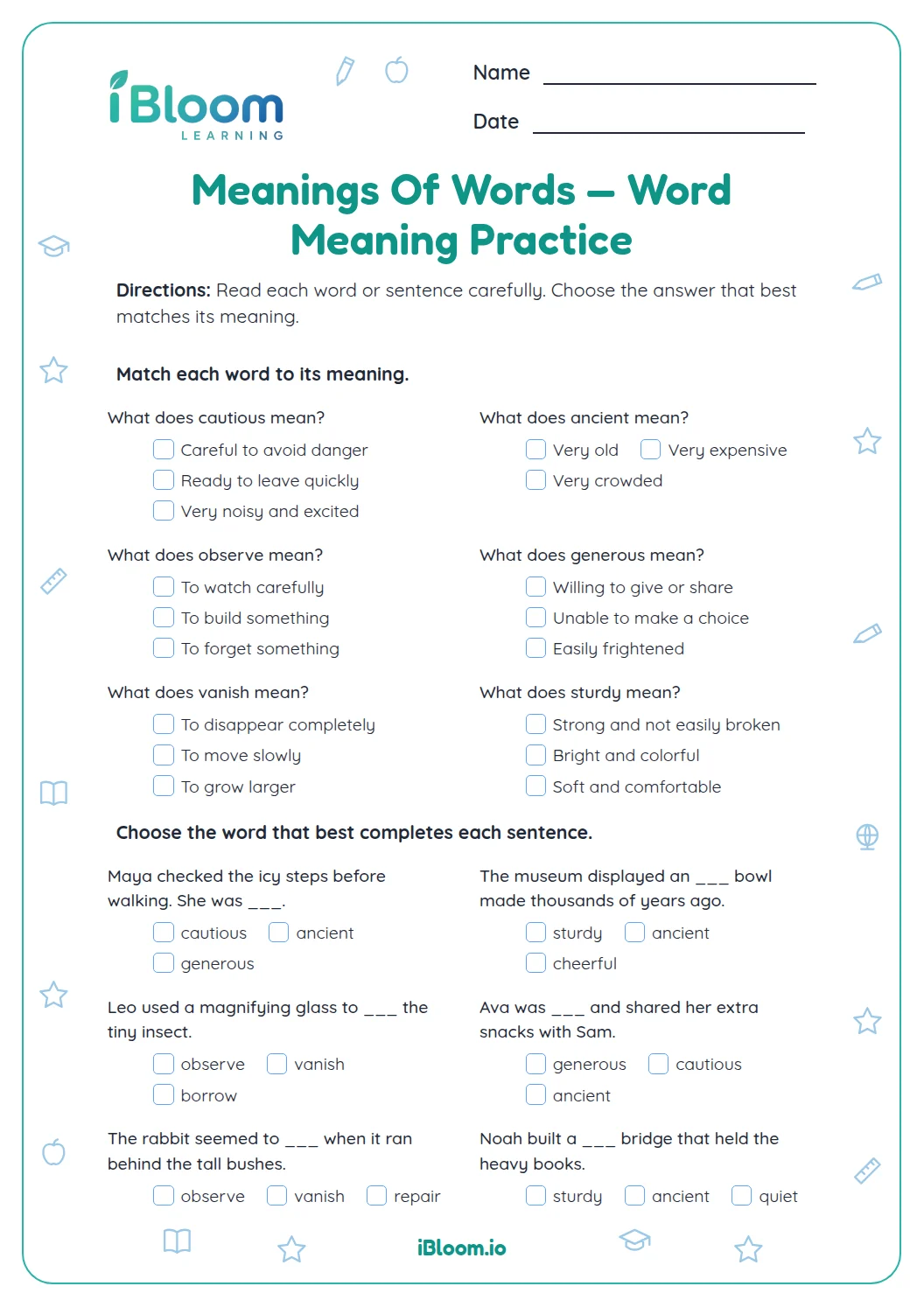
This Grade 5 worksheet gives learners 14 questions about homographs: words with the same spelling and different meanings. Children use sentence clues to distinguish meanings such as tree bark and a dog’s bark, then explain and apply the idea. Five parts move from meaning choices to written reasoning, with a separate key. Context clues practice CCSS L.5.4.a.
Aligned to L.5.4.a
How do context clues reveal a homograph’s meaning?
Parts A and B use bark, bat, date, wave, spring, and light in contrasting sentences. Part C asks about the two meanings of light, row, and word kind. Part D asks learners to explain why bark has two meanings and use watch in two ways. Part E checks meanings of tear in context.
- 1Question 3: “The bat flew out at dusk.”
- 2The word flew and the time clue “at dusk” point to an animal.
- 3Here, bat means a flying mammal, not sports equipment.
What words appear in the practice?
Parts A and B use bark, bat, date, wave, spring, and light in contrasting sentences. Part C asks about the two meanings of light, row, and word kind. Part D asks learners to explain why bark has two meanings and use watch in two ways. Part E checks meanings of tear in context.
What makes two uses homographs?
They are words spelled the same way but with different meanings. Some homographs also sound different, as row (a line) and row (to propel a boat) do. In every item, the sentence context helps identify the intended meaning.
How to use this using context to identify homograph meanings worksheet
- 1Read each sentence in Part A and use its clues to choose a word meaning.
- 2Compare sentence pairs in Part B and notice what changes the meaning.
- 3Answer the short context questions in Part C.
- 4Explain and apply meanings in Part D.
- 5Finish Part E, then check the separate answer key and review the sentence clues.
Common using context to identify homograph meanings slips and fixes
The mistake
Choosing the first meaning that comes to mind.
The fix
Read the whole sentence and use its action and setting as clues.
The mistake
Assuming a homograph always sounds the same.
The fix
Check both spelling and pronunciation; some same-spelling words sound different.
The mistake
Explaining a meaning without connecting it to the sentence.
The fix
Name the clue in the sentence that supports the chosen meaning.
Common Core alignment
These questions practice the listed Common Core skill.
Use sentence context to choose the intended meaning of each homograph.
On this sheet: Use sentence context to choose the intended meaning of each homograph.
Show the official wordingHide the official wording
Use context (e.g., cause/effect relationships and comparisons in text) as a clue to the meaning of a word or phrase.
What to practice next
Make more practice
Further reading
Questions parents and teachers ask
What is a homograph?
A homograph is a word spelling used for different meanings. For example, bark can mean the outside of a tree or the sound a dog makes. The worksheet uses sentences to show which meaning fits each time, so readers rely on context clues.
How can a child tell which meaning of “bat” is intended?
Look at the action and nearby words. In “The bat flew out at dusk,” flew shows that bat means the animal. In “She swung the bat at the ball,” swung and ball point to sports equipment. The surrounding sentence changes the intended meaning.
Do homographs always sound alike?
No. Some sound alike, while others have different pronunciations. Row can mean a line of seats or the action of moving a boat with oars, and those meanings are pronounced differently. The sentence helps readers identify the intended meaning.
How many questions are on the worksheet?
There are 14 questions in five parts. The first two parts ask learners to select meanings in sentence contexts, the third asks short-answer questions, and the last two ask for explanations and examples. A separate answer key includes model responses for the written prompts.
What should an explanation include?
It should identify the intended meaning and point to a clue that supports it. For the sentence about a bat flying at dusk, a child can explain that the action “flew” shows bat means the animal. The key gives a concise model.
Can children use different sentences for “watch”?
Yes. The prompt asks for two short sentences using watch with different meanings. A sentence about looking and one about a timepiece show the distinction; the answer key gives “I watch birds. My watch is blue” as one example.