





About this worksheet
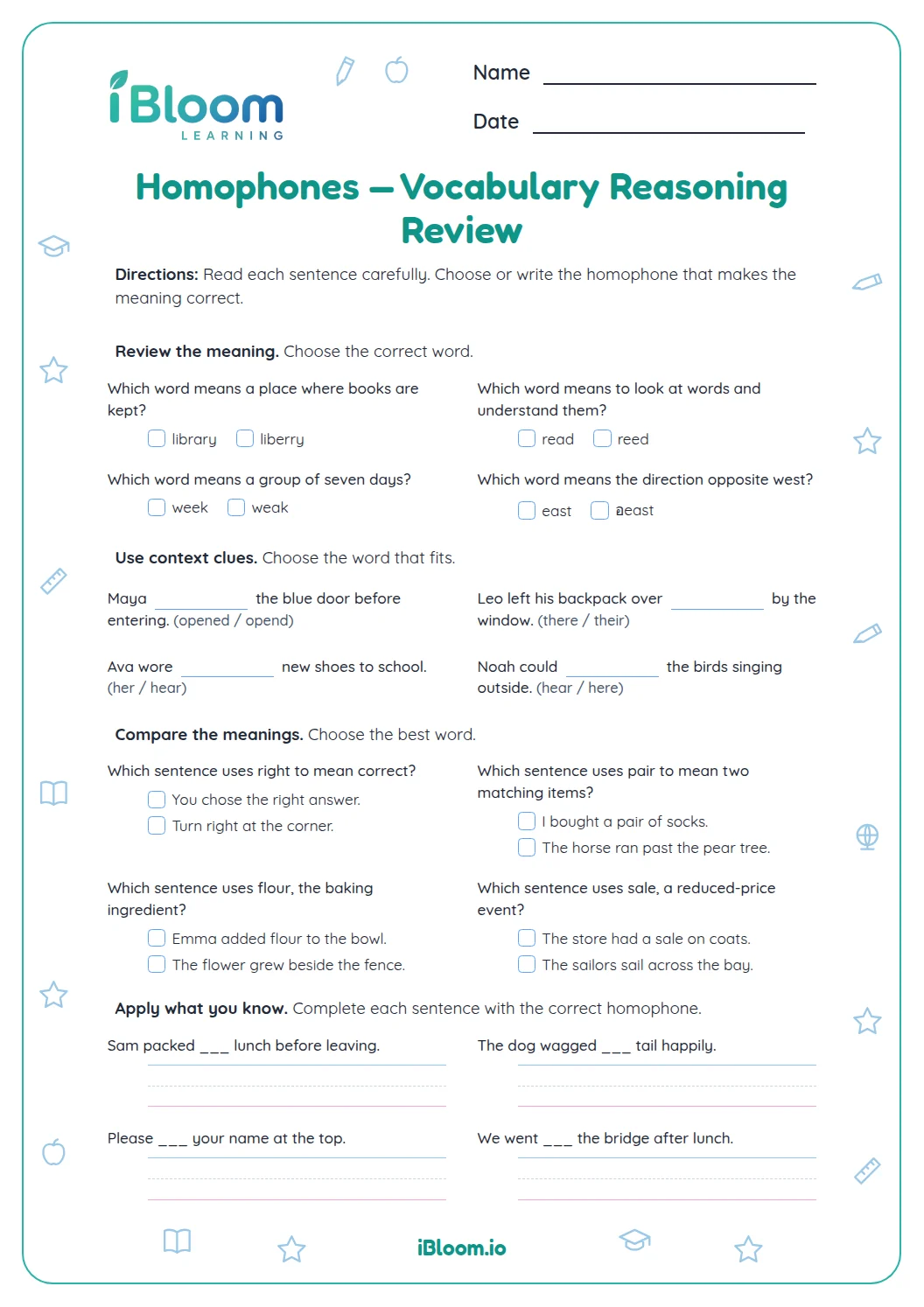
This free Grade 5 vocabulary worksheet asks students to use context to choose among homophones, words that sound alike but have different spellings and meanings. Part A uses multiple-choice sentences; Part B completes short sentences with the word the context calls for. Examples include there/their, its/it’s, hear/here and weather/whether. An answer key lists each choice. The practice supports CCSS L.5.4.a by using context as a clue to word meaning.
Aligned to L.5.4.a
How can context distinguish words that sound alike?
Read the whole sentence and look for a clue about meaning. A bicycle slows with a brake; an aircraft is a plane; a forecast describes the weather. The sound alone cannot tell which spelling belongs.
Question 7 says the cyclist squeezed a part to slow down, so brake is the right choice. The clue “to slow down” rules out break, which means to damage or separate.
- 1Question 7: The cyclist squeezed the ___ to slow down.
- 2Answer: brake — it is a bicycle part used to slow a bike.
What should students do when a sentence has a blank?
Read the sentence once with each possible spelling in mind. Check whether its meaning fits the people, place, action or object in the sentence. In Part B, each blank has one clear context clue.
For question 9, “twins” and “kites” point to the number two. The sentence is about how many kites they brought.
How can students check a homophone choice?
After choosing a spelling, reread the complete sentence and say what the word means there. If the sentence meaning no longer makes sense, revisit the clue. Pay special attention to contractions such as it’s and you’re, which include apostrophes.
For question 11, it’s means “it is” before easy. The second blank names whose tail wagged, so its is the possessive spelling.
How to use this worksheet
- 1Read the sentence all the way through.
- 2Name the meaning clue, such as a place, number, sound or object.
- 3Choose the homophone whose meaning matches that clue.
- 4For contractions, expand the apostrophe word aloud.
- 5Reread the full sentence and use the key to check the spelling.
Common mistakes and quick fixes
The mistake
Picking there because it sounds like their.
The fix
Ask whether the blank names a place or shows who owns something; place points to there, ownership to their.
The mistake
Writing it’s to show ownership.
The fix
Expand it’s to “it is.” If the sentence names what belongs to the dog, use its.
The mistake
Choosing a word from sound alone.
The fix
Use the sentence clue: squeezing a bike part to slow down calls for brake.
Common Core alignment
The sentences use context to make a word’s meaning clear.
Use sentence meaning and context to choose the correctly spelled homophone.
On this sheet: Each sentence supplies meaning clues that distinguish homophones pronounced alike but spelled differently.
Show the official wordingHide the official wording
Use context (e.g., cause/effect relationships and comparisons in text) as a clue to the meaning of a word or phrase.
What to practice next
Make more practice
Further reading
Questions parents and teachers ask
What is a homophone?
Homophones are words that sound alike but have different spellings and meanings. Examples on this page include hear and here, and their and there. Students use the sentence around each blank to identify the meaning, then choose the spelling that matches it.
How does a child choose between their and there?
Their shows ownership, as in “their backpacks.” There can point to a place, as in “over there.” Question 10 includes both clues in one sentence: backpacks belong to the students, and the backpacks are left in a location. The answer key lists both spellings.
When should students write its instead of it’s?
Its shows ownership, as in a dog wagging its tail. It’s is a contraction for “it is.” In question 11, “It’s easy” can be expanded to “It is easy,” while the puppy’s tail takes its without an apostrophe. That contrast is the clue to use in each sentence.
Why is brake correct in the bicycle sentence?
The sentence says the cyclist squeezed a part to slow down. A brake is the bicycle part that slows it; break means to damage or separate something. The clue is the action and purpose in the same sentence, so students can reason from context.
What is the best way to check a completed sentence?
Read it again and explain what the selected word means in that sentence. A choice can sound right but still have the wrong meaning. The answer key gives the correct spelling for all sixteen items, including the two-word completion in question 10.