




About this worksheet
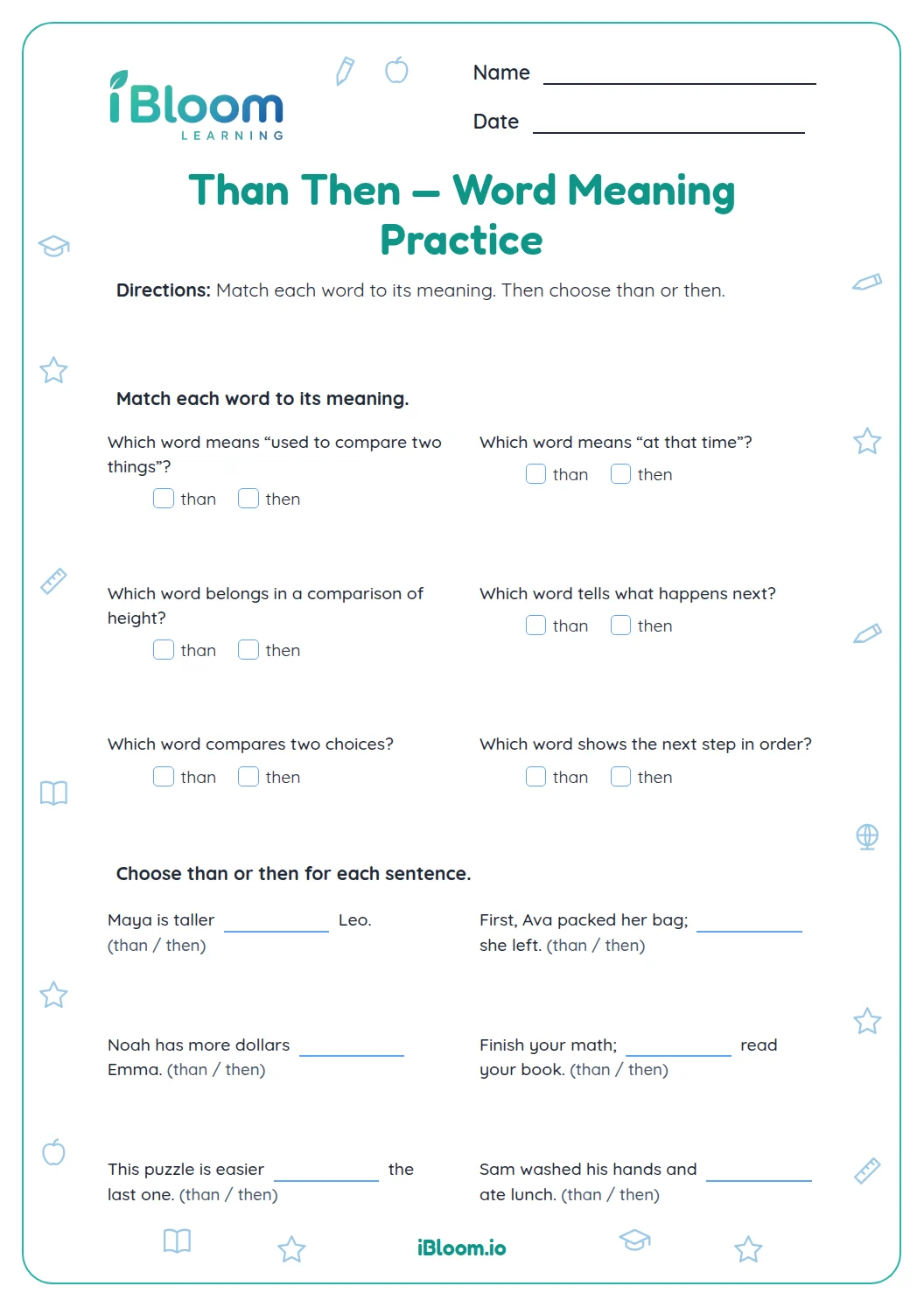
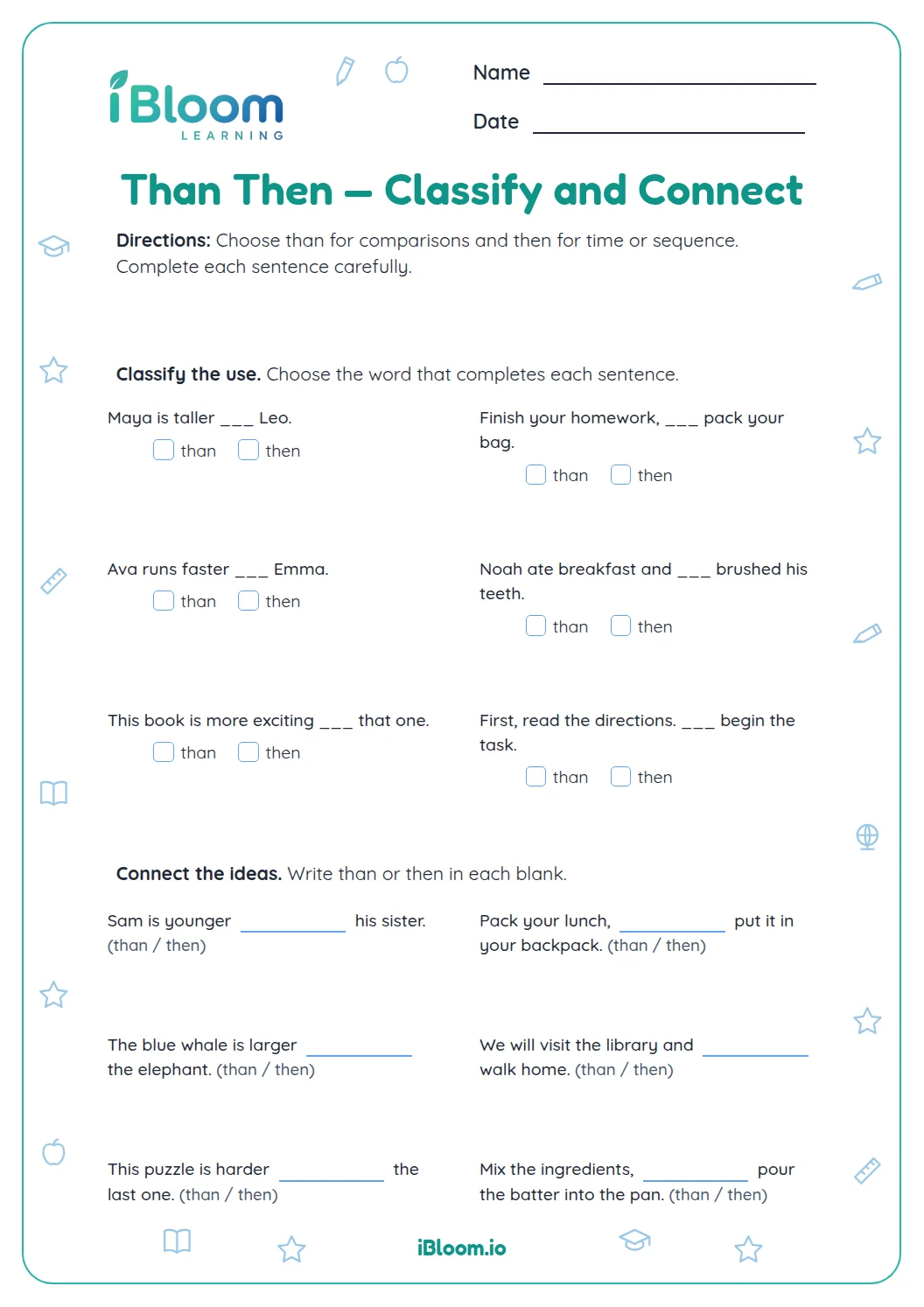
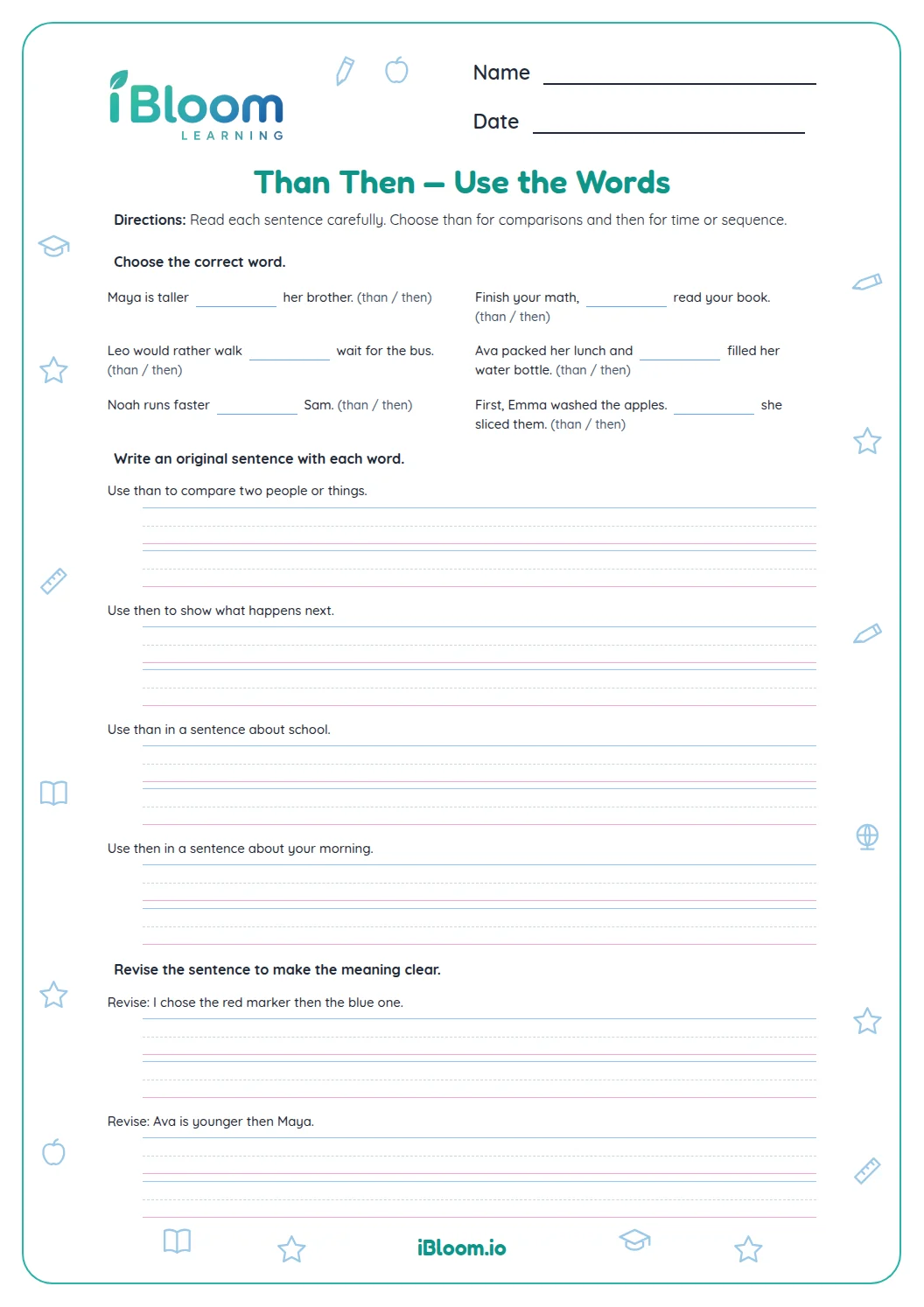
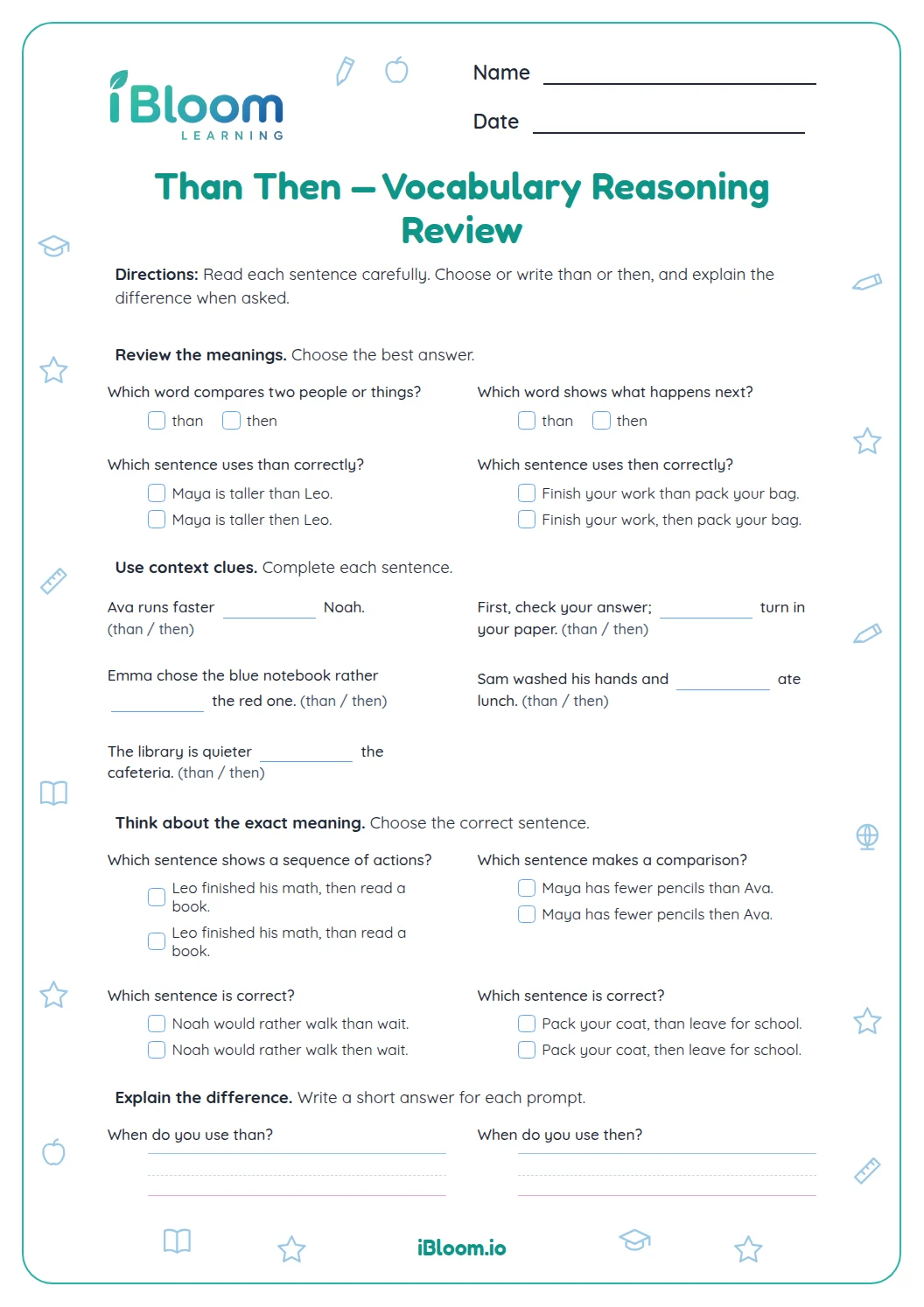
This free Grade 5 vocabulary worksheet asks students to use sentence meaning to distinguish than from then. Part A has eight sentence blanks involving comparisons, sequences, and a past time. Part B asks students to identify the meaning of the chosen word in four more sentences. Part C asks for two brief explanations that name the clue and the correct word. The work practices Common Core L.5.4a, using context and comparisons as clues to meaning. The separate answer key gives exact words and choices plus sample explanations.
Aligned to L.5.4a
How does a comparison signal than?
Than connects the two sides of a comparison. Look for words such as shorter, fewer, longer, and heavier, then identify what is being compared. The route and the trail in question 1 are being compared by length.
The phrase rather than compares alternatives. In question 6, the alternatives are reading a mystery and watching a movie; in question 12, they are walking and riding.
- 1This route is shorter ___ the trail by the lake.
- 2Clue: shorter
- 3Things compared: this route and the trail
- 4Answer: than
Does then always mean next?
Then can mean next in a sequence, as in packing bags and then setting off. It can also mean at that time. Question 4 supplies a past year and asks students to complete “I was five years old then.”
Use the whole sentence instead of memorizing a single substitute word. Until then in question 8 refers back to noon, the time the doors opened.
What should a strong explanation include?
In Part C, students write the chosen word and point to a clue that makes its meaning clear. For question 13, heavier compares two animals. For question 14, first establishes an order of actions.
The key gives sample explanations. Accept another accurate explanation when it uses the sentence’s meaning and names the correct word. Ask for a clearer reason if a student writes only “It sounds right.”
How to use this worksheet
- 1Say the two meanings aloud: than compares; then tells time or order.
- 2Read question 1 and identify the two things being compared.
- 3Finish Part A, underlining comparison words or time references.
- 4In Part B, decide whether the capitalized word signals a comparison, a next step, or a past time.
- 5Check Part C for both a correct word and a specific clue from the sentence.
Mistakes to discuss
The mistake
Writing then after heavier.
The fix
Heavier compares the puppy with the kitten, so than links the comparison.
The mistake
Treating every then as meaning next.
The fix
In the sentence about 1980, then means at that time. Read the earlier time reference.
The mistake
Missing the comparison in rather than.
The fix
Name the two alternatives: read a mystery or watch a movie. The phrase compares choices.
Common Core alignment
Use comparison and time clues to distinguish than from then.
On this sheet: Students use sentence context to choose the word and explain its meaning.
Show the official wordingHide the official wording
Use context (e.g., cause/effect relationships and comparisons in text) as a clue to the meaning of a word or phrase.
What to practice next
Make more practice
Further reading
Questions parents and teachers ask
What are the main clues for than on this worksheet?
Comparison words such as shorter, fewer, longer, and heavier help signal than. Students should also identify the two things being compared. The phrase rather than compares alternatives, so it works even without a word ending in er. Reading the complete sentence makes those alternatives visible.
What does then mean in the sentence about Maine?
Then means at that time, referring to 2020. The speaker says where they lived and how old they were during that year. Substituting at that time makes sense in the sentence. This example helps students see that then can refer to a past time as well as a next step.
Why is rather than used for choosing between activities?
Rather than links the alternatives being compared. In question 6, the speaker prefers reading a mystery to watching a movie. No sequence of two actions is described. Ask students to name both activities before filling the blank, then read the completed sentence to check its meaning.
Are the explanation answers fixed?
The correct words are fixed, but the explanations can vary. Question 13 needs than and a reference to the weight comparison. Question 14 needs then and a reference to the order of steps. The key supplies sample wording; students can explain those same relationships in their own words.
How can I help without giving away the word?
Ask whether the sentence compares two things or refers to a time. Have the student underline the words that support that decision before choosing than or then. For the final questions, ask them to turn that spoken explanation into one short written sentence beside their chosen word.