




About this worksheet
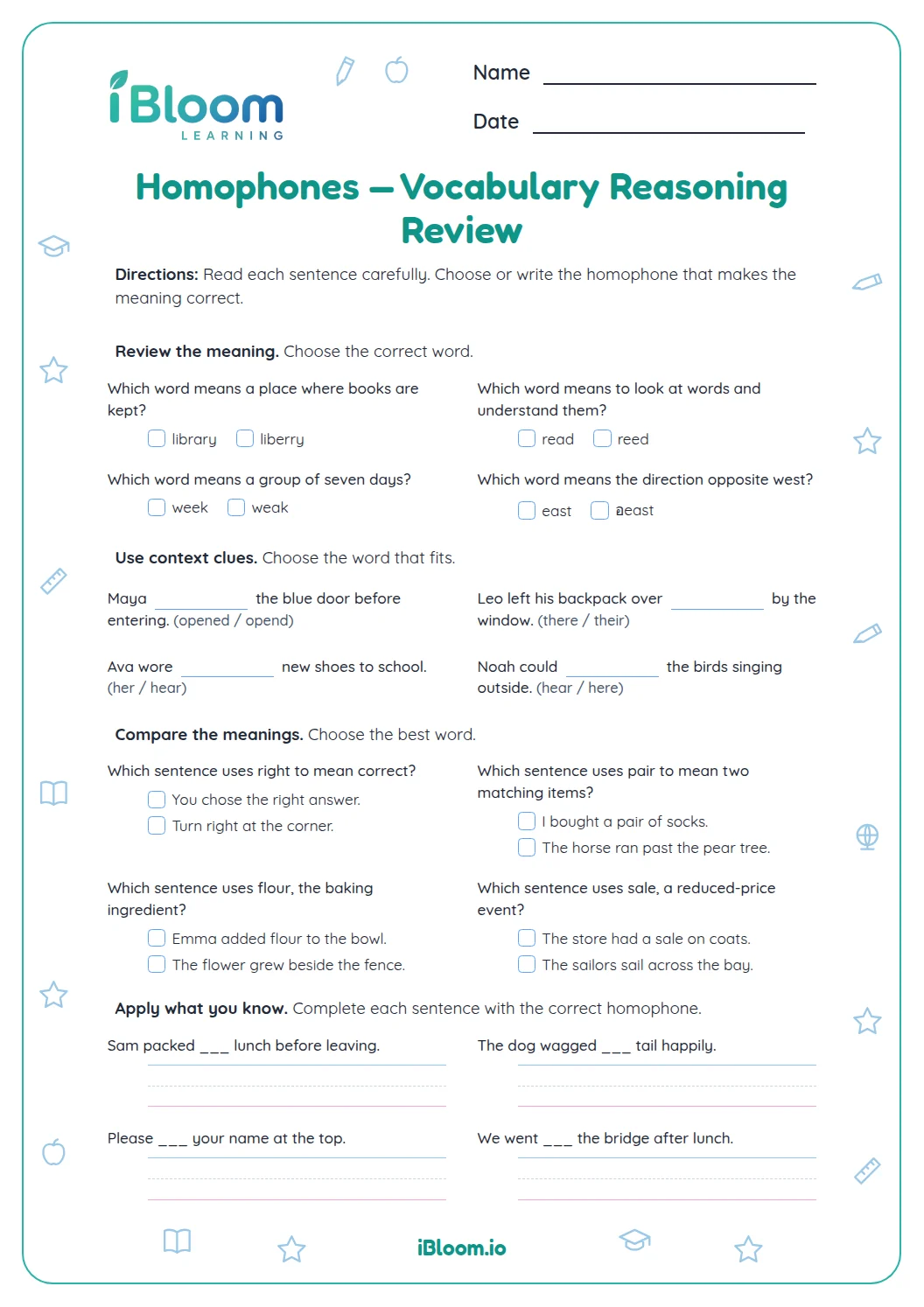
This free printable Grade 5 worksheet practices homophones through the original page’s three-step method: choose a spelling in context, use word pairs in an original sentence, then revise for clear meaning. Students complete six context choices, write one sentence using two homophone pairs, and answer seven spelling or revision questions. The work supports accurate spelling of grade-appropriate words (Common Core L.5.2e). A separate answer key provides fixed answers and a sample sentence.
Aligned to L.5.2e
Why does context matter when words sound alike?
Sounding out a word does not distinguish homophones such as its and it’s. Students need to ask what the sentence means, then choose the spelling that expresses that meaning. The first part offers a small set of spellings to compare.
The examples include commonly confused forms such as they’re/their/there, to/two/too, your/you’re and its/it’s.
What should a sentence with both words show?
The writing prompt asks students to use hear/here and threw/through in one complete sentence. The surrounding words should make both meanings clear. For example, hear names a sound, here identifies a place, threw describes an action and through describes a path.
- 1Use hear, here, threw and through in one sentence.
- 2“I threw the ball through the hoop, and I could hear it from here.”
- 3Hear names a sound; here names a place.
How does revision make meaning clearer?
The final seven questions ask students to write a corrected spelling or clearer wording. Some lines ask them to clarify a homophone’s meaning; others correct an error that changes the intended word. Read the answer aloud to check its meaning.
The key includes sample revisions. Other complete sentences are acceptable when they clearly express the intended meaning and use the spelling correctly.
How can adults check the answers?
For a choice, ask what the sentence says before checking spelling. For original writing, look for both required words and a context that supports each meaning. For revisions, make sure the sentence is clear and grammatically complete.
Choose, write and revise
- 1Read each sentence for its meaning before choosing a spelling.
- 2For each pair, say what both homophones mean.
- 3Write one complete sentence using both required words.
- 4Revise the final sentences so the intended meaning is clear.
- 5Compare fixed answers with the key and discuss any alternate wording.
Homophone mix-ups and fixes
The mistake
Writing their for the person leading a school or they’re for ownership.
The fix
Use the sentence: they’re means they are, their shows ownership, and there points to a place.
The mistake
Choosing its when the sentence means “it is.”
The fix
Try expanding it’s to it is; if the sentence still works, use the apostrophe.
The mistake
Using only one word from a required pair in an original sentence.
The fix
Check that both spellings appear and that context makes each meaning clear.
Common Core alignment
Choose and write the correct homophone spelling for the intended meaning.
On this sheet: Students complete sentences, repair homophone errors and use word pairs in original sentences.
Show the official wordingHide the official wording
Spell grade-appropriate words correctly, consulting references as needed.
What to practice next
Make more practice
Further reading
Questions parents and teachers ask
Which homophone spellings are practiced?
The first six questions include they’re/their/there, to/two/too, your/you’re and its/it’s as choices in context. The writing prompt uses hear/here and threw/through. Later questions revise two sentences and practice allowed/aloud and weather/whether. The key lists all answers. The separate key supports quick checking.
Why are there three choices for they’re, their and there?
The sentence “___ going to bring two bags” needs they’re because it can expand to “They are going to bring two bags.” Their shows ownership and there names a place. Reading the whole sentence before choosing helps students distinguish the spellings.
Do writing answers have to match the samples?
The key gives a sample sentence, but another sentence can work if it uses all four required words with their intended meanings and forms a complete thought. For hear and here, one word should refer to sound and the other should identify a place; threw and through also need clear context.
What does the revision section ask students to do?
The final questions ask students to write a spelling or revision that makes a homophone meaning clear. For example, knight becomes night in the time phrase, and sea becomes see before “the sea.” Other items ask for allowed, aloud or whether in a sentence.
Can a dictionary help with homophones?
Yes. After trying the sentence, students can look up both spellings and compare their meanings. Then they can return to the choices and ask which meaning fits. This keeps the focus on context while giving them a reliable way to check an unfamiliar word pair.