



About this worksheet
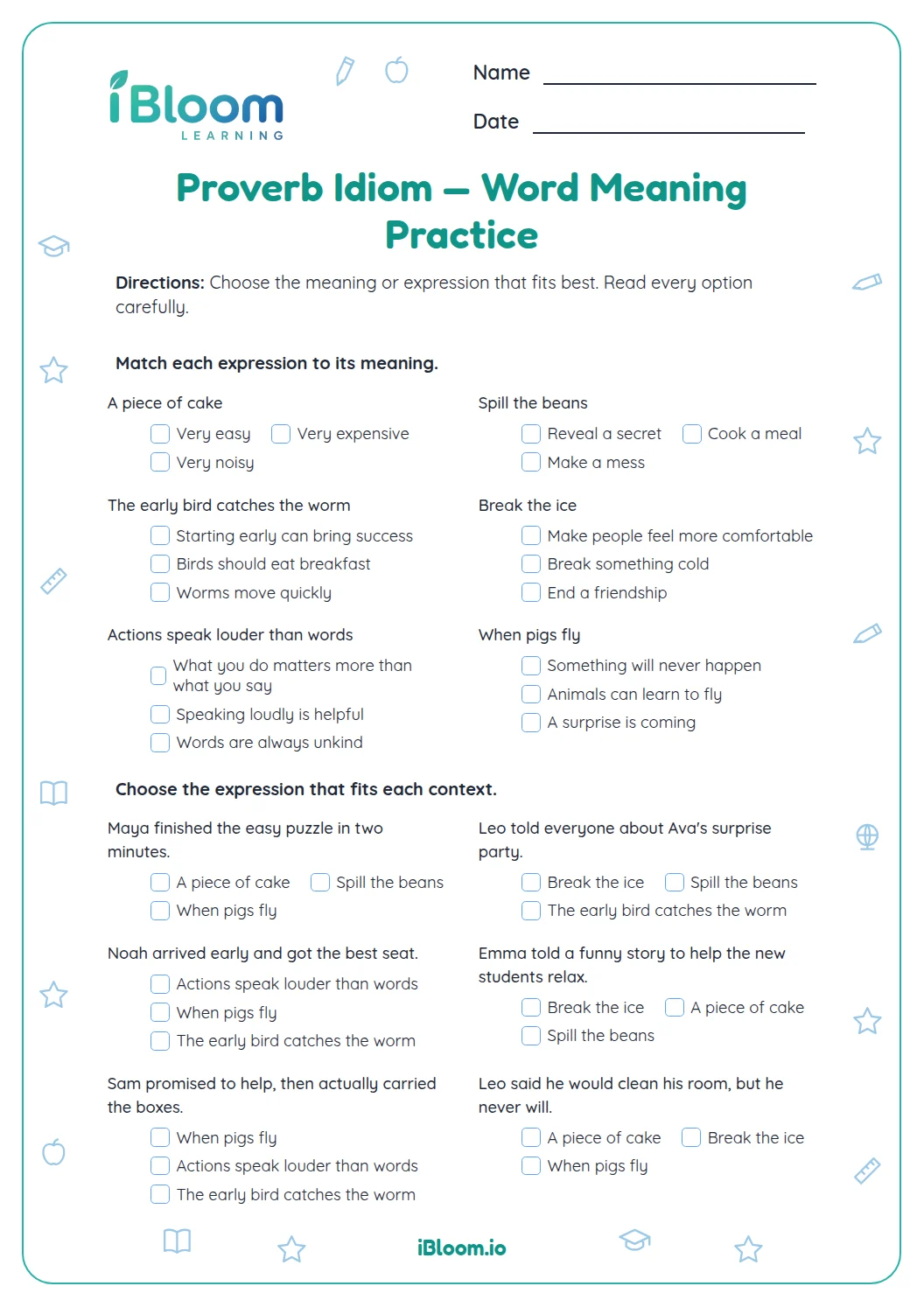
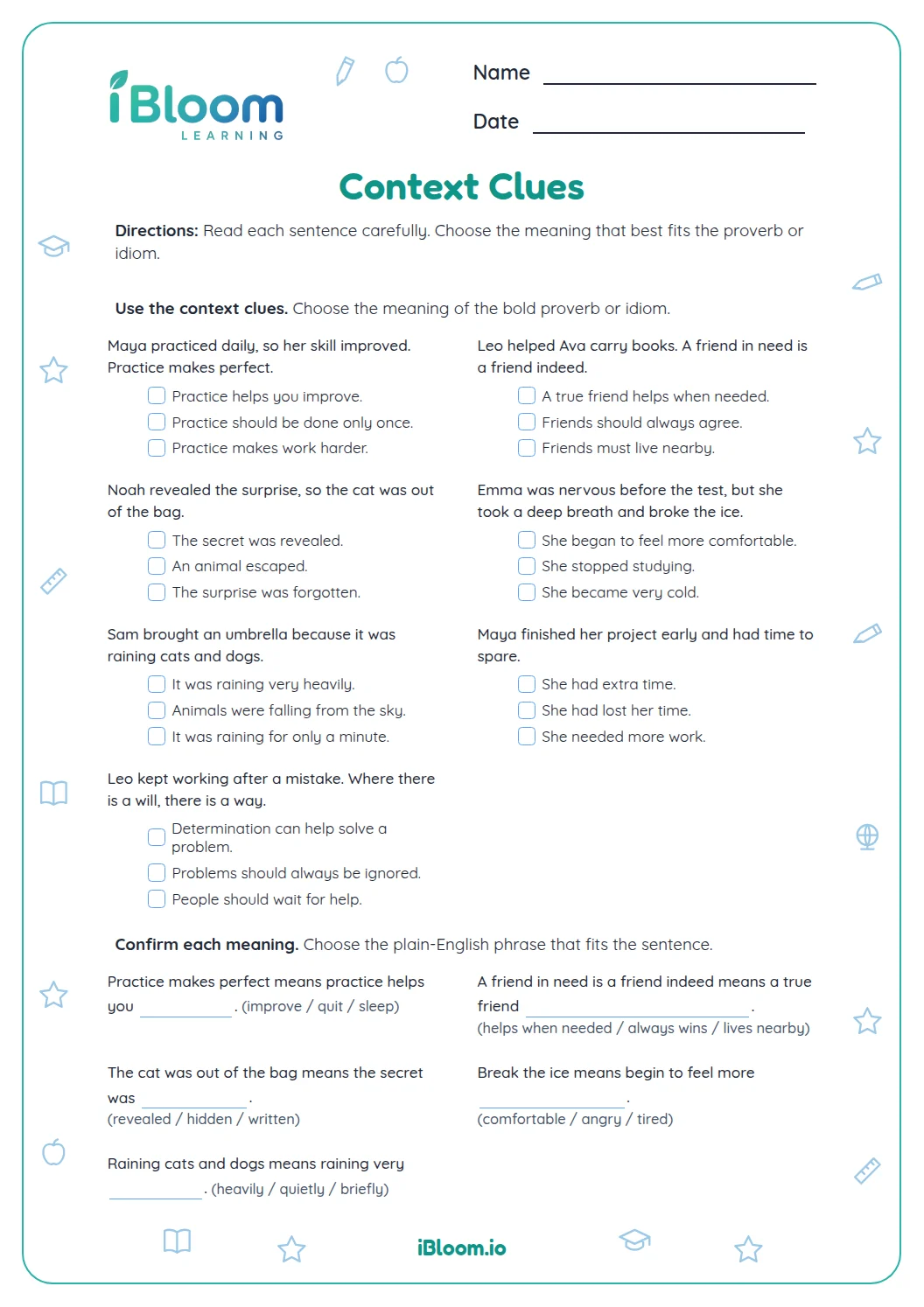
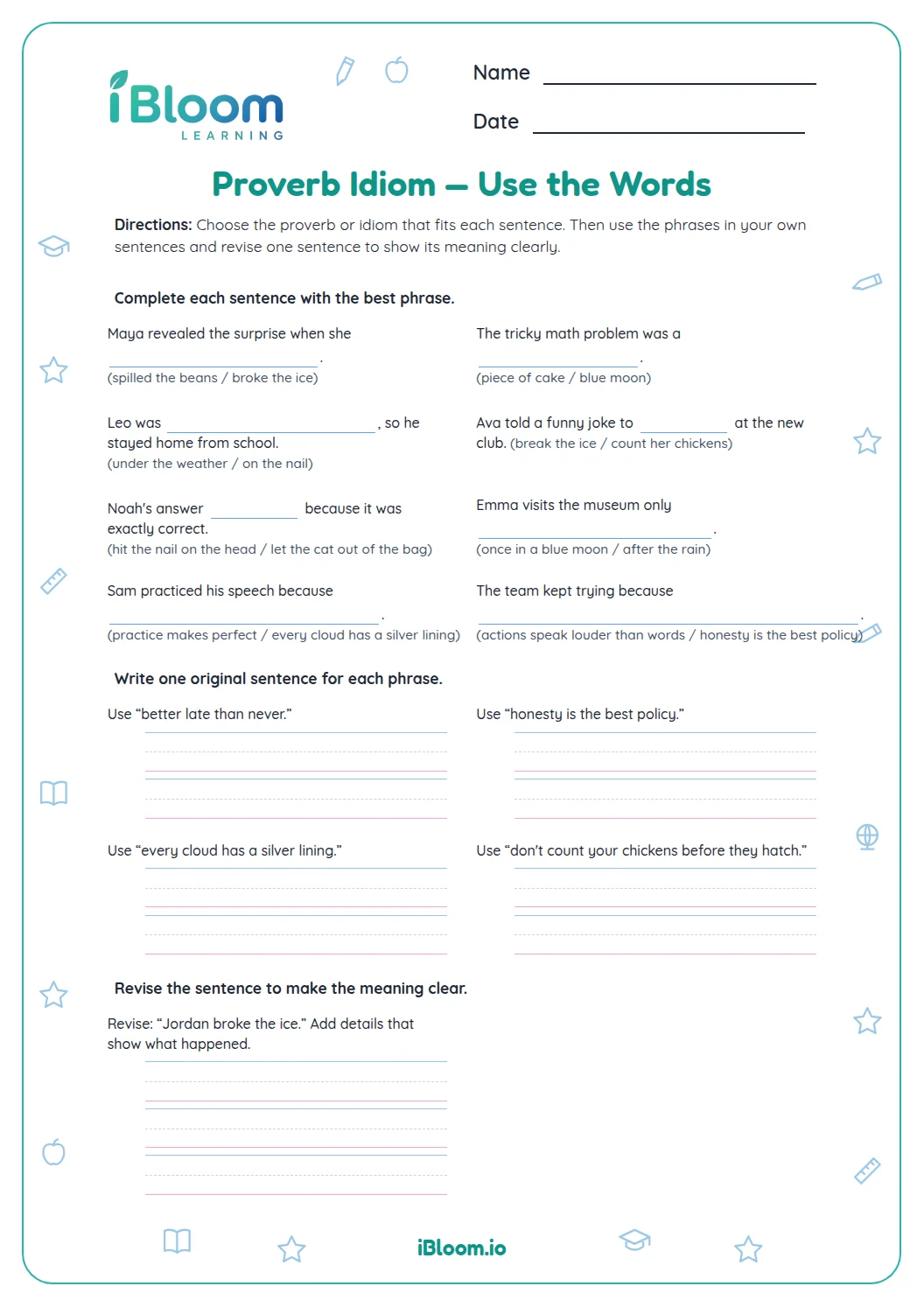
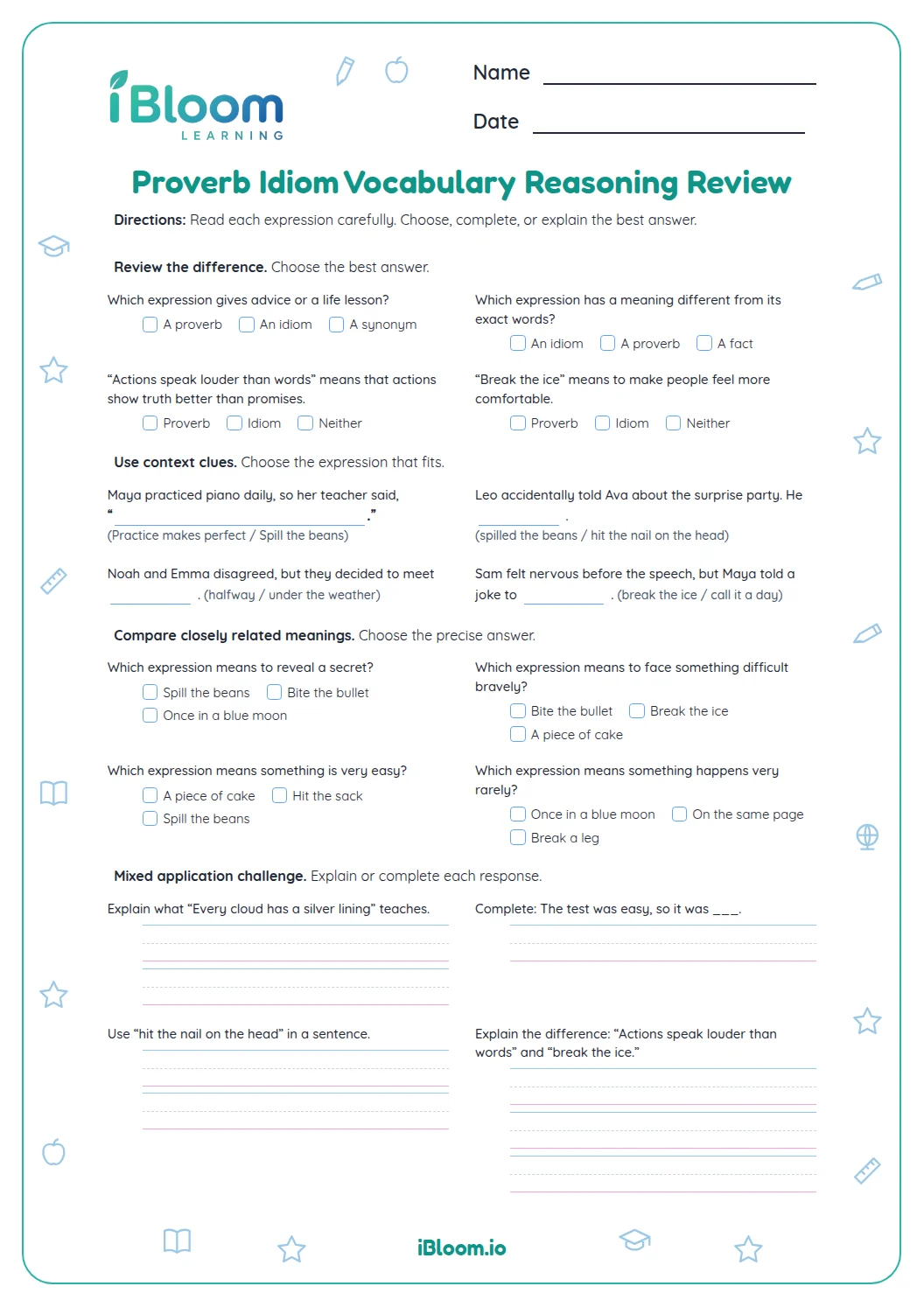
This Grade 5 printable revisits the proverb-and-idiom work in the original sheet with four kinds of practice. Students classify familiar expressions, choose meanings, connect sayings to situations, and explain a use in a short response. It supports CCSS L.5.5b by asking students to recognize and explain common idioms, adages, and proverbs. A separate answer key follows the worksheet.
Aligned to L.5.5b
How is a proverb different from an idiom?
A proverb is a short saying that offers advice or expresses a general truth, such as “Practice makes perfect.” An idiom is a familiar phrase whose intended meaning is different from its literal words, such as “break the ice.” Both kinds of expressions need to be understood as a whole.
How can you work out an expression’s meaning?
First recall how the expression is commonly used. Then test that meaning in the sentence or situation. “Spill the beans” is not about dropping food when someone reveals a secret; “look before you leap” advises a person to think before acting.
- 1Situation: A student plans before choosing.
- 2Candidate: “Look before you leap.”
- 3The saying advises someone to think first, so it fits.
What does each part ask students to do?
Part A sorts four expressions as proverbs or idioms. Part B checks meanings, Part C matches expressions with situations, and Part D asks for four brief explanations or examples. The short written answers may vary, so the key gives sample responses.
How to use this worksheet
- 1Read the expression aloud and think about how people use it.
- 2For Part A, decide whether it gives advice or has a nonliteral phrase meaning.
- 3For Part B, compare the choices with the expression’s familiar meaning.
- 4For Part C, connect the situation to the saying that best fits.
- 5Answer Part D in your own words, then compare with the sample key.
Common mistakes and quick fixes
The mistake
Treating every expression as a literal description.
The fix
Ask what the whole phrase usually means in conversation.
The mistake
Calling every short saying an idiom.
The fix
Check whether it gives advice or a general truth; that points to a proverb.
The mistake
Choosing a saying that shares one word with the situation but not its idea.
The fix
Restate the situation, then test the expression’s intended meaning.
Common Core alignment
This page practices the listed Common Core skill through the worksheet questions.
Recognize idioms, adages, and proverbs.
On this sheet: Both parts ask learners to classify familiar proverbs and idioms, including expressions given in context.
Show the official wordingHide the official wording
Recognize and explain the meaning of common idioms, adages, and proverbs.
What to practice next
Make more practice
Questions parents and teachers ask
What is a proverb?
A proverb is a short, familiar saying that gives advice or expresses a general truth. “Practice makes perfect” suggests that practice helps a person improve. Part A asks students to distinguish proverbs from idioms, and Part D invites them to explain a proverb in their own words.
What is an idiom?
An idiom is a phrase whose intended meaning differs from the literal meaning of its words. “Break the ice” means to make a first conversation easier, not to crack frozen water. The worksheet asks students to identify idioms and connect their meanings with everyday situations.
How many questions are on the printable?
There are 16 questions: four classification questions, four meaning questions, four situation matches, and four short written responses. A separate answer key follows the worksheet. The last responses allow different reasonable examples, so their key entries are models rather than the only possible wording.
Can students write different answers for the last part?
Yes. Questions 13–16 ask students to explain an expression or give a fitting situation. The answer key provides sample responses, but another response can work if it shows the right meaning. Ask the student to point to the words or details that make the example fit.
How can I help if a phrase is unfamiliar?
Read the full expression and the situation together, then discuss how someone might use the phrase in ordinary conversation. For example, a person told to “hold your horses” is being asked to wait. After talking it through, let the student select or explain the answer independently.