





About this worksheet
This free printable worksheet is for Grade 5 learners practicing metaphor word meaning. It builds the named skill with focused questions, a short worked example, and a separate answer key. Children read each direction, try the item, and use the key to review their thinking. The worksheet aligns with L.5.5.a: interpret similes and metaphors by using the surrounding context.
Aligned to L.5.5.a
How does a metaphor suggest a meaning?
A metaphor describes one thing as another to highlight a shared quality. In “The classroom was a beehive,” the comparison suggests a busy room, not a room full of bees. The words around the metaphor help the reader decide which quality matters.
Grade 5 readers can explain the image in context: identify what is compared, then name the idea the comparison suggests.
What clues help interpret a metaphor?
Read the whole sentence, picture the comparison, and test a possible meaning against the context. If the interpretation fits the sentence naturally, it is likely the intended meaning.
- 1“The classroom was a beehive before the concert.”
- 2A classroom is not literally a hive.
- 3A beehive is busy and buzzing with activity.
- 4The metaphor suggests that the classroom was busy.
What will children practice on this sheet?
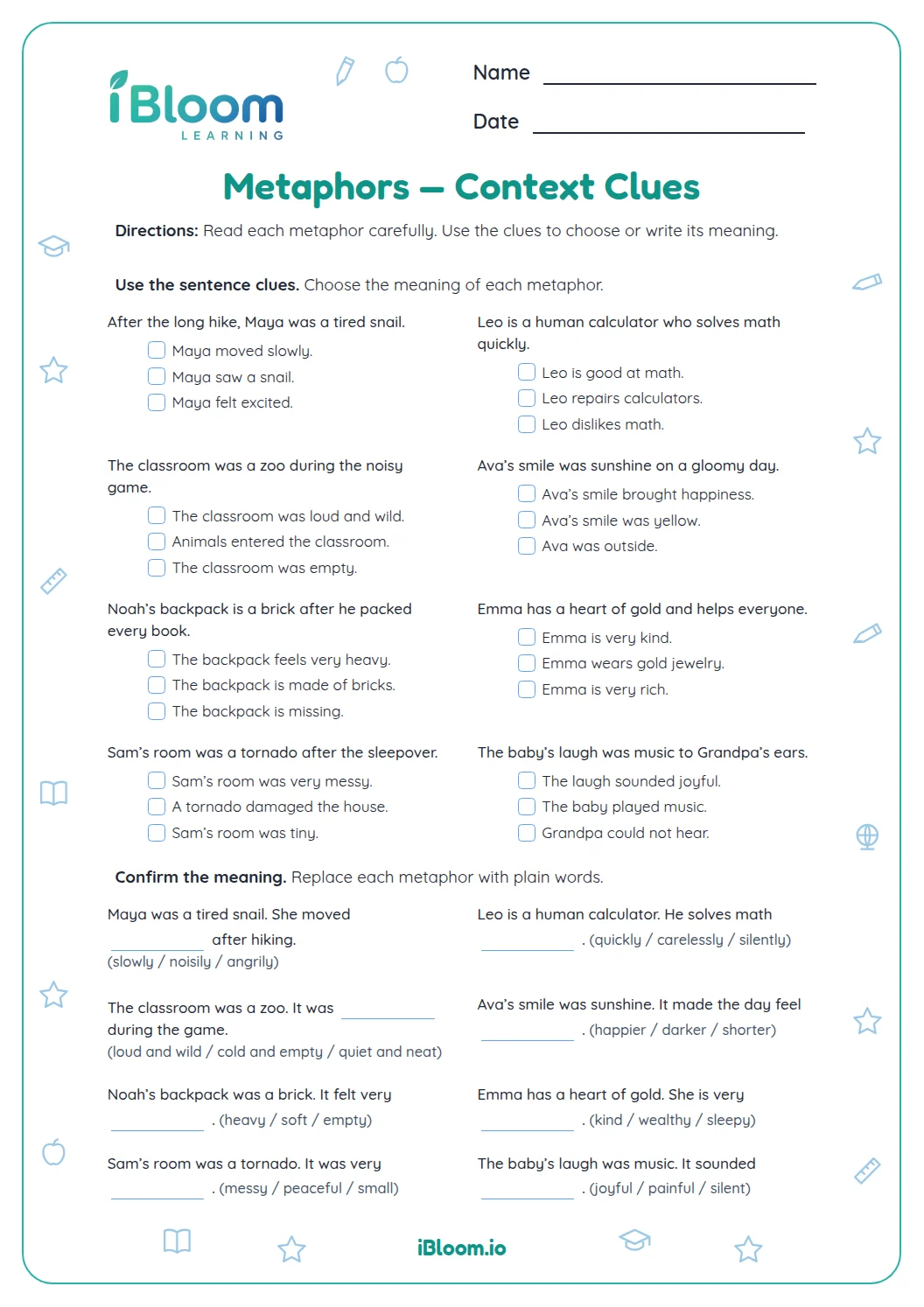
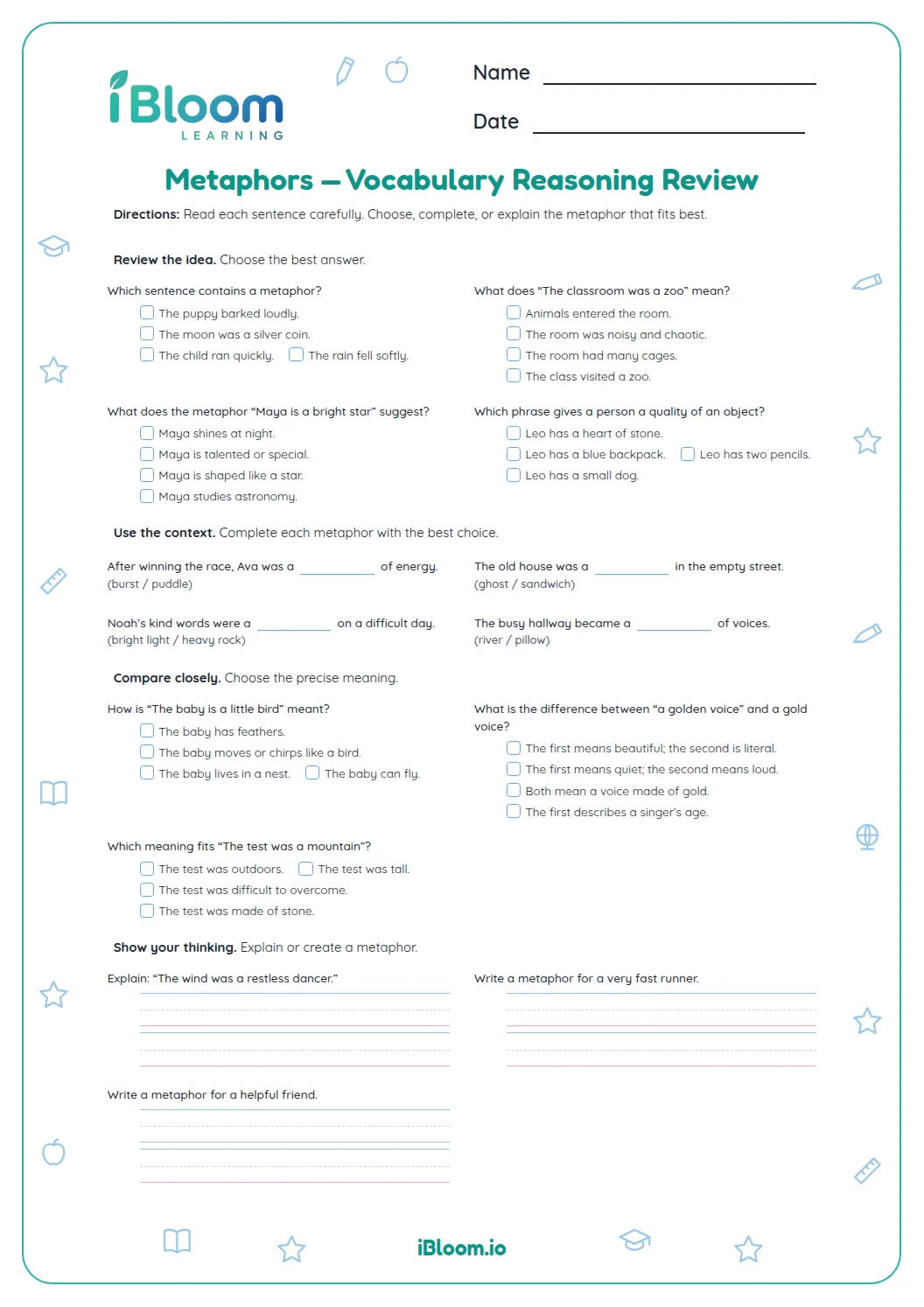
Part A completes meanings for metaphors about heavy legs, a busy classroom, an idea that starts action, and other familiar scenes. Part B asks children to apply the same thinking to images such as a burden, a window, or a mountain.
How to use the metaphor worksheet
- 1Read the entire sentence before thinking about the image.
- 2Name the two things being compared.
- 3Ask which quality they share in this sentence.
- 4Complete the meaning in a few clear words.
- 5Check the answer key and explain why the literal meaning does not fit.
Metaphor mistakes and quick fixes
The mistake
Taking a metaphor literally, such as picturing bees in a classroom described as a beehive.
The fix
Ask what quality of a beehive fits the scene; here, the room is busy and buzzing.
The mistake
Choosing a meaning that could fit the image but ignores the sentence around it.
The fix
Read the full sentence and make sure the interpretation fits the event or feeling described.
The mistake
Calling every comparison a metaphor even when it uses like or as.
The fix
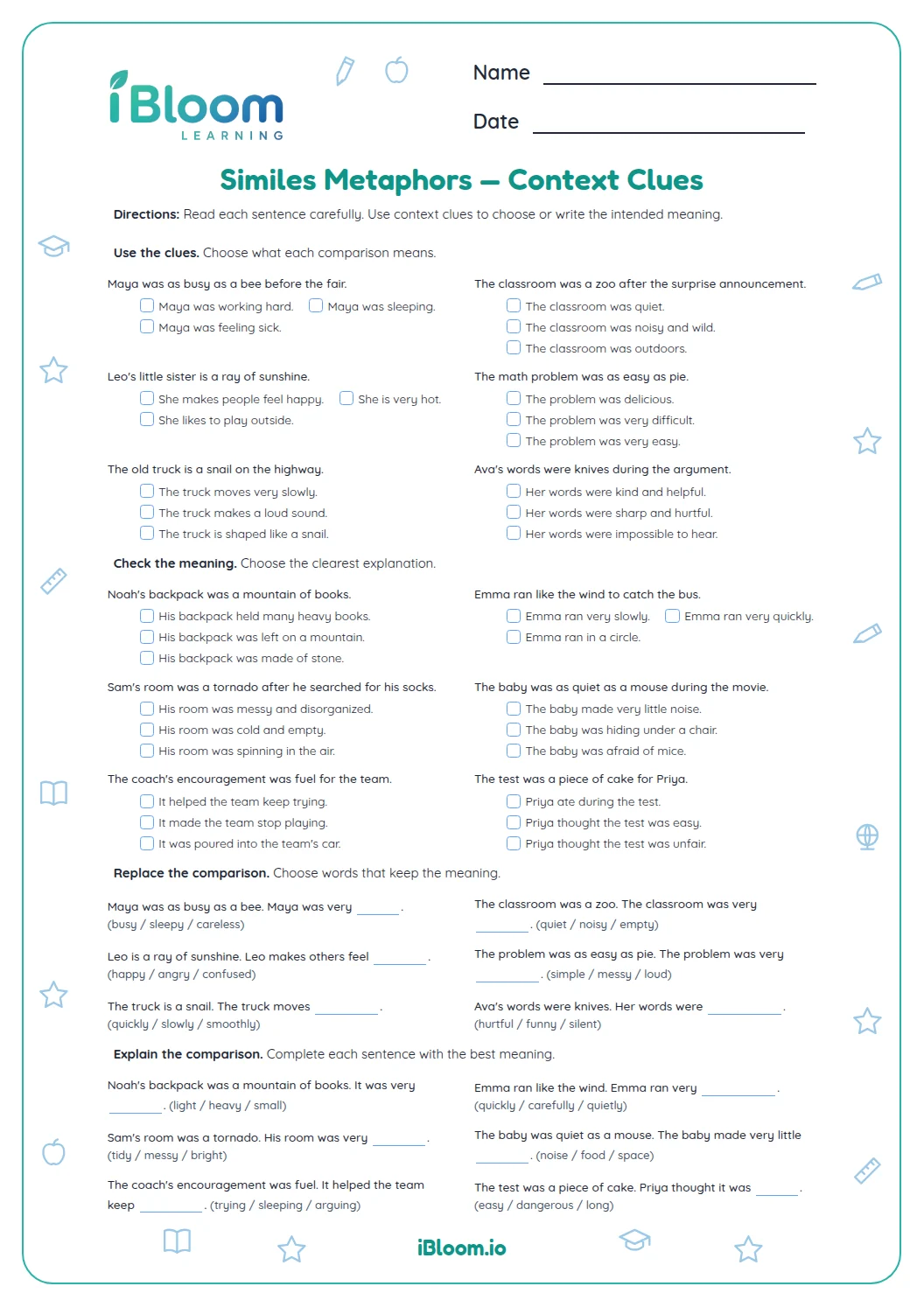
Notice how the comparison is phrased: a metaphor says one thing is another, while a simile signals the comparison with like or as.
Curriculum alignment
This worksheet practices the named grade-level skill through explicit questions and answer checking.
Interpret similes and metaphors by using the surrounding context.
On this sheet: Each item asks students to explain or choose the meaning of a metaphor in context.
Show the official wordingHide the official wording
Interpret figurative language, including similes and metaphors, in context.
What to practice next
Make more practice
Further reading
Questions parents and teachers ask
What skill does this metaphor word meaning worksheet practice?
A metaphor compares two unlike things directly to suggest an idea. In “The classroom was a beehive,” the classroom is not literally full of bees; the comparison suggests that people were busy and active. Children use the sentence around the image to work out its meaning.
How many questions are on the printable?
There are 14 fill-in questions. Each sentence contains an original metaphor, and the child completes its meaning using the surrounding context. The separate key gives a concise interpretation for every item. Children can explain which clue helped them choose.
Is an answer key included?
Yes. The key lists a concise meaning for each of the 14 metaphors. A different phrase can work when it expresses the same idea suggested by the sentence. Ask the child to point to the context that makes the interpretation fit.
How long should this worksheet take?
Allow about 20 to 25 minutes to read each sentence, consider the comparison, and review the answers. For a useful check, ask the child to explain which two things are being compared and what quality they share in that context.
How can I support a child who gets stuck?
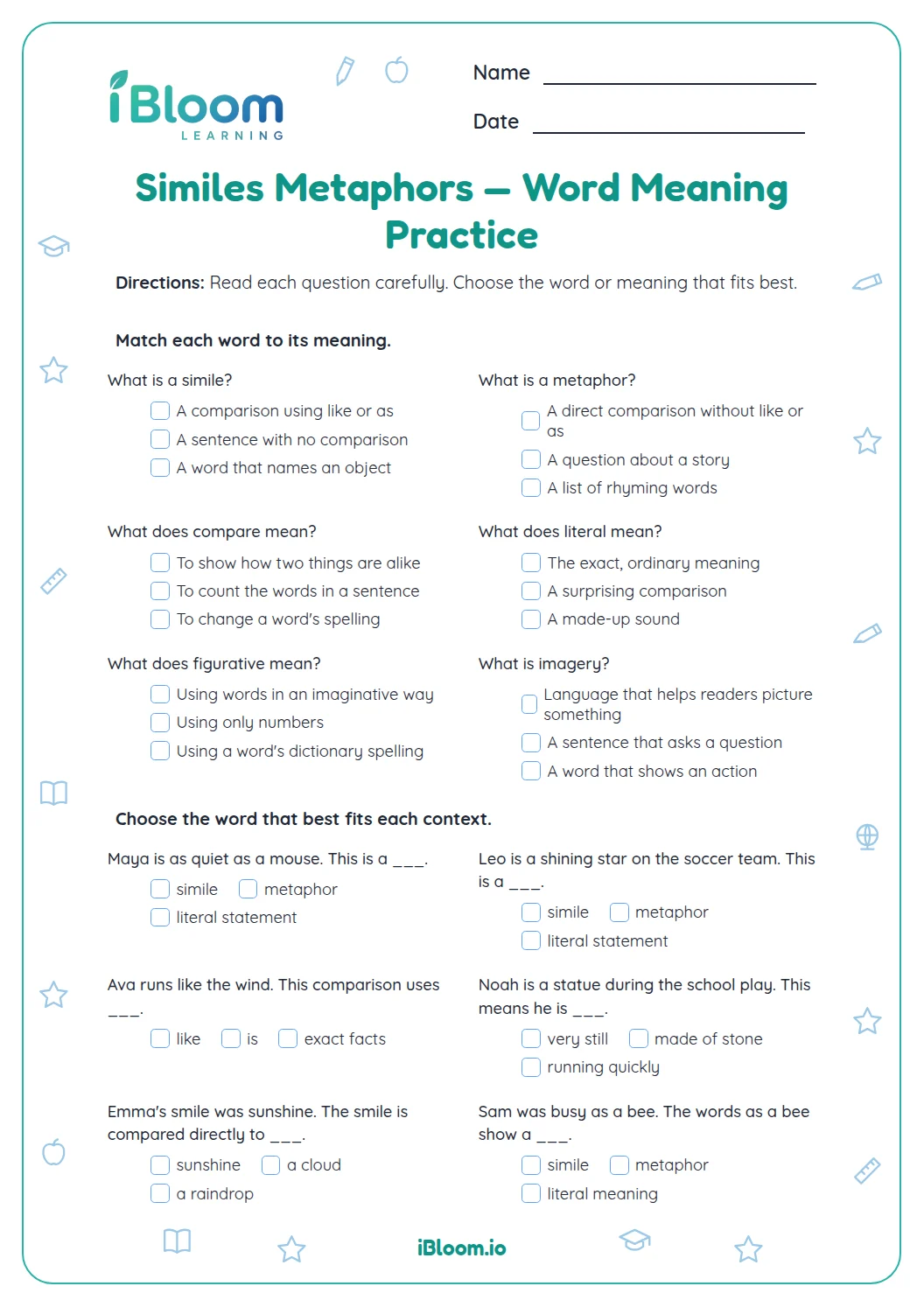
A metaphor makes a direct comparison, as in “Her voice was velvet.” A simile signals its comparison with like or as. Both can help a reader picture an idea, and context helps reveal what the writer means in either form.