






About this worksheet
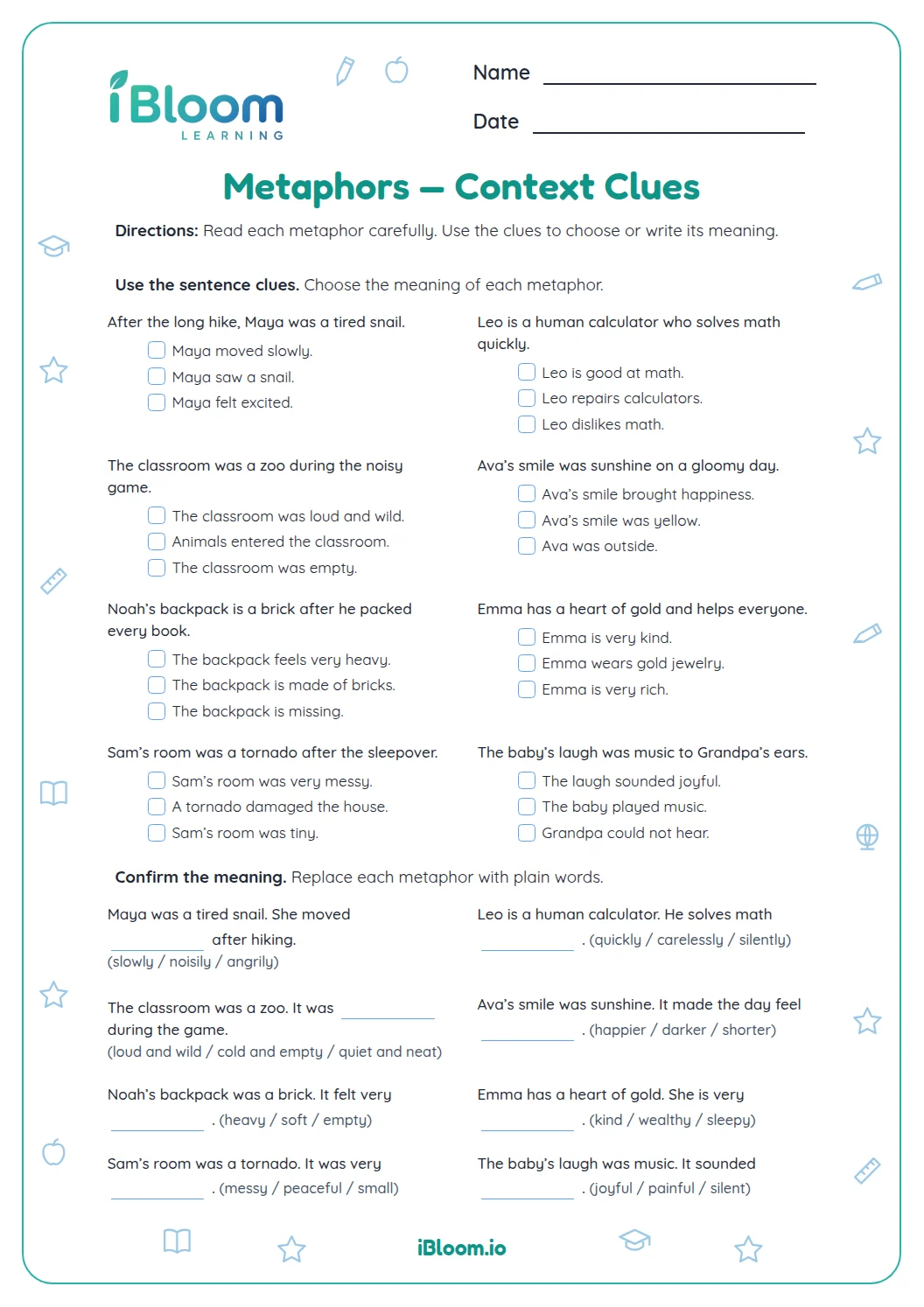
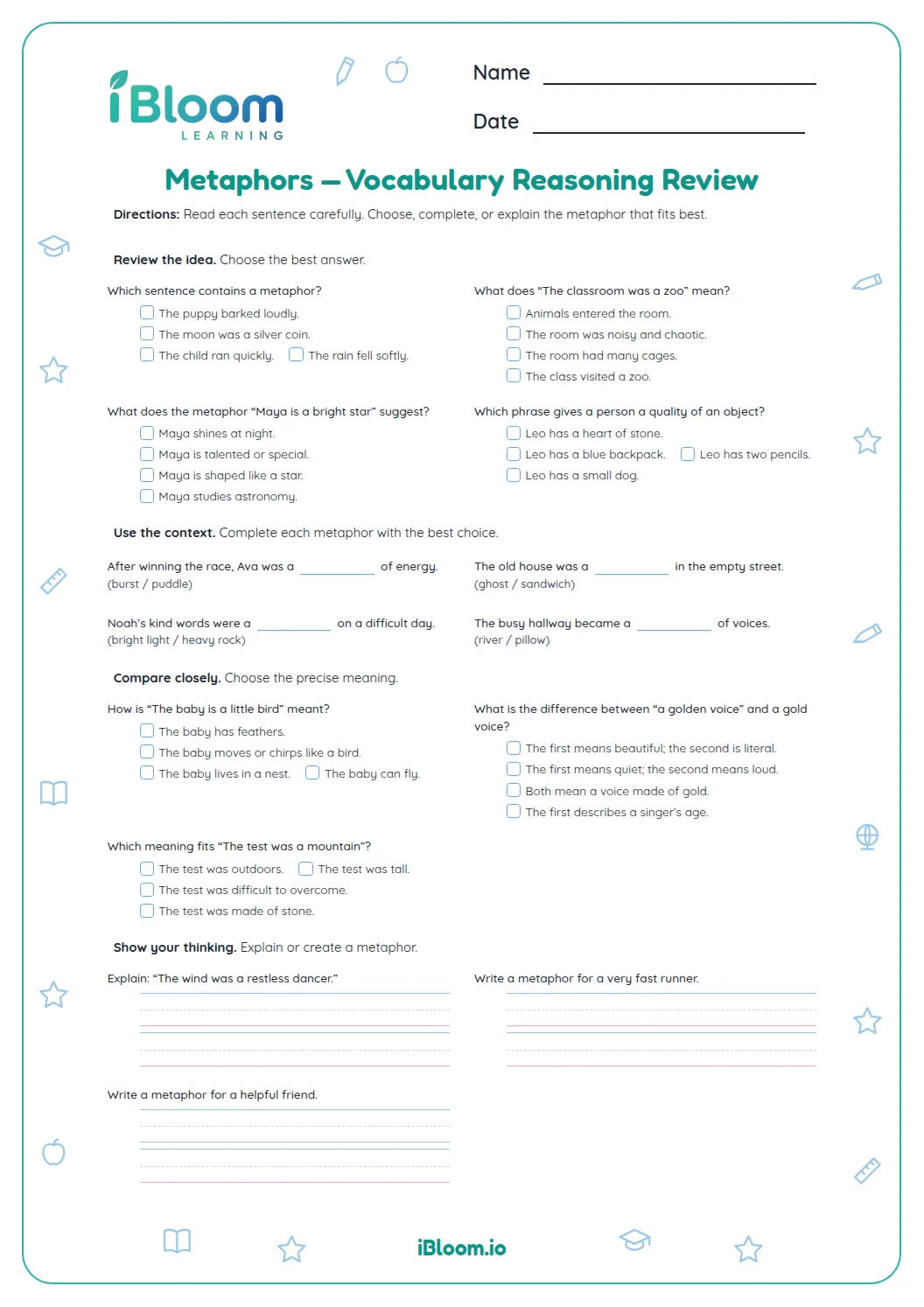
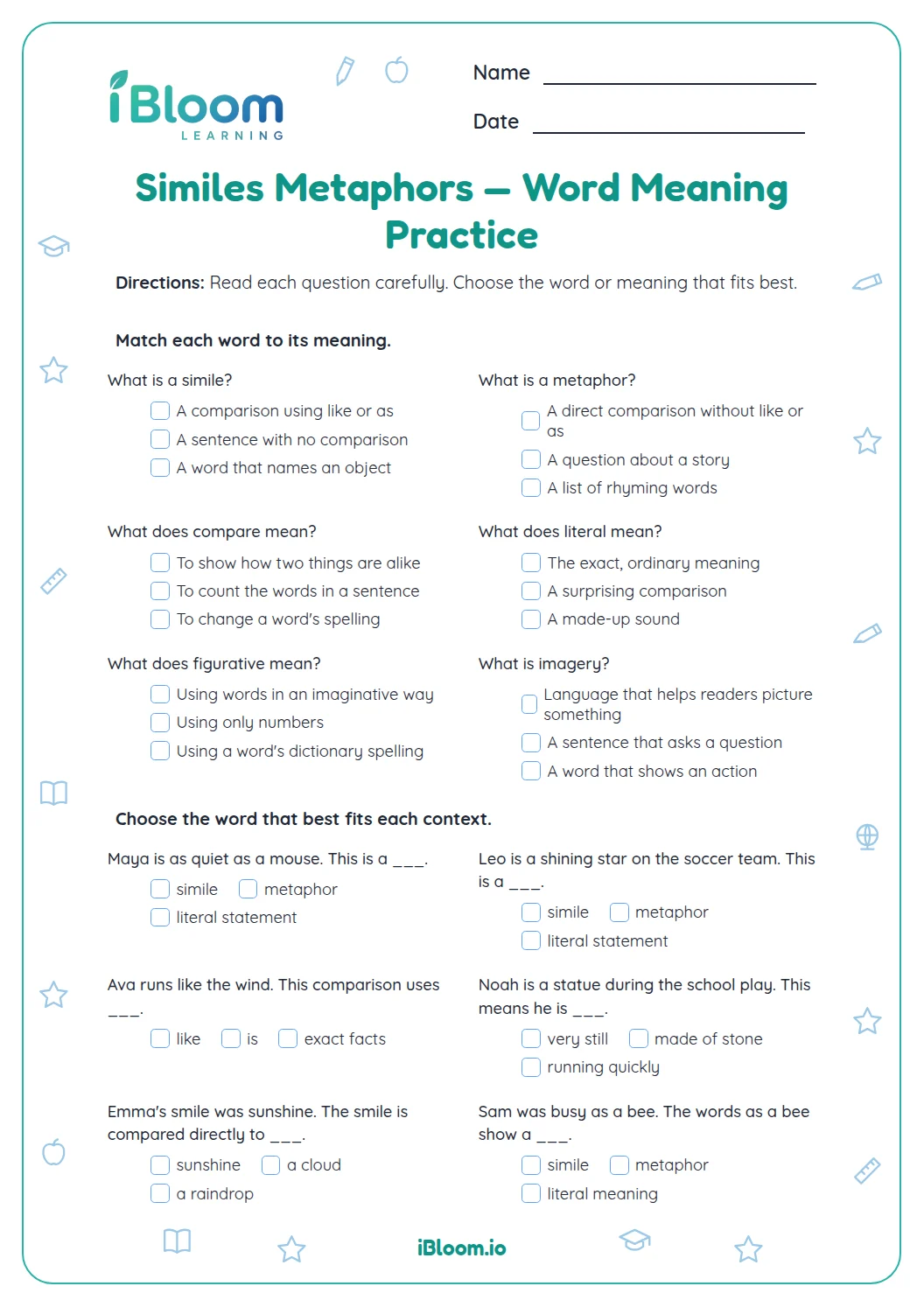
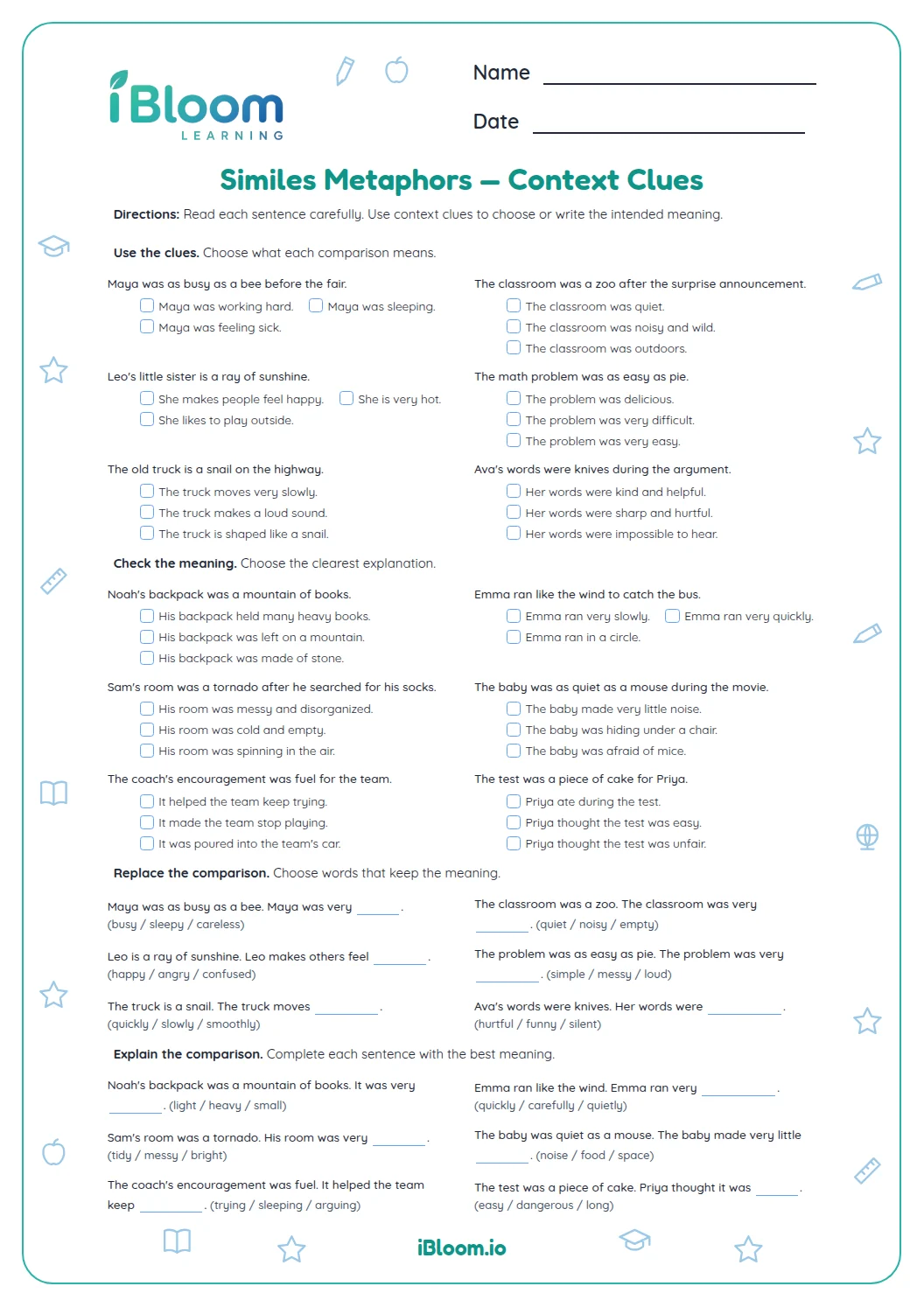
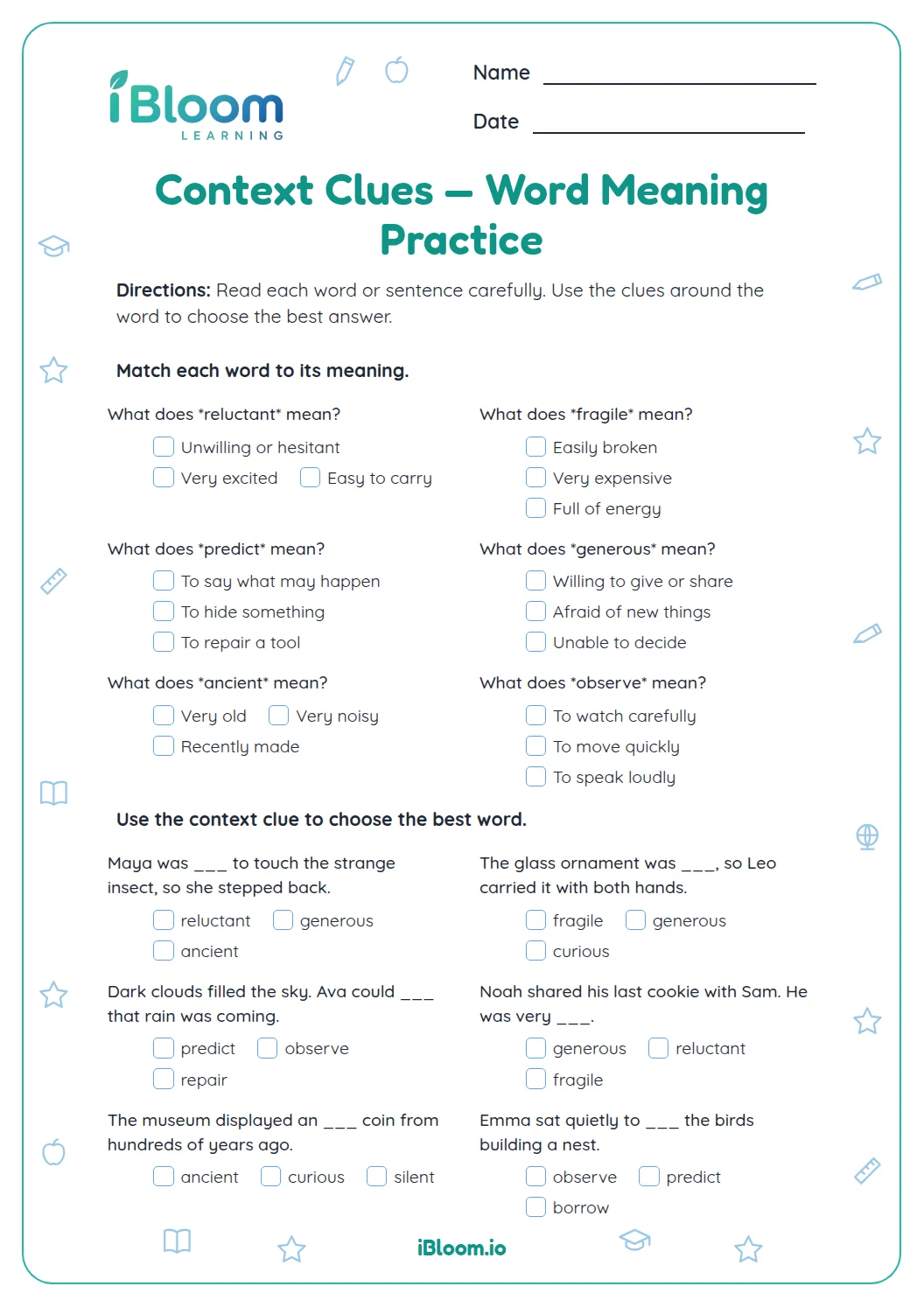
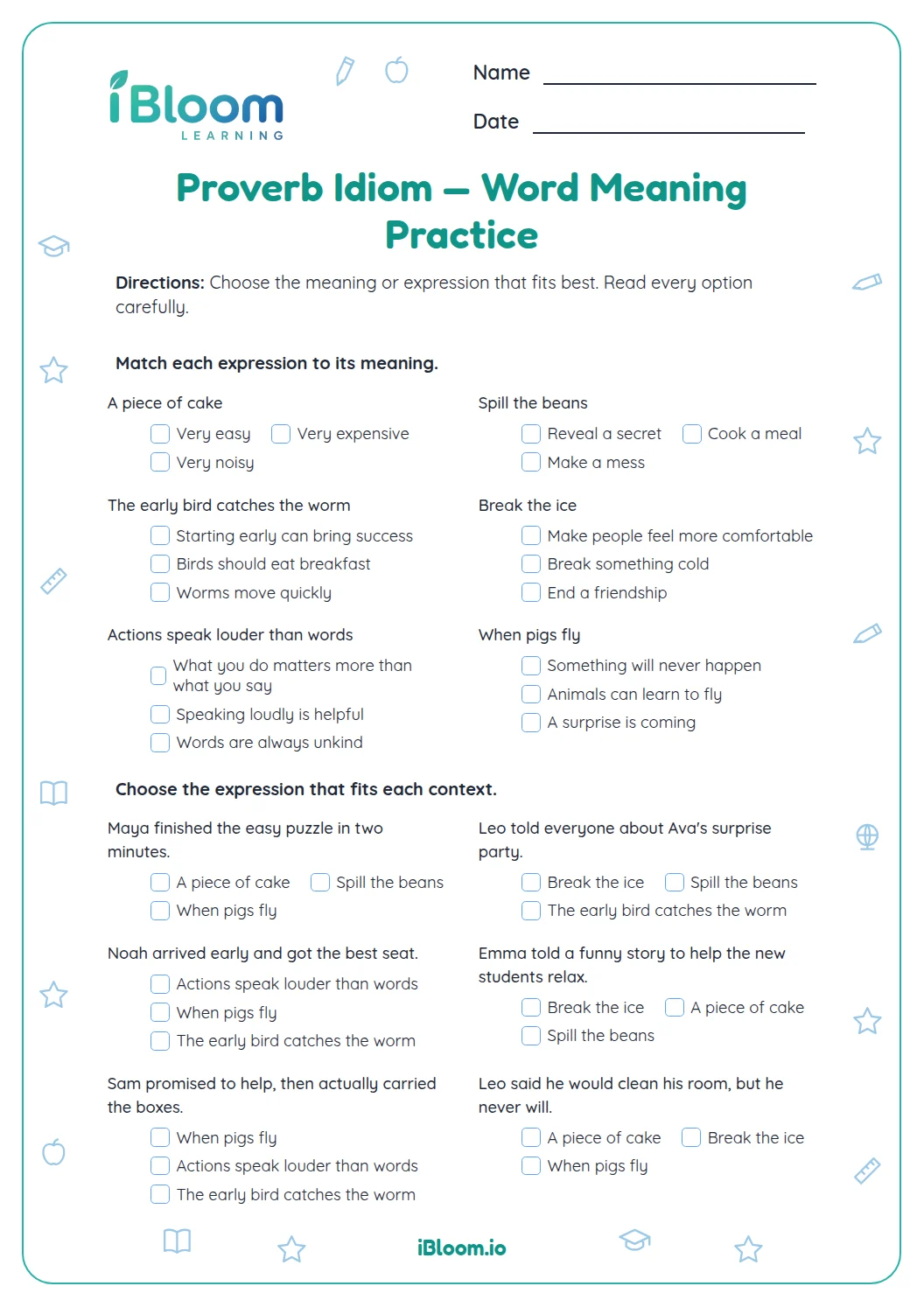
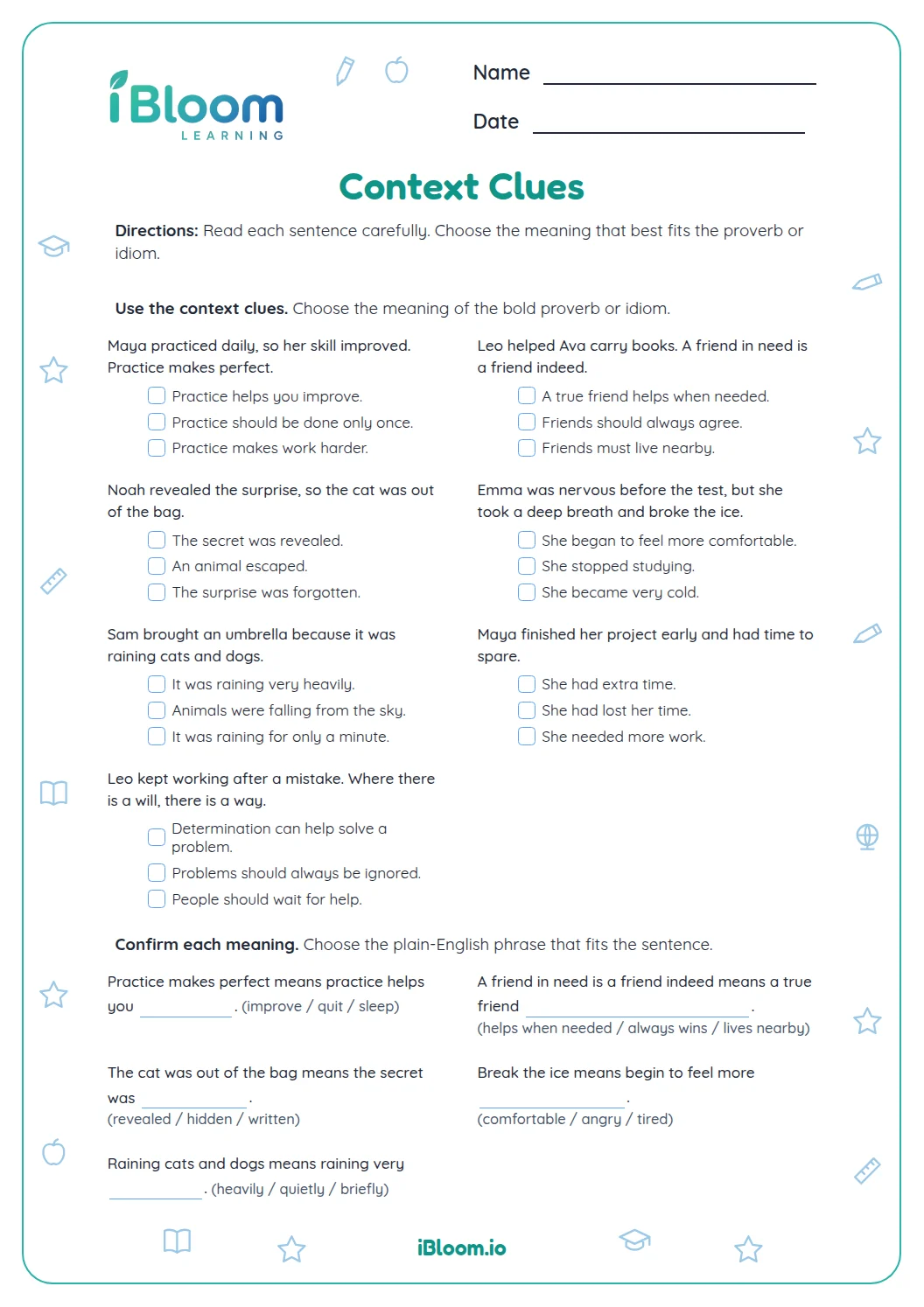
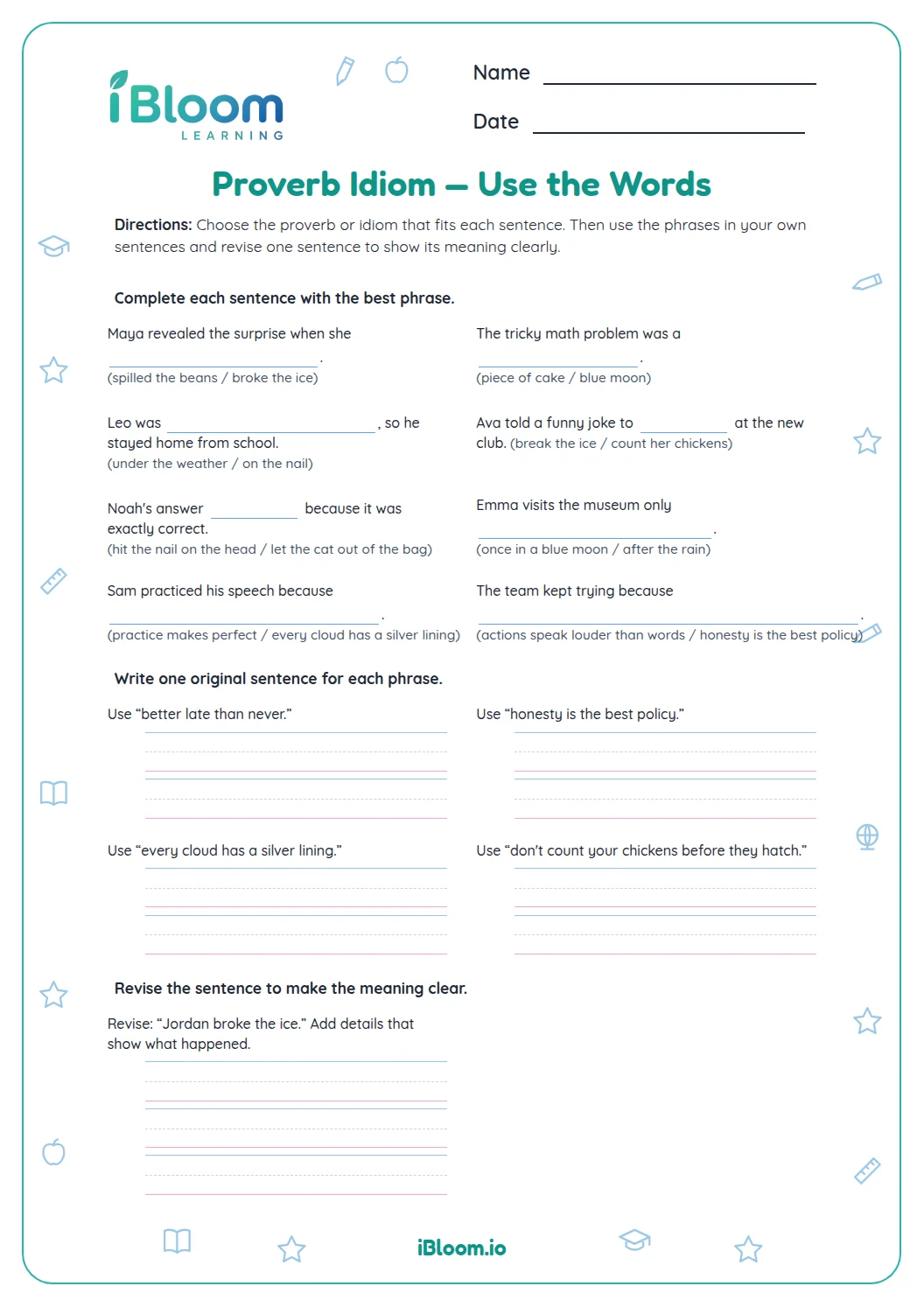
This free Grade 5 metaphor worksheet helps students classify direct comparisons and connect each phrase to its intended meaning. Students distinguish a metaphor from a simile, interpret familiar comparisons such as “a river of students,” and complete sentences with words that fit the context. Parts A and B move from selecting a meaning to finishing a metaphor connection. The answer key lists the intended word or choice for every item. The practice aligns with Common Core L.5.5.a, interpreting figurative language including metaphors in context.
Aligned to L.5.5.a
How can a student tell a metaphor from a simile?
Sixteen questions in two parts. Students choose meanings for four examples, then complete twelve sentences that connect metaphors to their intended ideas.
The words are not meant literally. The student should name the quality shared by the two ideas.
- 1“The hallway was a river of students.” → the hallway is compared to a river.
- 2The comparison suggests a steady, crowded flow of people.
How does context help explain a metaphor?
Nearby words and the situation point to the intended meaning. If news is called “a ray of sunshine,” the metaphor likely signals welcome, hopeful news. If a test is called “a mountain,” the comparison suggests a challenge that feels large.
Questions 3, 5 and 12 ask students to match the comparison to the feeling or idea the sentence conveys.
How can students create a useful metaphor?
Start with a quality worth describing, then choose a familiar image that shares it. A helpful friend might be “the glue” because glue holds things together. The comparison should give the reader a clear clue, even if it is imaginative.
Question 14 asks for a metaphor about a helpful friend; the answer key gives one model, but another clear comparison can work.
How to use this worksheet
- 1Read each sentence once for its literal words and once for its intended idea.
- 2Look for “like” or “as” when deciding whether a comparison is a simile.
- 3Name the shared quality instead of repeating the comparison.
- 4Use surrounding details to check the meaning.
- 5For original metaphors, choose an image that clearly shares the quality you mean.
Common mistakes and quick fixes
The mistake
Treating every comparison as literal.
The fix
Ask what quality the two things share in the sentence.
The mistake
Calling a simile a metaphor.
The fix
Check for “like” or “as”; those signal a simile.
The mistake
Explaining only one object in the comparison.
The fix
Complete the thought: the first thing is compared to the second because both share a specific quality.
Common Core alignment
This worksheet practices interpreting figurative language in context.
Interpret metaphors and other figurative language using context.
On this sheet:
Show the official wordingHide the official wording
Interpret figurative language, including similes and metaphors, in context.
What to practice next
Make more practice
Further reading
Questions parents and teachers ask
What is a metaphor?
A metaphor describes one thing as another to point out a shared quality. “The hallway was a river of students” does not mean water flowed through school; it suggests a crowded stream of people moving along. Question 2 asks students to identify the river as the comparison.
How is a metaphor different from a simile?
A simile signals its comparison with “like” or “as,” as in “slept like a kitten.” A metaphor makes the comparison directly, as in “the classroom was a beehive.” Questions 5 and 6 ask students to classify one example of each kind.
Are the fill-in answers the only words a student can use?
The key lists a word that completes each sentence as written. If a student suggests a different word, check that it fits the blank grammatically and matches the intended comparison. For instance, a “mountain” test should feel difficult, not quiet or bright.
How can context help explain a metaphor?
Read the complete sentence and ask what idea the image suggests. In “the test was a mountain,” a mountain is large and difficult to climb, so the comparison presents the test as a challenge. The blank in question 12 is completed with “difficult.”
How many questions are included?
There are 16 questions in two parts: four multiple-choice items and twelve sentence completions. Students classify a metaphor and a simile, explain comparisons, and complete images about a backpack, moon, clock, laughter and other familiar ideas. The key shows the intended completion.
What is a useful next step after this page?
Ask your child to find a metaphor in a book and name the quality it suggests. The Similes and Metaphors worksheet gives more classification practice, while the Context Clues worksheet helps students use nearby details to figure out unfamiliar expressions.