




About this worksheet
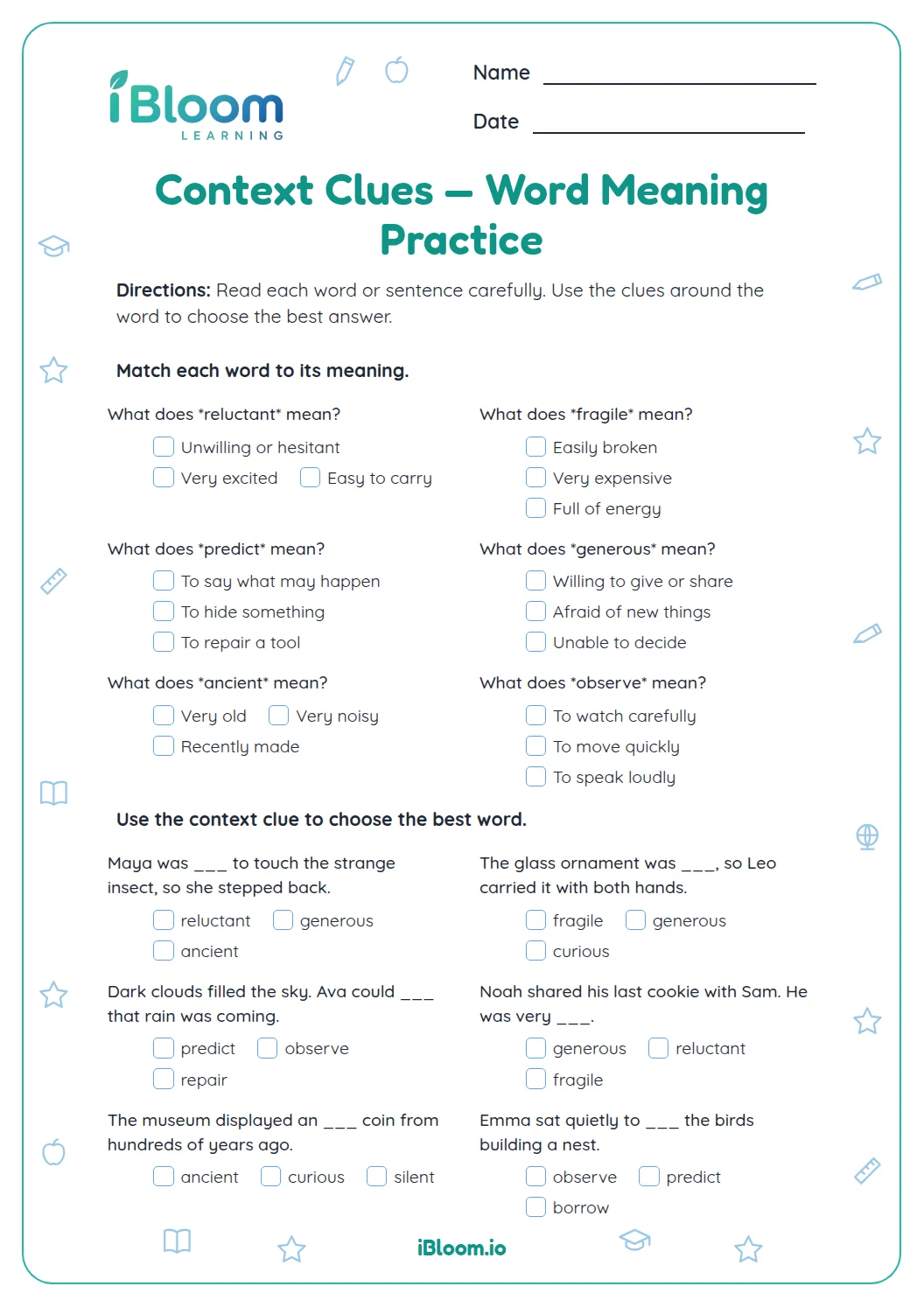
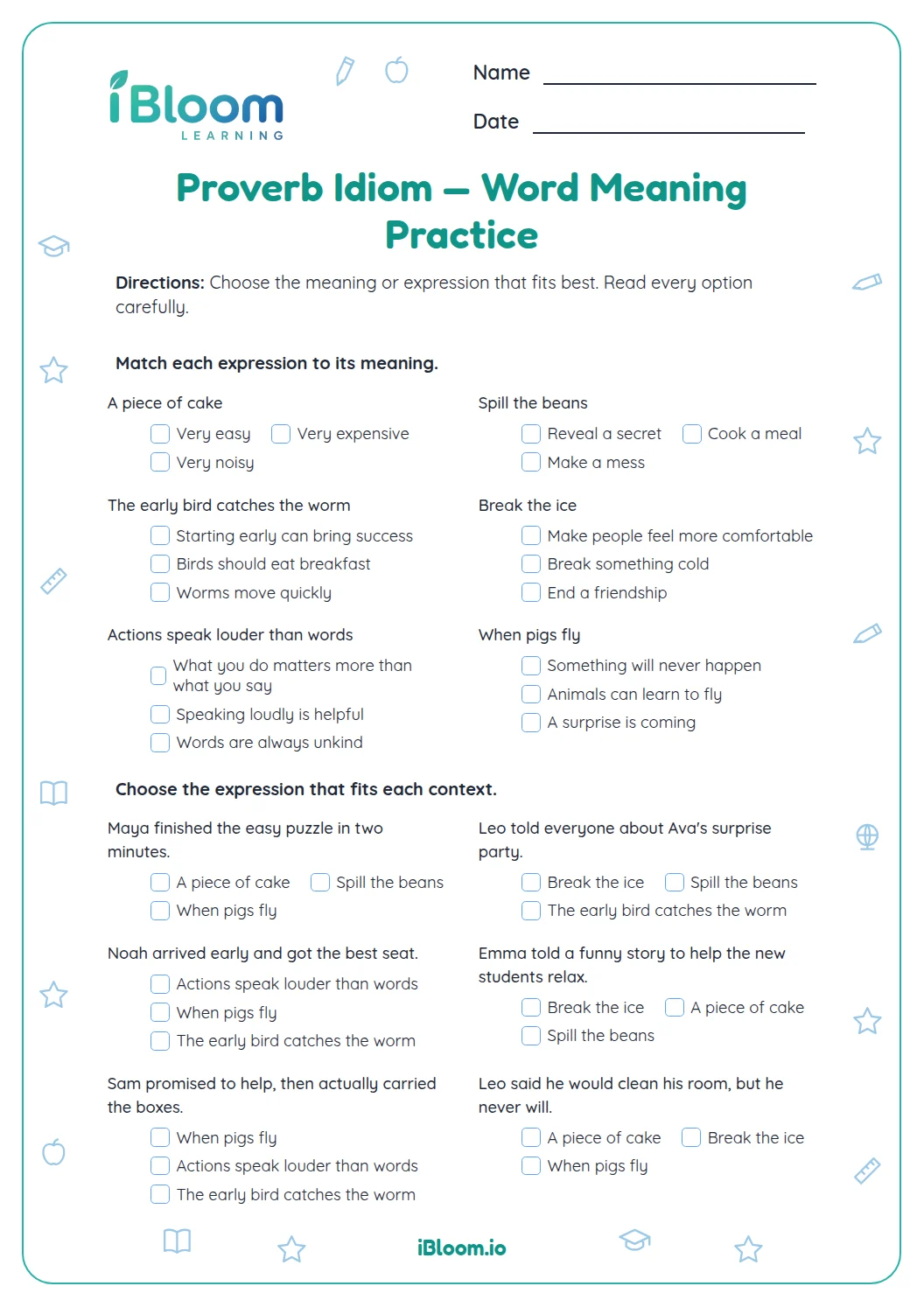
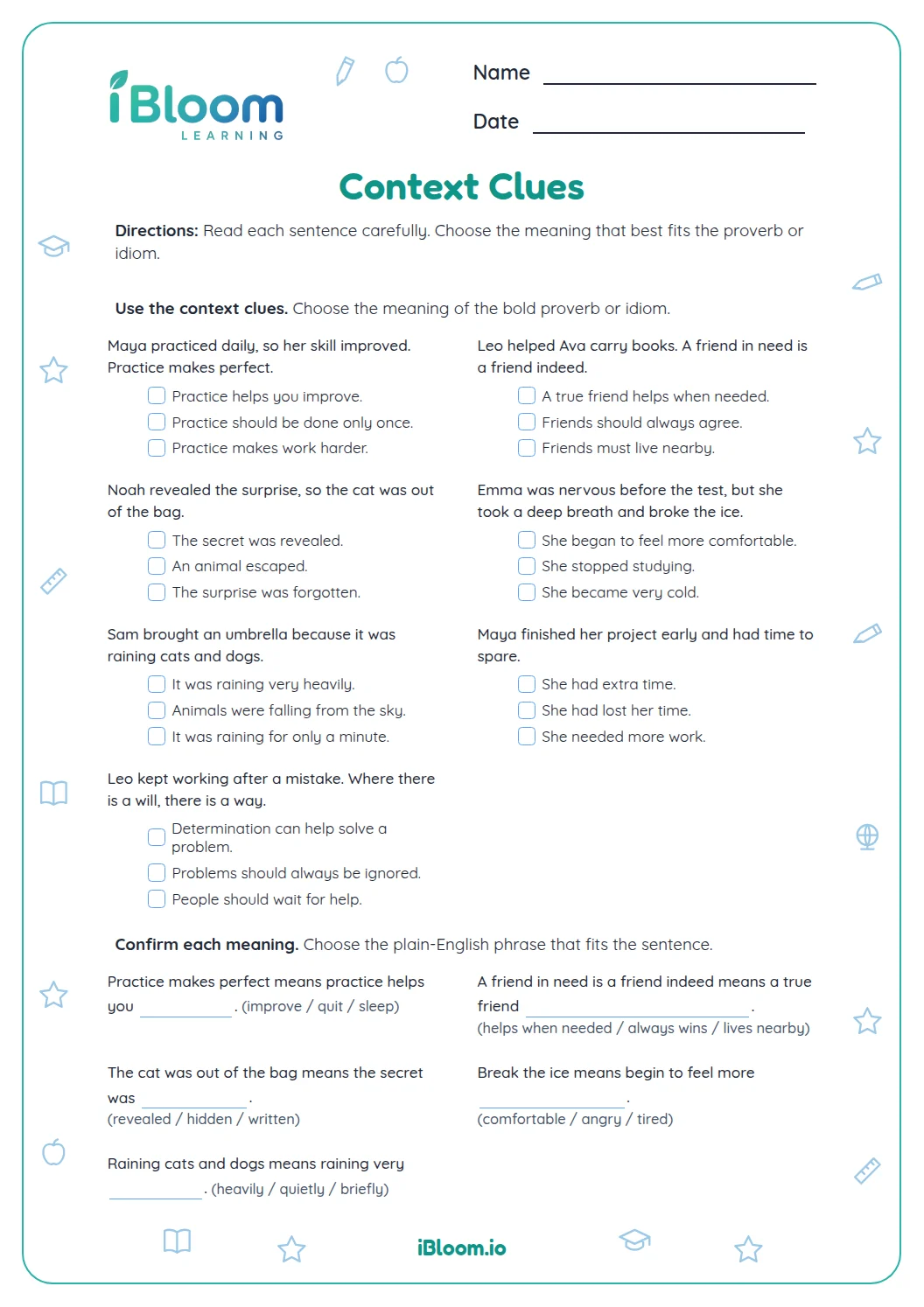
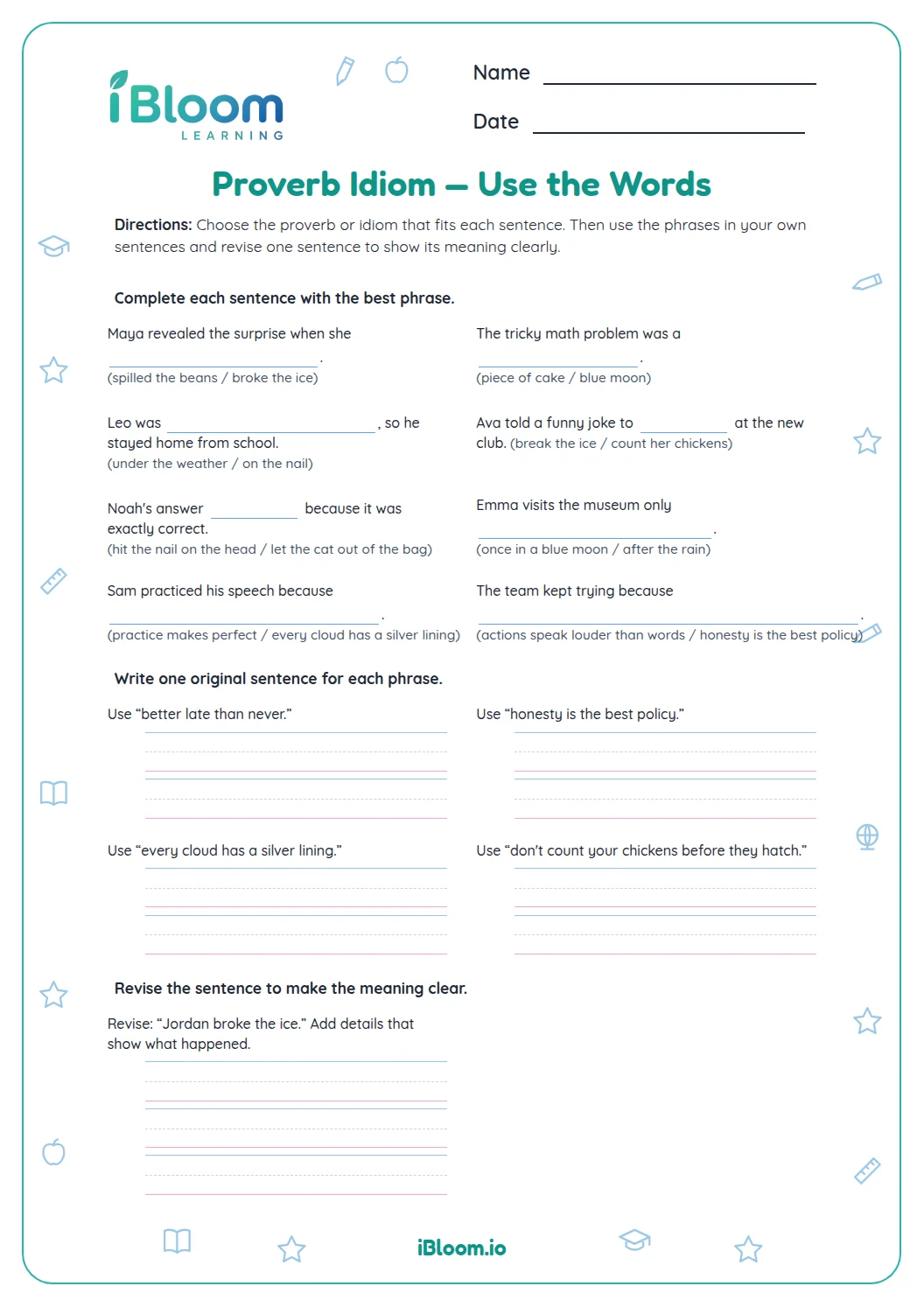
This Grade 5 vocabulary worksheet focuses on phrases whose meanings are revealed by sentence clues. Students infer meanings for expressions such as “on cloud nine” and “let the cat out of the bag,” explain an interpretation supported by context, and identify phrases in new sentences. It includes 14 questions and a separate answer key. It practices CCSS 5.L.4.a.
Aligned to 5.L.4.a
How do sentence clues reveal a phrase meaning?
Look at what happens around an expression. In question 1, Maya wins the spelling bee and feels positive, so “on cloud nine” means very happy. The event and reaction point to the meaning without taking the words literally.
- 1Maya was on cloud nine after winning the spelling bee.
- 2Clue: Maya won and feels positive.
- 3Meaning: very happy
How do you test a possible meaning?
For question 10, the coach wants players to keep their cool during a game. Replacing the phrase with “stay calm” fits the situation. Use the full sentence to check whether a possible meaning makes sense.
How can students use a phrase themselves?
The final questions ask students to write or explain phrases in context. A good example gives enough information for a reader to infer the intended meaning, as the missed window in “a close call” does.
How to use this worksheet
- 1Read the entire sentence, including what happens before and after the phrase.
- 2Underline a detail that hints at the meaning.
- 3Try a plain-language replacement for the phrase.
- 4Reread the sentence with the replacement to see if it makes sense.
- 5In a written answer, include the clue that supports your meaning.
Common mistakes and quick fixes
The mistake
Taking an idiom literally, such as picturing an actual cloud.
The fix
Replace the expression with a meaning that fits the event in the sentence.
The mistake
Guessing from only one word in the expression.
The fix
Use the action or result described by the entire sentence.
The mistake
Giving a meaning without showing why it fits.
The fix
Name a nearby detail that supports your interpretation.
Common Core alignment
This worksheet practices using sentence context to infer phrase meanings.
Use sentence clues to infer the meaning of unfamiliar words and phrases.
On this sheet: Each item asks students to use surrounding sentence details to infer or explain a phrase meaning.
Show the official wordingHide the official wording
Use context (e.g., cause/effect relationships and comparisons in text) as a clue to the meaning of a word or phrase.
What to practice next
Make more practice
Further reading
Questions parents and teachers ask
What does “on cloud nine” mean in question 1?
It means very happy. The sentence says Maya won the spelling bee, a positive event, so that context supports the expression’s figurative meaning rather than a literal cloud. Invite the student to name the exact detail that points to this meaning.
Are students meant to define every phrase literally?
No. Many phrases on the page are expressions, so their intended meanings differ from the literal words. Students use the sentence context to infer the meaning that fits the situation. The surrounding sentence should make the figurative meaning clear. Check the nearby details before deciding.
What makes a useful context clue?
A useful clue is a nearby action, result, explanation, or contrast that points toward the phrase meaning. In the “hit the books” item, the upcoming math test suggests that Leo needs to study. A student can paraphrase the clue before defining the expression.
Can a written answer use different wording from the key?
Yes. The answer key gives concise meanings for the phrase items. A response can use different words if it captures the expression’s meaning and the sentence provides a clue that supports it. Ask the student to show which detail supports the wording.
How can I help without giving away an answer?
Ask what happened in the sentence and whether the expression describes a feeling, action, or result. Then invite the student to replace the phrase with a simple meaning and reread the sentence to check that it fits. The replacement should fit the sentence without changing its main idea.