




About this worksheet
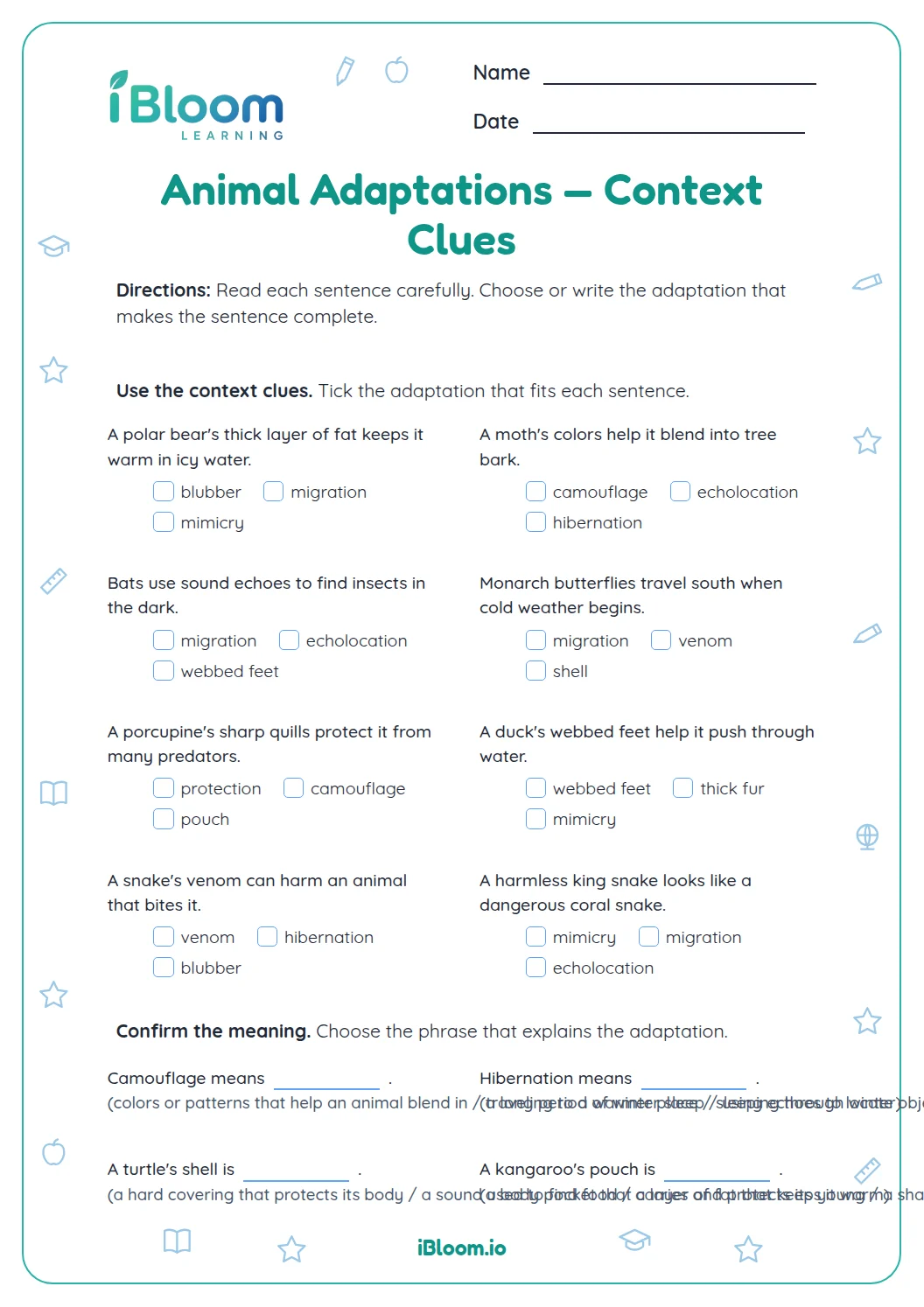
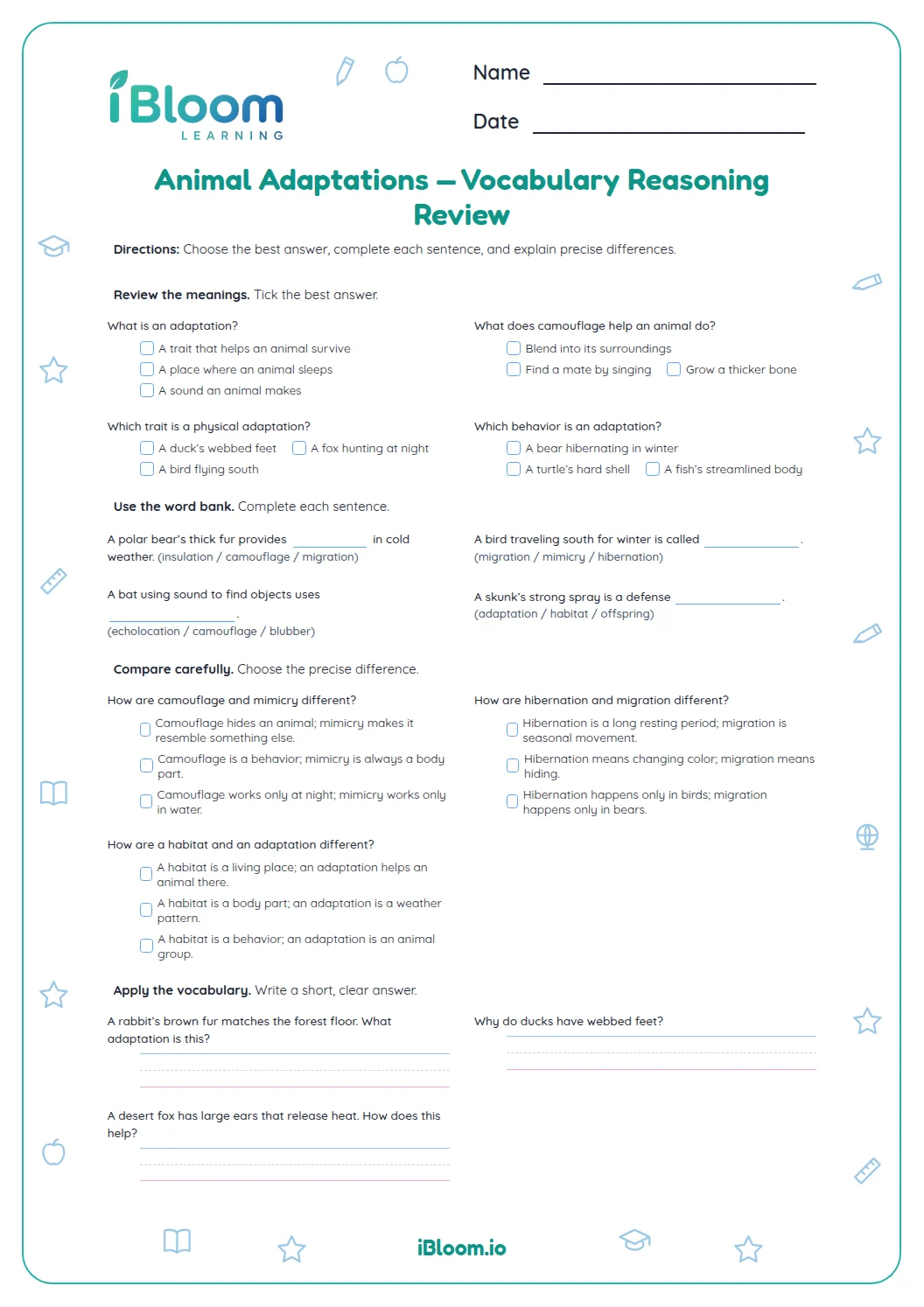
This Grade 5 worksheet builds animal adaptation vocabulary in three steps. Students find six terms in a word search, match six words to meanings, then use clues in eight animal sentences. The separate answer key lists the correct choices. It practices CCSS L.5.4a by using sentence context to determine word meaning.
Aligned to L.5.4.a
How do context clues reveal a word’s meaning?
A context clue is information around an unfamiliar word that helps a reader infer what it means. The clue may describe a cause, result, comparison, or example. Students should use the sentence’s idea, not just guess from the word alone.
For example, if a thick coat “insulates” an animal from bitter wind, the sentence suggests that the coat helps keep warmth in.
- 1A camel’s body helps it endure dry conditions.
- 2Clue: the camel goes several days without water.
- 3Infer: endure means survive.
What does each part practice?
Part A finds six adaptation words in a grid. Part B matches six words to meanings. Part C has eight animal sentences with a missing vocabulary word or meaning.
Students use the sentence details to choose the best fit, connecting each word to the role a trait plays.
How does the answer key help?
The key lists the correct choice for every item. For a context question, reread the sentence with the chosen word to check that the meaning fits.
How to use this worksheet
- 1Read the complete sentence before looking at the options.
- 2Identify what the animal feature does in that sentence.
- 3Try each possible meaning in place of the target word.
- 4Choose the meaning that fits the clue and the whole sentence.
- 5Use the key to check each answer and reread any uncertain item.
Common mistakes and quick fixes
The mistake
Choosing a familiar meaning without checking the sentence.
The fix
Replace the word with the choice and reread the sentence.
The mistake
Confusing a trait with its effect, such as thinking webbed feet are the same as swimming.
The fix
State the feature first, then name what it helps the animal do.
The mistake
Writing a broad synonym that does not fit the context.
The fix
Include the clue from the sentence in a short explanation.
Common Core alignment
These activities give children focused practice with the named grade-level skill.
Use context relationships to infer a word’s meaning.
On this sheet: Questions 1–14 ask students to infer the meaning of adaptation vocabulary from the surrounding sentence.
Show the official wordingHide the official wording
Use context (e.g., cause/effect relationships and comparisons in text) as a clue to the meaning of a word or phrase.
What to practice next
Make more practice
Further reading
Questions parents and teachers ask
Is this a word search?
Yes. The first activity is a word search with six adaptation terms. The sheet then has six meaning matches and eight context sentences, keeping the animal adaptation topic while moving from finding a word to applying it. Students can mark the found words before moving on.
What does the answer key include?
The key lists the correct choice for all 14 questions. For context items, students can reread the complete sentence with the selected answer to check whether the word meaning fits the animal and its adaptation. Each word has a matching definition, and the key lists the correct choice.
Can students use this without prior animal science lessons?
Yes. The word search and meaning matches can be completed without a separate animal science lesson. The context sentences include clues about what a body feature does, such as how a shell or layer of fat helps an animal.
How does Part B differ from Part A?
Part A finds six terms in a grid. Part B matches six terms to meanings, and Part C applies vocabulary in seven animal sentences. For example, students use the sentence about a whale staying warm to identify blubber.
How long should this worksheet take?
Plan for about 20 minutes. Students find six words, match six meanings, and complete eight context items. Encourage them to point to the clue in each sentence before checking answers with the key. The key provides a quick way to check all three kinds of practice after students finish.