




About this worksheet
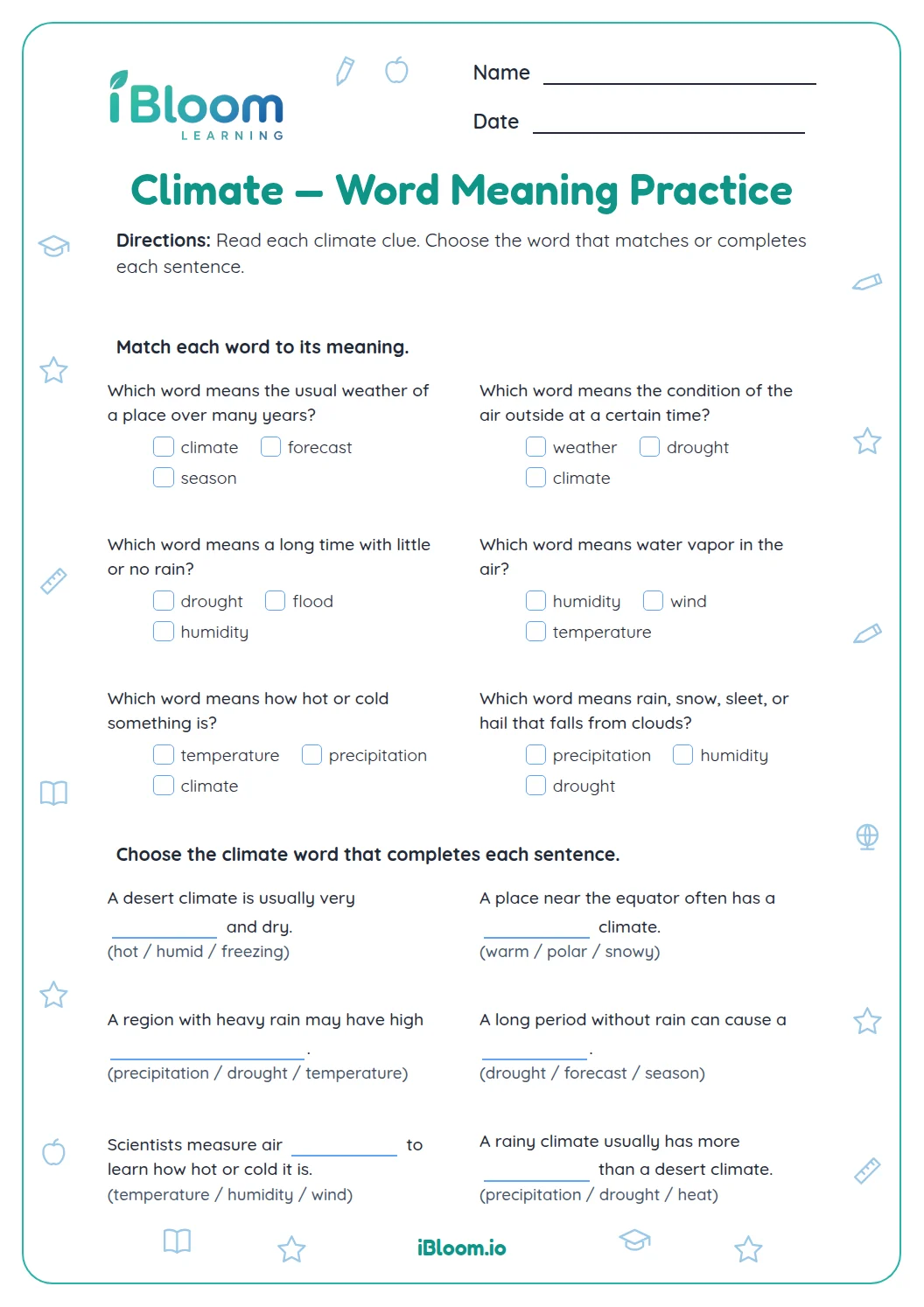
This Grade 5 printable helps students use climate vocabulary in context. Six multiple-choice clues, five sentence completions and four original-sentence prompts move from recognizing a meaning to using a word independently. Words include climate, drought, habitat, conserve, forecast, renewable, emissions and erosion. The answer key gives the selected words and sample sentences.
Aligned to L.5.4a
How is the practice organized?
Part A matches six short clues to climate words. Part B places five words in sentence context. Part C asks students to write four sentences that make a word’s meaning clear.
- 1“A forest is a ___ for many birds and insects.” → habitat
How do context clues help?
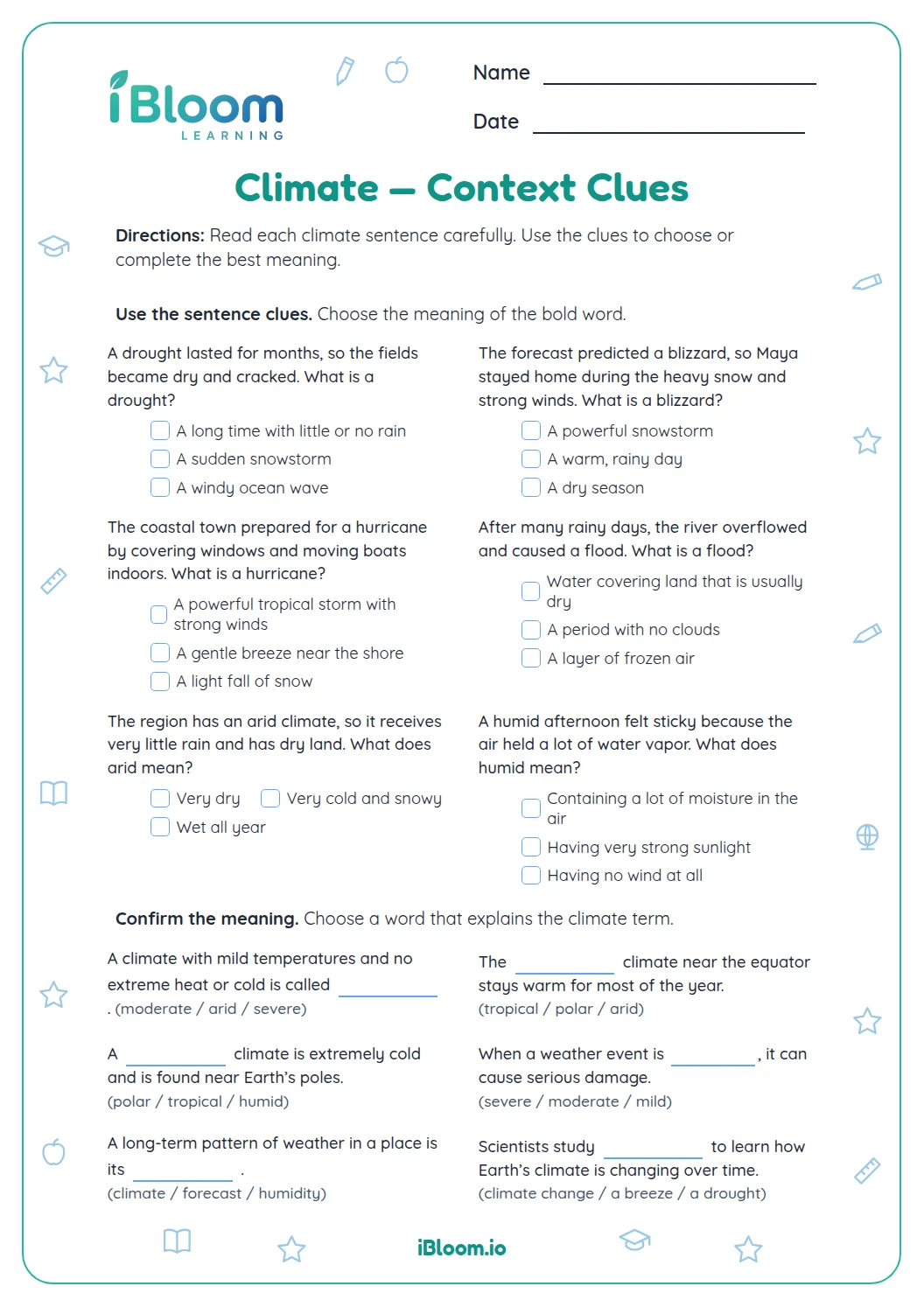
Read the whole sentence and look for details that point to a word’s meaning. “A forest is a ___ for many birds and insects” gives the clue that the missing word names a place where living things stay.
What makes a strong vocabulary sentence?
A useful sentence shows how a word works rather than merely repeating it. For emissions, explain what releases them; for erosion, name what wears away. The model key gives one possible response, and students may write another accurate sentence.
How to use this worksheet
- 1Read the clue or sentence all the way through.
- 2In Part A, compare both word choices with the clue.
- 3In Part B, check that the completed sentence makes sense.
- 4In Part C, use the target word in a complete sentence.
- 5Use the key to discuss any answer that differs from a model.
Common mistakes and quick fixes
The mistake
Choosing a word because it shares a topic, not because it fits the clue.
The fix
Replace it in the sentence and check whether the meaning still works.
The mistake
Using climate as if it meant today’s weather.
The fix
Climate describes usual patterns over many years; weather describes current conditions.
The mistake
Writing a sentence that includes a word but does not show its meaning.
The fix
Add a concrete detail that makes the word’s use clear.
Common Core alignment
This worksheet practices the listed Common Core English language arts skill.
Use sentence clues to choose and apply climate vocabulary.
On this sheet: The clues and sentence context support selecting and using the target climate words.
Show the official wordingHide the official wording
Use context (e.g., cause/effect relationships and comparisons in text) as a clue to the meaning of a word or phrase.
What to practice next
Make more practice
Further reading
Questions parents and teachers ask
How many questions are on the worksheet?
There are 15 questions in three parts. Students choose a climate word for six clues, complete five sentences, and write four original sentences. The answer key gives the selected words and sample sentences, so a teacher can check both the fixed answers and the open responses.
Which climate words are practiced?
The practice includes climate, drought, habitat, conserve, forecast, renewable, emissions, and erosion. Students meet several words in clues and sentence blanks, then use climate, emissions, erosion, and forecast in original sentences. The key models one accurate sentence for each open response.
Are there more than one right sentence for the final questions?
Yes. The key offers a sample for each of the four sentence prompts. A response may use different details if it is a complete, accurate sentence that makes the target word’s meaning clear. For example, a student can describe emissions from a source other than a car when the sentence still fits the prompt.
How can I help with a missed answer?
For a missed choice, reread the full clue and test each option in its place. For an original sentence, ask whether a reader could understand the target word from the details. The answer key provides one model, but other clear, accurate sentences can also work.
How long does the page take?
Plan for about 20 minutes, with extra time if students discuss or revise their sentences. The first two parts ask for brief responses; the final four prompts require a complete sentence. Students can use the answer key to compare meaning rather than copy its exact wording.