



About this worksheet
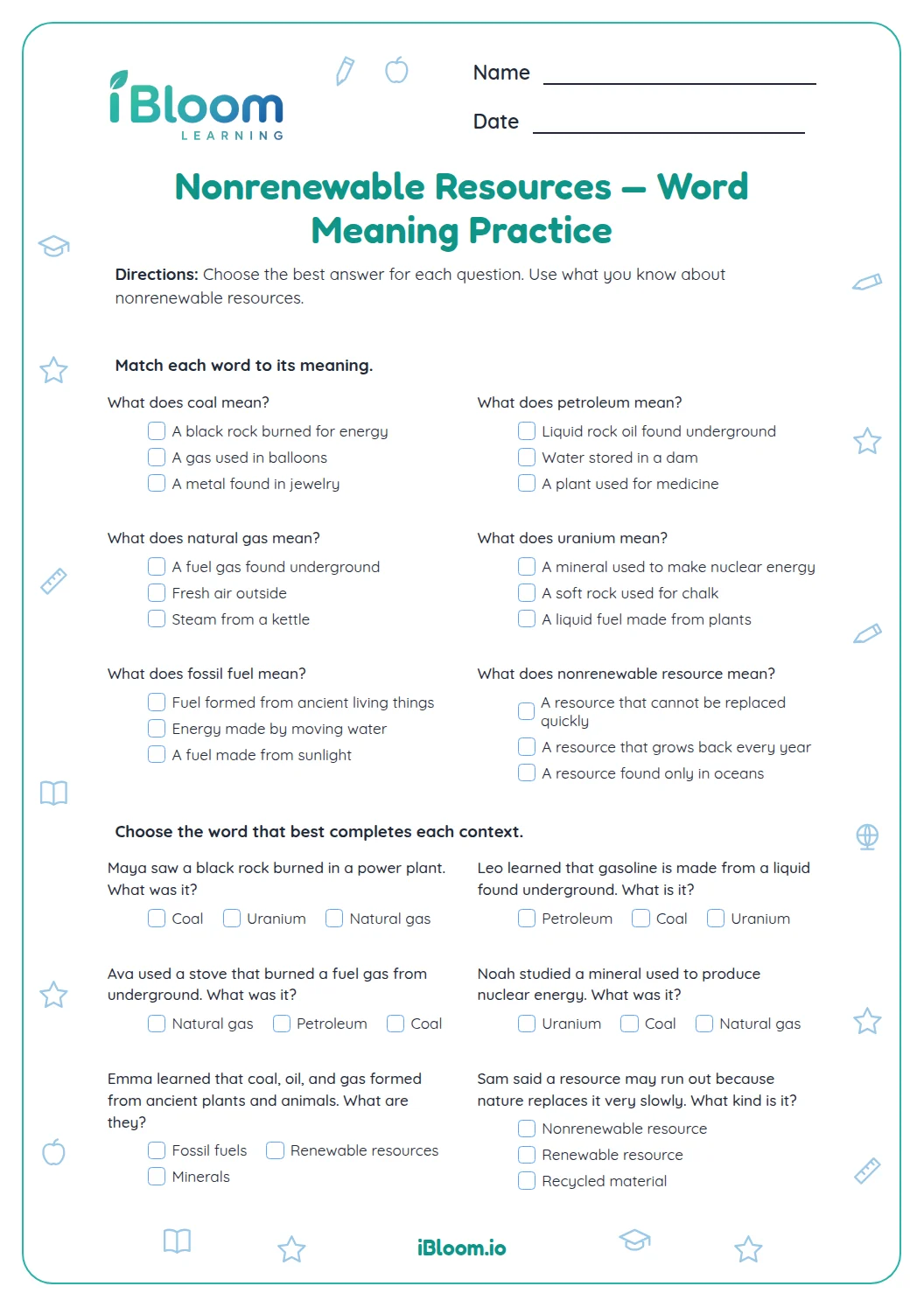
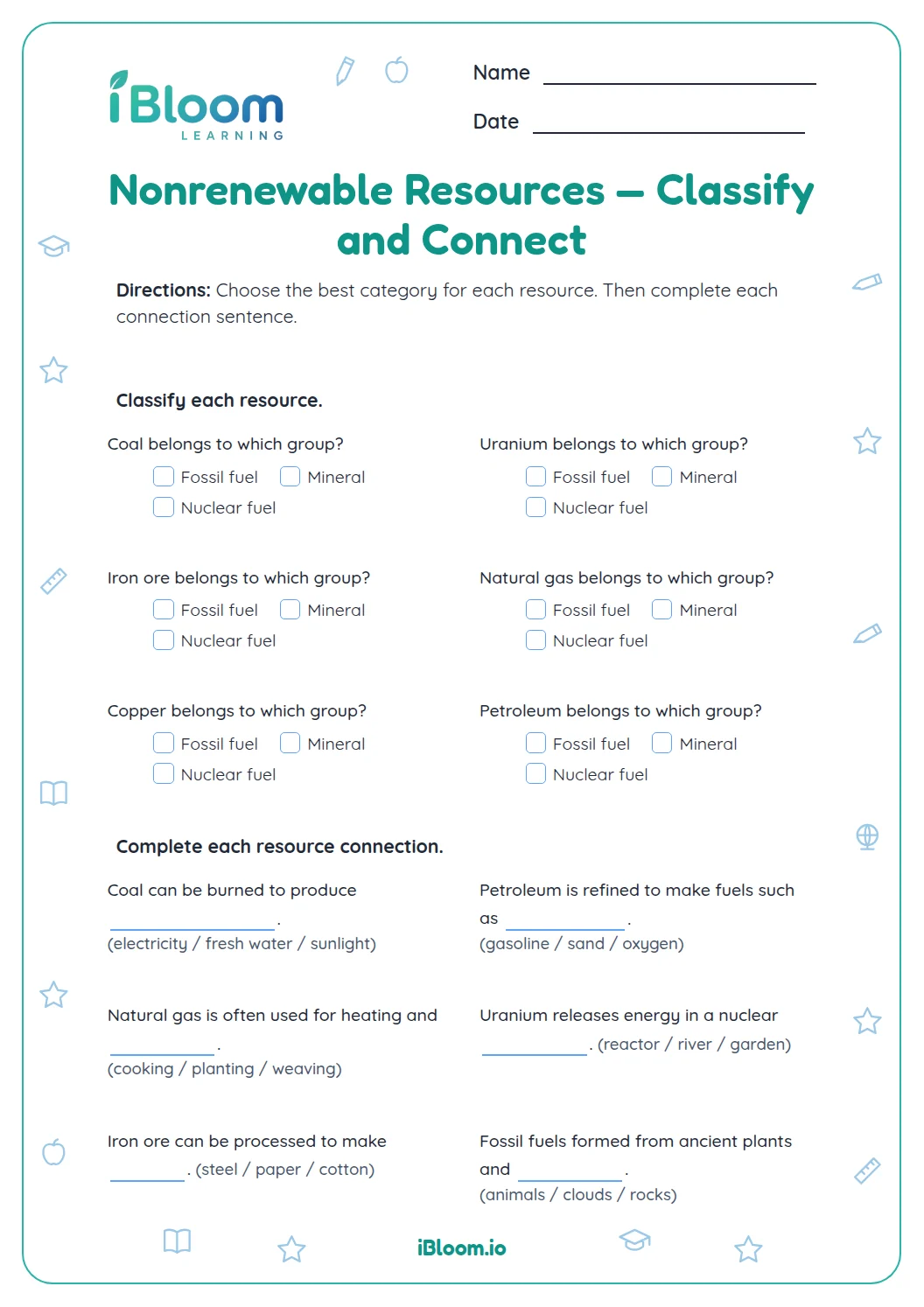
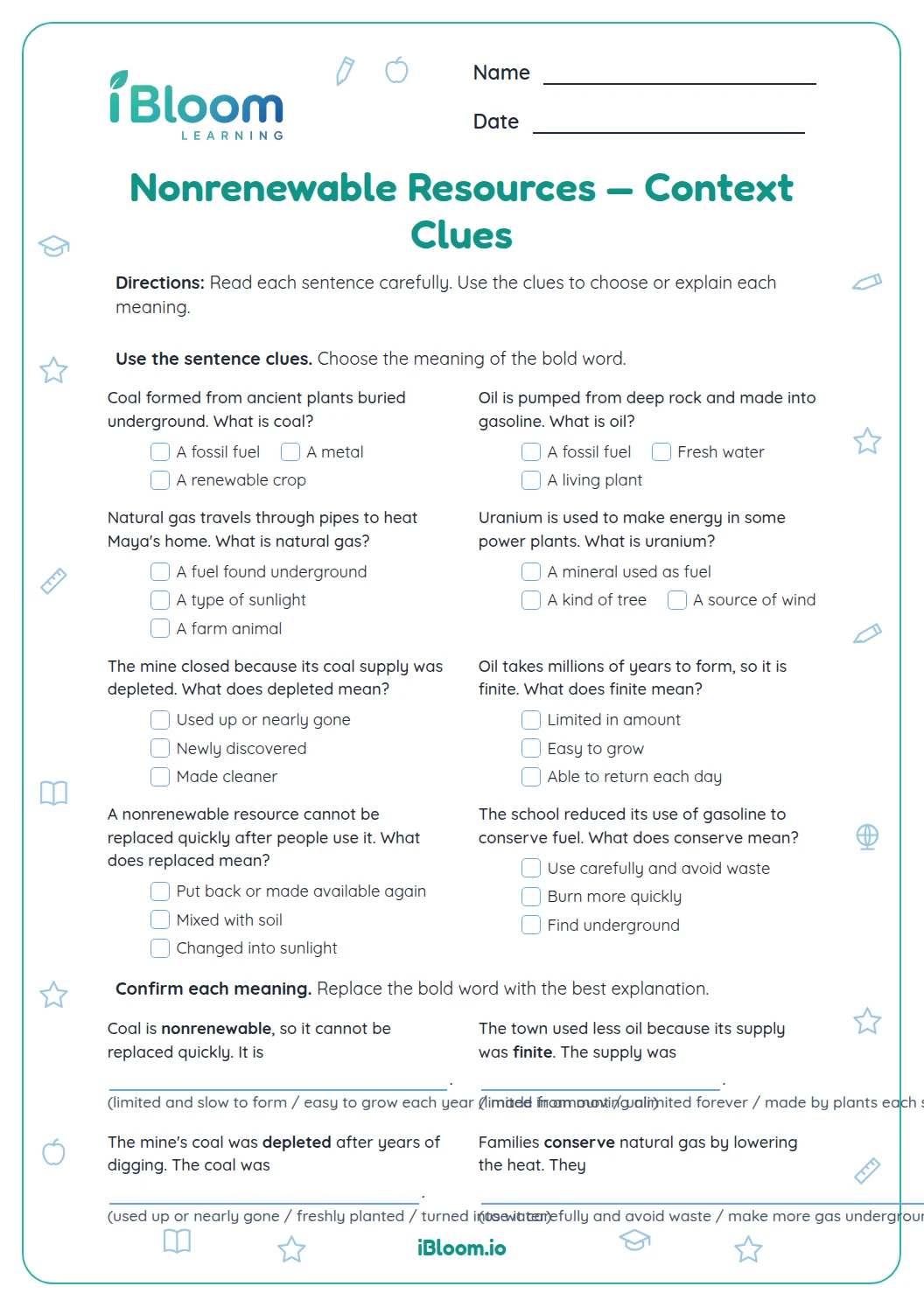
This Grade 5 vocabulary worksheet practices words used to describe nonrenewable resources, including coal, petroleum, fossil fuel, and finite. Students find ten terms in a word search, then use science sentence clues to apply resource vocabulary. This connects to Common Core L.5.6, acquiring and using grade-appropriate domain-specific words. A separate answer key is included.
Aligned to L.5.6
What are nonrenewable resource words?
Nonrenewable resources, such as coal, oil, and natural gas, are available in limited supplies. They form so slowly that people use them much faster than nature can replace them.
A word search helps children notice the terms. The sentence questions show how each word works in a science context.
How can context help with science vocabulary?
Look for nearby details that explain a word. “Gasoline is made from ___, a material found underground” points to petroleum. The clue connects the product to its source.
- 1A supply that cannot be replaced quickly is ___.
- 2The clue is “cannot be replaced quickly.”
- 3Answer: finite
How does this page build word use?
Children locate ten terms, then choose words that complete sentences about how resources form, where they are found, and how people use them.
How to use this worksheet at home or in class
- 1Scan the grid across and down for each resource term.
- 2Read each sentence completely before looking at the choices.
- 3Use science details in the sentence as clues.
- 4Check that the selected word fits both meaning and grammar.
- 5Review the key and revisit any term that was unclear.
Common mistakes and quick fixes
The mistake
Calling a fossil fuel renewable because people can use it again.
The fix
Ask whether nature replaces the supply quickly; fossil fuels form over very long periods.
The mistake
Mixing up petroleum and gasoline.
The fix
Petroleum is crude oil; gasoline is a product made from petroleum.
The mistake
Choosing a word from the topic without checking sentence clues.
The fix
Reread the full sentence and test the choice in the blank.
Common Core alignment
This worksheet gives focused practice with a grade-level skill named in the Common Core standards.
Use grade-appropriate domain-specific words accurately.
On this sheet: Students apply domain-specific energy and resource words in science sentences.
Show the official wordingHide the official wording
Acquire and use accurately grade-appropriate general academic and domain-specific words and phrases, including those that signal contrast, addition, and other logical relationships (e.g., however, although, nevertheless, similarly, moreover, in addition).
What to practice next
Make more practice
Further reading
Questions parents and teachers ask
What makes coal, oil, and natural gas nonrenewable?
These resources take a very long time to form, while people use them much faster than nature replaces them. The worksheet uses words such as fossil fuel, finite, and resource to describe this idea and asks students to apply the words in sentences.
What does petroleum mean in this worksheet?
Petroleum is crude oil found underground. People process it to make products such as gasoline. Read the full sentence around the word to see how it connects with the other energy terms and to choose the meaning that fits. The choices help distinguish its source from its products.
Does this page have an answer key?
Yes. The separate key lists the ten words in the grid and the intended answer for each of the 13 sentence questions. Use it to check spelling and revisit any science term whose meaning is still unclear from its sentence clues.
What is a finite resource?
A finite resource has a limited supply. In the worksheet, this vocabulary connects to coal, oil, and natural gas because people use them faster than they naturally form again. The nearby sentence details help explain why the word finite applies.
What kinds of terms are in the word search?
The grid contains ten resource and energy terms: coal, oil, natural gas, petroleum, fossil fuel, energy, mining, fuel, finite, and resource. The sentence questions use these words in brief science contexts, giving students another chance to apply the vocabulary after finding it in the puzzle.