






About this worksheet
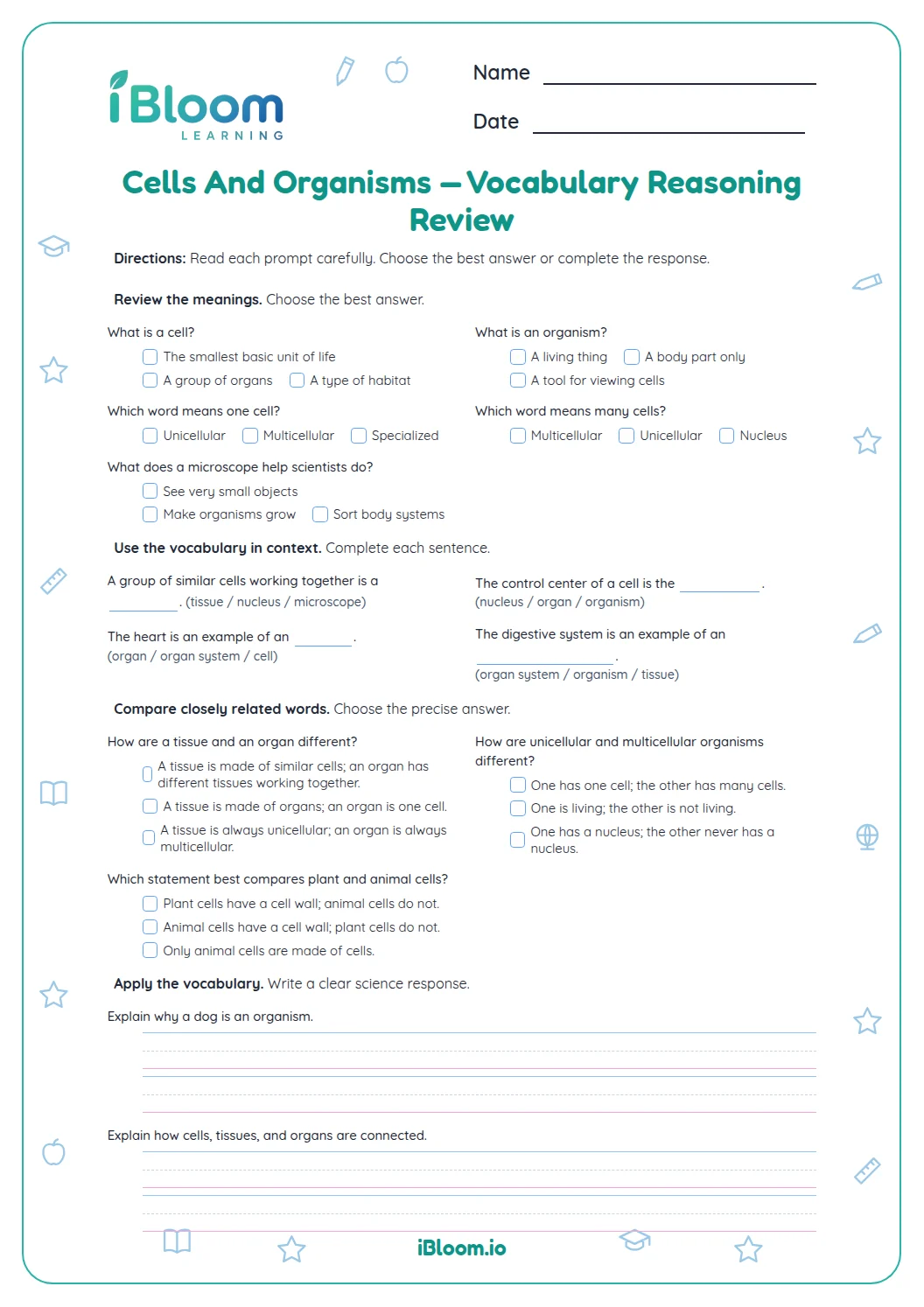
This Grade 5 printable pairs a word search with definition blanks and precise word choices for cell and organism vocabulary. Children find cell, organism, nucleus, membrane, tissue, organ, system, and energy, then use those terms to interpret concise science clues. The answer key lists the target words and answers for all 16 items. The vocabulary practice supports accurate use of grade-appropriate domain-specific words (CCSS L.5.6).
Aligned to L.5.6
Which cell words appear here?
The word hunt and definition questions use eight connected terms: cell, organism, nucleus, membrane, tissue, organ, system, and energy. Children first locate the words and then retrieve their meanings.
How does the word hunt support meaning?
Finding a term is only the first step. The follow-up items ask children to connect each word to a biological definition, so recognition leads into precise vocabulary use.
How can a definition narrow the choices?
For “A cell’s control center is its ___,” compare each term with the job described. Nucleus names the control center; membrane names the thin boundary.
- 1Clue: cell’s control center
- 2Check the terms: membrane is the boundary; nucleus is the control center.
- 3Answer: nucleus
How to use this worksheet
- 1Find all eight words in the grid before answering the definitions.
- 2Read each definition and identify the key scientific idea.
- 3Use nearby questions to review related terms.
- 4For the final choices, check that each word matches the full definition.
Common mistakes and quick fixes
The mistake
Mixing up tissue and organ because both are body structures.
The fix
Compare the definitions: tissue is a group of similar cells; an organ is made of tissues and has a job.
The mistake
Choosing membrane for the control center because both are cell parts.
The fix
The nucleus directs cell activities; the membrane forms the cell boundary. Match each word to its distinct role.
The mistake
Treating organism as the name of one cell part.
The fix
An organism is a living thing made of one or more cells, not a cell part. Ask whether the clue describes a whole living thing.
Common Core alignment
Use grade-appropriate science vocabulary accurately in learning and writing.
On this sheet: Acquire and use grade-appropriate domain-specific vocabulary, including science terms.
Show the official wordingHide the official wording
Acquire and use accurately grade-appropriate general academic and domain-specific words and phrases, including those that signal contrast, addition, and other logical relationships.
What to practice next
Make more practice
Further reading
Questions parents and teachers ask
What terms are in the word search?
The grid contains cell, organism, nucleus, membrane, tissue, organ, system, and energy. Children can locate each term, then use the definition questions to connect the vocabulary to its meaning. The answer key lists the full set. Children can use the printed list as a checklist and cross off each word after finding it.
What does the worksheet ask children to do?
There are 16 items: one word search activity, eight definition blanks, and seven multiple-choice meaning questions. The word search introduces the terms; the remaining items ask children to retrieve or recognize the best-fitting meaning. The blanks use the same vocabulary, so recalling a term matters after the search is finished.
How are tissue and organ different?
Tissue is a group of similar cells working together. An organ is a body part made of tissues that performs a specific job. Reading the whole definition helps distinguish these related levels of organization. A tissue is one level of organization; an organ combines tissues for a particular function.
How can a child tell nucleus from membrane?
A membrane is the thin boundary around a cell. The nucleus is the cell part that contains genetic material and directs cell activities. Look for boundary or covering in a clue for membrane, and control or genetic material for nucleus. Comparing the two definitions helps keep these neighboring cell structures distinct.
What does the answer key include?
The key lists the eight hidden words and the answers for each definition and choice question. Use it after the child has tried the clues, then ask them to explain how a word fits its definition. It also lets a learner check spelling as well as the meaning selected for each clue.
How can an adult support the word search?
Invite the child to scan one row or column at a time and mark each found term on the word list. Afterward, ask for a quick explanation of each word. Explaining a term checks whether its meaning is clear. Recalling the definition in their own words makes the term easier to distinguish from related words.