


About this worksheet
This free Grade 5 vocabulary worksheet makes data collection words concrete through classroom surveys. In Part A, six short contexts explain terms such as data, survey, and response. Part B asks children to choose precise words for six situations, including a sample of students and a written record of answers. All 12 questions are multiple choice, with a separate answer key. The sheet practices Common Core L.5.4.a by using context to clarify word meanings. Children can apply the same vocabulary when they collect lunch preferences, group survey answers, or explain results in class.
Aligned to L.5.4.a
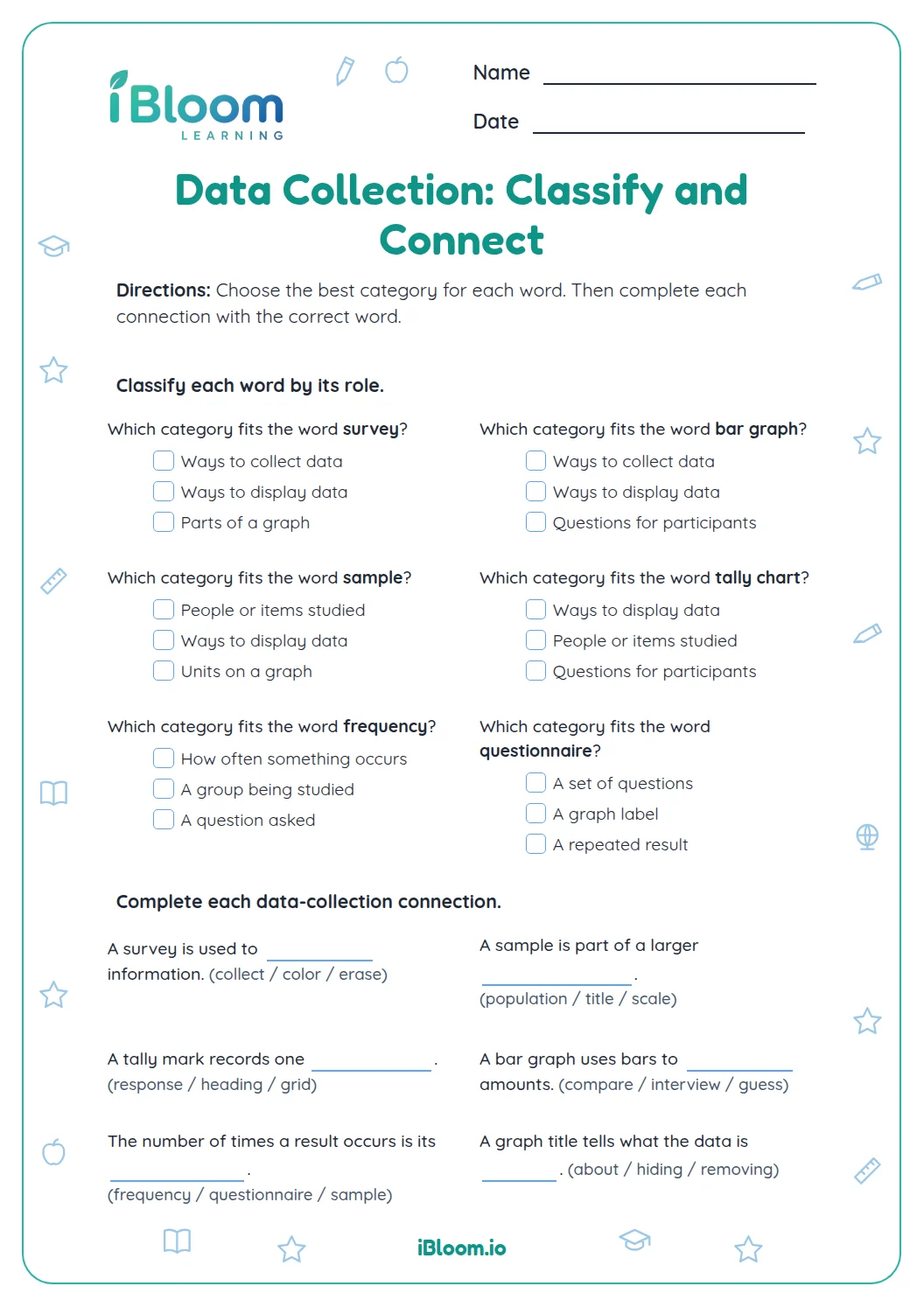
Which data collection words are on the worksheet?
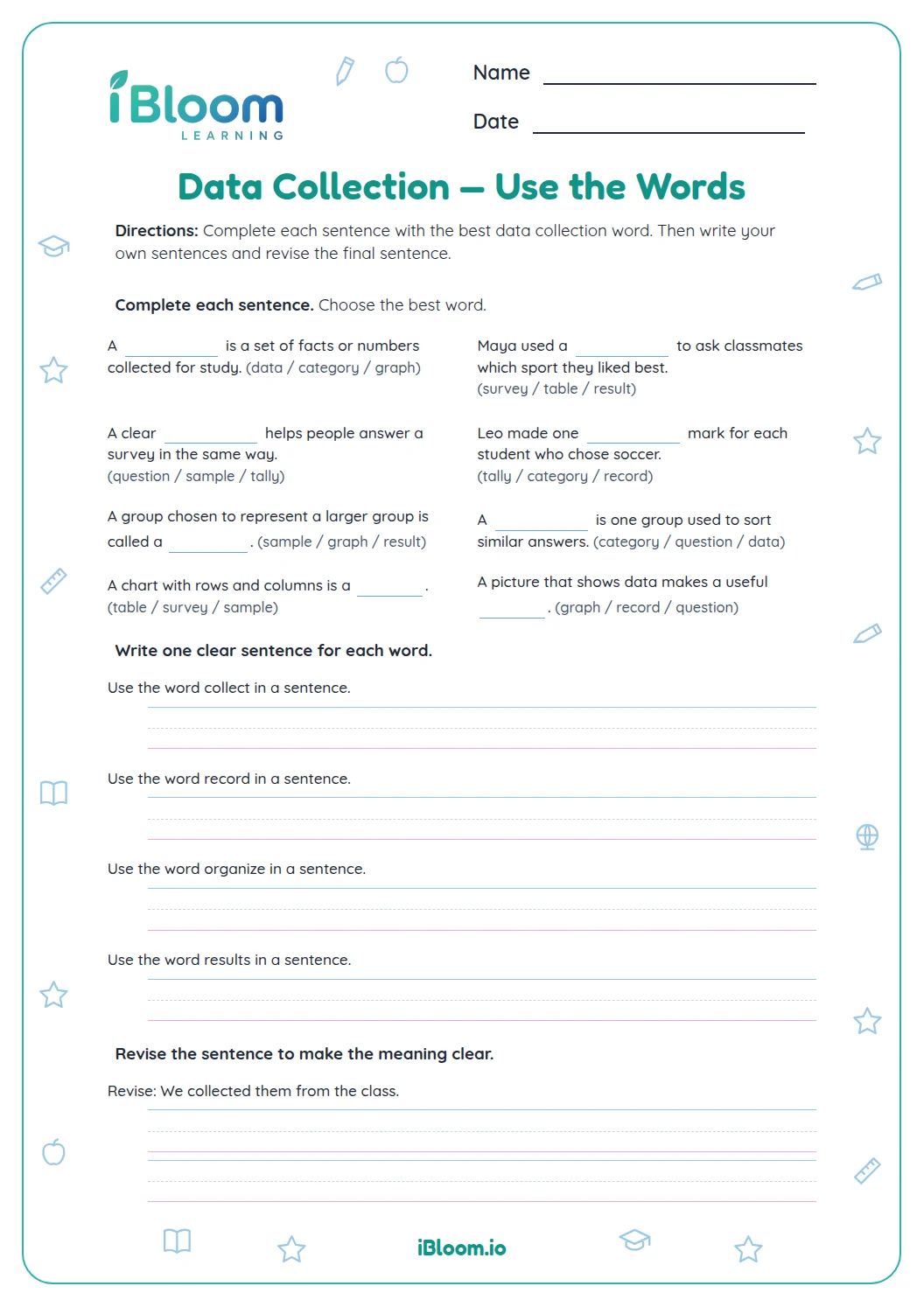
Part A introduces data, collect, survey, response, tally, and category through short explanatory contexts. Children choose each meaning using the information in its sentence. The examples involve plant heights, leaf counts, lunch choices, and fruit votes.
Part B applies record, sample, results, question, table, and frequency. These words name different jobs or features in collecting and organizing information. A table arranges information in rows and columns; frequency tells how often a particular answer occurs.
How are a survey, a question, and a response different?
A survey is a set of questions used to gather information. A question is something it asks, and a response is an answer someone gives. Reading the three terms as steps helps children avoid swapping them.
In question 4, “Which fruit do you prefer?” asks for information and “Peaches” supplies it. The word response names the answer, even though both appear in the same prompt.
- 1Question 4: “Peaches” was my RESPONSE to “Which fruit do you prefer?”
- 2The question asks about a preference.
- 3“Peaches” answers that question.
- 4Response means an answer.
How can children use these words after the sheet?
Conduct a brief preference survey with a few willing classmates or family members. Write one clear question, keep a record of responses, and make tally marks as answers arrive. Then organize the categories and counts in a table.
Use the worksheet’s final distinction when discussing the totals: the category names the choice, while its frequency counts how many times that choice appears. Keep vocabulary explanations connected to the information the children actually gathered.
How to use this worksheet
- 1Read a Part A sentence and locate the explanation of the capitalized word.
- 2Try each meaning in context before selecting a choice.
- 3Finish Part A and explain survey, question, and response aloud.
- 4Complete Part B, checking what job the missing word names.
- 5Review the key and use three of the words to describe a small survey.
Mistakes to discuss
The mistake
Calling “Peaches” a question because it appears in a survey.
The fix
Identify which words ask for information and which words give the answer.
The mistake
Confusing the sample with all 300 students.
The fix
In question 8, the sample is the smaller group of 20 students actually asked.
The mistake
Choosing category when asked how many times pizza appears.
The fix
Category names the kind of lunch; frequency counts the occurrences of that answer.
Common Core alignment
Use school-survey contexts to understand data collection vocabulary.
On this sheet: Students infer meanings from explanations and choose precise vocabulary for classroom examples.
Show the official wordingHide the official wording
Use context (e.g., cause/effect relationships and comparisons in text) as a clue to the meaning of a word or phrase.
What to practice next
Make more practice
Further reading
Questions parents and teachers ask
Which words does this vocabulary sheet practice?
The 12 questions practice data, collect, survey, response, tally, category, record, sample, results, question, table, and frequency. Part A gives explanatory contexts for six words. Part B asks learners to apply the remaining words to school-survey situations, such as recording answers or counting how often a choice appears.
What is the difference between a tally and a frequency?
A tally mark is a mark used while counting, while frequency is the number of times a value or response occurs. On this sheet, Nia makes a mark for each vote. Later, Luis counts the appearances of pizza to find the frequency of that response.
What does sample mean in question 8?
A sample is the smaller group selected from a larger group to provide information. In question 8, Nia asks 20 students out of a school of 300, so those 20 form the sample. Have the learner identify both groups before choosing the word that describes the smaller one.
How can I help with unfamiliar survey words?
Read the full sentence and ask which words explain the unfamiliar term. For response, compare the lunch or fruit question with the answer someone gives. For table, point out rows and columns in the sentence. Encourage children to justify their choice before consulting the answer key.
How does this sheet connect to a classroom survey?
The vocabulary describes the steps children can take in a real survey. They ask a question, collect responses, keep a record, and organize answers into categories. They can then report results in a table and discuss frequency. Reusing those words during the activity makes their meanings easier to explain.