




About this worksheet
This Grade 5 printable combines a word search with 14 sentences about matter. Students find eight terms, then use vocabulary for states, properties and changes in context. It practices CCSS L.5.6 through accurate use of grade-appropriate academic and domain-specific words. The answer key is on a separate page.
Aligned to L.5.6
How do matter words describe states?
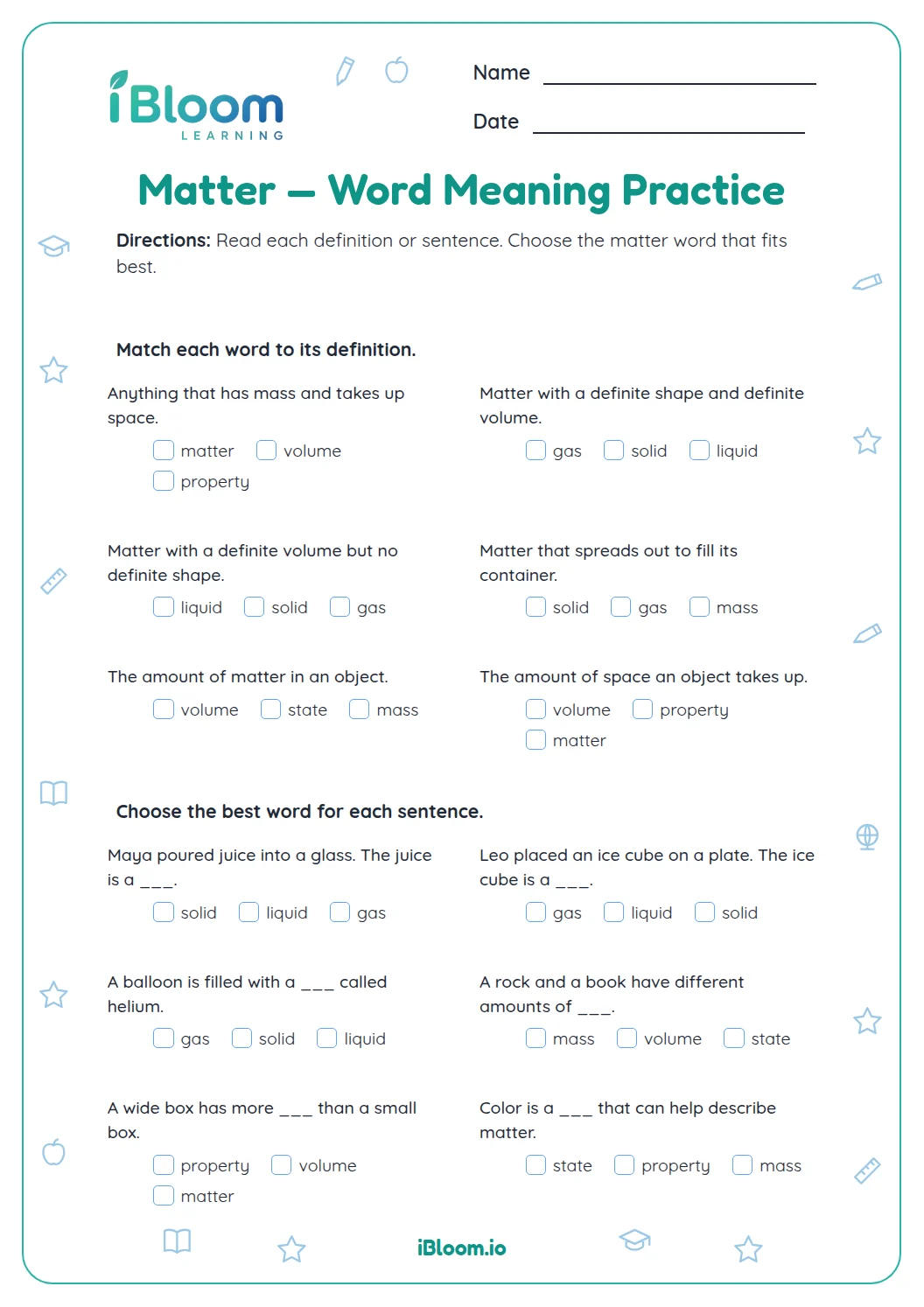
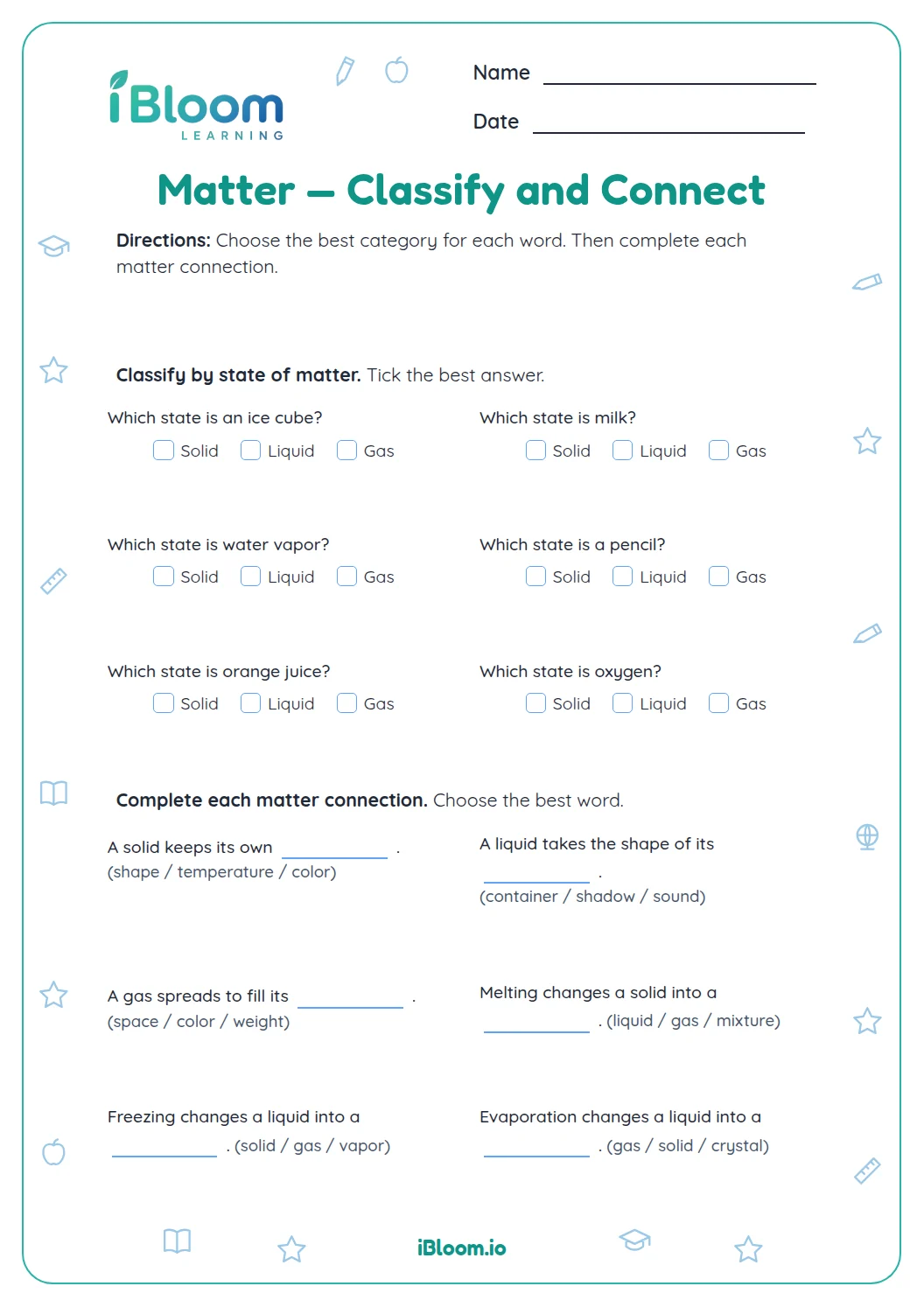
The opening activity asks students to find eight matter words in the grid. The next sentences connect state words with their defining properties. A solid keeps its own shape; a liquid takes the shape of its container.
Which words name changes in matter?
Part B uses heating and cooling examples. Melting, freezing, evaporation and condensation name changes in state, and each sentence supplies a clue to the direction of change.
How do context clues narrow the word choice?
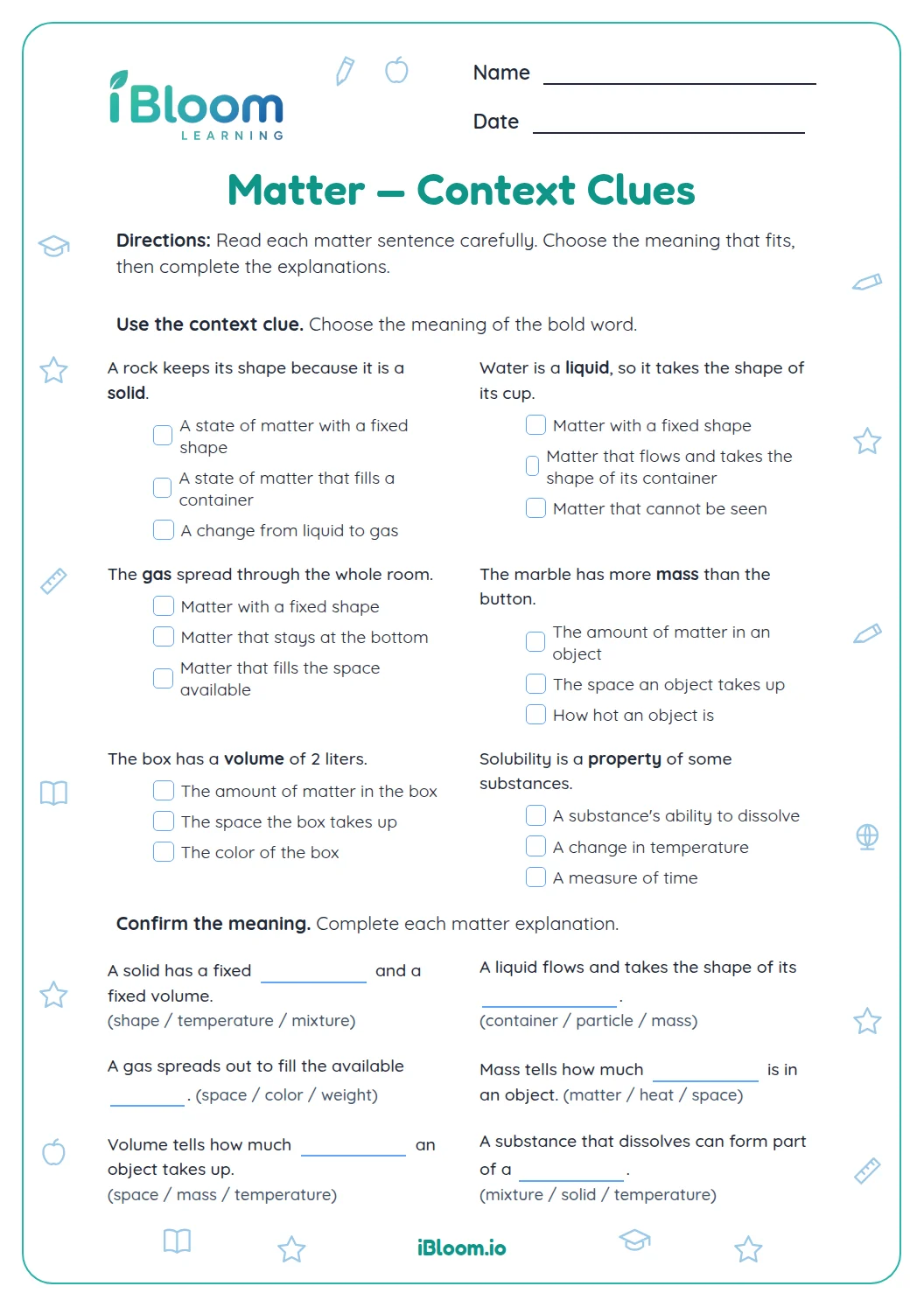
Part C includes properties and broader academic terms. Students should check that a word fits both the science idea and the grammar of the sentence.
How to use this worksheet
- 1Read the part heading and its one-line direction.
- 2Work through the items in order and keep each answer tied to the prompt.
- 3Reread any item where two choices seem possible.
- 4Use the key after completing the page to correct specific answers.
Common slips and helpful fixes
The mistake
Choosing a word by topic alone.
The fix
Read the whole sentence and check how the word is used.
The mistake
Rushing past a key clue.
The fix
Underline or notice the phrase that determines the answer.
The mistake
Copying an answer without checking it.
The fix
Compare each response with the exact question.
Common Core alignment
This worksheet practices the listed Common Core skill through its questions.
Use grade-appropriate general academic and domain-specific words and phrases.
On this sheet: Use grade-appropriate general academic and domain-specific words and phrases.
Show the official wordingHide the official wording
Acquire and use accurately grade-appropriate general academic and domain-specific words and phrases, including those that signal contrast, addition, and other logical relationships (e.g., however, although, nevertheless, similarly, moreover, in addition).
What to practice next
Make more practice
Further reading
Questions parents and teachers ask
Does this sheet include a word bank?
Yes. The first activity is a word search with eight terms: solid, liquid, gas, shape, mass, heat, space and freeze. The following 14 items ask students to use vocabulary in science sentences. The answer key gives the completed words and a note for the grid activity.
Which matter terms appear?
The items include solid, liquid, gas, heat, air, shape, container, water, space, freeze, evaporate, condensation, transparent and soluble, along with the general academic words compare and contract. The questions use each term in a short sentence. Students can explain the clues they used and give a new example for each word.
How should students answer the blanks?
Read the whole sentence, then use its clues to choose a precise matter term. For example, “Ice melts when it gains ___” points to heat. Write one word in each blank; the key lists the intended answer for every sentence.
Is every question about a change of state?
No. Several questions focus on states and changes, while others review observable properties and vocabulary used to describe materials. This variety helps students distinguish a property word from a process word. Some prompts name a process, while others describe a material property or a state.
What can we do after checking the key?
Ask students to choose three completed terms and explain them in their own words, then give a new example. For instance, they might describe condensation on a window or identify another transparent material. A brief definition and a real example help make the word easier to remember.