



About this worksheet
This free Grade 5 worksheet combines a word search with vocabulary reasoning about matter. Students locate eight terms—matter, solid, liquid, gas, atom, mass, volume, and melt—then use them in short descriptions and comparisons. The follow-up questions connect each word to a clear meaning, such as mass describing how much matter an object has and volume describing the space it takes up. The sheet has 14 questions including the search activity, plus a separate answer key. It aligns with Common Core L.5.4a, using context as a clue to word meaning.
Aligned to L.5.4a
How should students approach the word search?
Scan one row at a time, then look vertically and diagonally if needed. Mark each listed term when every letter has been found in order.
- 1The word SOLID appears left to right in the second row.
- 2Mark it on the grid and cross it off the list.
How do the matter terms connect?
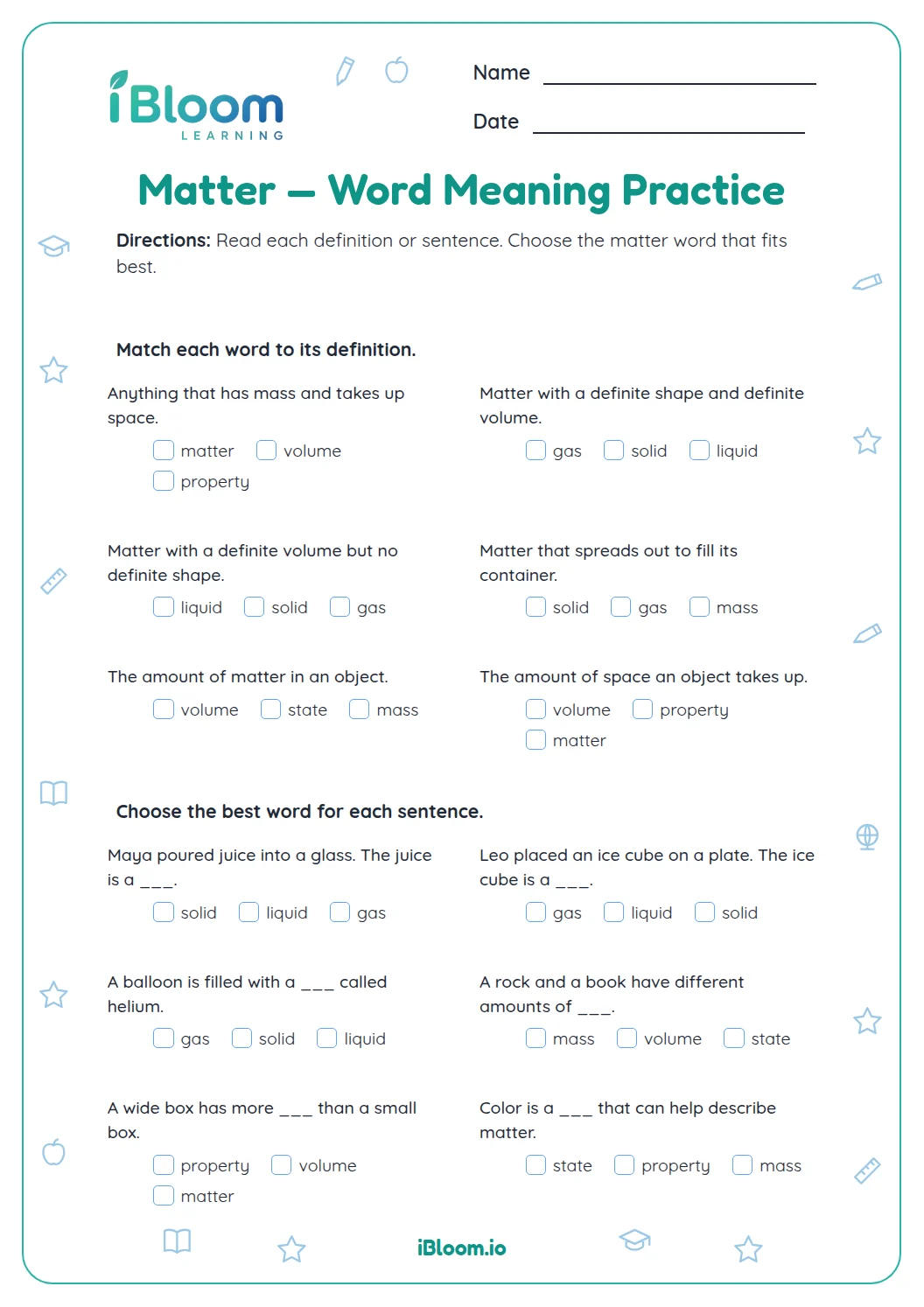
Matter is anything that has mass and takes up space. Solid, liquid, and gas are states of matter. Mass describes how much matter an object has; volume describes the space it occupies.
How can a sentence help identify a state?
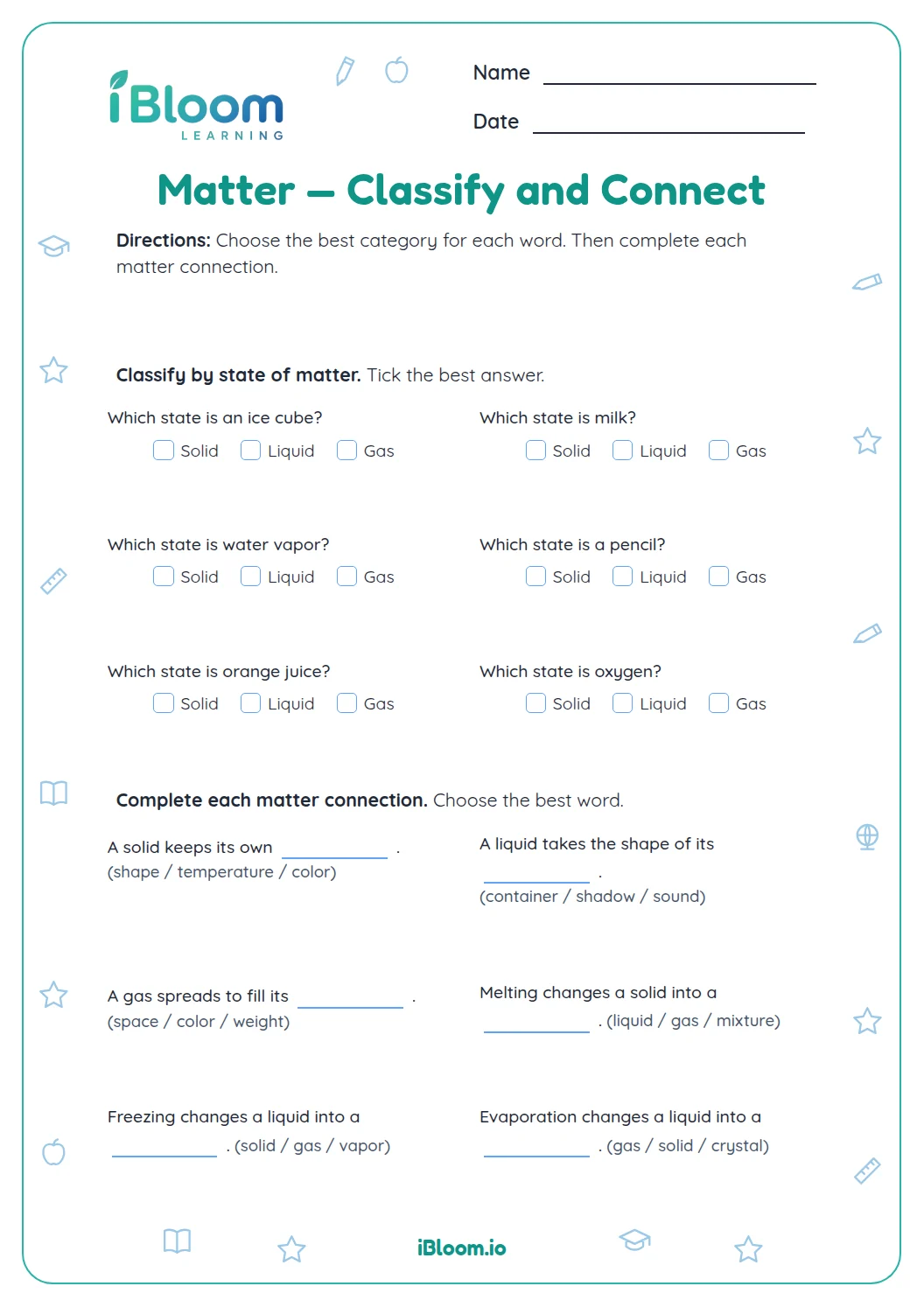
A sentence may describe a property rather than name a state directly. Water that takes the shape of a container but keeps a fixed volume is a liquid. Ice changing to water melts from a solid into a liquid.
How to use this worksheet
- 1Find each listed term in the grid and mark it.
- 2Read the vocabulary questions carefully.
- 3Use the property or example in the sentence as a clue.
- 4Choose the word that matches the meaning.
- 5For short responses, include a vocabulary word and a reason.
- 6Check spelling and explanations with the answer key.
Common mistakes and quick fixes
The mistake
Confusing mass with volume.
The fix
Remember: mass is the amount of matter; volume is the space it takes up.
The mistake
Calling a liquid a gas because both take the shape of a container.
The fix
A liquid has a fixed volume; a gas spreads to fill its container.
The mistake
Treating melt as the name of a state instead of a change.
The fix
Use melt for the change from a solid, such as ice, into liquid.
Common Core alignment
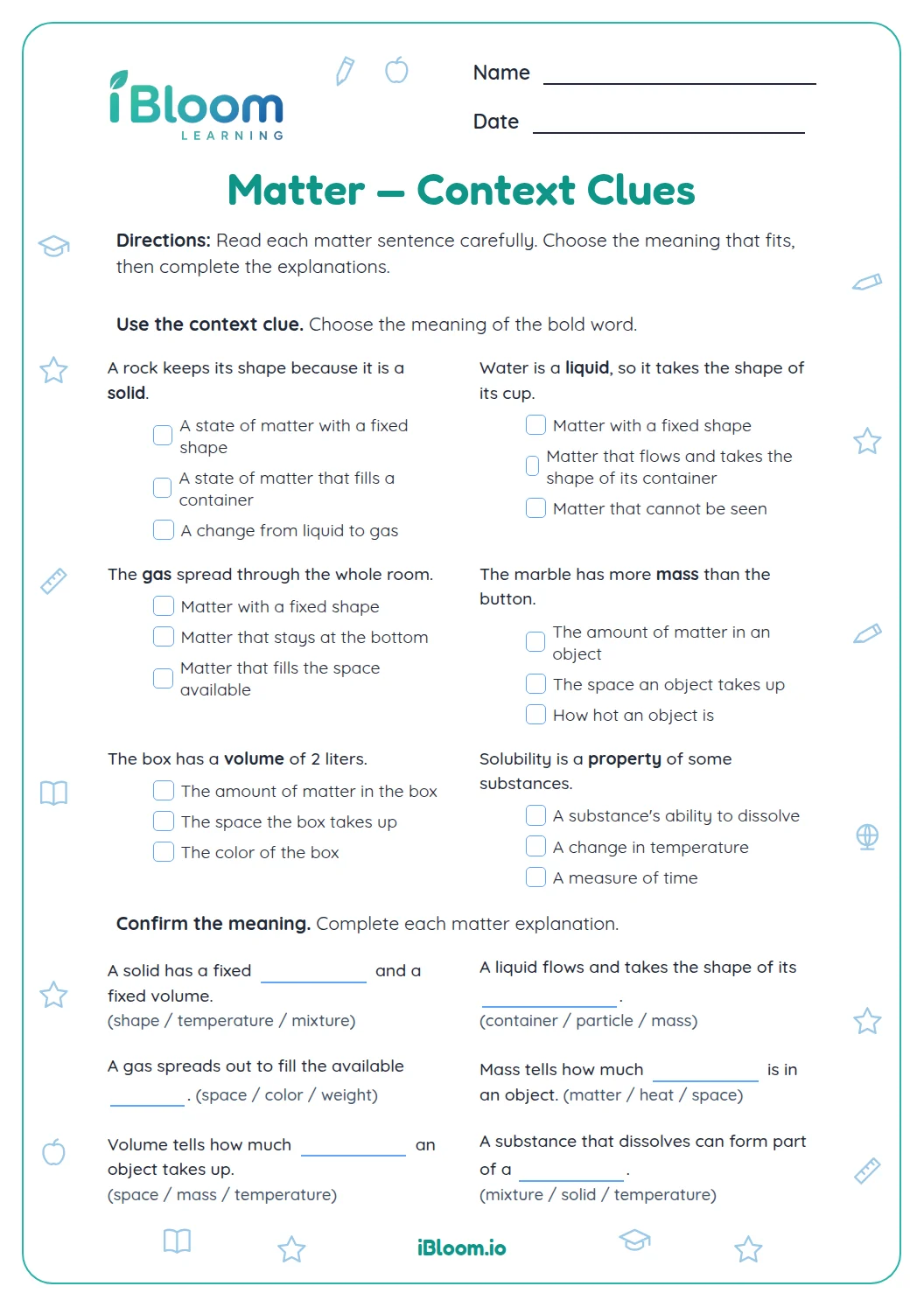
Students use sentence context to clarify the meaning of grade-level vocabulary.
Use context, including comparisons and cause-and-effect, to clarify vocabulary.
On this sheet: Students infer and explain matter-word meanings from short sentence contexts.
Show the official wordingHide the official wording
Use context (e.g., cause/effect relationships and comparisons in text) as a clue to the meaning of a word or phrase.
What to practice next
Make more practice
Further reading
Questions parents and teachers ask
Which words are hidden in the grid?
The eight words are matter, solid, liquid, gas, atom, mass, volume, and melt. The search activity begins the worksheet; the later questions ask students to connect those words with properties and examples. The answer key lists each term and provides answers to the follow-up questions.
What is the difference between mass and volume?
Mass tells how much matter an object has. Volume tells how much space it takes up. For example, when describing air, a student can say it has mass and occupies volume, which supports the idea that air is matter. The two terms name different properties, even though both describe an object.
How can you tell whether a substance is a liquid?
Look for a property such as taking the shape of its container while keeping a fixed volume. Water in a cup fits that description. A gas also takes a container’s shape, but it spreads to fill the available space. Notice that “fixed volume” is the clue separating liquid from gas here.
What does melt mean in the worksheet?
Melt names a change in which a solid becomes a liquid. In the example of ice changing into water, ice is the solid at the start and liquid water is the new state. The answer key also identifies the two states in order.
Is air matter?
Yes. Air has mass and takes up space, which means it has volume. Question 13 asks students to use one of these vocabulary terms as evidence for their answer. This explanation connects the everyday example to the meaning of matter.