




About this worksheet
This Grade 5 vocabulary review pairs a short passage about a class survey with a word search with questions about surveys, samples, records, and results. Students first locate eight data collection terms, then apply the words to classroom examples and simple counts. The answer key includes brief model responses for questions that invite explanation.
Which data words can you find?
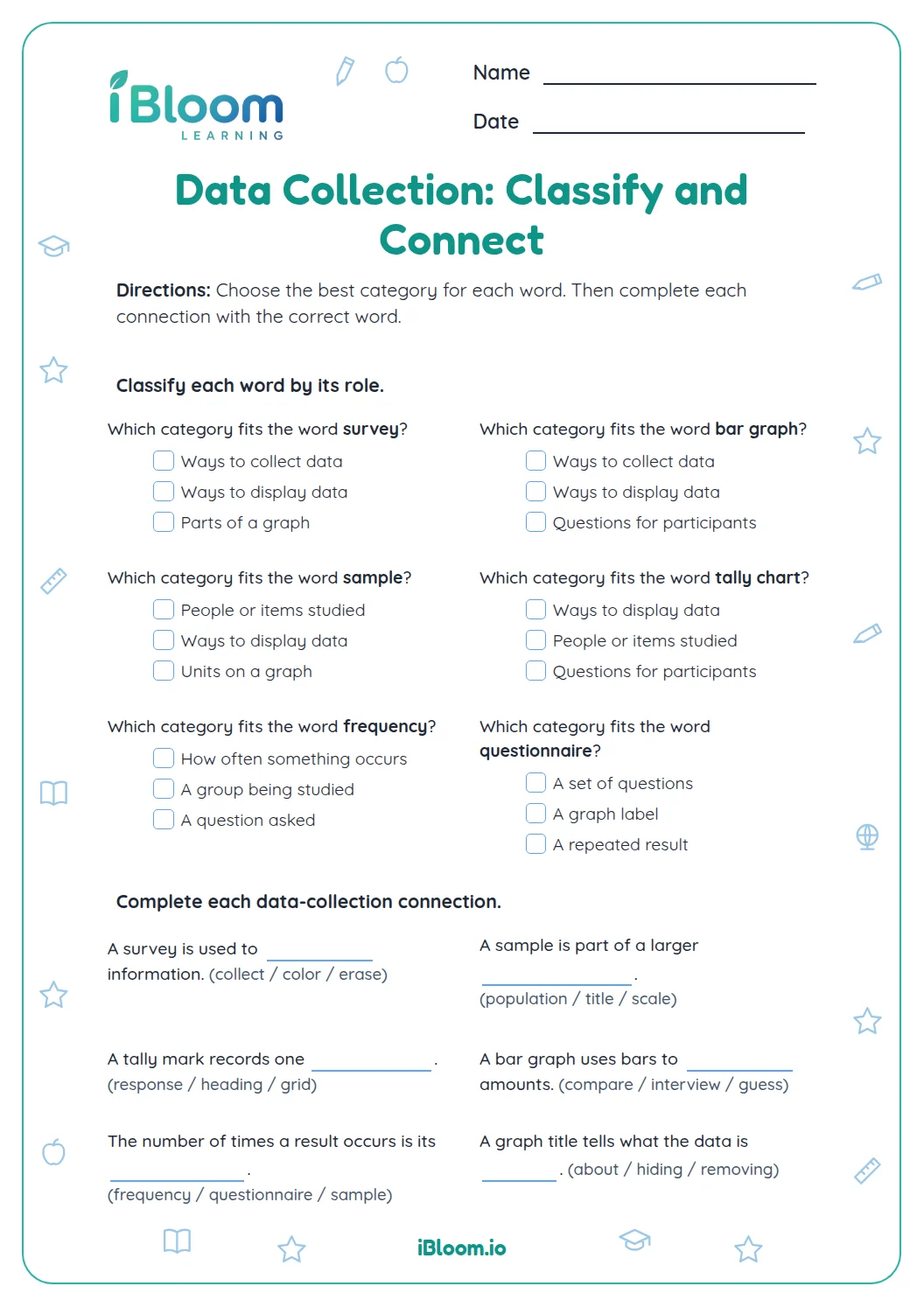
The puzzle contains terms for gathering and showing information. Question 1 asks students to locate eight words, including survey, sample, and graph.
- 1Find SURVEY in the row of letters.
- 2Then use the word to name a way to gather answers.
How do the words describe a study?
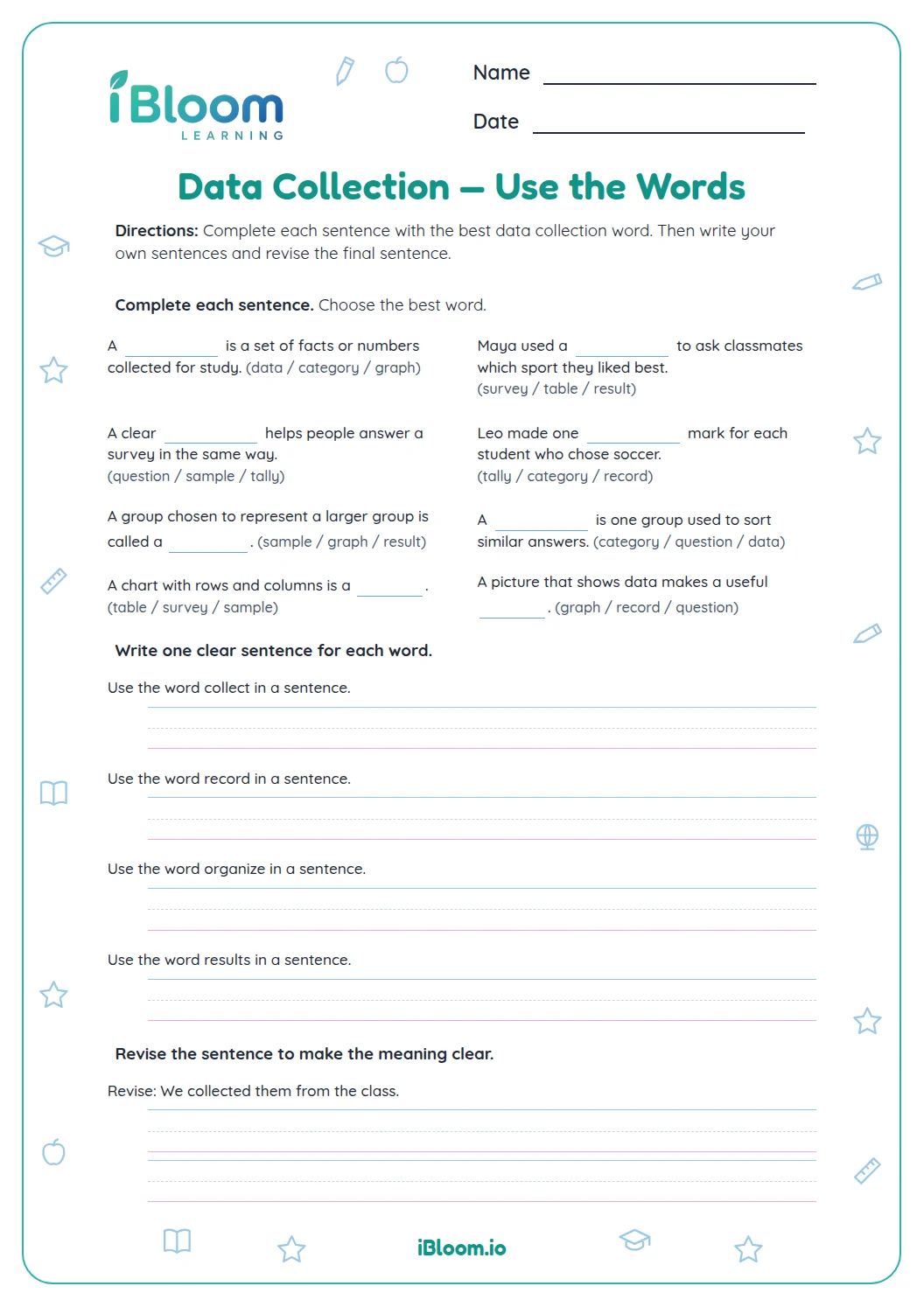
A survey asks questions, a sample is the group whose answers are collected, and a record stores the responses. Results are what the collected information shows.
How can you judge a data collection choice?
Look for a fair sample, a clear question, and a reliable record. These choices make results easier to understand and compare.
How to use this worksheet
- 1Circle each complete vocabulary word in the grid.
- 2Read each example before choosing a term.
- 3Check who or what is included in a sample.
- 4Use labels and counts to explain results.
Common mistakes and quick fixes
The mistake
Calling one answer a result for everyone.
The fix
Check how many people were asked and whether the group represents the larger set.
The mistake
Changing the question for different people.
The fix
Keep the prompt the same so responses can be compared.
The mistake
Leaving graph categories unlabeled.
The fix
Add labels that identify each group or response type.
What to practice next
Make more practice
Questions parents and teachers ask
Which words are hidden in the puzzle?
The puzzle hides eight terms: data, sample, survey, record, result, question, chart, and graph. Students find each word in the grid, then use data-collection ideas in the remaining questions. The passage provides a classroom survey example that connects several of the terms.
What is the difference between a sample and a survey?
A survey is a way to collect information by asking questions. A sample is the group whose responses are collected to represent a larger group. In the passage, Room 12 answers a survey question, and Room 12 is the sample for that survey.
Why use the same question for everyone?
Giving everyone the same question makes responses easier to compare because each person answers the same prompt. The class-survey passage also keeps the choices consistent when students compare answers from two classes. Students apply this idea again in the reasoning questions.
Are the short explanation answers fixed?
The sheet has 14 questions across three worksheet pages, followed by a three-page answer key. One question is the word search; the other 13 apply vocabulary and data reasoning. A class-survey passage introduces how students collect, record, organize, and compare responses.
How many questions are on this worksheet?
A word search generator can make another puzzle, while this printable also asks students to apply vocabulary in context. The sheet includes a survey passage, an eight-word grid, and 13 vocabulary or reasoning questions. The key gives brief responses for questions with more than one valid wording.