




About this worksheet
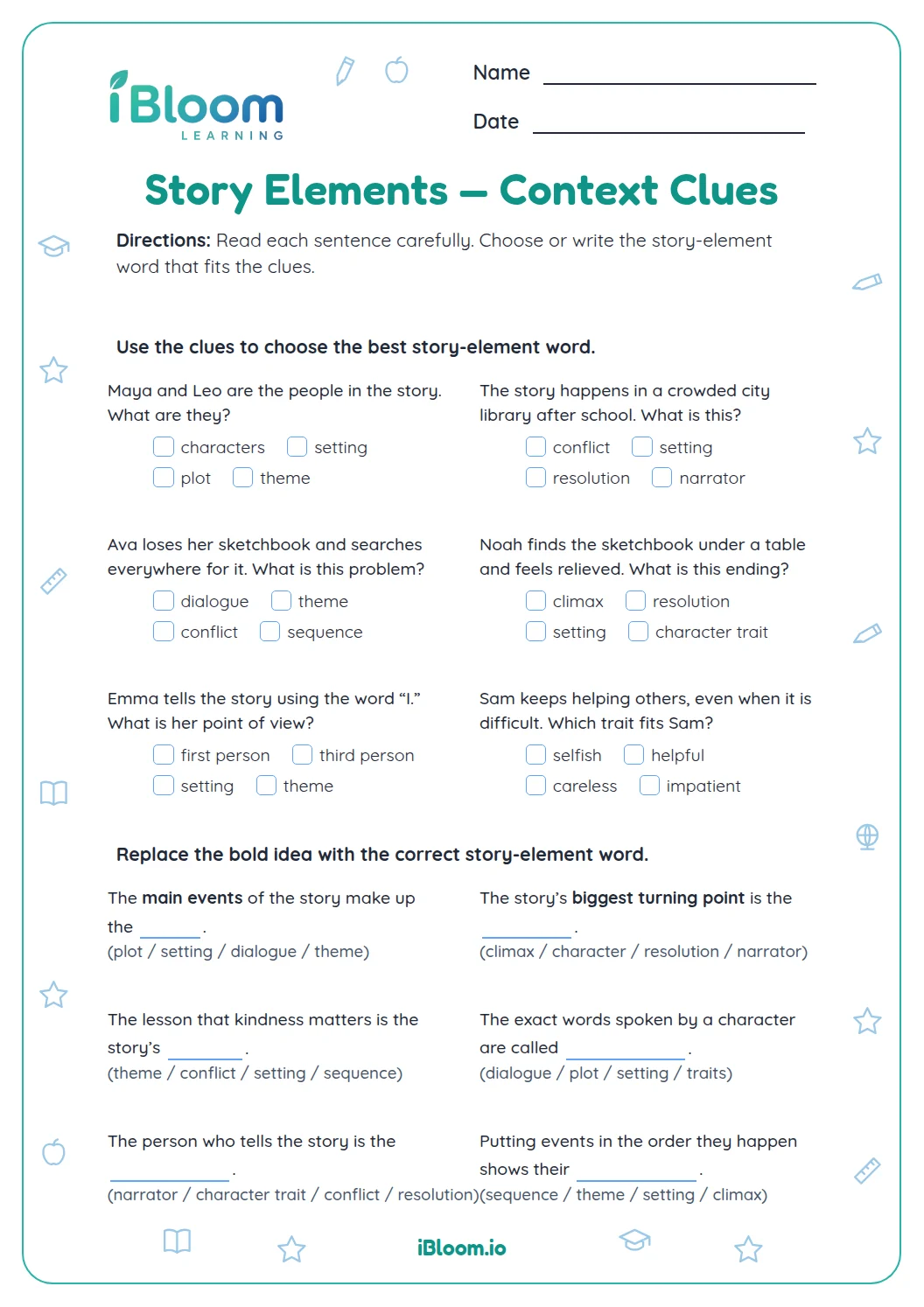
This Grade 5 vocabulary worksheet helps students use story-element terms accurately. It starts with short definitions for character, setting, plot, conflict, resolution, theme, narrator, dialogue, sequence, and climax; then asks students to choose terms from clues and write their own sentences. The old sheet had sentence completion and writing but no actual word-search grid, so this replacement focuses on applying the vocabulary instead of adding a decorative puzzle. An answer key includes sample sentences.
What does each story-element word name?
A story word is useful when it points to a specific part of a narrative. Characters are the people or animals; setting is where and when; plot is the sequence of events.
Question 4 describes the main problem. That clue points to conflict, the challenge that drives the story.
- 1Clue: the main problem in a story
- 2Term: conflict
- 3Check: conflict names the problem, not the solution.
How can a clue help you choose a term?
Look for what the sentence tells you. “A snowy village at dawn” gives a place and time, so setting fits. A clue about fixing a problem points to resolution. The context choices ask students to use these distinctions.
How can a student use the words in a sentence?
A complete sentence should make the term’s meaning clear. For dialogue, include spoken words and a speaker; for narrator, say who tells the story. The last four questions invite original sentences, and the answer key offers samples rather than a single required wording.
How can students practice the story words?
- 1Read each definition clue and say the meaning in your own words.
- 2Fill each blank with the term that matches the clue.
- 3For context choices, underline the phrase that gives the hint.
- 4Write complete sentences for the final four prompts.
- 5Check that the chosen word means exactly what the sentence says.
Common story-word mix-ups
The mistake
Using plot to mean the message of a story.
The fix
Plot is what happens; theme is an idea or lesson the story suggests.
The mistake
Calling the problem resolution.
The fix
Conflict names the problem; resolution names how it is settled.
The mistake
Calling a character’s spoken words the narrator.
The fix
Dialogue is speech; narrator is the voice that tells the story.
What to practice next
Make more practice
Questions parents and teachers ask
Is this worksheet a word-search puzzle?
No. The activity practices story-element vocabulary through definitions, context clues, and sentence writing. Students use terms such as setting, conflict, and resolution in context, matching the old sheet’s “Use the Words” activity and its focus on applying story vocabulary.
Which story-element words appear?
The worksheet uses ten terms: characters, setting, plot, conflict, resolution, theme, narrator, dialogue, sequence, and climax. Students first match words to meanings, then identify terms in short clues and use several terms in their own sentences to show they understand each word.
What is the difference between conflict and resolution?
Conflict is the central problem or challenge in a story. Resolution is how that problem is settled. Questions 4 and 5 ask students to distinguish the two terms, and a later context item asks them to recognize a resolution in a short event.
What is a sample answer for the dialogue prompt?
One sample is, “I cannot find the map,” said Nia. A response should include words spoken by a character, ideally with enough context to make the speaker clear. Other original dialogue sentences can also be correct, so the key supplies a model.
How long should the sentence responses be?
One clear sentence is enough for each writing prompt. Students should make the story term’s meaning evident, such as using a narrator as the voice that tells the story. The answer key gives examples; students may use different details when the term is used correctly.