




About this worksheet
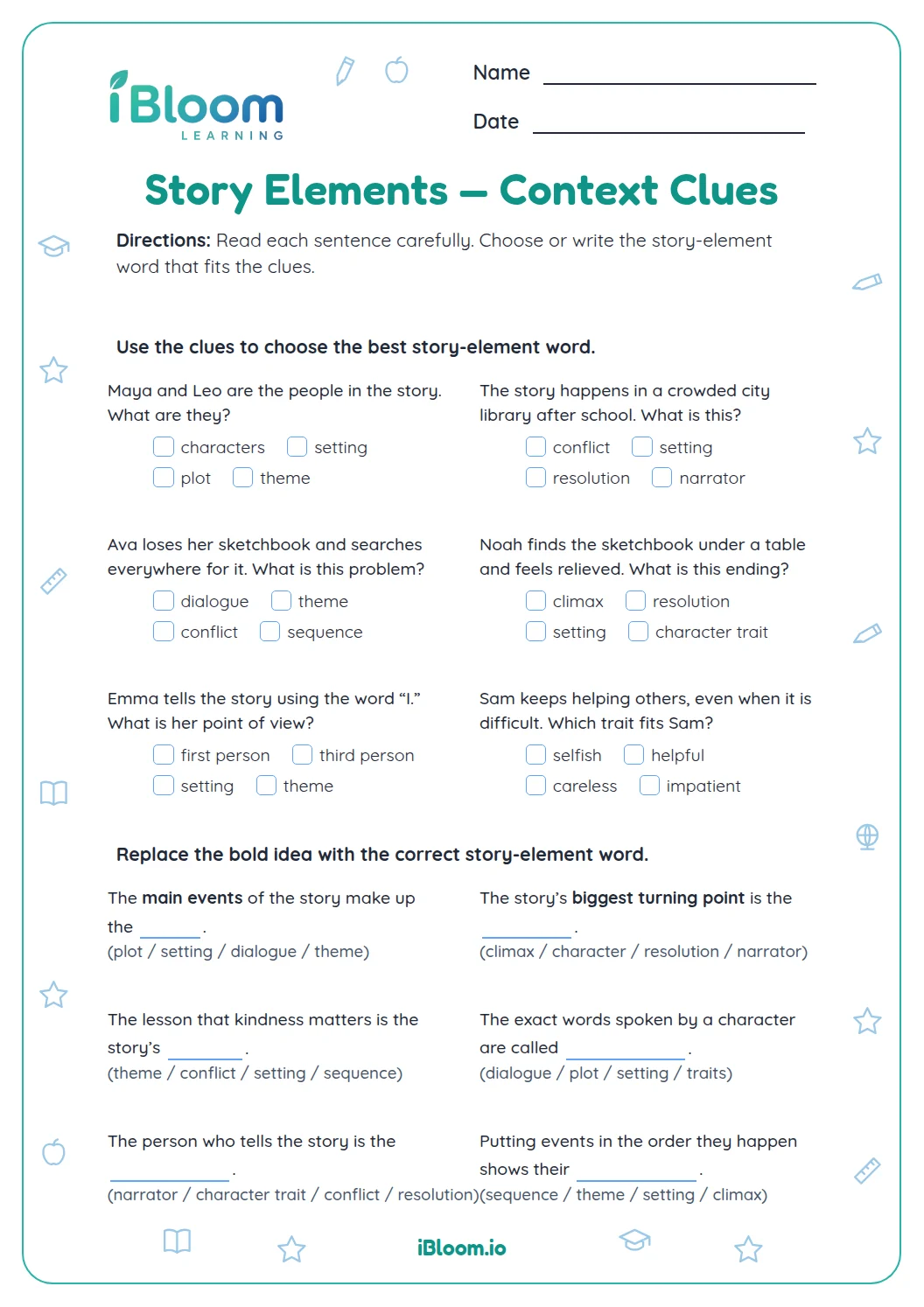
This Grade 5 vocabulary worksheet reviews story terms through a word search, definition prompts, and short applications. Children find five terms in the grid, identify meanings for seven terms, and use story situations to reason about six more. The page gives practice determining and clarifying vocabulary in CCSS L.5.4, with a separate answer key.
Aligned to L.5.4
Which words name parts of a story?
The grid contains character, setting, conflict, theme, and detail. Other prompts review plot, resolution, narrator, dialogue, point of view, and motive.
- 1Clue: “Where and when a story happens.”
- 2Term: setting
How can you tell similar story terms apart?
Conflict names the central problem. Resolution describes how the problem is settled. Theme is a message a reader can infer from the events, while a detail is one specific piece of information.
How do story clues help you use the vocabulary?
One activity asks readers to find five words in the grid. Seven definition prompts and six short story situations give practice distinguishing and applying related terms.
How to use this worksheet
- 1Scan the grid for each word in the list.
- 2Read each meaning and identify the role it describes.
- 3For an application item, underline the clue in the situation.
- 4Distinguish a problem from the way it is solved.
- 5Use the key to check the exact vocabulary term and reasoning.
Common mistakes and quick fixes
The mistake
Using conflict for the solution to a problem.
The fix
Conflict is the problem; resolution is how it is settled.
The mistake
Calling every lesson a plot.
The fix
Plot is the sequence of events; theme is a message suggested by them.
The mistake
Confusing the narrator with the author.
The fix
The narrator is the voice telling this story; the author is the person who wrote it.
Common Core alignment
This worksheet gives focused practice with the standard below.
Use context and word relationships to clarify vocabulary.
On this sheet: Learners use definitions and story clues to identify and apply story-element terms.
Show the official wordingHide the official wording
Determine or clarify the meaning of unknown and multiple-meaning words and phrases based on grade 5 reading and content, choosing flexibly from a range of strategies.
What to practice next
Make more practice
Further reading
Questions parents and teachers ask
Which words are included in the puzzle?
The grid contains character, setting, conflict, theme, and detail. Other questions also use plot, resolution, narrator, dialogue, point of view, and motive, so the full worksheet reviews eleven related story terms through definitions and short applications. Children practice noticing how each term names a different part of a story.
How many questions are on the worksheet?
There are 14 numbered items: one word-search activity, seven definition prompts, and six applications. The key lists the five found words and answers for the other items, including a sample response for the open-ended theme question. Review the example situation together and ask which clue supports each answer.
What is the difference between conflict and resolution?
Conflict is the central problem; resolution is how that problem is addressed or settled. In the worksheet situation, losing a recipe book is the conflict, while finding the book is the resolution. Naming each role helps distinguish the two related terms.
What does motive mean in a story?
A motive is the reason behind a character’s action. In one worksheet item, Nia returns a wallet because she believes it is right; that reason is her motive. A motive answers why a character acts, not what happens next in the plot.
Can theme be one word?
A theme is a message or idea a reader can infer from a story, such as helping neighbors matters. A topic names what the story is about, such as friendship or storms. The worksheet asks children to select a possible message from a brief situation.
What standard does this vocabulary sheet support?
The page supports CCSS L.5.4, which focuses on determining or clarifying word meaning with vocabulary strategies. Children use definitions and short story situations to identify and apply story-element terms, including setting, conflict, resolution, motive, and theme. This gives practice connecting unfamiliar terms to context.