




About this worksheet
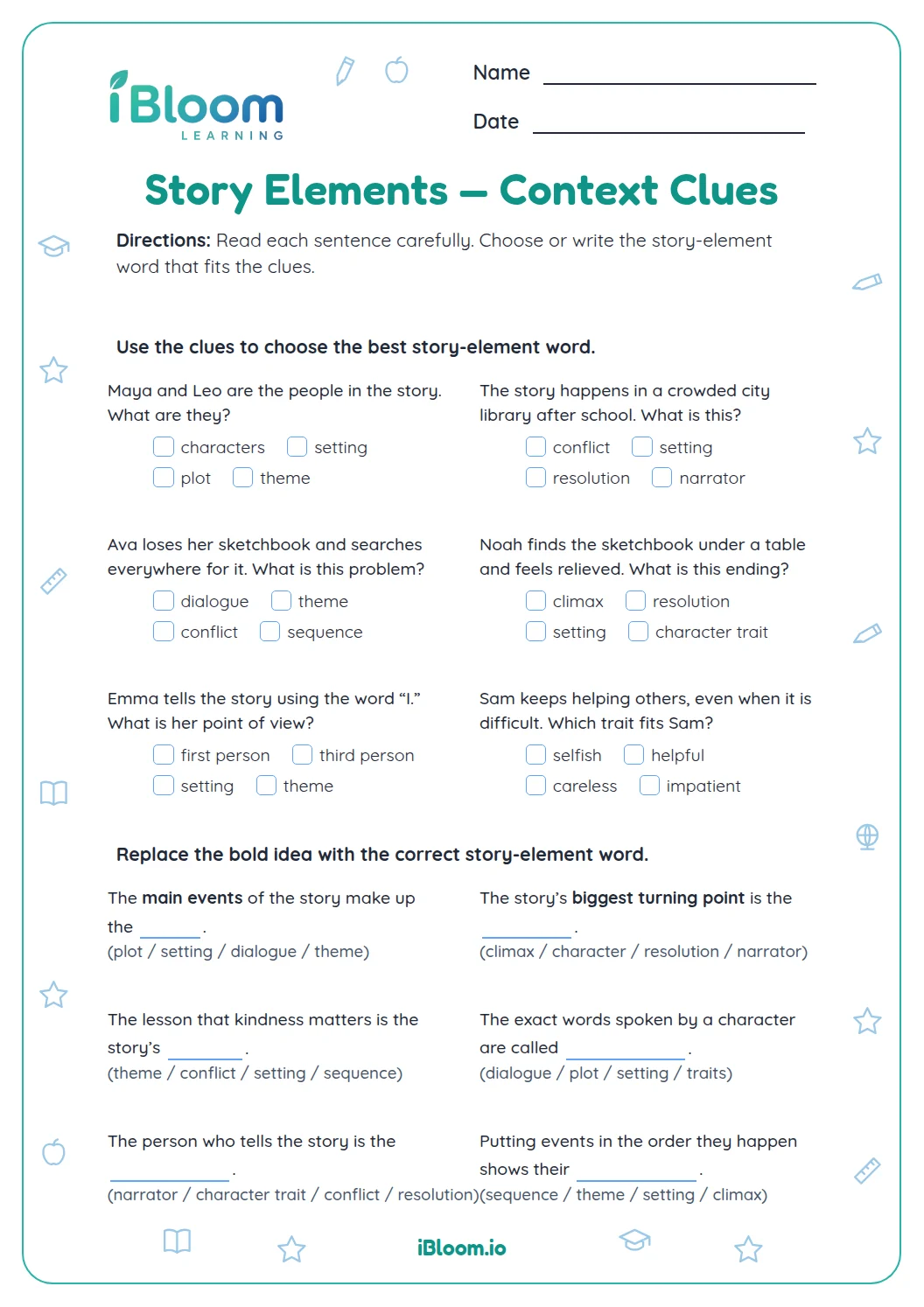
This free printable Grade 5 vocabulary worksheet helps students use context to determine the meaning of story terms. Its 16 questions place words such as conflict, resolution, narrator, and inference in complete sentences with clues to interpret. Students choose the meaning that fits, then check their work with the separate answer key. The practice aligns with CCSS L.5.4.a, using context as a clue to word meaning.
Aligned to L.5.4.a
How does a sentence reveal a story word’s meaning?
Read the whole sentence and notice what happens around the target word. In question 4, a washed-out bridge leaves hikers wondering how to cross, which points to conflict as the main problem or struggle.
- 1The bridge washes out, leaving the hikers unable to cross.
- 2That event creates the problem they must solve.
- 3Conflict means the main problem or struggle.
Which story terms describe different parts?
Setting names where and when a story happens; character names a person or creature; plot is the sequence of events. Conflict names the problem, and resolution describes how it is settled. Use each sentence’s clues to distinguish these related terms.
How can clues support an inference or theme?
An inference is an idea drawn from details. A theme is a message about life. The remaining questions also use clues to distinguish mood, perspective, motive, evidence, and summary.
How to use this worksheet
- 1Read the complete sentence before studying the choices.
- 2Find the action, detail, or result that gives a clue.
- 3Try each definition in the sentence and keep the one that fits.
- 4Check whether a similar story term could fit better.
- 5Use the answer key after completing a section and revisit missed terms.
Common mistakes and quick fixes
The mistake
Choosing a definition from memory without using the sentence.
The fix
Point to the phrase that supports the meaning you selected.
The mistake
Mixing up conflict and resolution.
The fix
Conflict is the problem; resolution is how the problem is settled.
The mistake
Treating a theme as a topic word such as “honesty.”
The fix
State the message about the topic, such as “honesty helps people trust one another.”
Curriculum alignment
This worksheet practices the skill described in the standard below.
Use context as a clue to the meaning of a word or phrase.
On this sheet: Every question asks students to use sentence context to select a story term’s meaning.
Show the official wordingHide the official wording
Use context (e.g., cause/effect relationships and comparisons in text) as a clue to the meaning of a word or phrase.
What to practice next
Further reading
Questions parents and teachers ask
How many story words does the worksheet cover?
The 16 questions practice setting, character, plot, conflict, resolution, narrator, dialogue, theme, climax, motive, sequence, evidence, inference, perspective, mood, and summary. Each term appears in a sentence with context to help students select its meaning. Have students point to the exact sentence detail that supports the definition they selected.
Does the worksheet include an answer key?
Yes. A separate answer key lists the correct meaning for all 16 questions. Students can finish a part before checking, then return to the sentence and identify the clue that supports each answer. Have students point to the exact sentence detail that supports the definition they selected.
What is the difference between conflict and resolution?
Conflict is the central problem or struggle in a story. Resolution is the way the problem is settled. For example, a washed-out bridge can create a conflict, and building a safe footbridge can provide its resolution. Have students point to the exact sentence detail that supports the definition they selected.
How does context help with story vocabulary?
Nearby actions and details can show what a story word means. In a sentence where someone shares lunch so a classmate feels welcome, the reason for sharing provides a clue to the word motive. Have students point to the exact sentence detail that supports the definition they selected.
Which standard does this worksheet practice?
It aligns with CCSS L.5.4.a, which asks students to use context as a clue to the meaning of a word or phrase. Each item asks students to use a sentence clue to select a story-term meaning. Have students point to the exact sentence detail that supports the definition they selected.