




About this worksheet
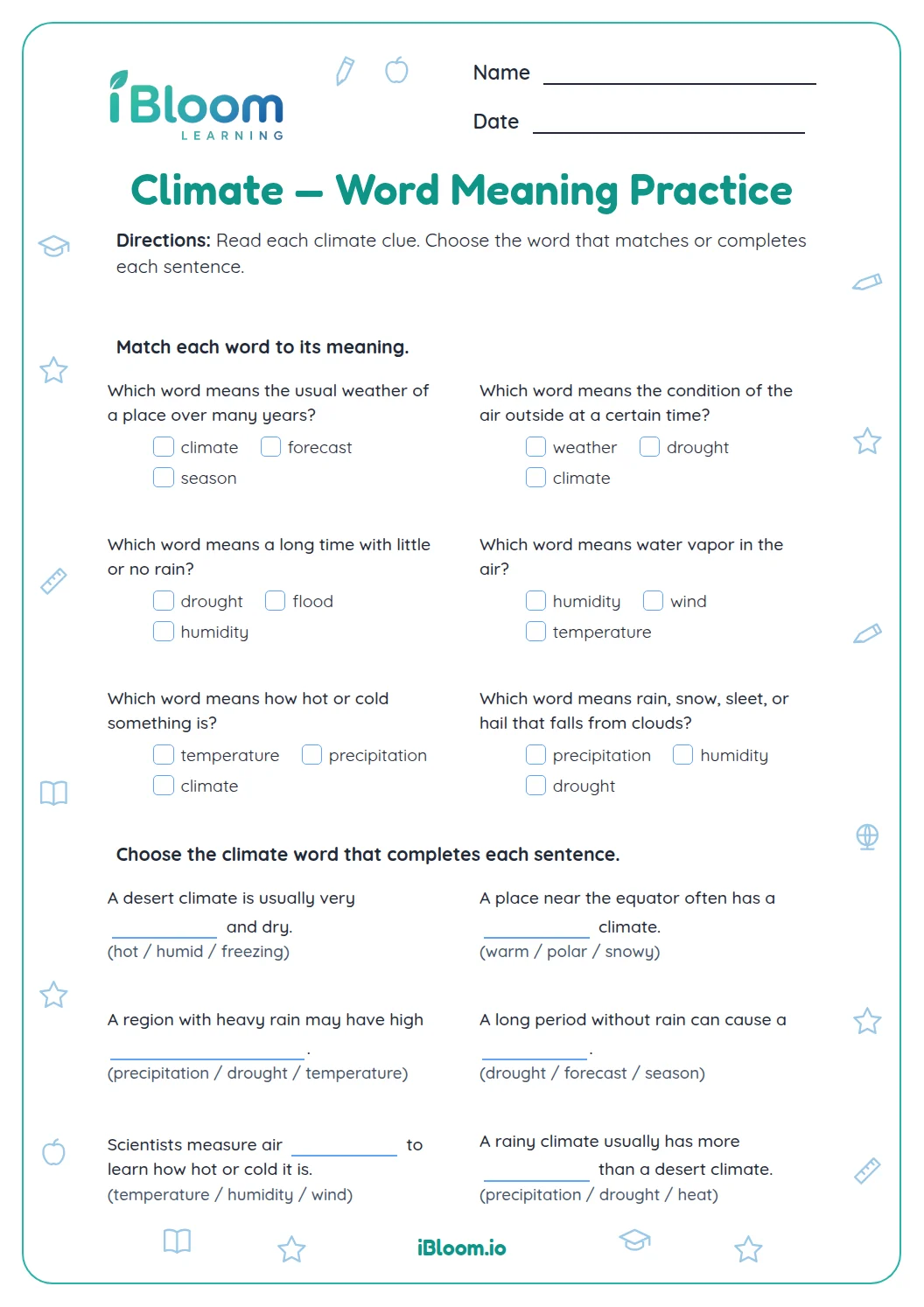
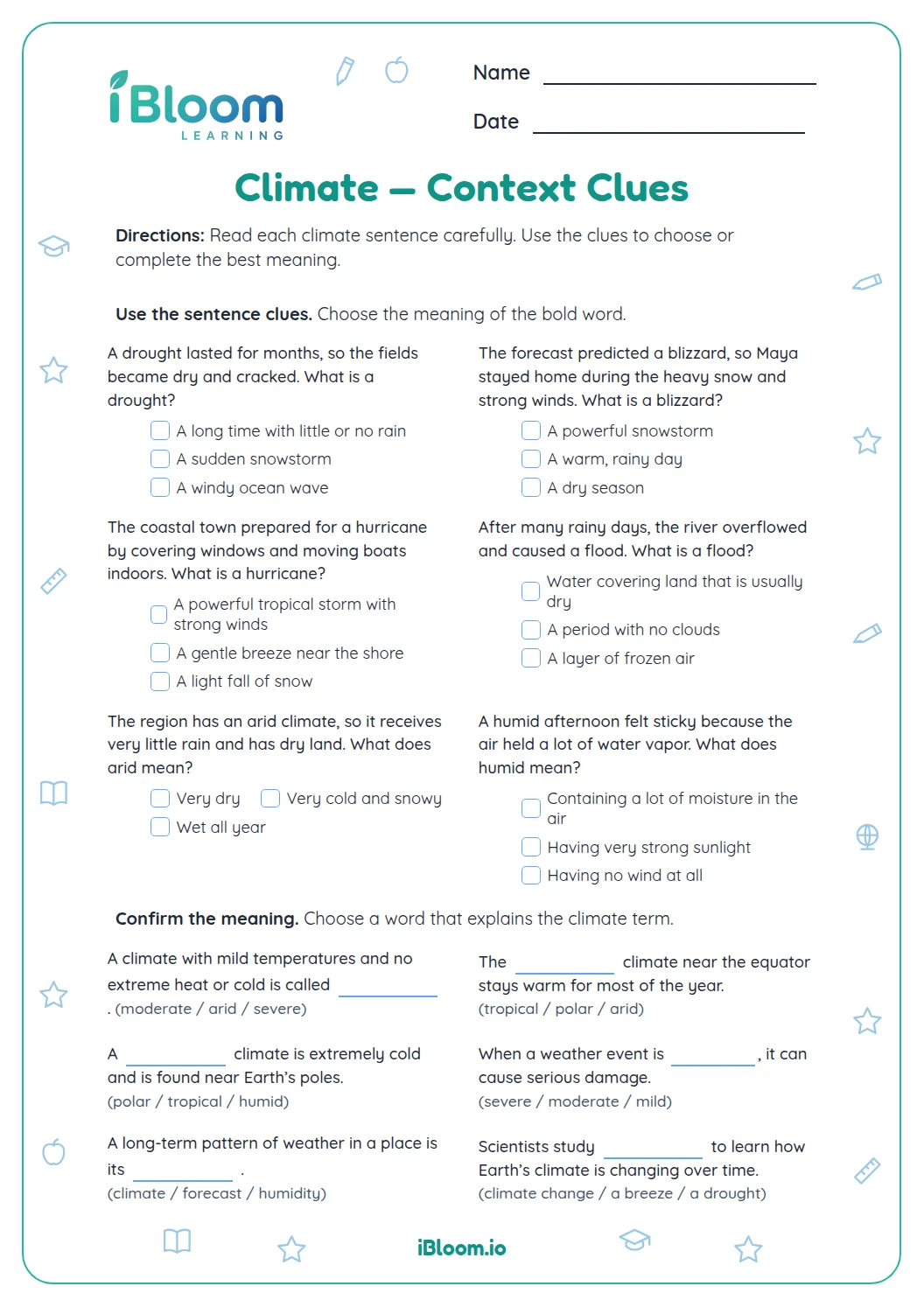
This Grade 5 printable combines a 12-word climate search with 13 concise vocabulary questions. Students find the terms in the grid, use context to interpret words such as drought and forecast, and distinguish related ideas such as weather and climate. The separate answer key shows the word-search targets and short answers. The questions practice CCSS L.5.4 by asking students to clarify grade-level and content vocabulary.
Aligned to L.5.4
Which climate words are in the search?
The activity asks students to find 12 climate terms in the grid. Each word appears horizontally in its own row, including precipitation and atmosphere.
How can context clarify a climate word?
Read nearby details and ask which meaning makes the sentence fit. In question 3, “A long drought harmed crops” points to a long dry spell, rather than a short shower.
- 1Clue: crops were harmed during a long dry spell.
- 2Meaning: drought is a long period with little or no rain.
How do climate words connect?
Weather describes short-term conditions, while climate describes usual patterns over many years. Students also distinguish humidity, temperature, and other climate terms.
How to use this worksheet
- 1Scan the grid one row at a time and circle each listed climate word.
- 2Read all the words around a target term in each question.
- 3Use the sentence clue to test the meaning that fits.
- 4Compare related terms such as weather, climate, humidity, and temperature.
- 5Check the answer key after completing all 14 items.
What should students check?
The mistake
Treating weather and climate as interchangeable.
The fix
Weather describes short-term conditions; climate describes usual patterns over many years.
The mistake
Choosing a meaning from memory without using the sentence clue.
The fix
Read the nearby detail and test whether the meaning fits that context.
The mistake
Mixing up humidity and temperature.
The fix
Humidity is water vapor in air; temperature tells how warm or cold it is.
Common Core alignment
Students use context and relationships among climate terms to determine word meanings.
Use context and other strategies to clarify unknown or multiple-meaning words.
On this sheet: Students use context and word relationships in climate sentences to clarify domain-specific meanings.
Show the official wordingHide the official wording
Determine or clarify the meaning of unknown and multiple-meaning words and phrases based on grade 5 reading and content, choosing flexibly from a range of strategies.
What to practice next
Make more practice
Further reading
Questions parents and teachers ask
Which words are hidden in the climate word search?
The grid contains climate, weather, drought, humidity, forecast, season, wind, sunlight, region, heatwave, precipitation, and atmosphere. Each target appears horizontally in its own row. Scan across the rows, circle all 12 words, and then use the vocabulary questions to review their meanings.
How does context help with climate vocabulary?
Nearby details help readers infer a word’s meaning. A “gust” that shakes leaves is a burst of wind, while crops harmed during a long dry spell point to drought. Students read the whole sentence, use its clues, and choose the meaning that makes the context clear.
What is the difference between weather and climate?
Weather describes conditions over a short time, such as a sunny afternoon. Climate describes a place’s usual weather patterns over many years. One question asks students to select a comparison that states this difference accurately, using the terms in a climate vocabulary context.
How many questions are on this worksheet?
There are 14 items: one word-search activity and 13 short-answer vocabulary questions. Students find the target terms and use context or word relationships to interpret them. The separate answer key lists all 12 search words and a concise answer for every vocabulary question.
Which vocabulary standard does this worksheet practice?
The questions practice CCSS L.5.4 by asking students to clarify content words with context and word relationships. They apply those strategies to climate terms such as drought, humidity, forecast, and region. The linked Common Core page provides the official wording of the standard.