


About this worksheet
This Grade 5 vocabulary worksheet teaches students to infer human-body word meanings from sentence context. The first two parts ask about words such as contracted, pulse, respiration, and barrier; a word search reviews eight body terms, and a final part adds fresh context-clue practice. The three-page printable includes a matching answer key.
Aligned to L.5.4a
Which sentence clues explain body words?
In question 6, Ava’s muscles contracted as she lifted a box. The action clue shows that contracted means tightened or shortened.
How can a familiar word replace a body term?
Question 9 says the spine supports the back. “Backbone” names the same structure, so it completes the sentence without changing its meaning.
What does the word search review?
The grid contains skeleton, heart, lungs, muscle, brain, skin, spine, and pulse. Finding each word reinforces the body vocabulary used throughout the page.
How to use the worksheet
- 1Read the part heading and direction before starting.
- 2Work through each prompt in order.
- 3Reread a sentence or inspect its model before choosing.
- 4Explain a choice by pointing to its clue.
- 5Use the separate key to check and correct answers.
Common slips and fixes
The mistake
Answering after reading only part of a prompt.
The fix
Reread the full sentence or direction before deciding.
The mistake
Choosing a response that is related but does not fit the exact clue.
The fix
Try the answer in the sentence or compare it with the model.
The mistake
Checking the key before trying the item.
The fix
Make a first attempt, then use the key to find and correct a missed clue.
Curriculum alignment
Use sentence clues to infer precise meanings of human-body words.
On this sheet:
Show the official wordingHide the official wording
Use context (e.g., cause/effect relationships and comparisons in text) as a clue to the meaning of a word or phrase.
What to practice next
Further reading
Questions parents and teachers ask
Which body words do students practice?
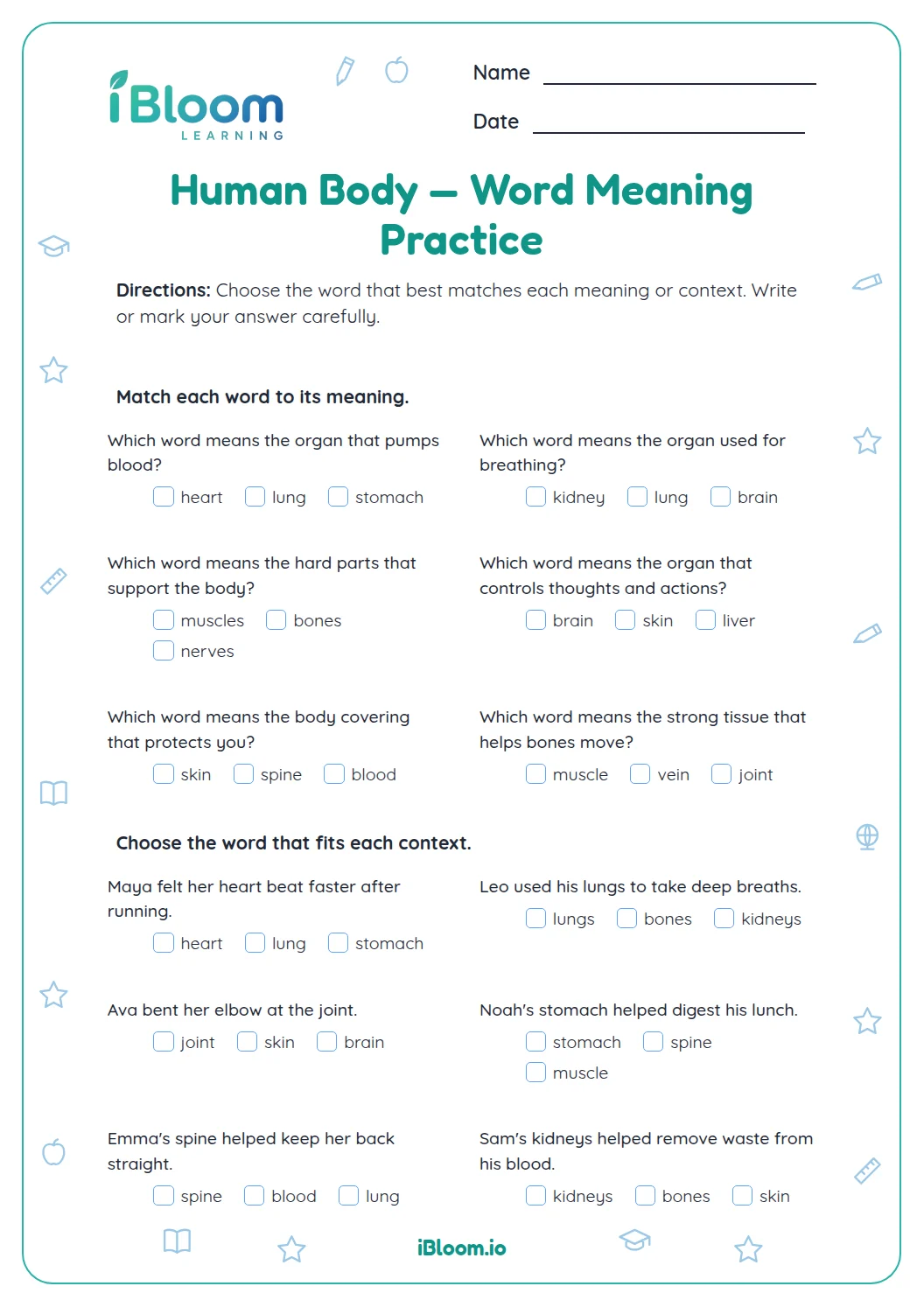
The sentence questions use skull, chest, lungs, elbow, blood vessels, muscles, stomach, pulse, spine, respiration, skin, brain, ribs, ankle, heartbeat, and tendon. Students use each sentence to infer meaning instead of relying on a memorized definition. Have the student reread the nearby sentence and name its meaning clue.
What is the word search for?
The word search contains eight terms: skeleton, heart, lungs, muscle, brain, skin, spine, and pulse. It adds a visual review of body vocabulary alongside the context-clue questions, where the surrounding sentence helps explain a word. Have the student reread the nearby sentence and name its meaning clue.
How does the answer key help with context clues?
The key gives the intended meaning or replacement word for each item. For example, “contracted” means tightened or shortened in the sentence about lifting a box. Ask the student which nearby detail supports that meaning before checking. Have the student reread the nearby sentence and name its meaning clue.
Does the worksheet ask students to write answers?
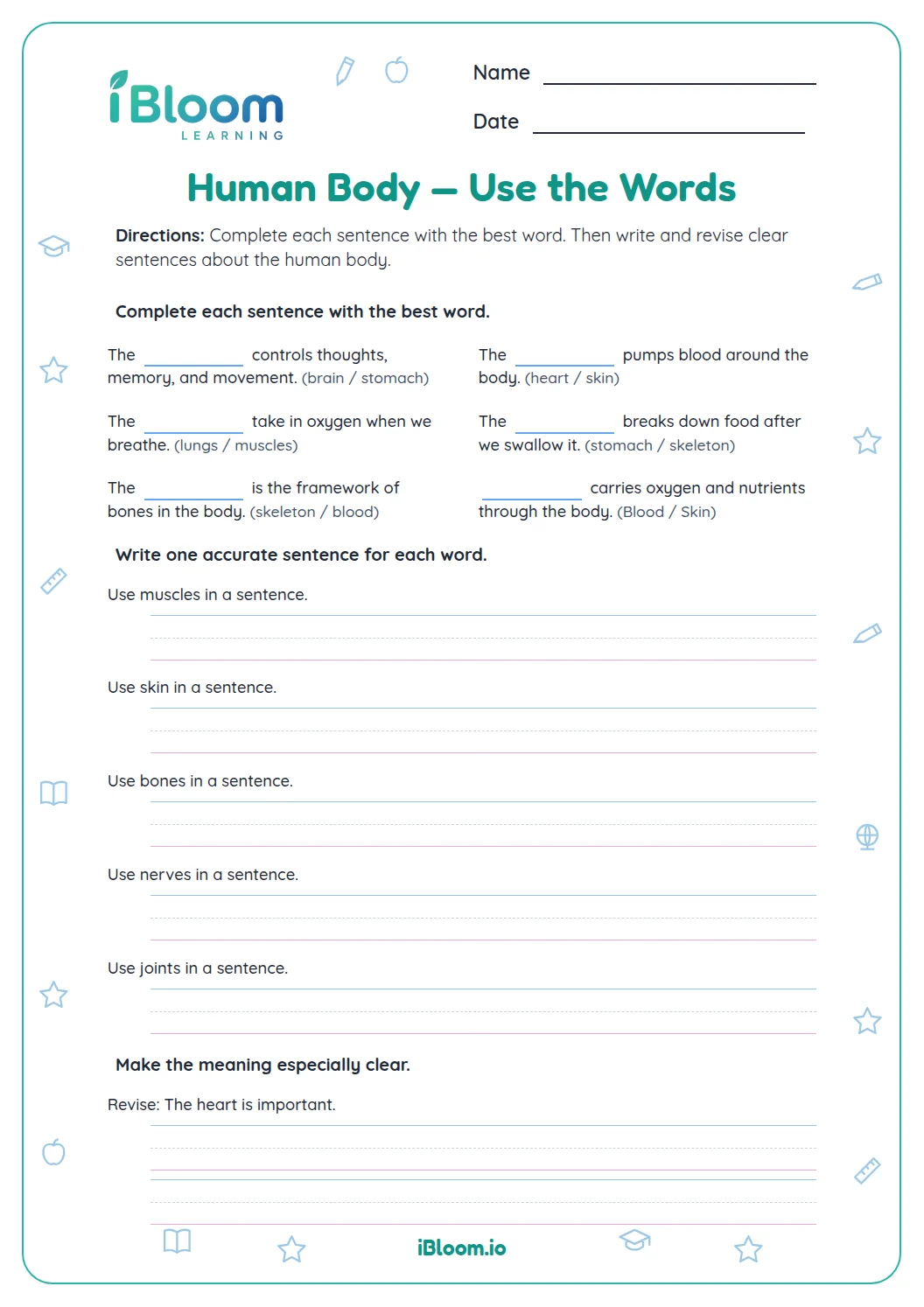
Yes. Four questions replace a body term with a familiar phrase, such as changing “respiration” to “breathing.” Students also complete the word search and choose meanings from sentence clues. Have the student reread the nearby sentence and name its meaning clue.
How long does this worksheet take?
Plan about 20 minutes for the three worksheet pages, including time to complete the word search. Students can pause at unfamiliar terms, reread the sentence, and use the answer key afterward to review the clue that supports each meaning. Have the student reread the nearby sentence and name its meaning clue.