





About this worksheet
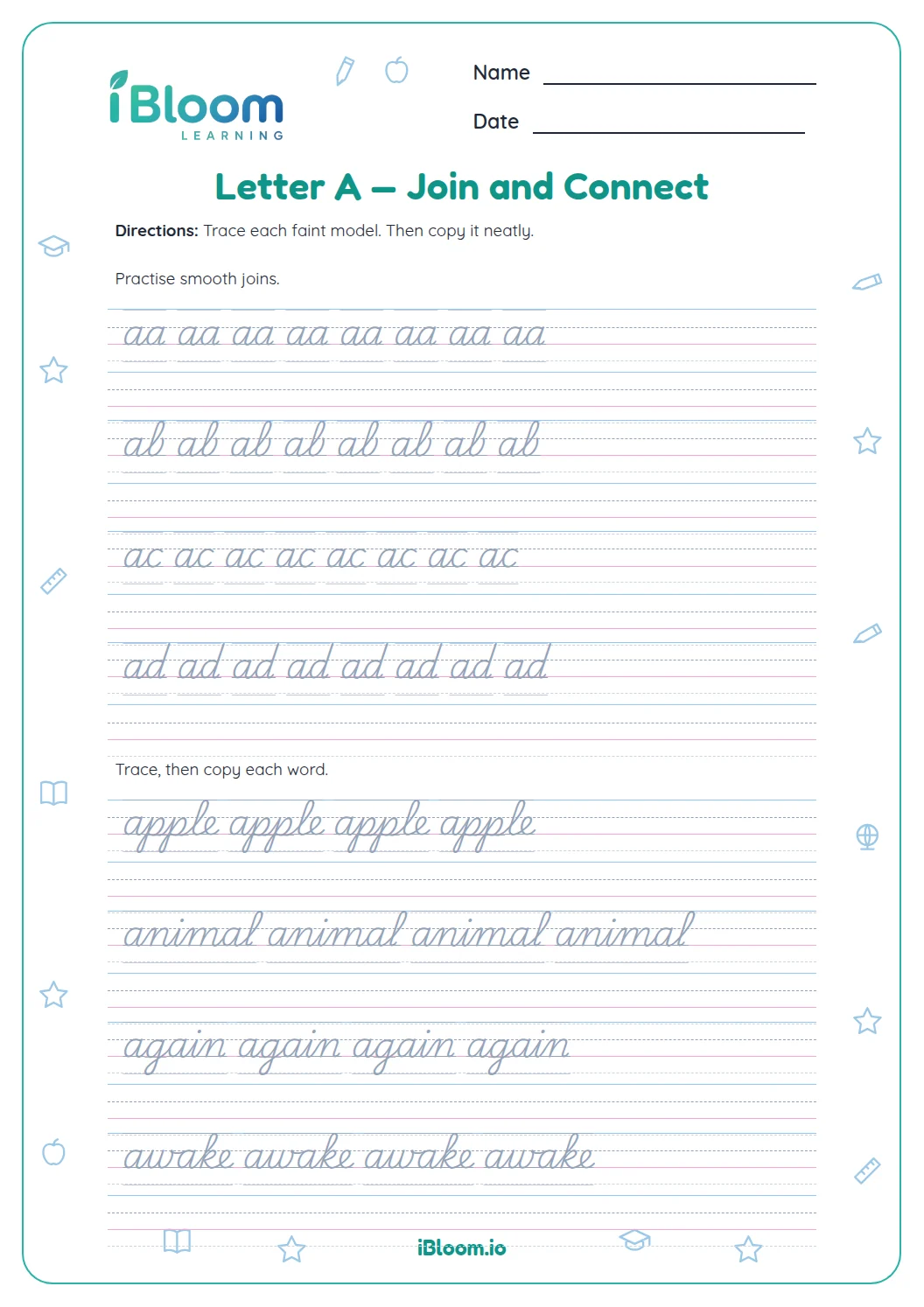
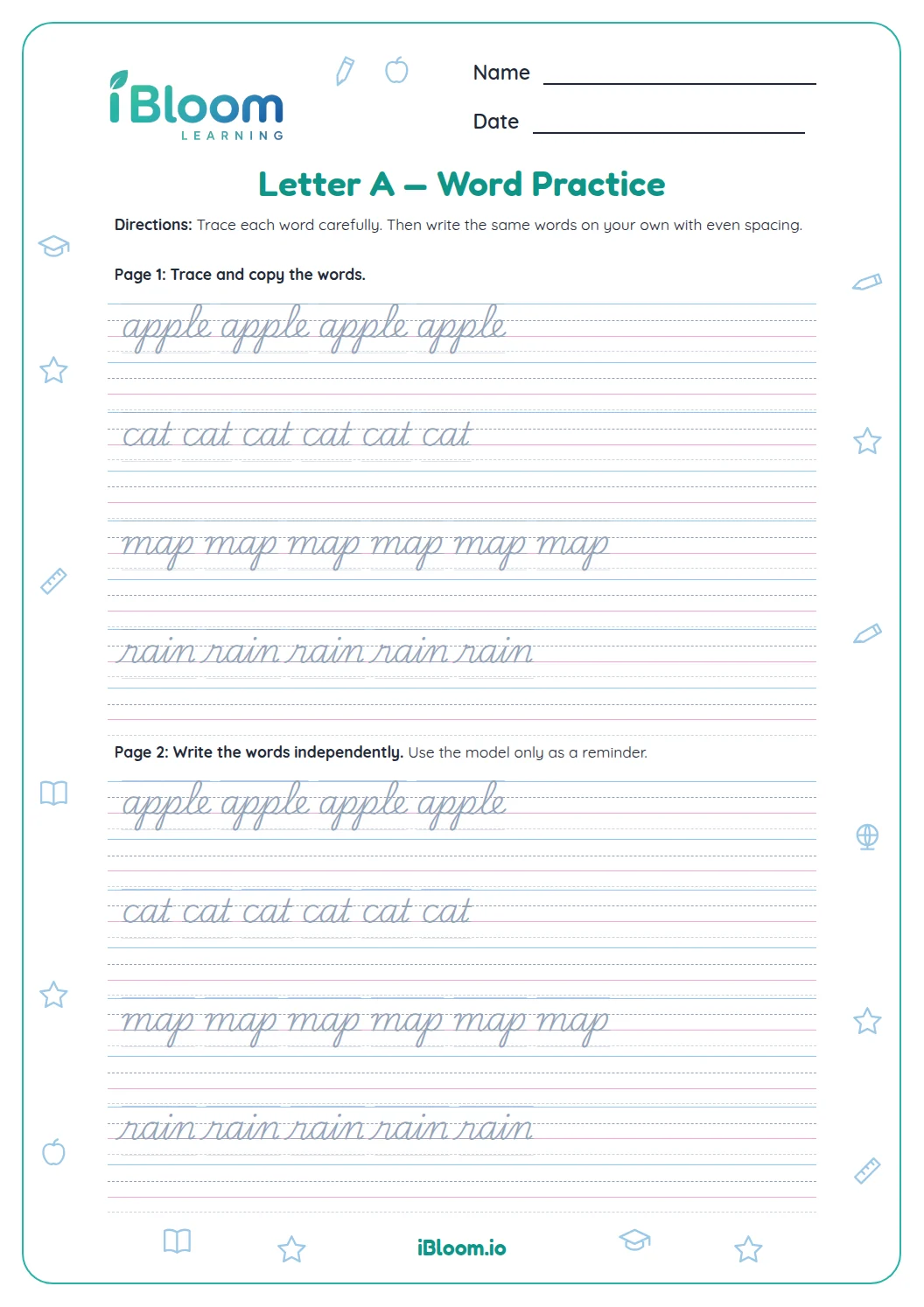
This printable Grade 2 cursive worksheet reviews lowercase and capital A, then moves from connected letter joins to words and short sentences. Students trace the gray cursive model and copy each item on handwriting lines. The 14 prompts build fluency with a in several positions while keeping the words and sentences readable. A model answer key is included.
How does the practice move from letters to sentences?
The first part isolates lowercase a and capital A. Students then connect a to a following letter in six short pairs, practice A-containing words, and finish by copying complete sentences.
- 1ab: trace the connected pair, then copy ab without lifting between the letters.
What makes a cursive copy easy to read?
Look for a clear oval in a, a steady slant, connected joins, and spaces between words. The goal is a controlled copy, not speed at the cost of legibility.
How can a child build fluency?
Trace once, copy once, and compare the copy with the model. A short pause between rows helps keep the joins smooth and the letter size consistent.
How to use this worksheet
- 1Sit with the paper tilted slightly toward the writing hand.
- 2Trace the gray model slowly, following each letter shape.
- 3Copy the item on the empty row with connected joins.
- 4Leave a clear space between words in the sentences.
- 5Compare the copy with the model for shape, slant, and spacing.
Common mistakes and quick fixes
The mistake
Rushing and making the a hard to recognize.
The fix
Slow down and form a clear oval before joining to the next letter.
The mistake
Lifting the pencil between letters in a join.
The fix
Keep the exit stroke of a connected to the next letter.
The mistake
Running words together.
The fix
Leave a finger-space between words, even when letters within a word connect.
What to practice next
Make more practice
Questions parents and teachers ask
Which letter forms are included?
The first part gives a separate model for lowercase a and capital A. Later parts move to six short lowercase joins, four words containing A, and two complete sentences. Each prompt shows a trace row and a copy row, so children can study the letter shape before practicing it independently.
How many prompts are included?
There are 14 prompts across four parts: two letter forms, six joins, four words, and two sentences. Every item is a cursive trace-and-copy task. The key shows the text to write; it is a reference for the letters and words, while the child’s own handwriting will naturally vary.
Should students write quickly?
No. The goal is a readable, controlled copy. Trace the gray model slowly, then copy it at a comfortable pace while keeping the oval in a recognizable a and the line steady. Once the forms and joins are consistent, students can repeat a short row to build a smoother rhythm.
How should students space words?
Connect letters within a word, then leave a clear gap before the next word. A finger space is a practical guide for the two sentence prompts. This keeps phrases such as “Ava has an apple” readable without interrupting the joins inside Ava, has, or apple.
What does the answer key show?
The key gives the exact letter, join, word, or sentence modeled by each prompt. For handwriting, compare the child’s copy for recognizable forms, connected joins, slant, and spacing rather than expecting an identical personal style. The key is especially useful for checking the capital A and the four A-words.