




About this worksheet
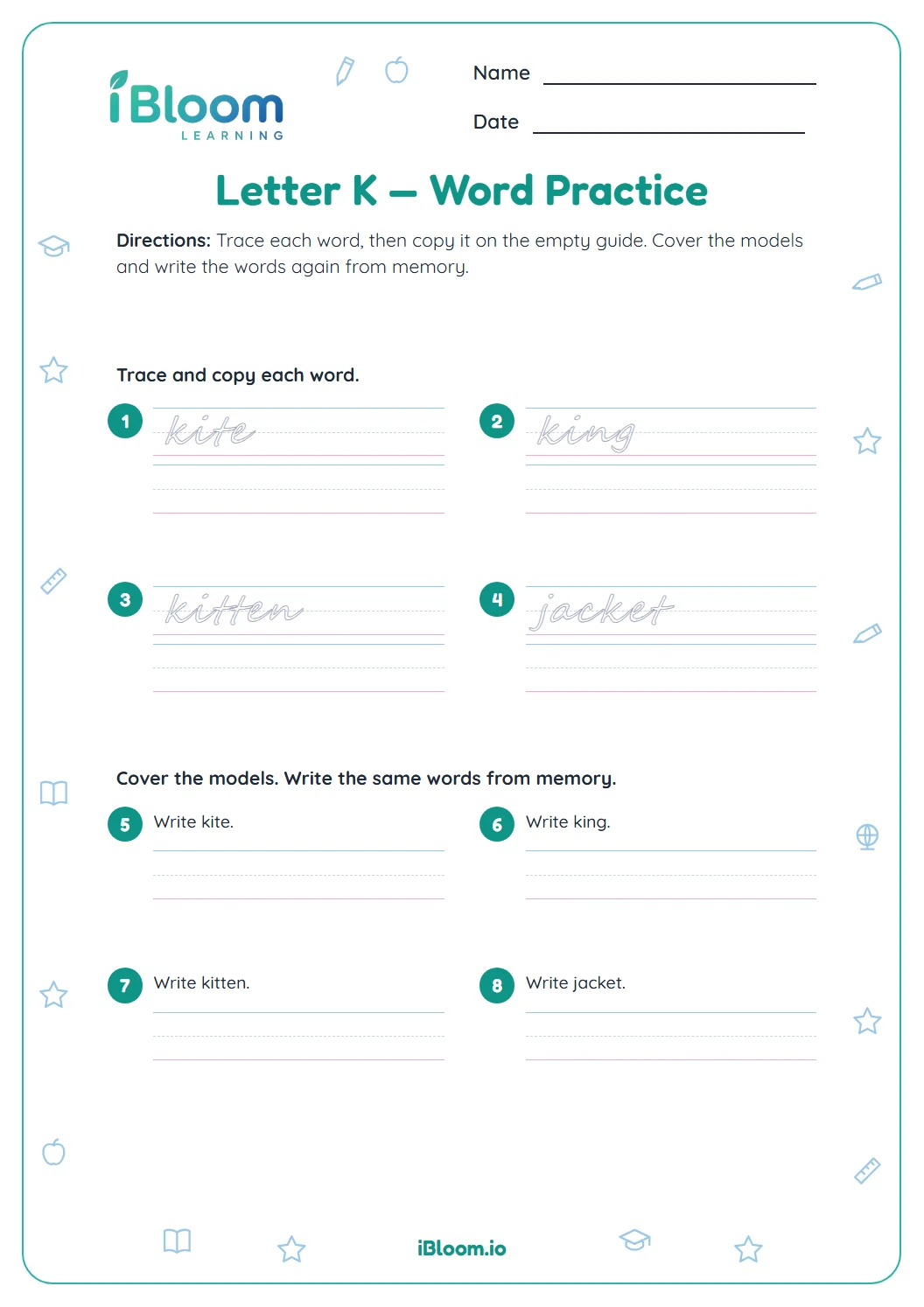
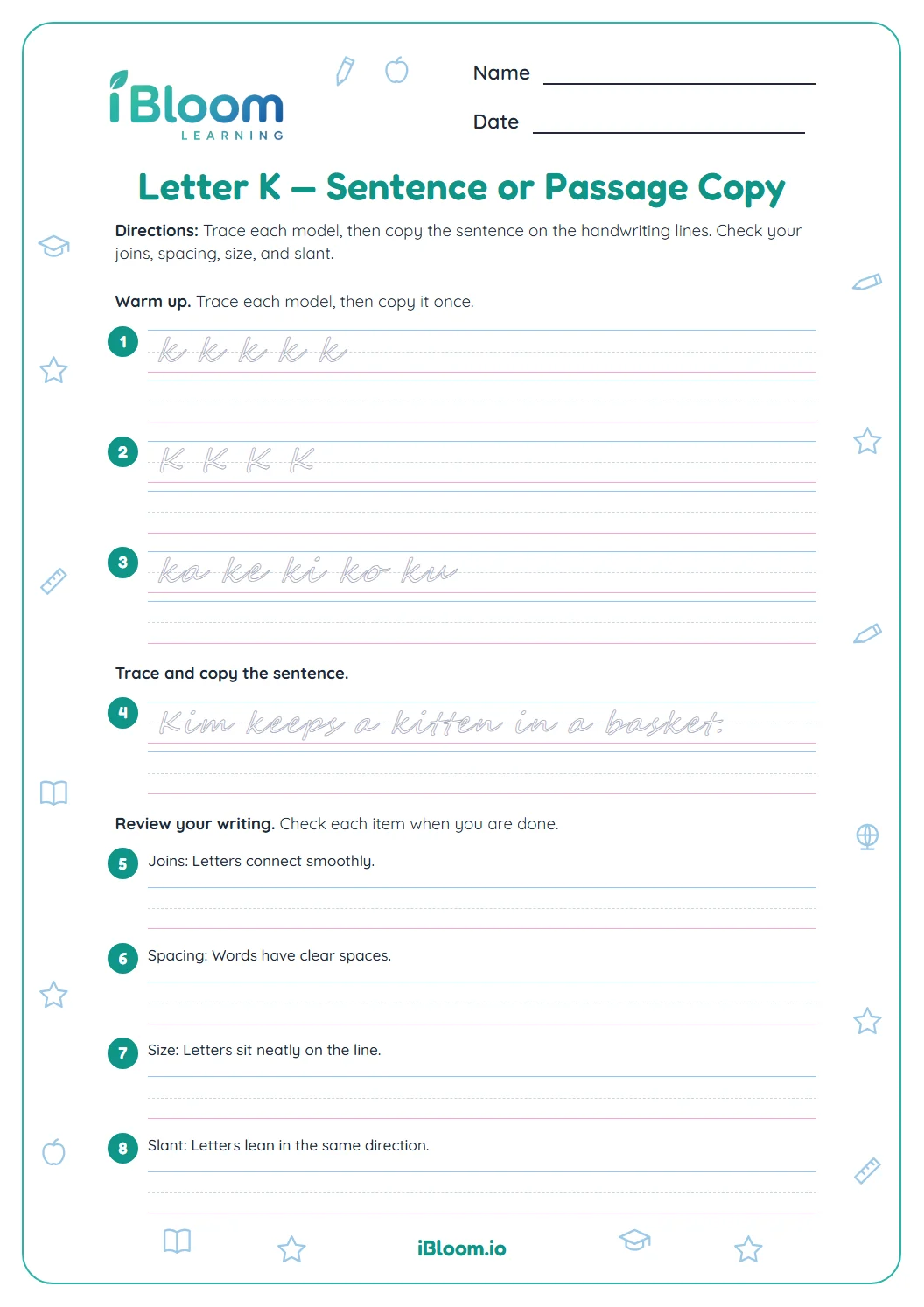
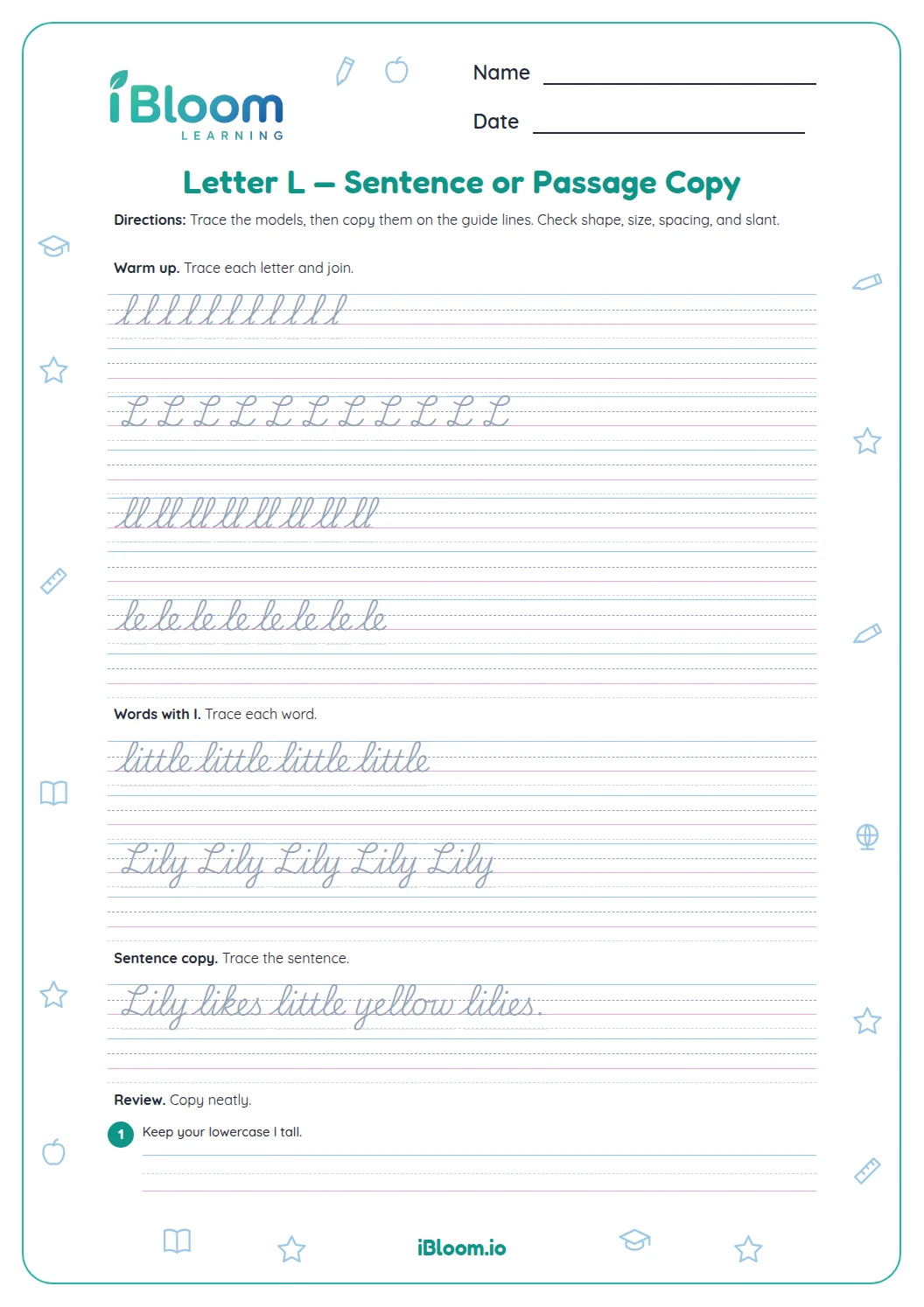
This cursive printable gives students in Grades 2–5 guided practice with capital K, lowercase k, K words, and complete sentences. Each item shows a cursive model to trace and a line for copying, so children can focus on letter shape and readable connections. The separate answer key provides the model text for all 15 prompts.
How does the review build cursive fluency?
The page begins with the capital and lowercase letter forms, then places K in familiar words. This sequence lets children focus on the letter before attending to longer strings of connected cursive writing.
- 1Model: kite
- 2Trace the model on the handwriting line.
- 3Copy kite on the empty line, keeping each letter readable.
Why practice K inside words?
Words help children carry a letter shape into connected handwriting. The practice words include varied neighboring letters, so the child must make each K clear while keeping the whole word legible.
What changes when children copy sentences?
Sentence copying adds spaces, capitals, and end punctuation to the handwriting task. Questions 12–15 use new sentences, so students can focus on copying a complete thought while forming K and k clearly.
How to use this worksheet at home or in class
- 1Sit with the paper turned slightly toward the writing hand.
- 2Trace the capital and lowercase models slowly.
- 3Copy each word while keeping the K shape clear.
- 4For sentences, include the capital letter, spaces, and punctuation.
- 5Compare the copied text with the model for missing or changed letters.
Common mistakes and quick fixes
The mistake
Making capital K and lowercase k look alike.
The fix
Pause at the model and compare the size and starting point of each form.
The mistake
Rushing through the word and losing the K shape.
The fix
Slow down for the K, then continue the word with smooth, controlled strokes.
The mistake
Leaving out a word or punctuation when copying a sentence.
The fix
Read the model once, then track each word with a finger while copying.
What to practice next
Make more practice
Questions parents and teachers ask
Which letters and words are on this page?
The page starts with capital K, lowercase k, and the pair Kk. It then uses kite, kind, king, keep, kick, kitten, kitchen, and kind kids before moving to complete sentences. Each prompt is designed for cursive tracing and copying. Ask the child to reread the prompt and explain which words or details support the response.
Should a child trace or copy first?
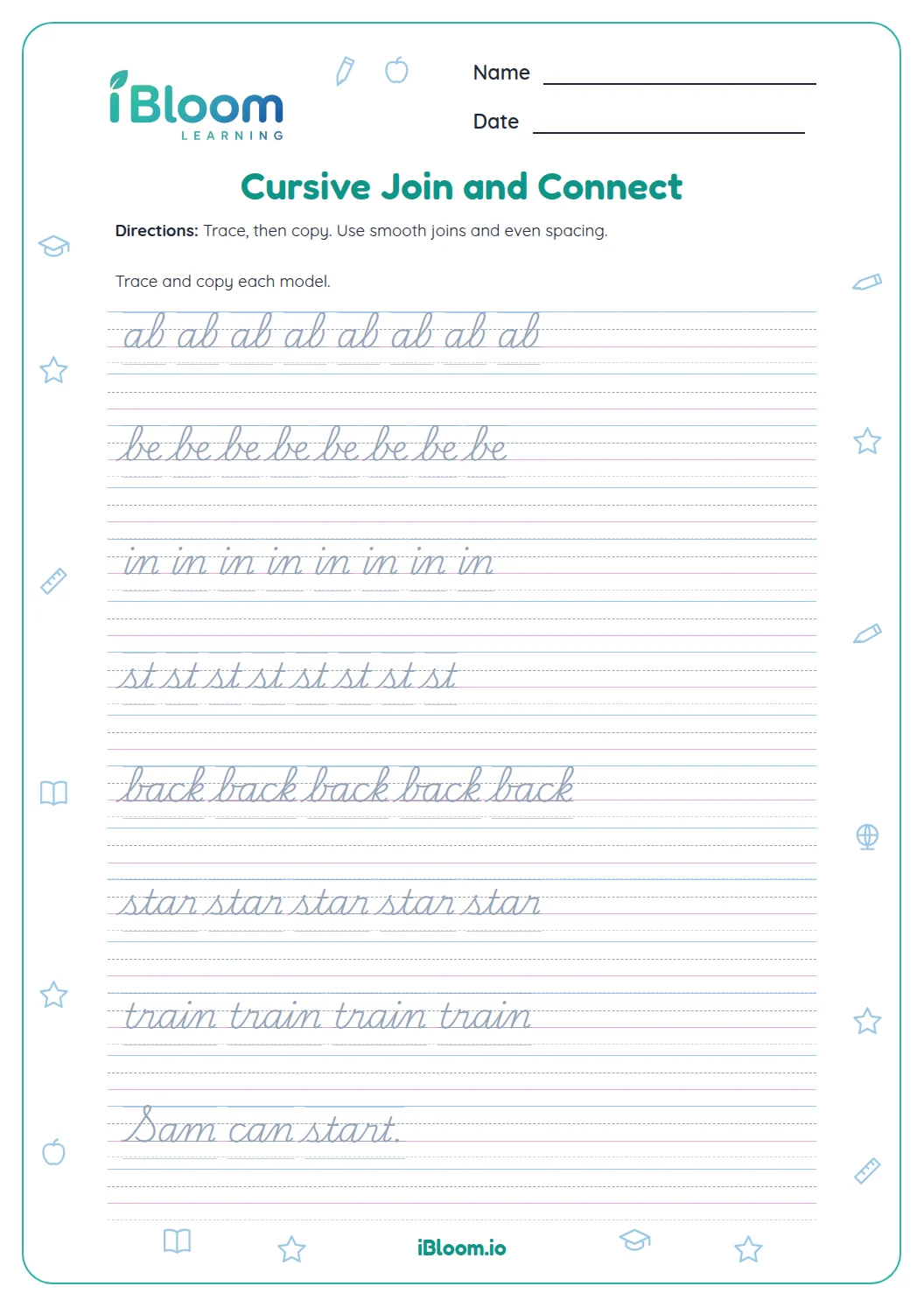
Each cursive prompt provides a gray model to trace and a blank handwriting row to copy. Following that order gives the child a chance to observe the strokes, practice them with guidance, and then write the text independently. Ask the child to reread the prompt and explain which words or details support the response.
What should I check in a copied sentence?
Compare the copy with the model for letter order, spaces, capitalization, and punctuation. Read the sentence aloud together so the child can notice whether a word or ending mark was left out. Then check that each K remains clear and the words are easy to read.
Can older children use this page?
Yes. The practice is listed for Grades 2–5 and can be used whenever a learner wants more cursive practice with K. Older students can focus on consistent size, spacing, and a steady writing pace across the sentence lines. Ask the child to reread the prompt and explain which words or details support the response.
How long does the review take?
Plan for about 20 minutes. Encourage a short break between the word practice and sentence copying if the child’s hand gets tired, then return to the models with a relaxed grip. The page includes 15 short and longer cursive models.