





About this worksheet
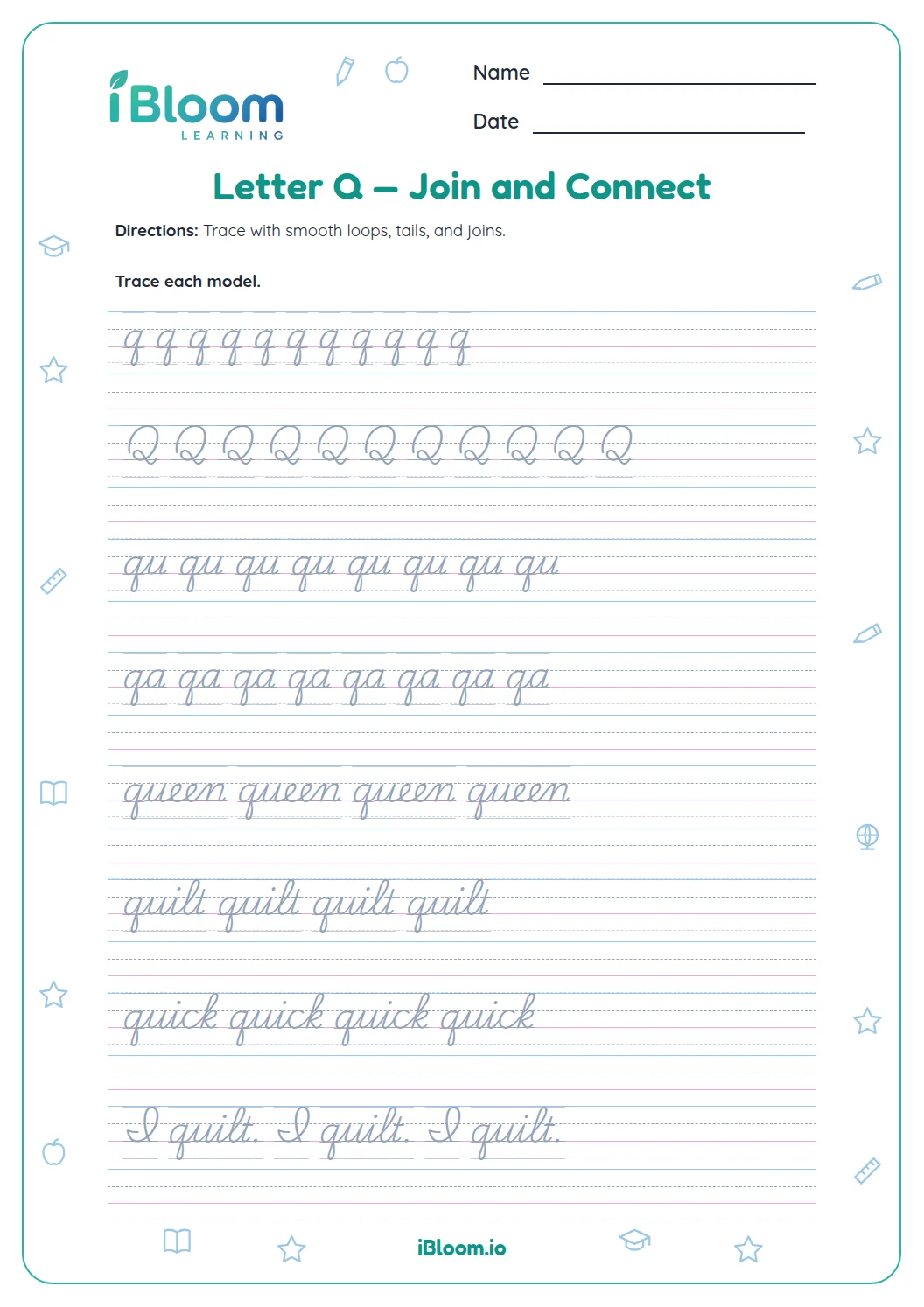
This cursive letter Q worksheet follows the old sheet’s warm-up, trace-and-copy, and sentence-copy routine. Six exercises move from lowercase and uppercase q forms to a qu join, two q words, and a sentence about Quinn reading. Each model appears on handwriting lines with space to copy; the key shows each target.
How does the sheet build cursive Q practice?
Part A starts with lowercase and uppercase q, then moves to qu joins and the words queen, quick, and question. Part B asks students to trace and copy a complete sentence.
The old sheet uses a light tracing model followed by handwriting lines for copying. This printable keeps that method so children can focus on shape, spacing, and joins.
- 1question
- 2Trace the model, then copy the word on the next line.
How to use this worksheet
- 1Begin with the lowercase and uppercase q forms.
- 2Follow each gray model slowly with a pencil.
- 3Copy the letters or word on the blank line.
- 4Keep the oval, downstroke, and exit stroke clear.
- 5Use a steady join in qu words and check spacing.
Common mistakes and quick fixes
The mistake
Writing q like a printed letter.
The fix
Follow the cursive model’s oval, descending stroke, and exit.
The mistake
Breaking the connection between q and u.
The fix
Continue from q’s exit into u as the model shows.
The mistake
Letting a sentence crowd together.
The fix
Leave a clear word space and keep letters an even size.
What to practice next
Make more practice
Questions parents and teachers ask
Which q forms does the worksheet include?
It begins with lowercase q and uppercase Q, then presents the joins qu and Qu. Students move from these short forms to whole words and a sentence, so they can see the letter at the beginning and within connected cursive writing.
What words do students copy?
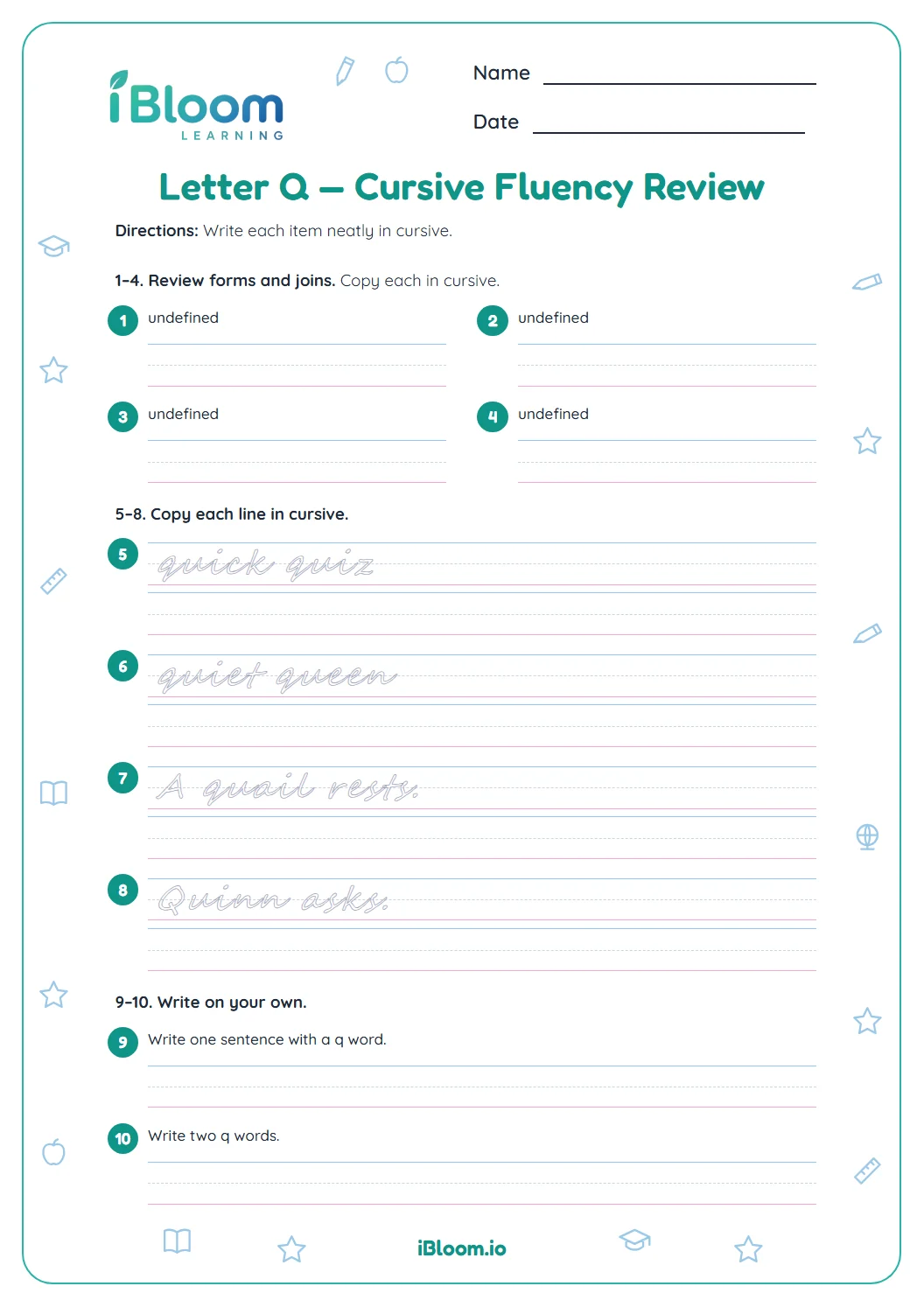
There are six models: lowercase q, uppercase Q, the join qu, two q words, and a sentence. Each includes handwriting lines for tracing and copying. The key repeats the exact target for every exercise and provides a quick way to check the copied text.
How should a child use the handwriting lines?
Trace the light model once, then copy the same text on the following writing line. Encourage a comfortable pace, consistent letter size, and a clear space between words. The goal is legible, connected handwriting rather than speed. Encourage the child to compare the copied shapes with the printed model.
Is a sentence included?
Yes. The final item is “Quinn quietly reads a book.” Students trace that sentence and copy it on handwriting lines. It has a capital Q at the beginning, lowercase q inside words, and clear word spaces. The key shows the target sentence.
Does the worksheet include an answer key?
Yes. The key displays the exact letter forms, joins, words, and sentence students are asked to copy. Handwriting can vary, so use it to check that the requested text is present and readable rather than expecting every child’s letter shape to look identical.