








About this worksheet
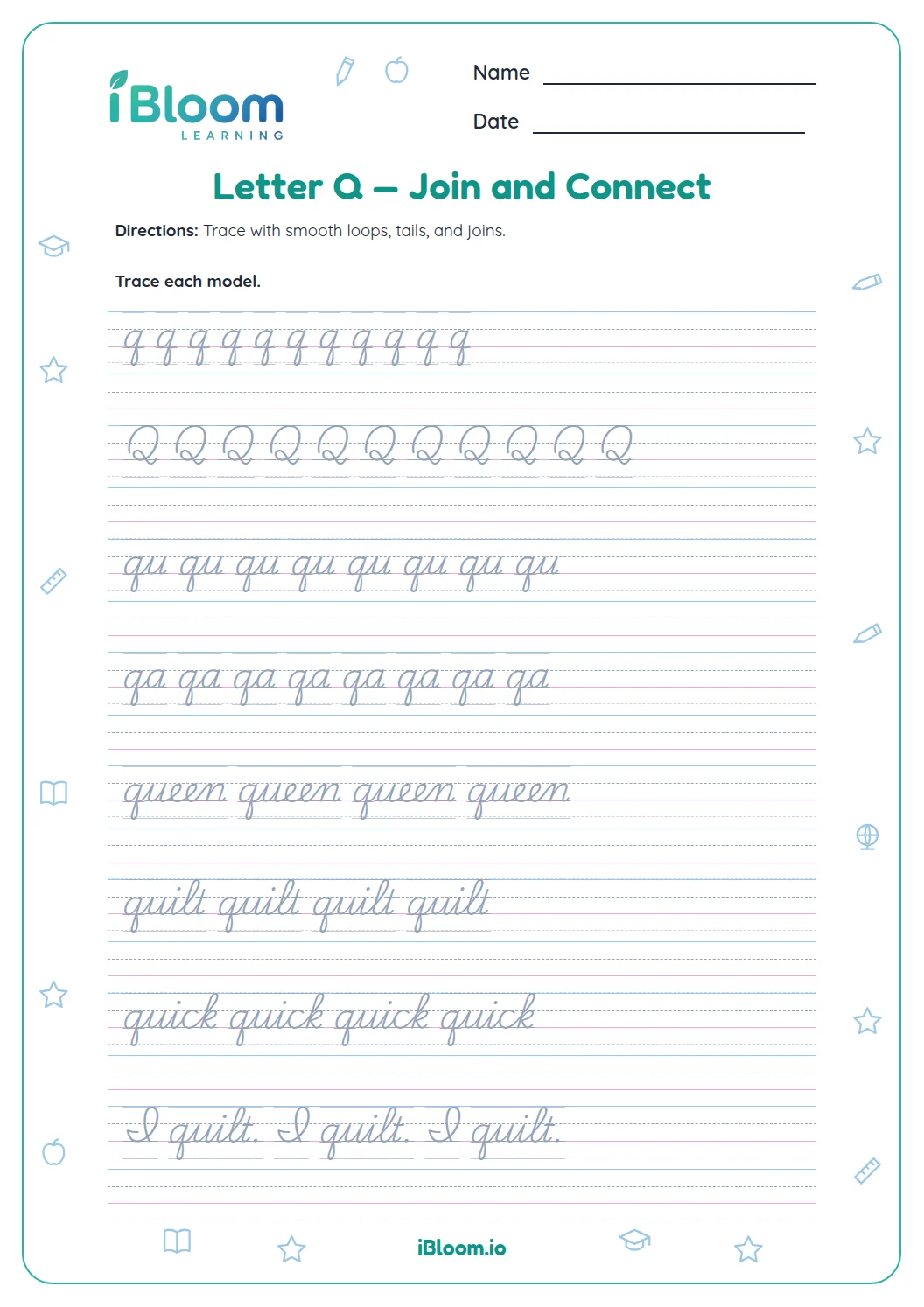
This cursive worksheet is for learners in Grades 2–5 who want focused practice with uppercase Q, lowercase q, the qu join, Q words, and short sentences. Its 14 trace-and-copy lines move from letters to words and sentence copying across three parts. A separate key repeats the text models for checking spelling and sequence.
How can tracing build a clear cursive Q?
This cursive worksheet is for learners in Grades 2–5 who want focused practice with uppercase Q, lowercase q, the qu join, Q words, and short sentences. Its 14 trace-and-copy lines move from letters to words and sentence copying across three parts. A separate key repeats the text models for checking spelling and sequence.
Start with Q and q, then practice the qu join before copying full words. For example, queen begins with the qu connection and continues through a repeated word model.
What will students do in each part?
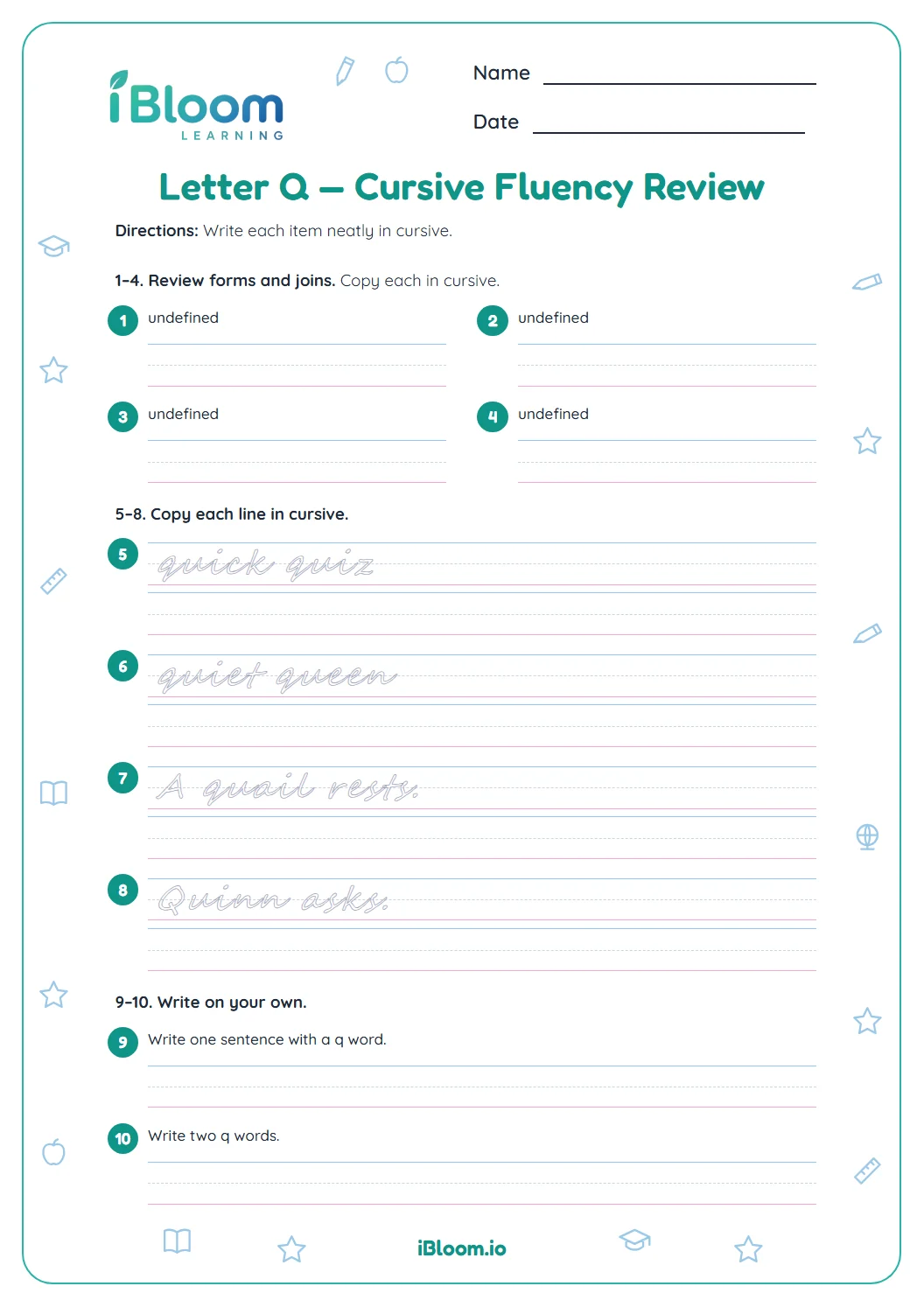
Part A traces Q, q, Qu, and qu. Part B moves to words such as queen, quiet, question, and squid. Part C copies two sentences and a final word. Each prompt provides a gray cursive model followed by a row for independent copying.
How can an adult support practice?
Move slowly through the model and notice where the letter joins the next one. In queen, trace the q and continue into u before forming the remaining letters. Then copy the whole word on the next row, keeping the letters on the line and the spaces clear.
How to use this worksheet
- 1Read the directions and scan the first model or example.
- 2Work through each part in order, writing clearly in the answer spaces.
- 3Pause to explain one strategy or shape clue aloud.
- 4Check every response with the separate answer key.
- 5Choose one missed question and solve or copy it again carefully.
Common mistakes and quick fixes
The mistake
Making q look like a printed p by changing its descender.
The fix
Follow the model’s entry stroke, rounded body, and descender before copying.
The mistake
Choosing an answer without checking the amount or clue.
The fix
Use the visual model, place value, or stated attribute to verify the choice.
The mistake
Skipping the check after finishing.
The fix
Compare each response with the key and correct one item in a different color.
What to practice next
Make more practice
Questions parents and teachers ask
What does the cursive worksheet include?
The 14 lines cover uppercase Q, lowercase q, the Qu and qu joins, Q words, and short sentence copying. Students first trace a model and then copy it on the following row. The separate key repeats the requested text so an adult can check spelling and sequence.
Which words can students practice?
The word prompts include queen, quiet, quick, question, quilt, squid, and quail. Each gives practice forming q and joining it to following letters. The page also includes two short sentences, including “Quinn found a quilt,” for copying connected words and spaces.
Is an answer key needed for handwriting?
The answer key is useful as a text reference, since handwriting can vary from student to student. It repeats the letters, words, and sentences in order. Compare the copied text with the key, then look at letter shape, joins, size, and spacing beside the printed model.
What is a helpful way to practice cursive Q?
Begin with Q and q, then trace Qu and qu before moving to words. Follow the gray model without rushing, keeping strokes on the handwriting line. On the copy row, focus on consistent letter height and a smooth connection from q into the next letter.
Can older students use this page?
Yes. The worksheet is labeled for Grades 2–5 and offers focused practice with Q, q, qu joins, words, and sentences. Older learners can use the models to refresh letter formation, while students who are new to cursive can take one line at a time.