

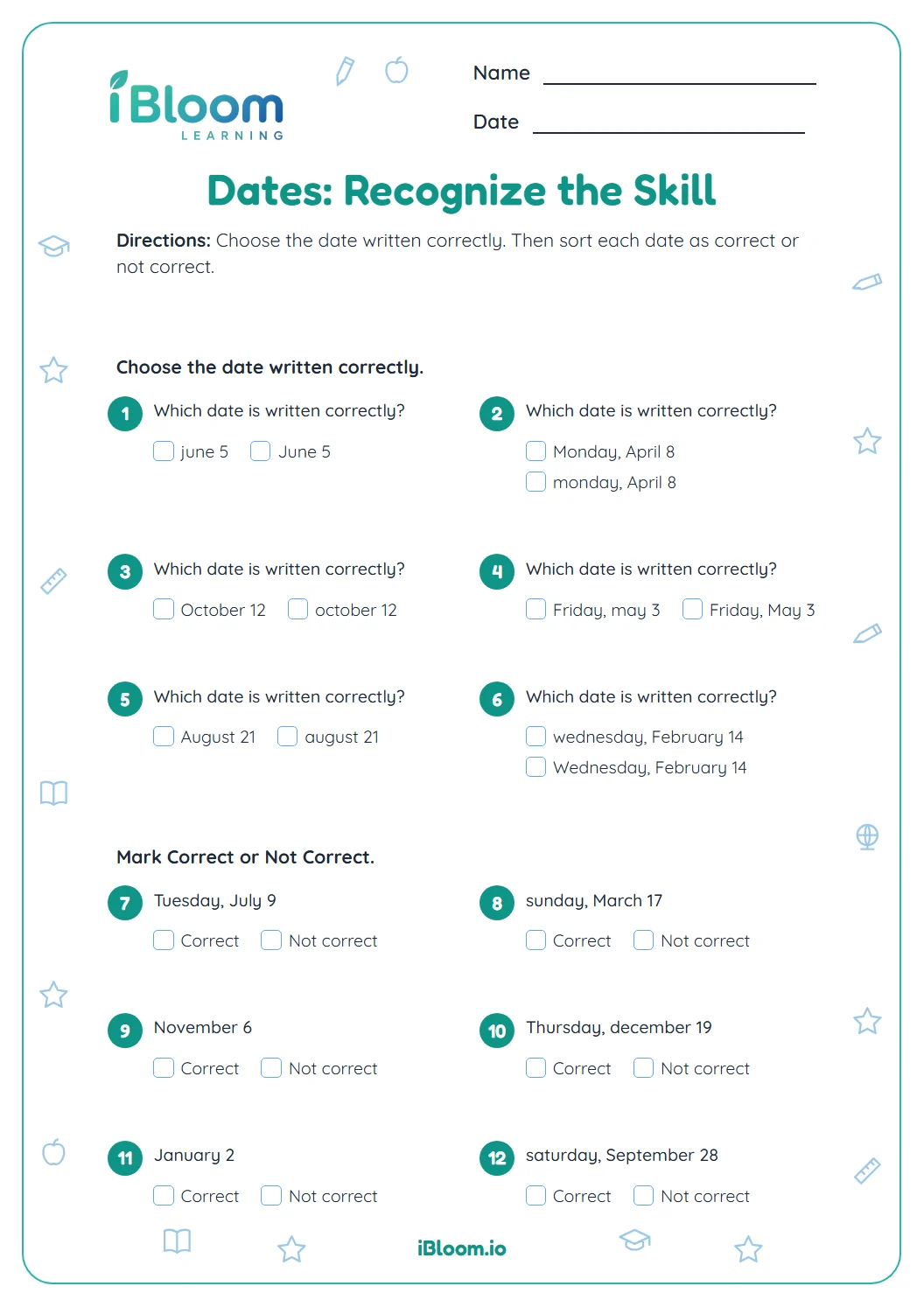

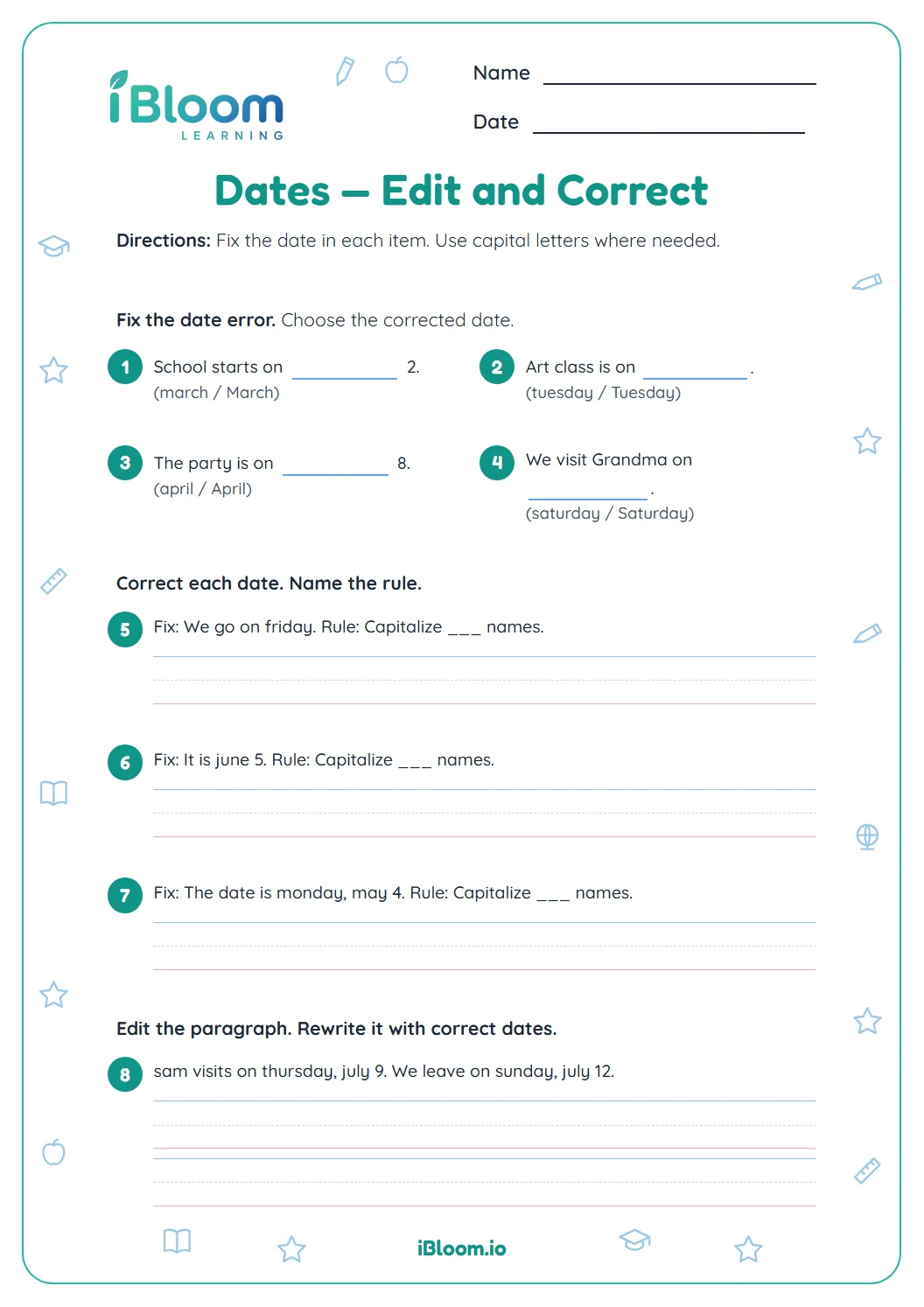
About this worksheet
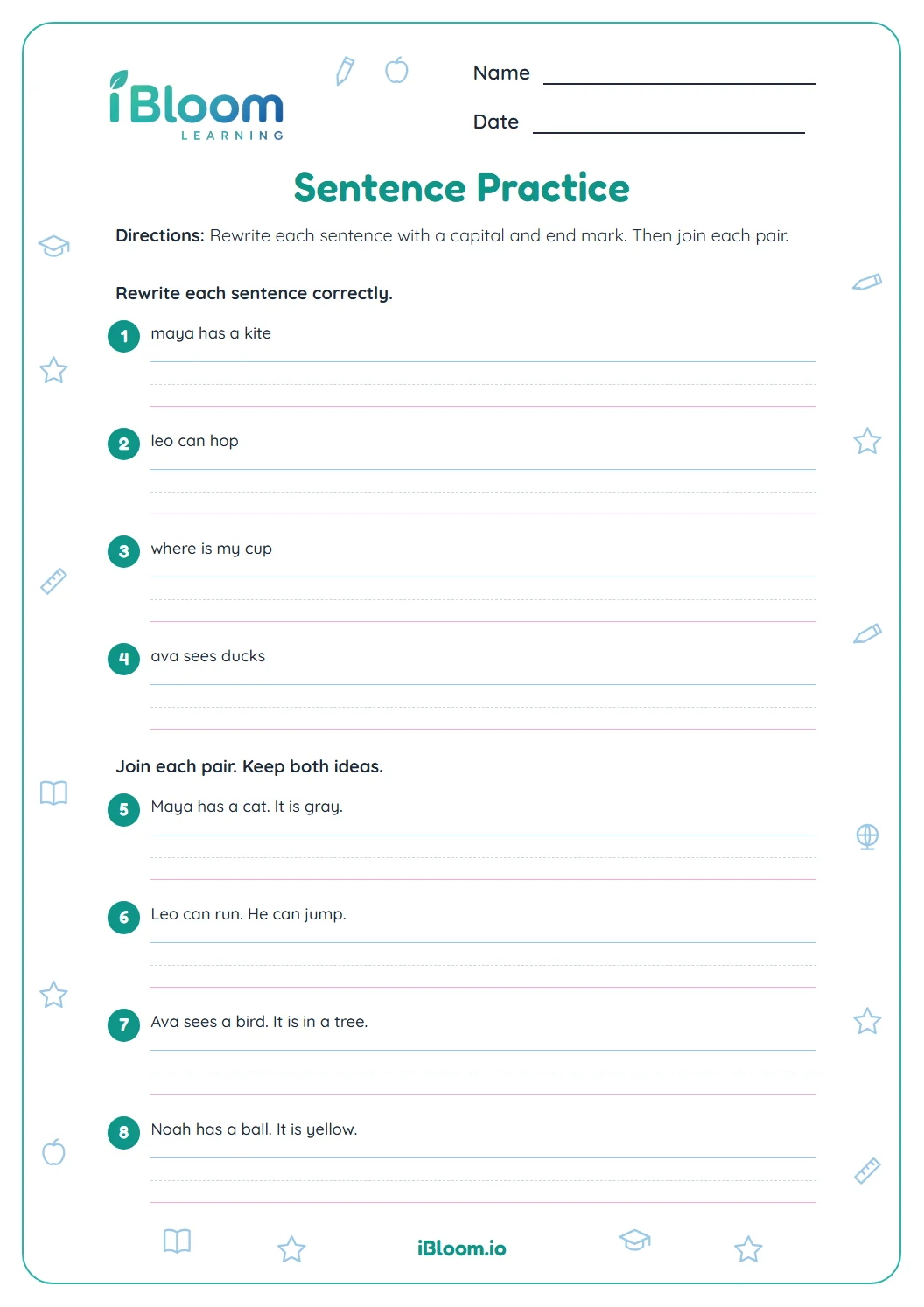
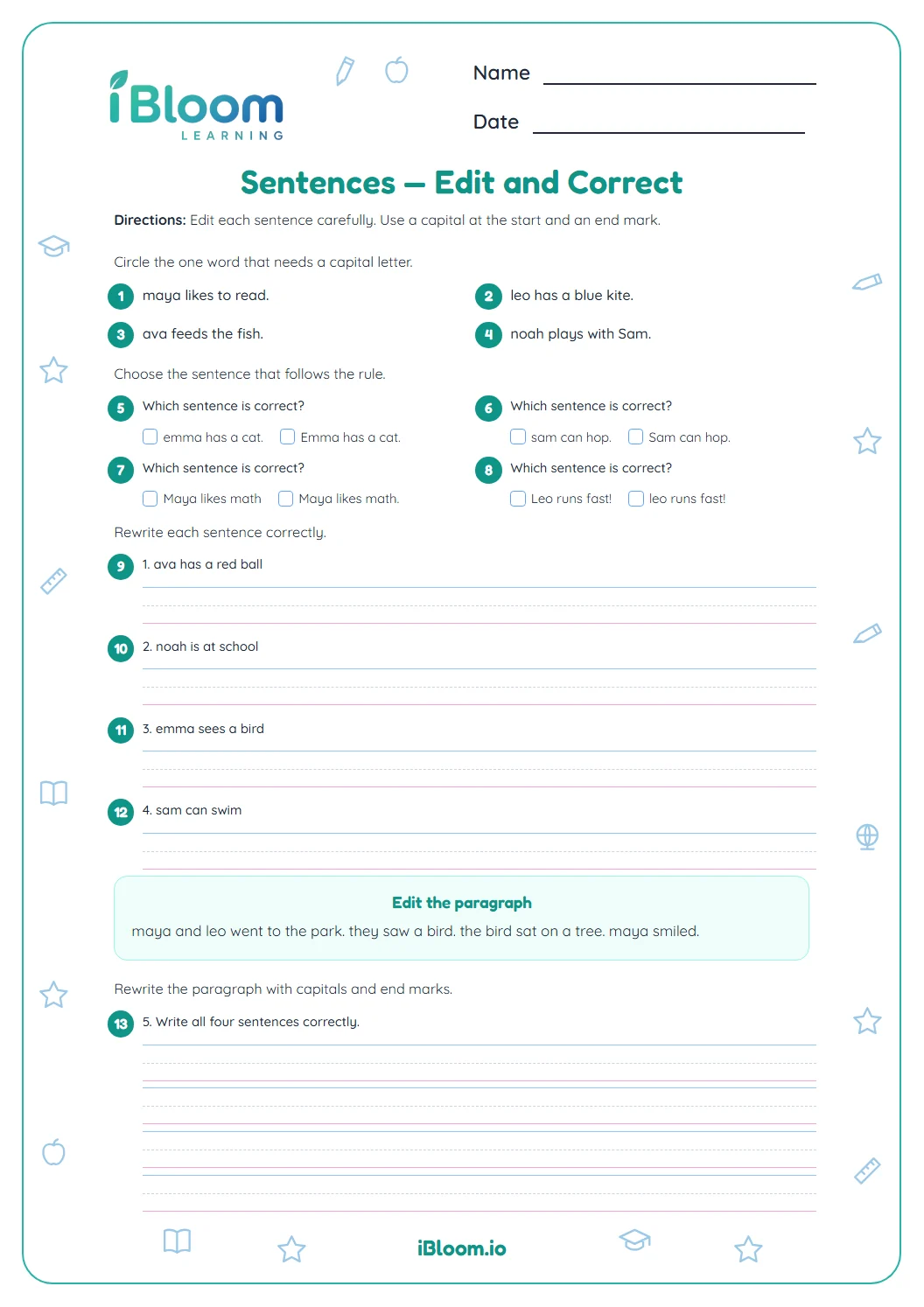
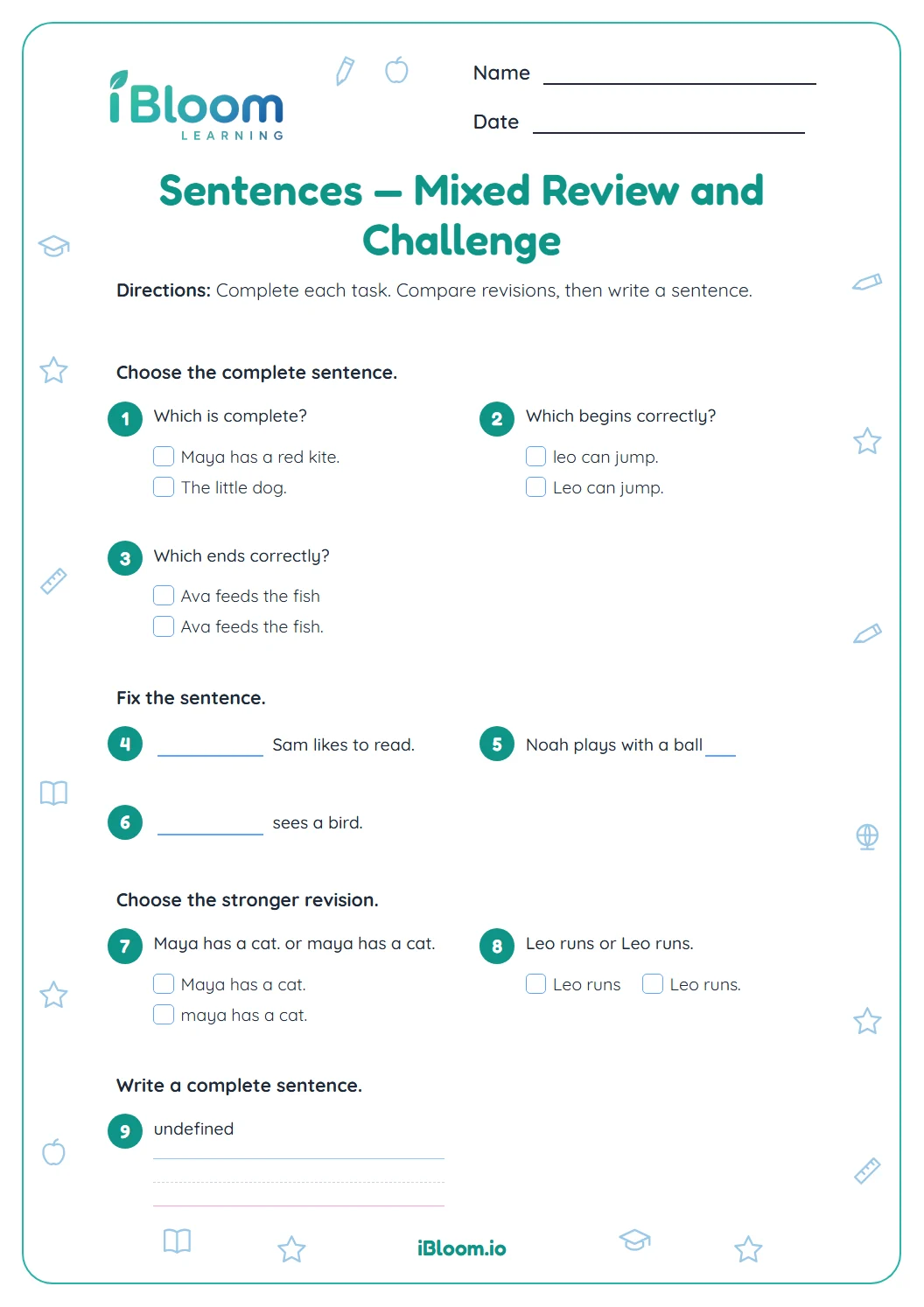
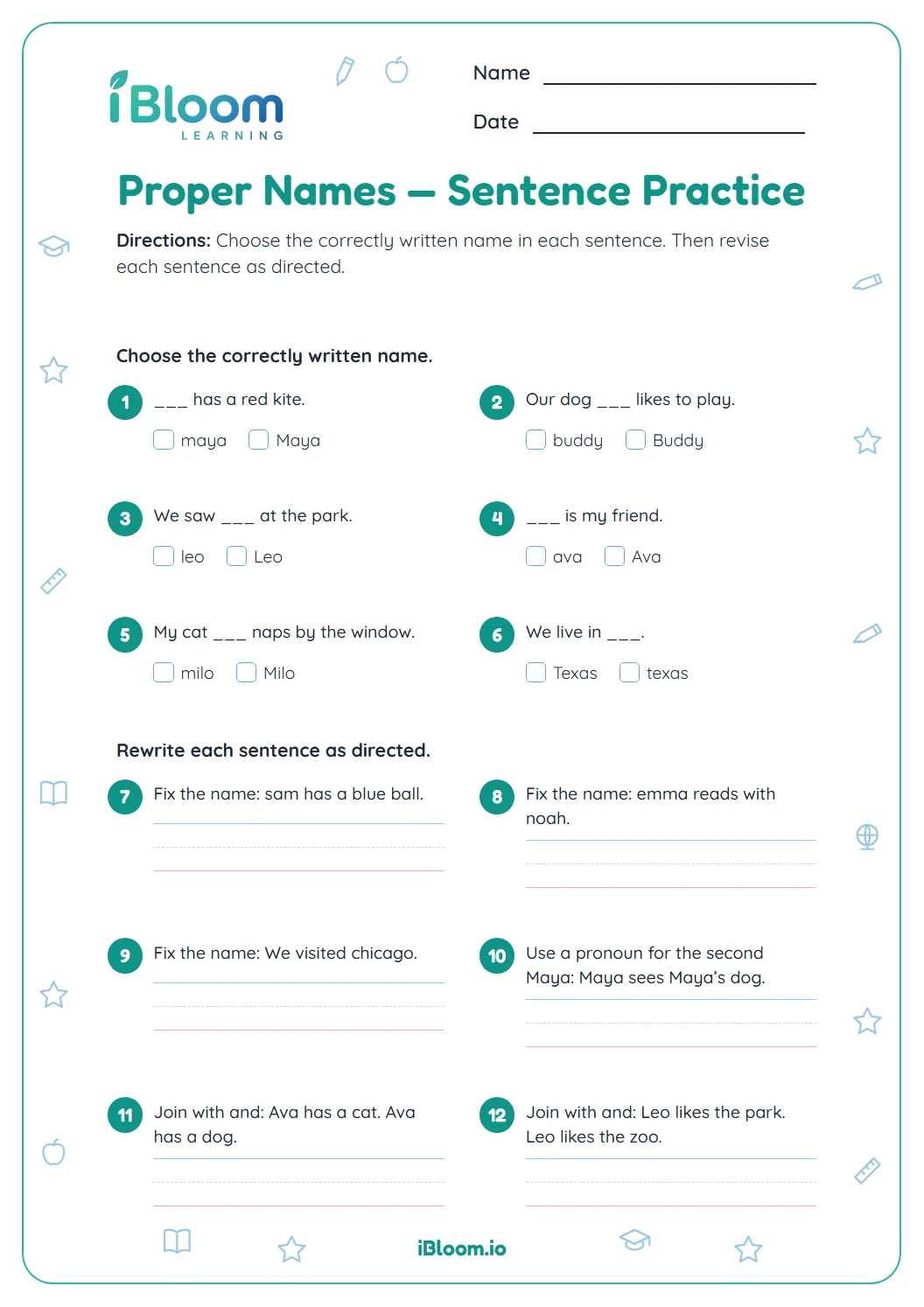
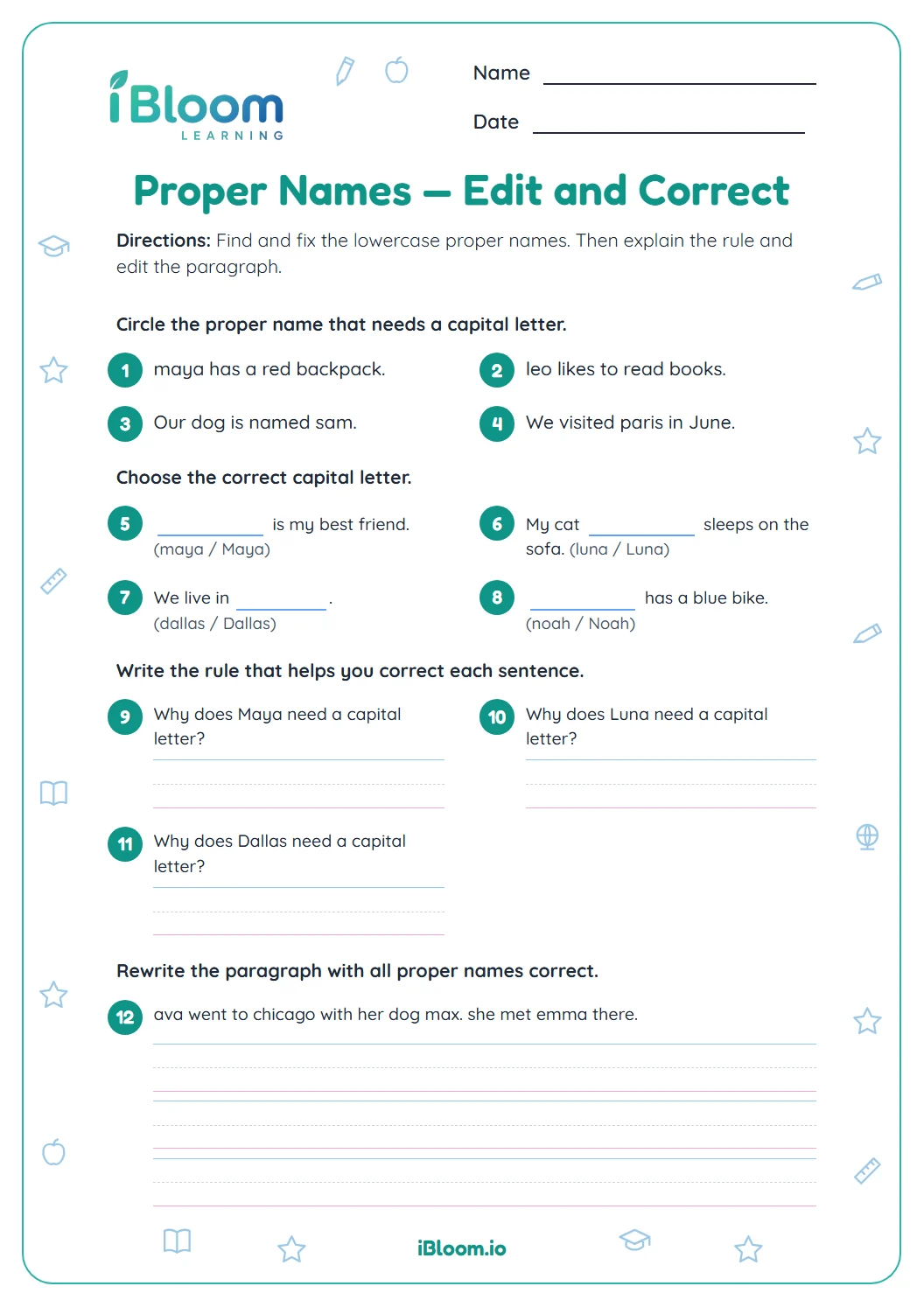
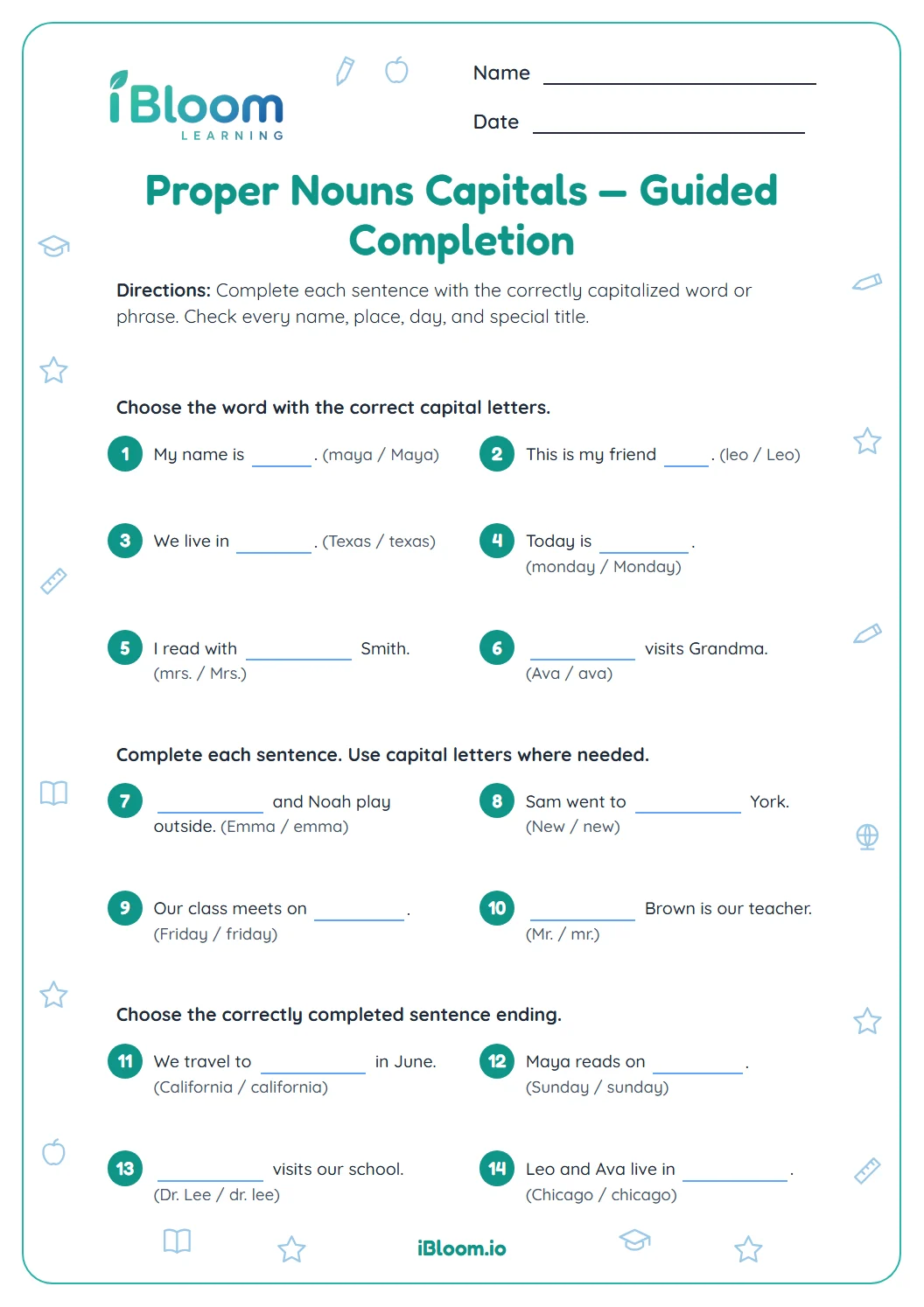
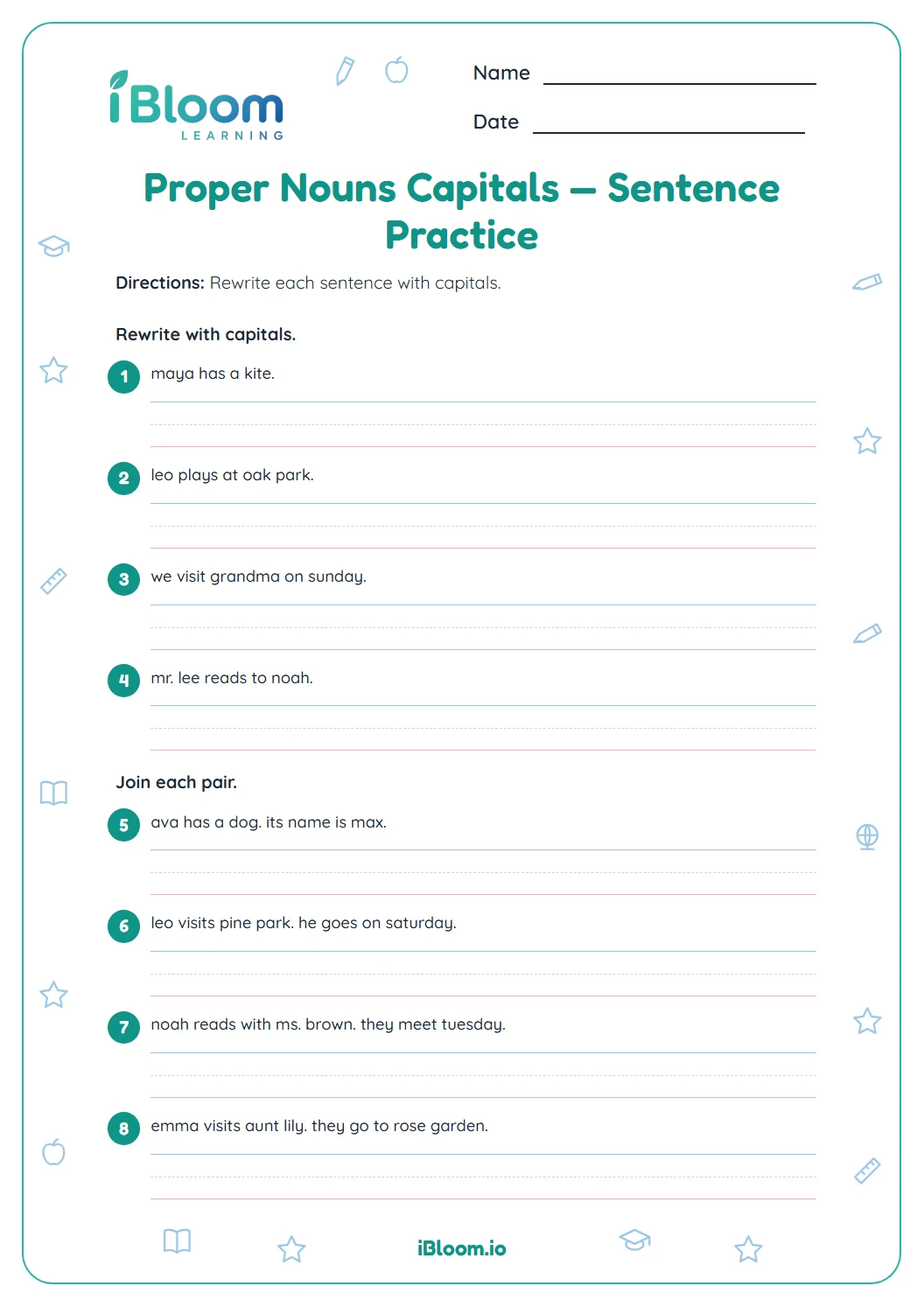
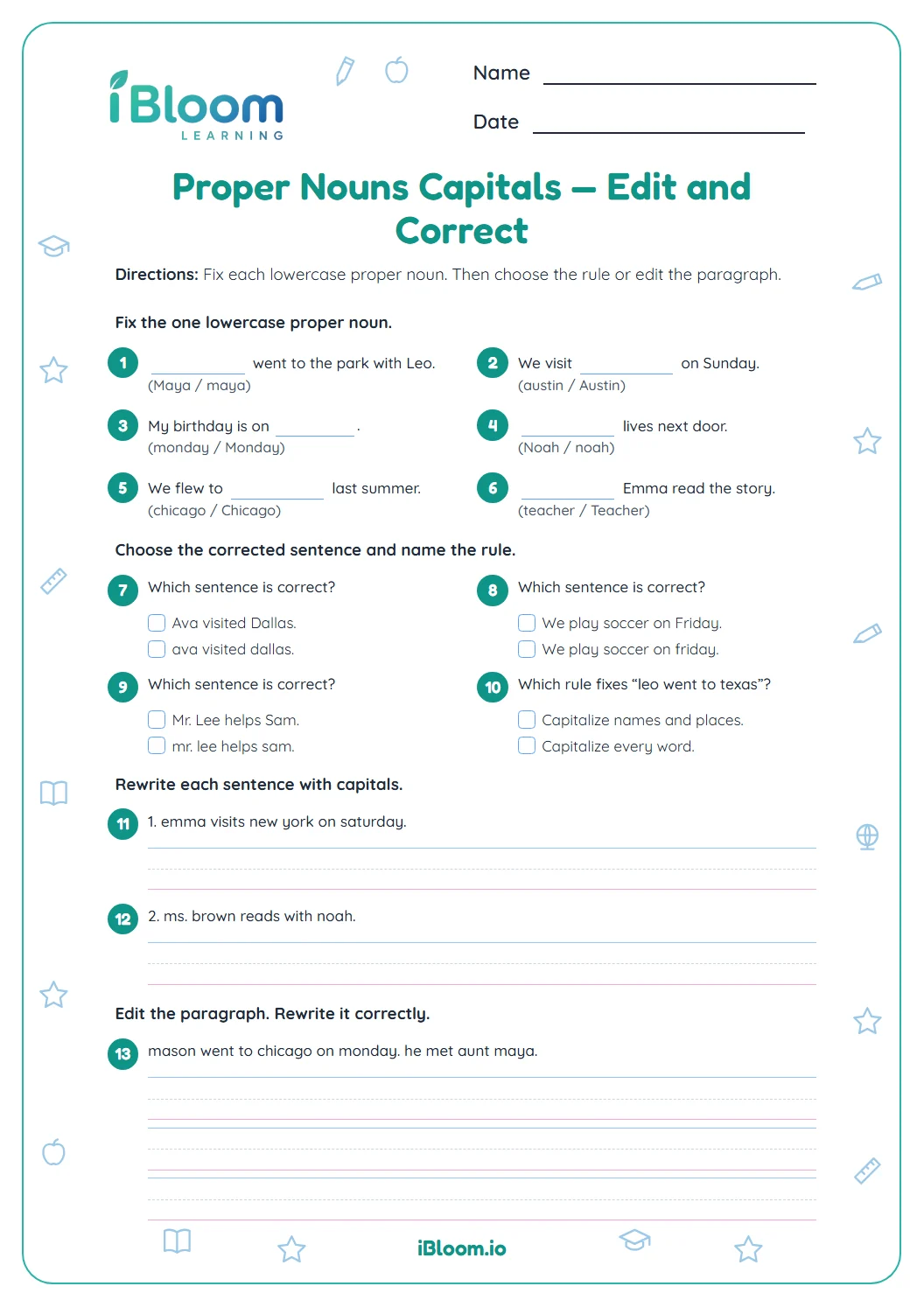
This Grade 1 worksheet helps children complete and check sentences that need capital letters. Part A begins sentences with a capitalized word, Part B completes familiar names, and Part C asks children to choose sentences with correct capitalization. The examples use short, readable sentences and names. A separate answer key shows the correct word or sentence for each item.
Aligned to L.1.2
What kinds of sentences are included?
The worksheet gives children three ways to notice capitals: supply a capitalized first word, complete a name, and identify a correctly written sentence. Each sentence is short so attention stays on capitalization.
- Part A: capitalize the first word
- Part B: capitalize names
- Part C: choose a correctly capitalized sentence
How can a child check a sentence beginning?
Look at the very first letter. A sentence begins with a capital letter, even when the word is a familiar word like “we” or “the.”
- 1___he has a red kite. → He
- 2The first letter starts the sentence, so it is uppercase.
Why do names need capitals?
A person’s name is a proper noun. Check that its first letter is uppercase wherever the name appears in a sentence.
How to use this worksheet
- 1Read each sentence aloud once.
- 2For Part A, check the first letter and write the capitalized word.
- 3For Part B, say the name and capitalize its first letter.
- 4For Part C, check both the sentence opening and any name.
- 5Compare answers with the key and correct one item at a time.
Capitalization mix-ups to watch for
The mistake
Capitalizing a word in the middle of a sentence for no reason.
The fix
Use a capital at the beginning of the sentence and for names.
The mistake
Writing a name with a lowercase first letter.
The fix
Find the name and make its first letter uppercase.
The mistake
Capitalizing every word in a sentence.
The fix
Capitalize the first word and proper names; leave other common words lowercase.
Common Core alignment
The worksheet practices conventions used in children’s writing.
Children capitalize sentence beginnings and names in short sentences.
On this sheet: Children capitalize people’s names in short sentences.
Show the official wordingHide the official wording
Capitalize dates and names of people.
What to practice next
Make more practice
Further reading
Questions parents and teachers ask
What should be capitalized in these sentences?
The first word of each sentence needs a capital letter, and each person’s name begins with a capital letter. Other common words in the middle of a sentence usually stay lowercase unless they are names or begin another sentence.
How many questions are on the page?
There are 16 questions in three parts. Children complete sentence beginnings, write names with capitals, and choose correctly capitalized sentences. The answer key is on separate pages and can be used for a quick review together after the child finishes.
Why is “I” always uppercase?
The pronoun “I” is always written as a capital letter in English. The worksheet includes “I” as the beginning of one sentence so children can practice this familiar convention and notice its uppercase form in context. It is a special case.
Should children capitalize every word?
No. In a regular sentence, capitalize the first word and proper names. Words such as “has,” “a,” and “kite” stay lowercase unless they begin a sentence or are part of a name. Ask the child to check each word.
Can an adult read the prompts aloud?
Yes. Read each sentence aloud and ask the child to look at its first letter or any name. The goal is to notice where capitals belong, not to decode difficult vocabulary. Then have the child write the corrected form.