


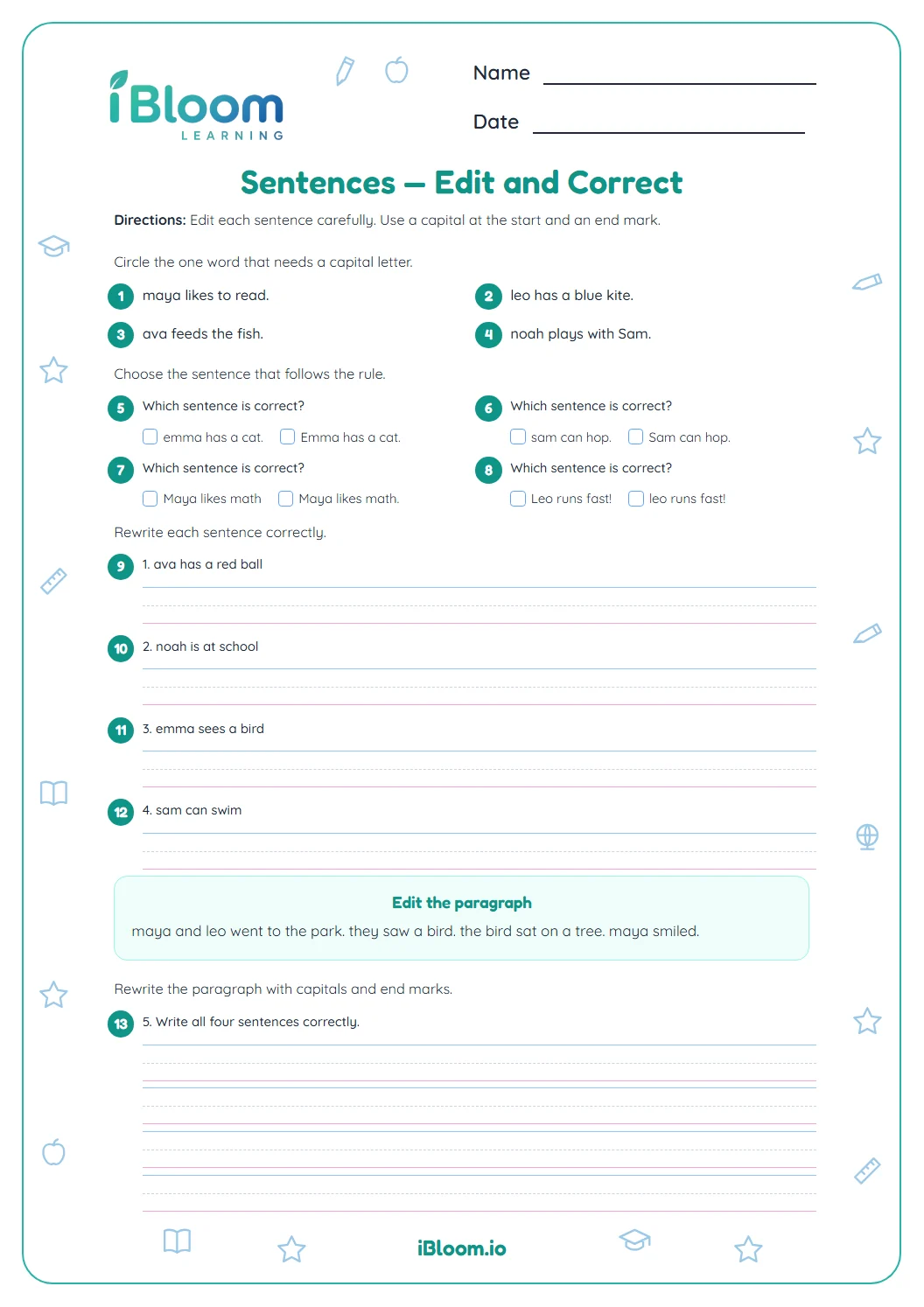
About this worksheet
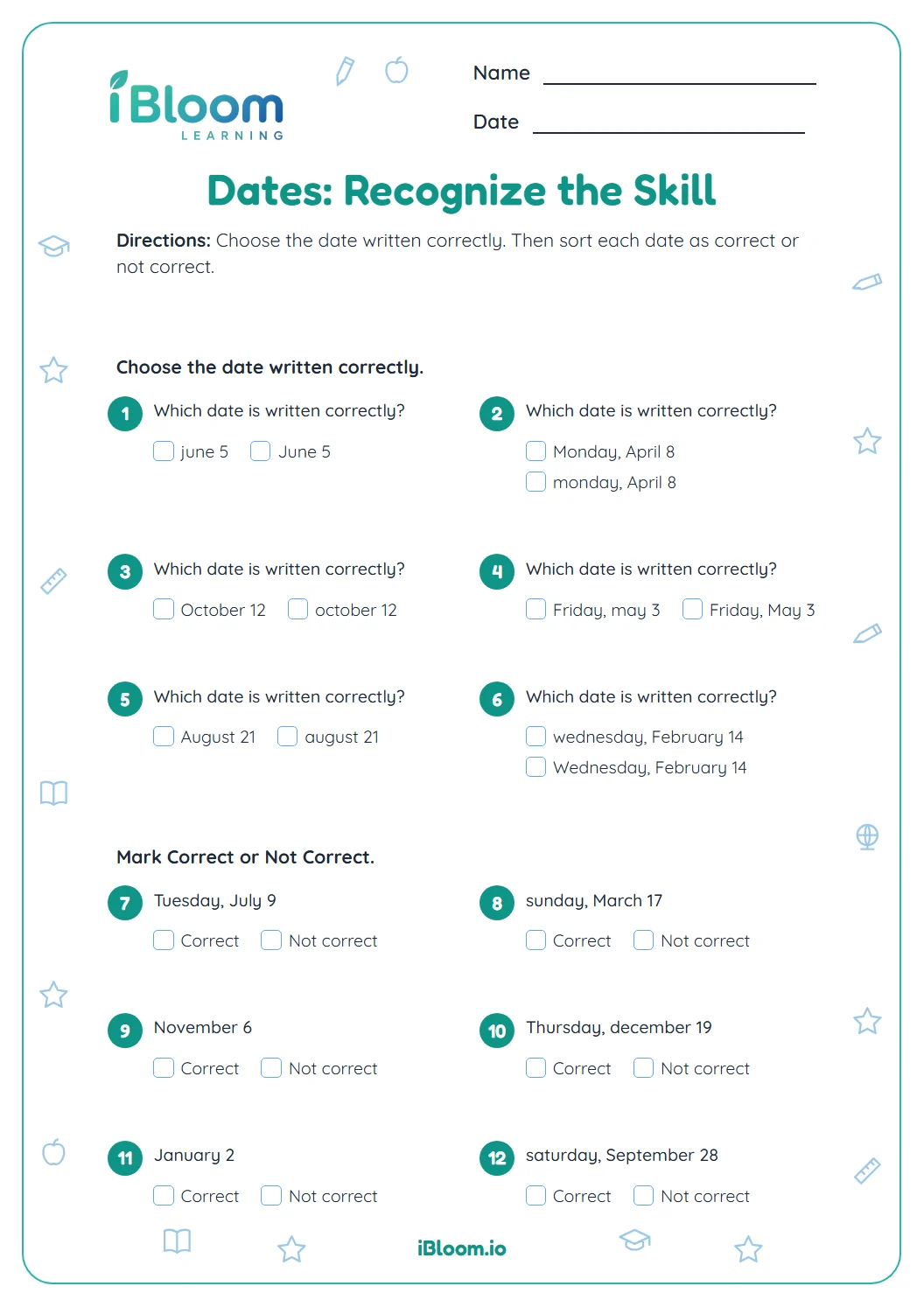
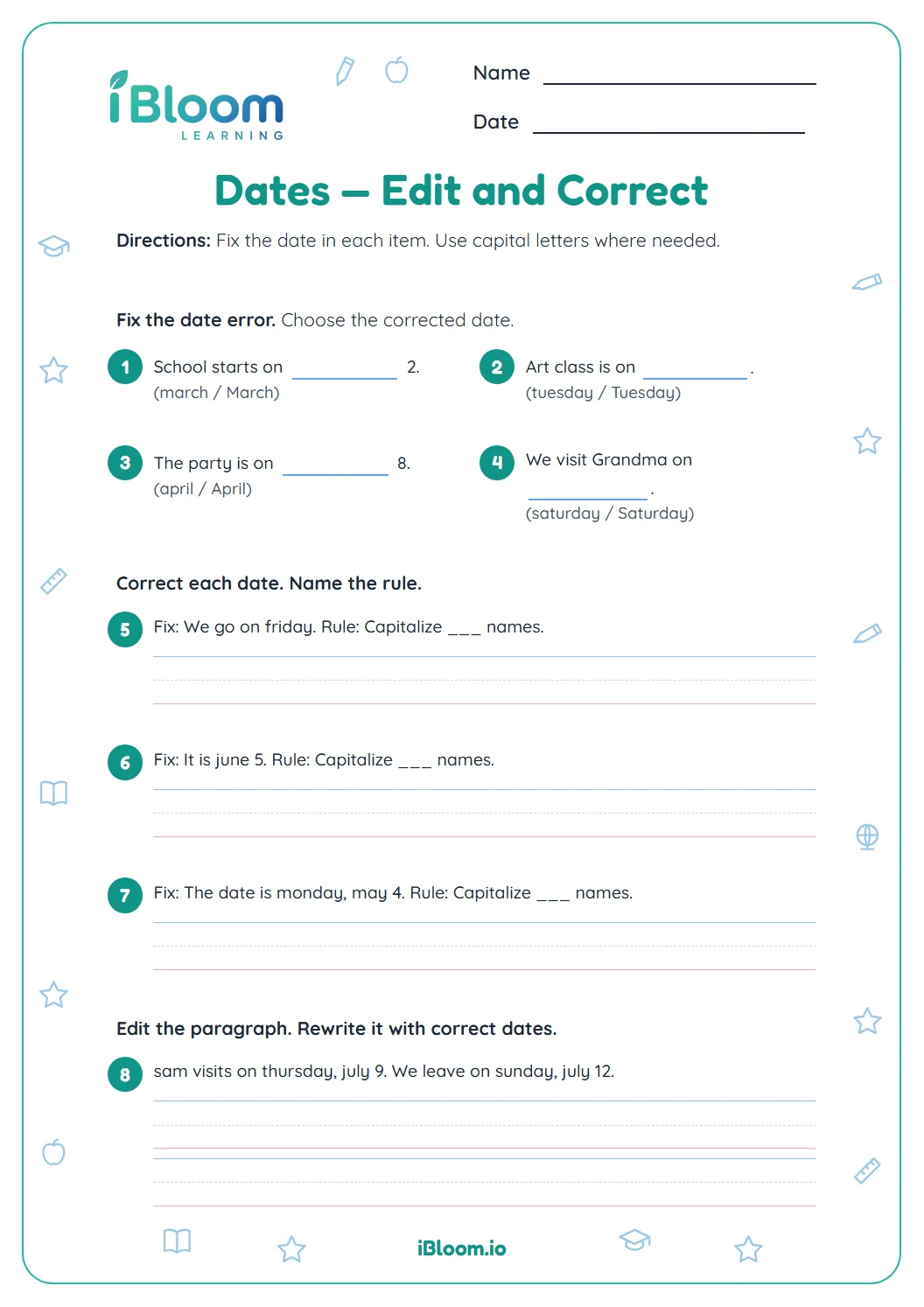
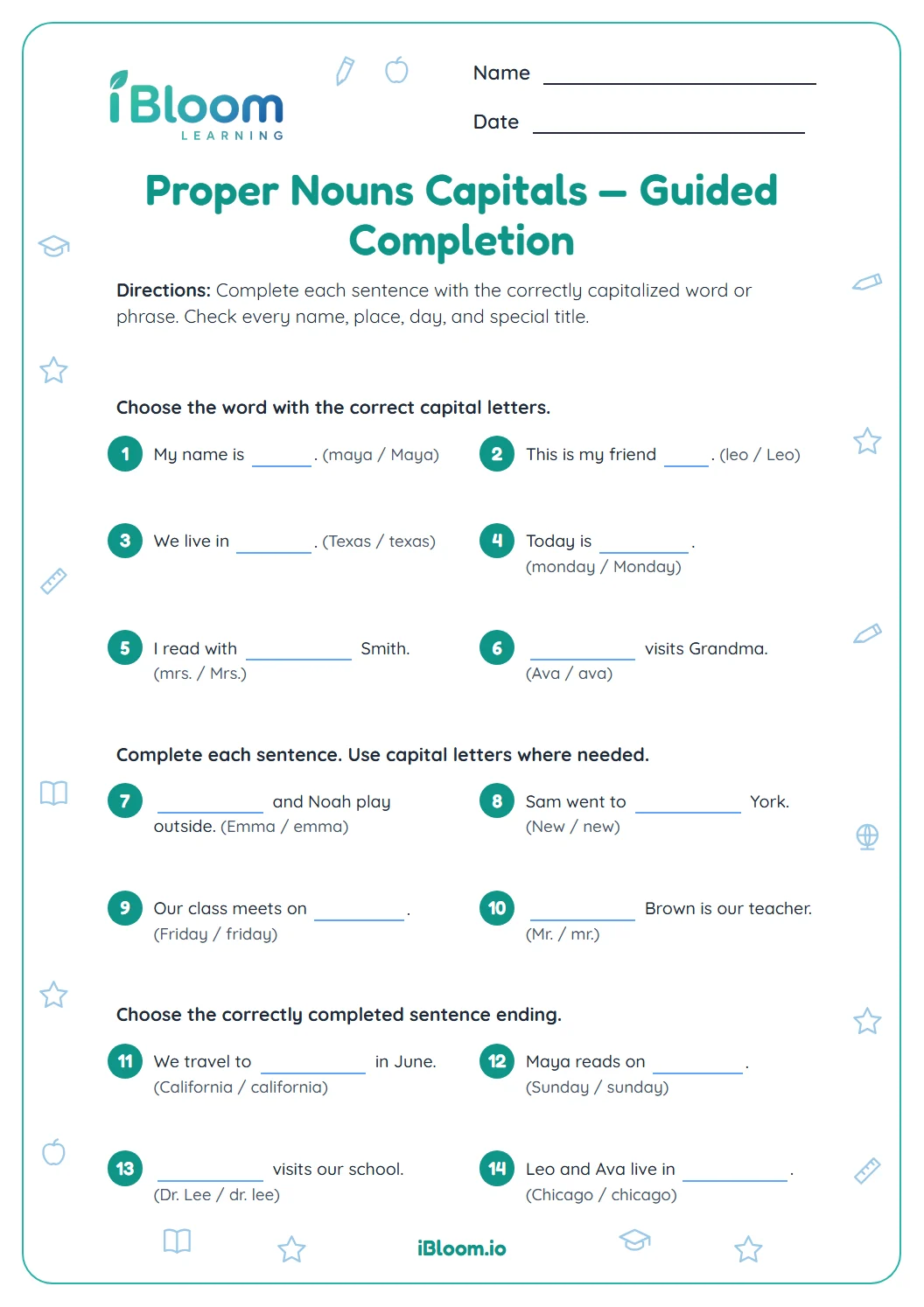
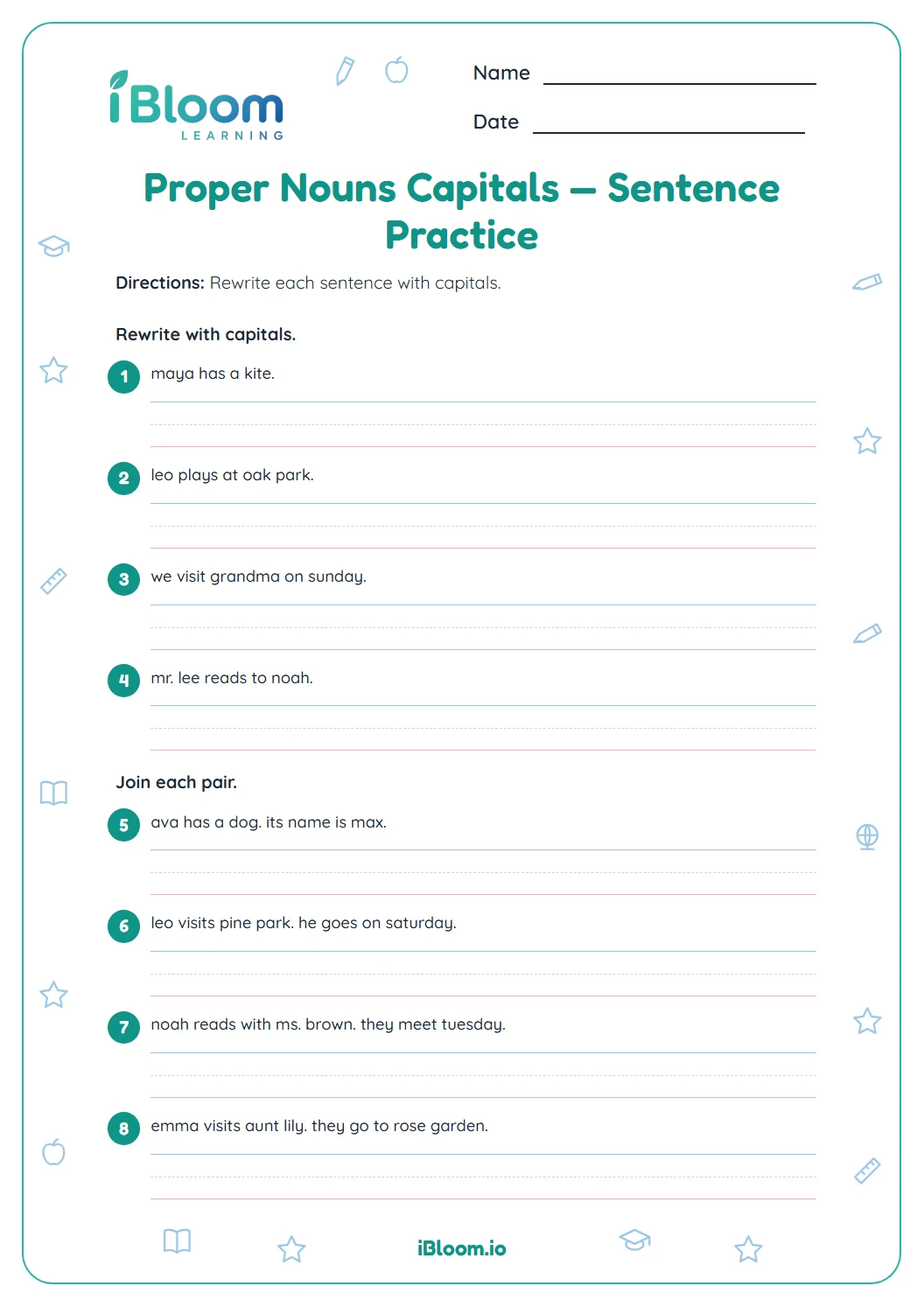
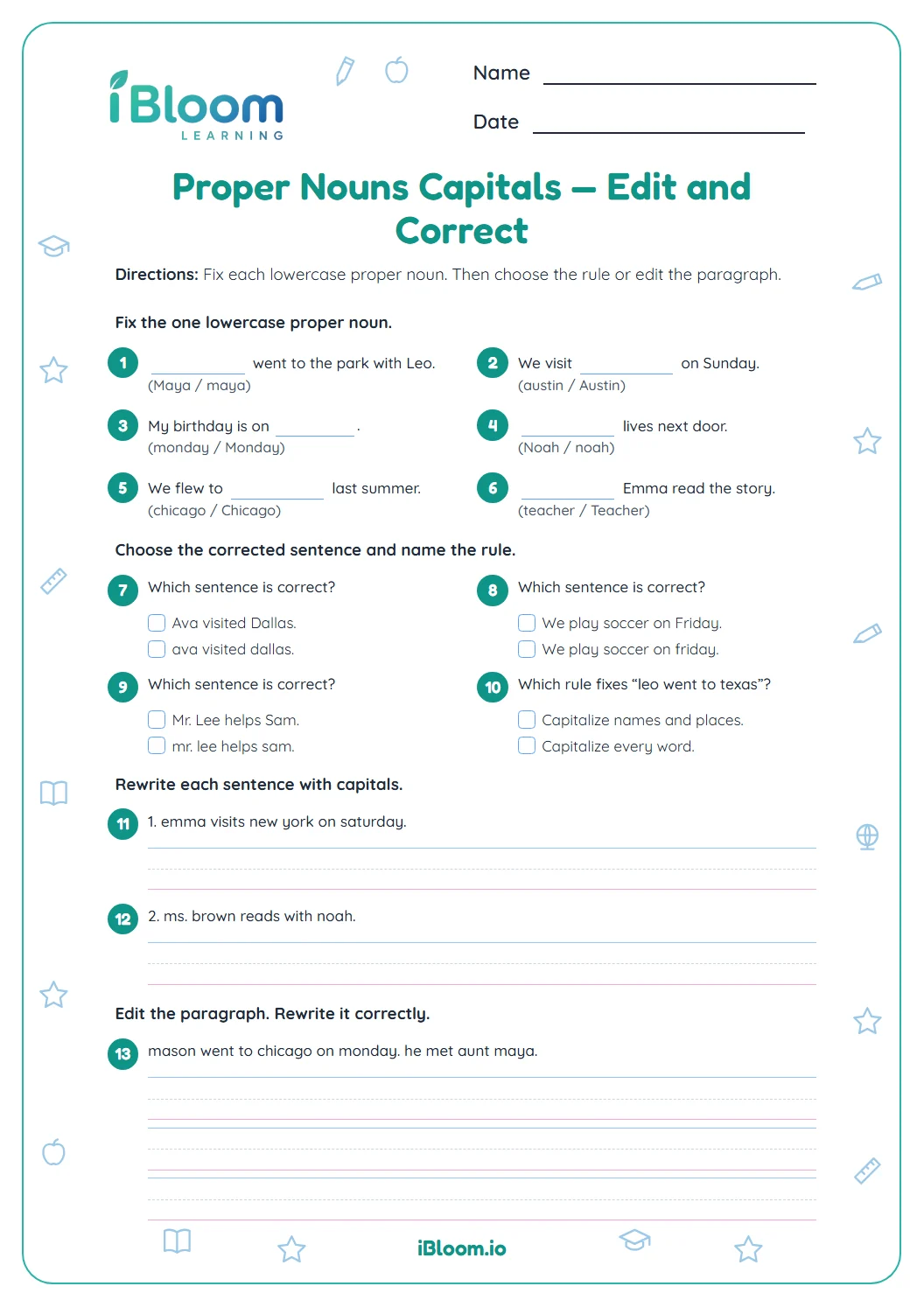
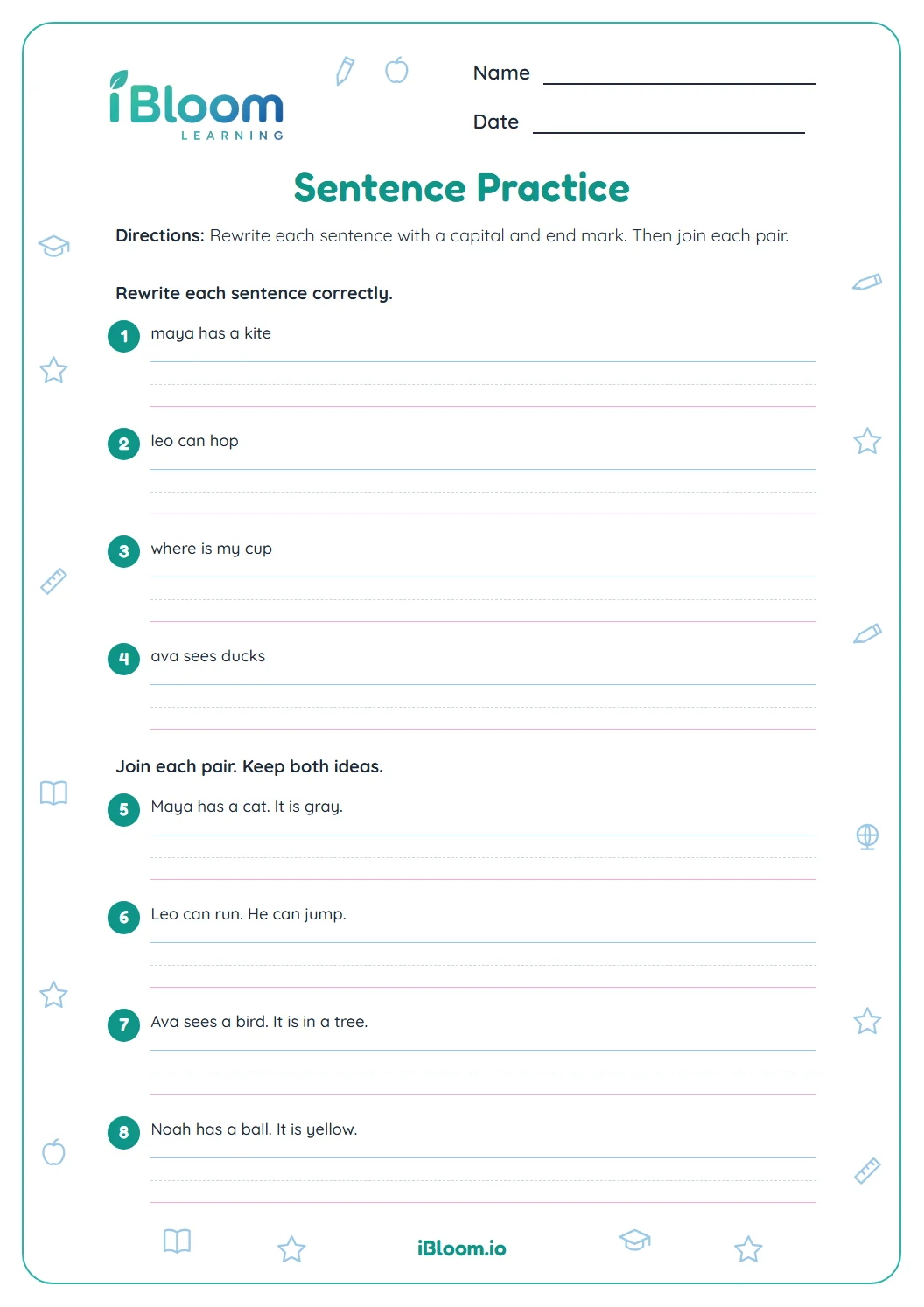
This free Grade 1 capitalization worksheet focuses on weekdays and months in dates. Children choose correctly written dates, fix lowercase examples, and complete sentences with a weekday or month. Fourteen questions move from recognition to editing and guided completion. The printable includes an answer key with sample words where more than one answer is possible, and practices CCSS L.1.2.a.
Aligned to L.1.2.a
Which parts of a date need capital letters?
Weekdays and months are names, so they begin with capital letters: Monday, April. The comma in a date such as Monday, April 8 separates the weekday from the month and day.
In question 5, “tuesday, march 5” becomes “Tuesday, March 5.” Both names need capitals, while the number stays the same.
- 1we go on tuesday, march 5.
- 2We go on Tuesday, March 5.
How can a date help complete a sentence?
A weekday or month can fill a blank in a date. Begin it with a capital letter, even in the middle of a sentence: “The picnic is on Monday, August 2.” The sample key gives one option, but other correctly spelled choices can fit.
How can children check a date?
Read the date word by word. Check the weekday, then the month. Keep the comma and number in place when rewriting a sentence.
How to use this worksheet
- 1Read each whole sentence and find its date.
- 2Check the weekday and month for capital letters.
- 3Choose a fully correct date when options are given.
- 4Rewrite the whole sentence when asked to fix it.
- 5For open blanks, choose any weekday or month that makes sense.
- 6Use the key to check capitals as well as spelling.
Common mistakes and quick fixes
The mistake
Leaving a weekday lowercase, as in “tuesday.”
The fix
Start the weekday with a capital: Tuesday.
The mistake
Capitalizing only the first word of the month, as in “july.”
The fix
Capitalize the month name: July.
The mistake
Writing every letter in capitals when the task asks for standard capitalization.
The fix
Use one capital at the beginning of the weekday and month, then lowercase letters.
Curriculum alignment
This worksheet practices the following standard.
Capitalize dates and names of people.
On this sheet: Children capitalize weekdays and months in written dates.
Show the official wordingHide the official wording
Capitalize dates and names of people.
What to practice next
Make more practice
Further reading
Questions parents and teachers ask
Which words in a date need capital letters?
Capitalize the weekday and month, as in Monday, April 8. The number does not need a capital letter. This worksheet asks children to recognize correctly capitalized dates, repair lowercase weekday and month names, and write capitalized names in date phrases.
Should a month be capitalized in the middle of a sentence?
Yes. Month names are capitalized wherever they appear, including in the middle of a sentence. For example, “We swim in August” keeps August capitalized. Questions 5, 6, and 11 ask children to correct sentences where a month or weekday begins with a lowercase letter.
Can my child give a different answer for a blank?
Yes, when a question asks for any weekday or month, several names can fit. The key gives one sample. Accept another correctly spelled weekday or month with its initial capital in the right place, as long as it makes sense in the date phrase.
What does the comma do in a date?
In a date such as Friday, May 10, the comma separates the weekday from the month and day. Keep it when rewriting a date sentence. The capitalization practice focuses on the weekday and month names; the comma and number stay as printed.
How many questions and pages are included?
The printable has 14 questions across three pages total, including a separate answer key page. Four questions ask children to choose a correctly capitalized form; the remaining ten ask them to correct or complete date words. The key shows sample answers for open blanks.