


About this worksheet
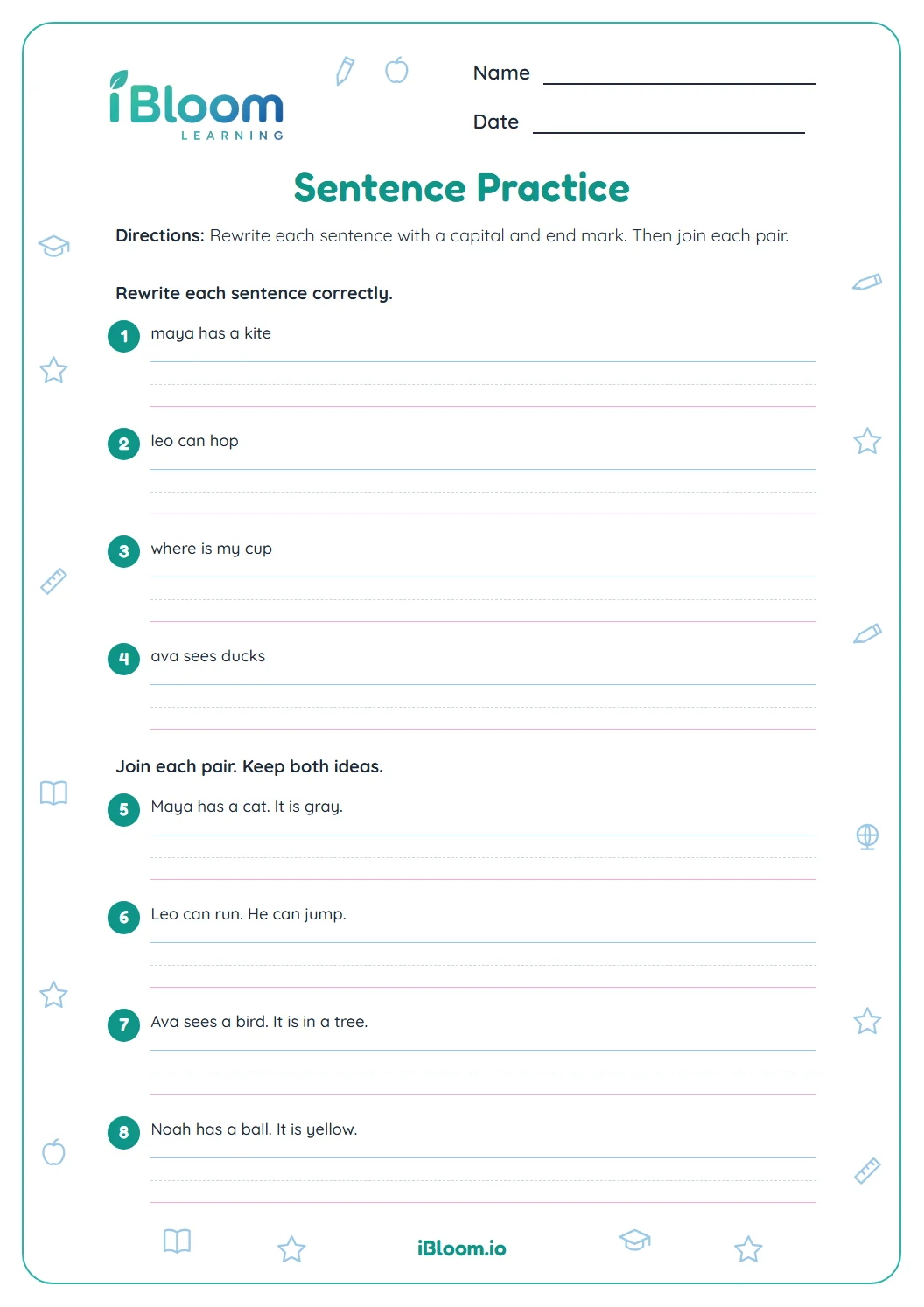
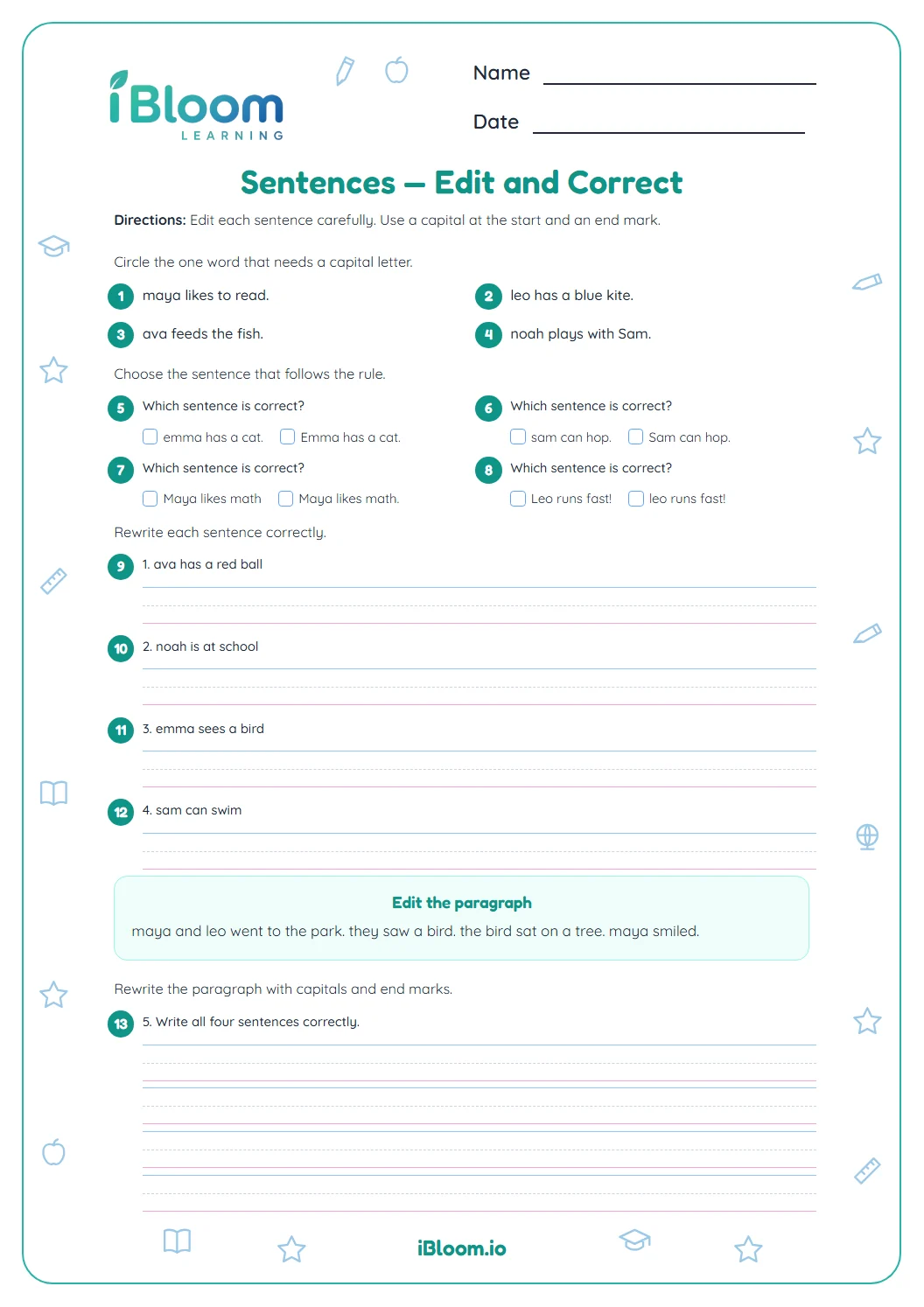
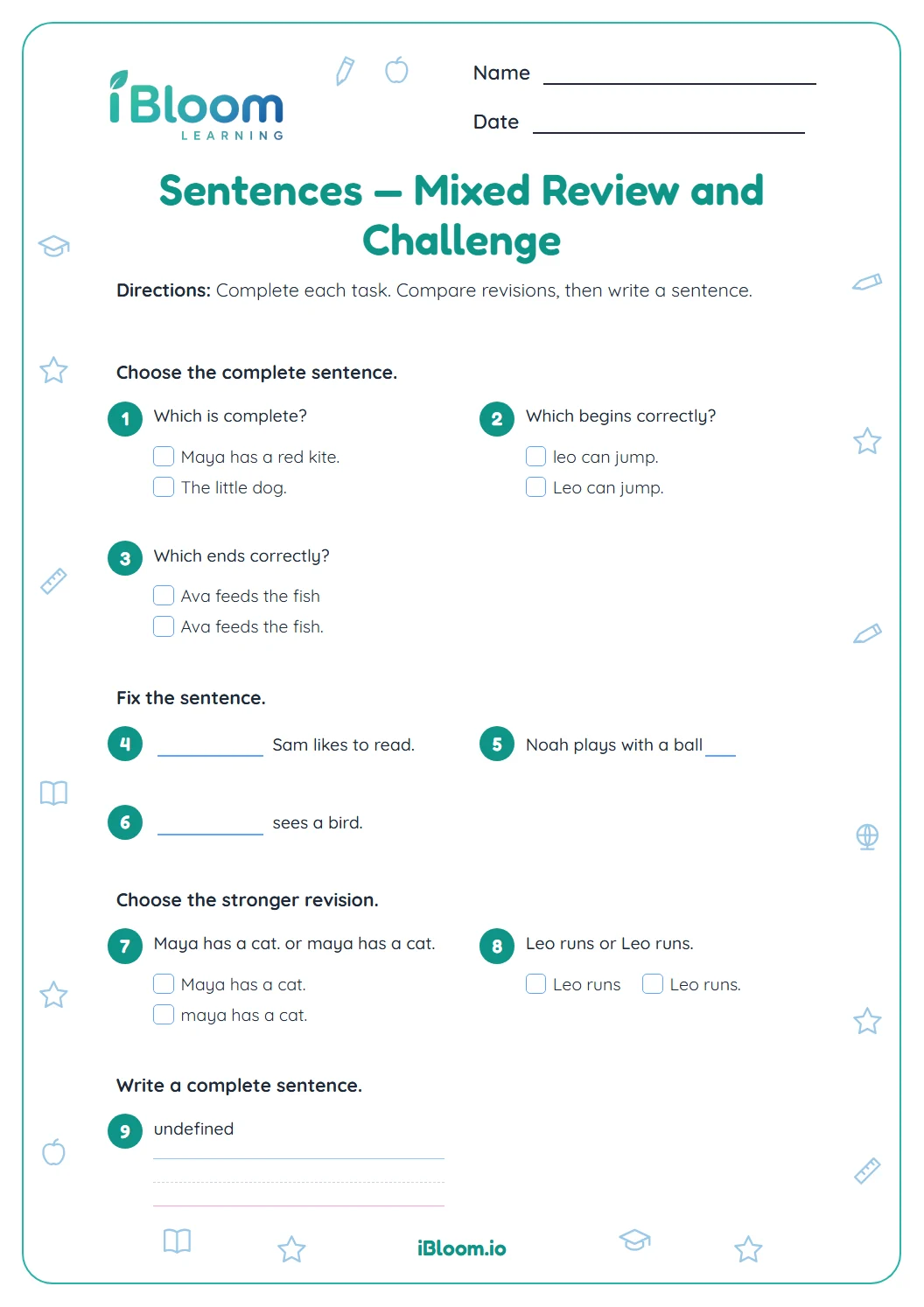
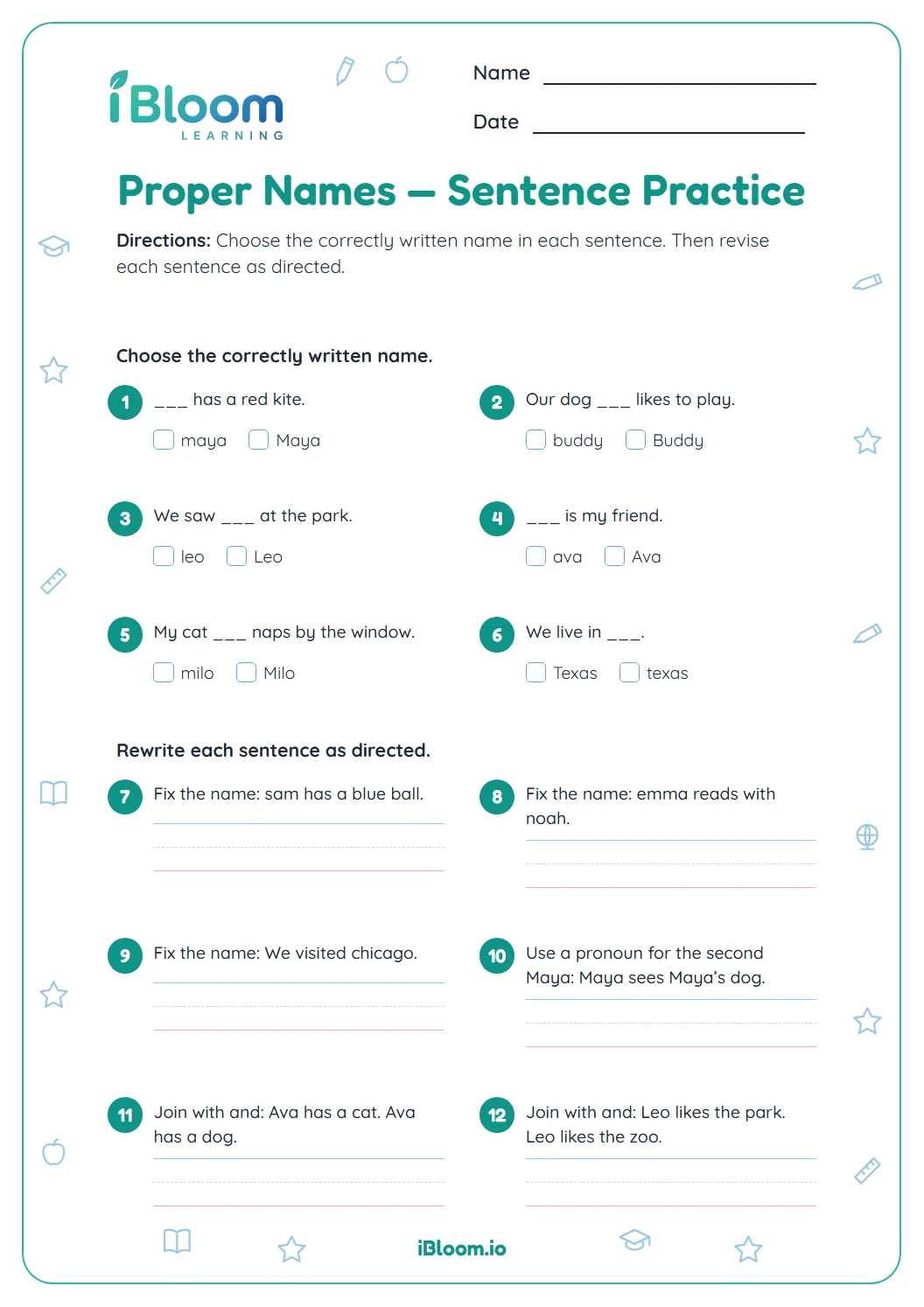
This free printable Grade 1 worksheet helps children carry capitalization into their own writing. Part A asks them to rewrite six short sentences, changing lowercase sentence beginnings and lowercase i to capitals. Part B gives four simple prompts for original sentences about play, food, a pet, and a question. Children check the first letter, the word I, and the ending mark each time. The work supports Common Core L.1.2, using written English conventions. A separate answer key shows the corrected sentences and sample responses for the open writing prompts.
Aligned to L.1.2
Which letters need to be capitals?
The first letter of a sentence needs a capital. The word I also needs a capital wherever it appears. In “the cat and i nap.” children must change two letters: the first t and the i.
The supplied sentences already have ending marks. Copy those marks when rewriting. In Part B, children choose a period for a statement or a question mark for a question.
How should children rewrite a sentence?
Read the whole sentence first. Find its first word, then look for the word i elsewhere. Rewrite the sentence with the needed capitals, keeping the remaining letters lowercase unless another capitalization rule applies.
- 1Question 5: the cat and i nap.
- 2The starts the sentence, so T is capital.
- 3The word I is always capital.
- 4Corrected sentence: The cat and I nap.
How does Part B help children apply the rule?
Children write four original sentences using the given starting words: I, I, The, and Can. The subjects are familiar so the main work is forming a complete thought and remembering its capitals.
Accept different ideas from the sample key. A sentence about a pet can describe an imagined animal. For the last prompt, check that the child has written a question and ended it with a question mark.
How to use this worksheet
- 1Read the first sentence aloud together.
- 2Point to the first word and say which letter needs a capital.
- 3Rewrite all six Part A sentences, checking for the word I.
- 4Say each Part B sentence aloud before writing it.
- 5Reread each sentence. Check its first letter, the word I, its ending mark, and whether it tells a complete thought.
Mistakes to catch and correct
The mistake
Capitalizing every word: The Dog Runs.
The fix
Keep the capital at the sentence beginning; dog and runs stay lowercase.
The mistake
Leaving i lowercase in “The cat and i nap.”
The fix
Find the single-letter word and replace it with I.
The mistake
Writing “Can you run.” for the final prompt.
The fix
Read it as a question and change the period to a question mark.
Common Core alignment
Capitalize sentence beginnings and I, and use ending punctuation when writing sentences.
On this sheet: Children rewrite sentences with capitals and write their own complete, punctuated sentences.
Show the official wordingHide the official wording
Demonstrate command of the conventions of standard English capitalization, punctuation, and spelling when writing.
What to practice next
Make more practice
Further reading
Questions parents and teachers ask
What capitalization rules does this worksheet practice?
It practices capitalizing the first word of a sentence and the word I. Children first apply those rules to six supplied sentences, including two with I inside the sentence. They then write four sentences of their own and check their starting capitals and ending punctuation.
Should my child copy the whole sentence in Part A?
Yes, children rewrite the entire sentence with corrected capitals and the supplied ending mark. Copying the whole sentence lets them apply the rule in context. After writing, ask them to compare the original with their version and point to each letter they changed to a capital.
Can I help my child spell words in Part B?
Yes, you can supply a spelling after your child decides what to say. Keep the child responsible for the starting capital, the word I, and the ending mark. Saying the sentence aloud before writing can help them hold the whole idea while they work on individual words.
Does my child need a real pet for question 9?
No, the pet sentence can describe an imagined pet or an animal your child knows. The prompt gives The as the starting word. A response such as “The cat is soft.” works because it expresses a complete thought, starts with a capital, and ends with a period.
How do I use the sample answers?
Use the first six answers to check the rewritten sentences exactly, including their capitals and ending marks. The last four answers are examples, so children may write different ideas. Check that each response follows its prompt, begins correctly, expresses a complete thought, and has an appropriate ending mark.