
About this worksheet
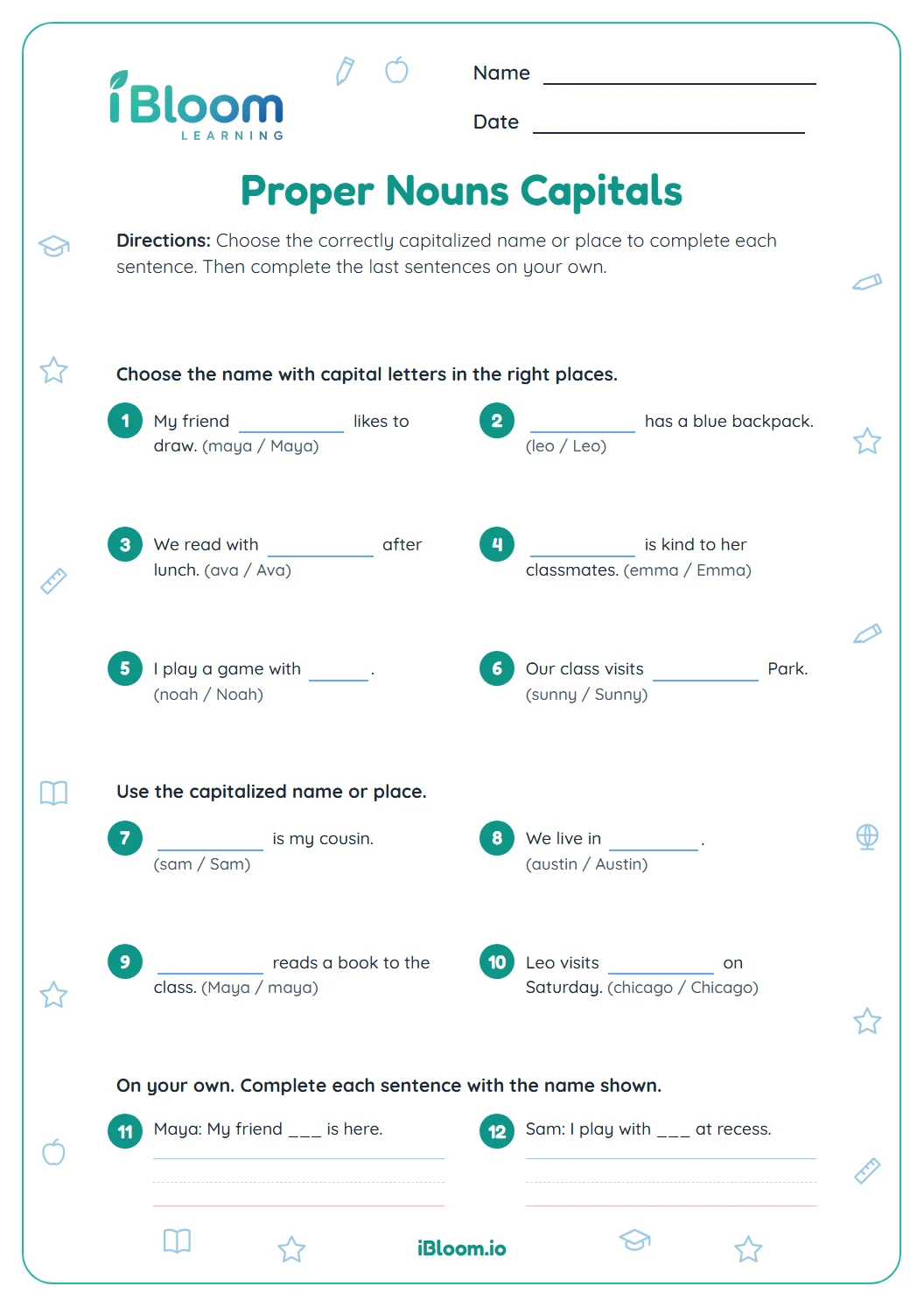
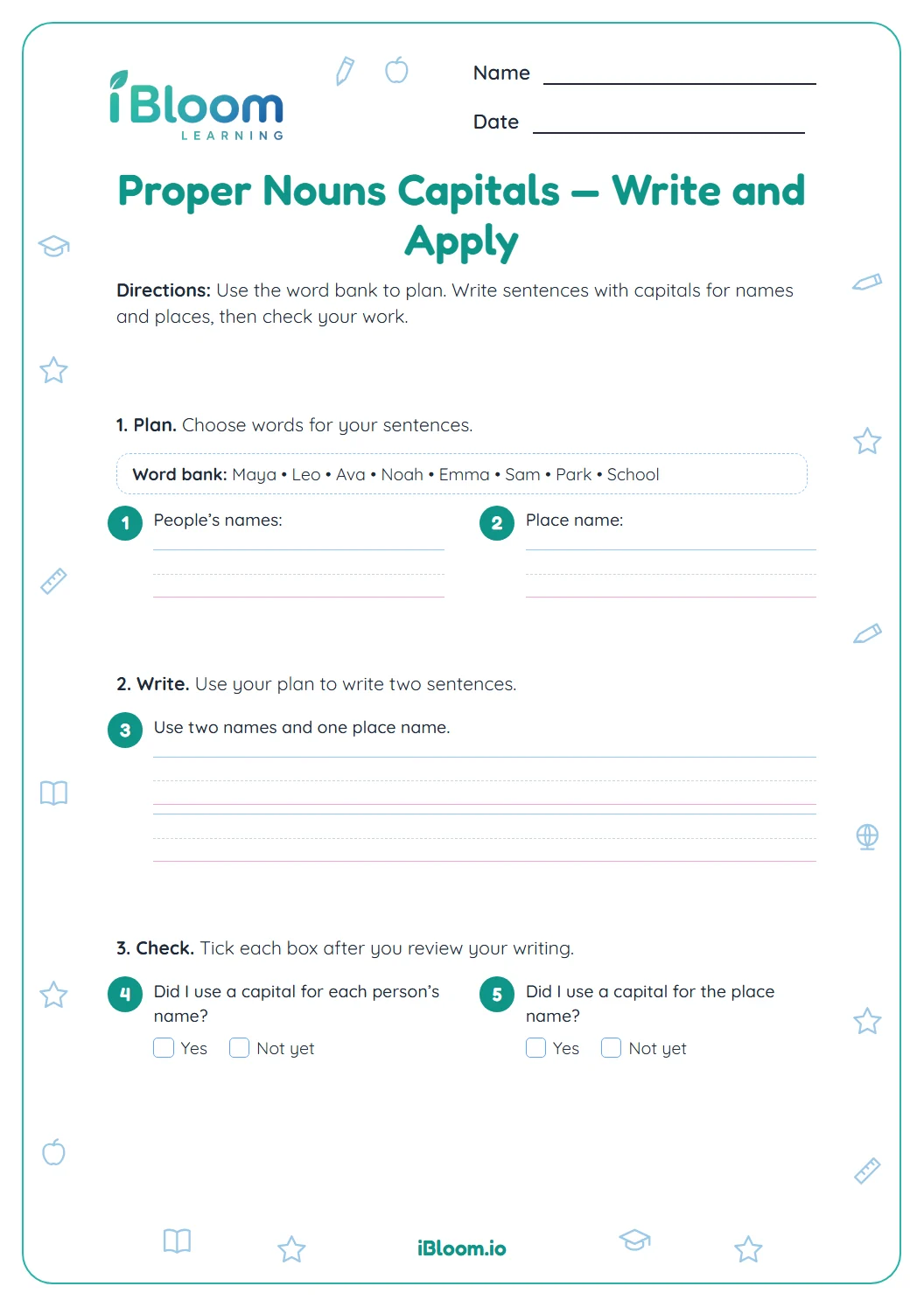
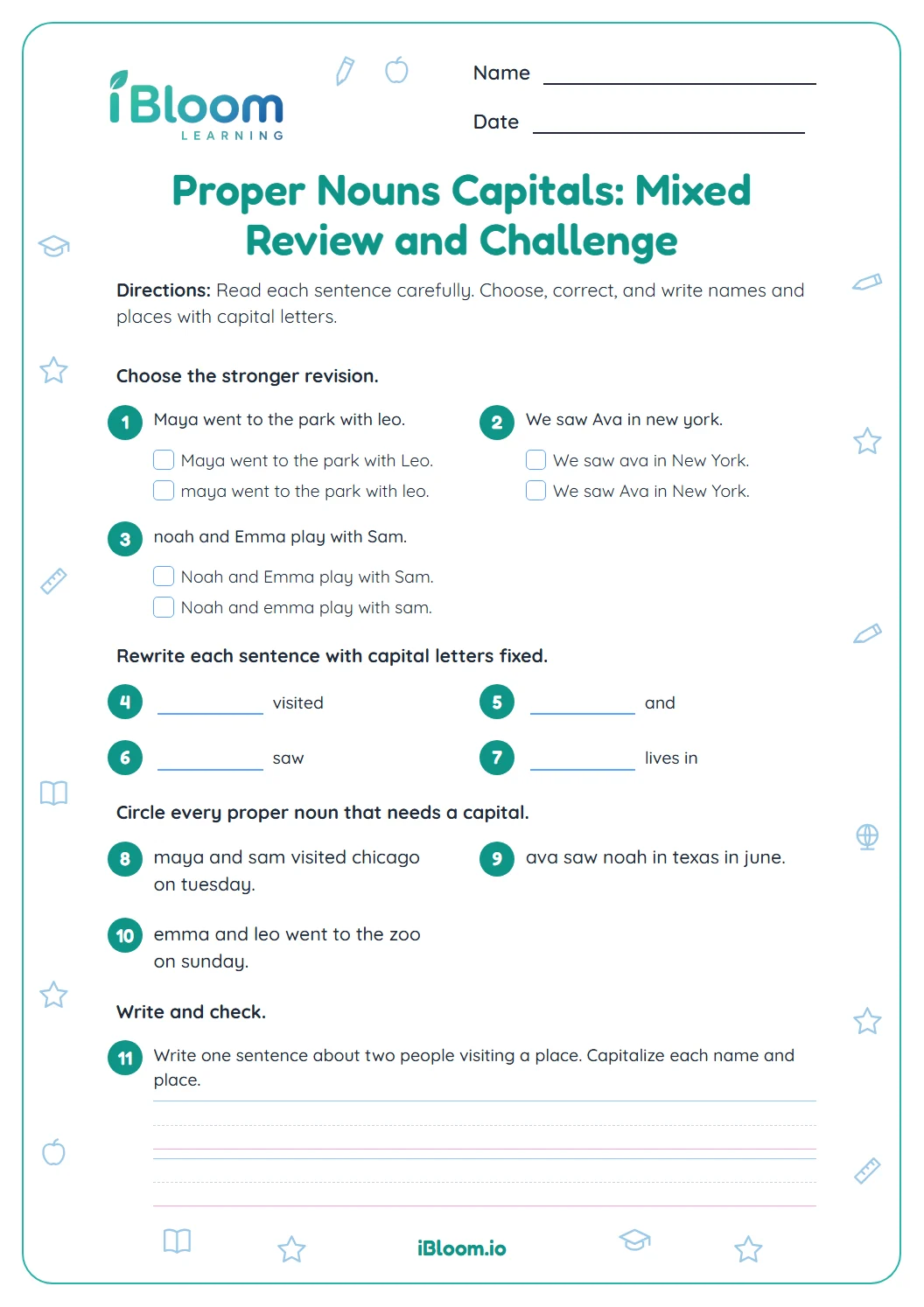
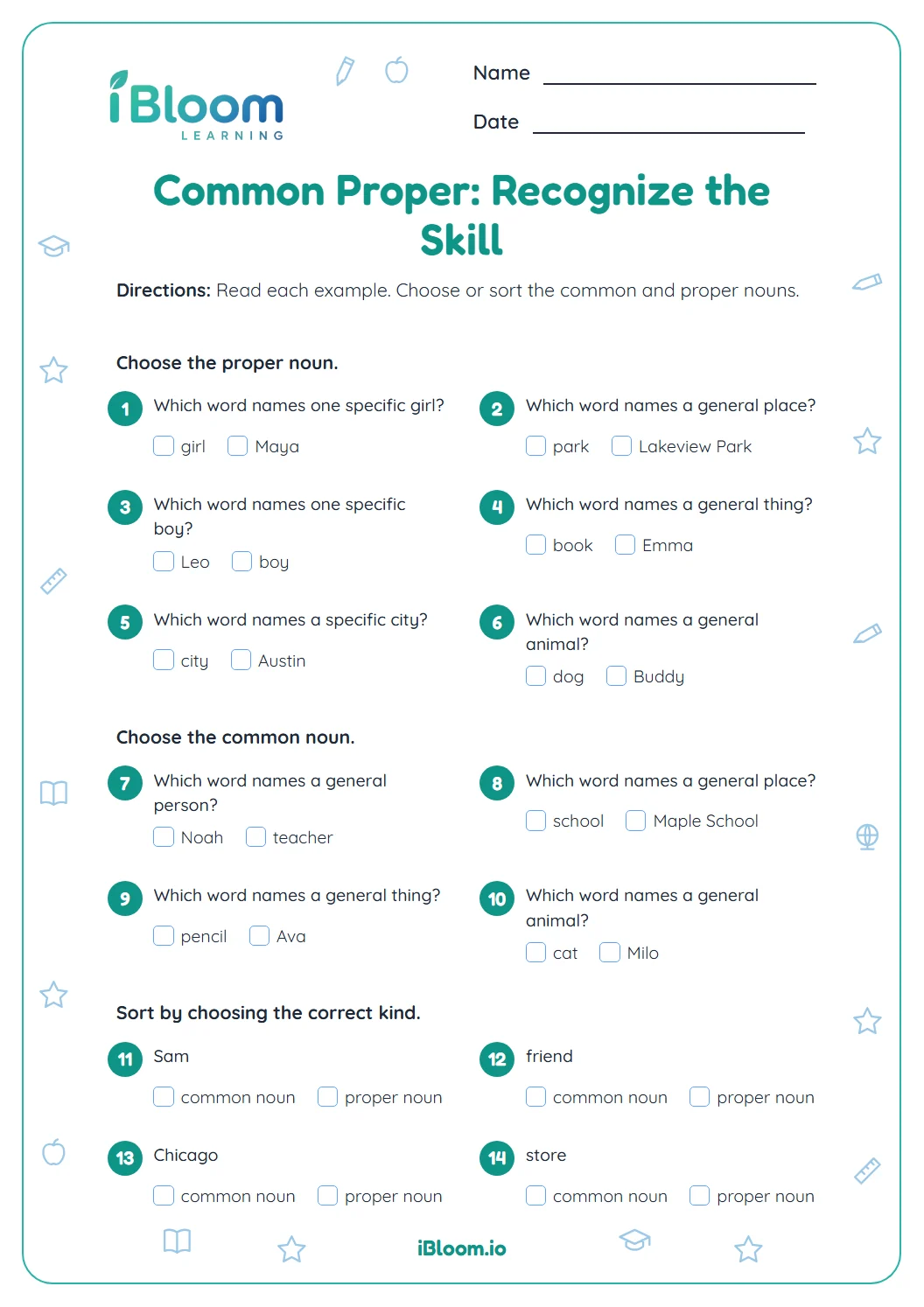
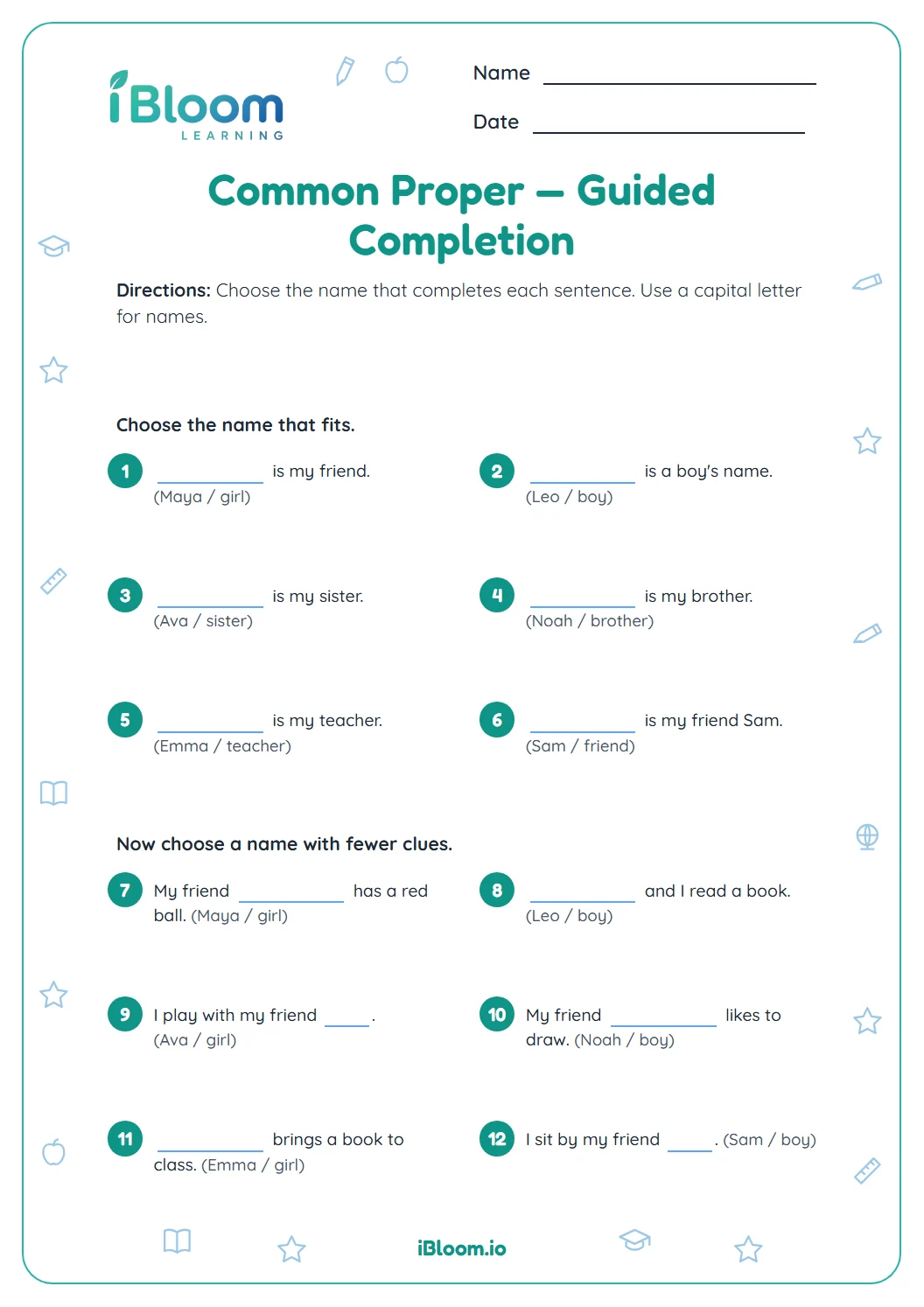
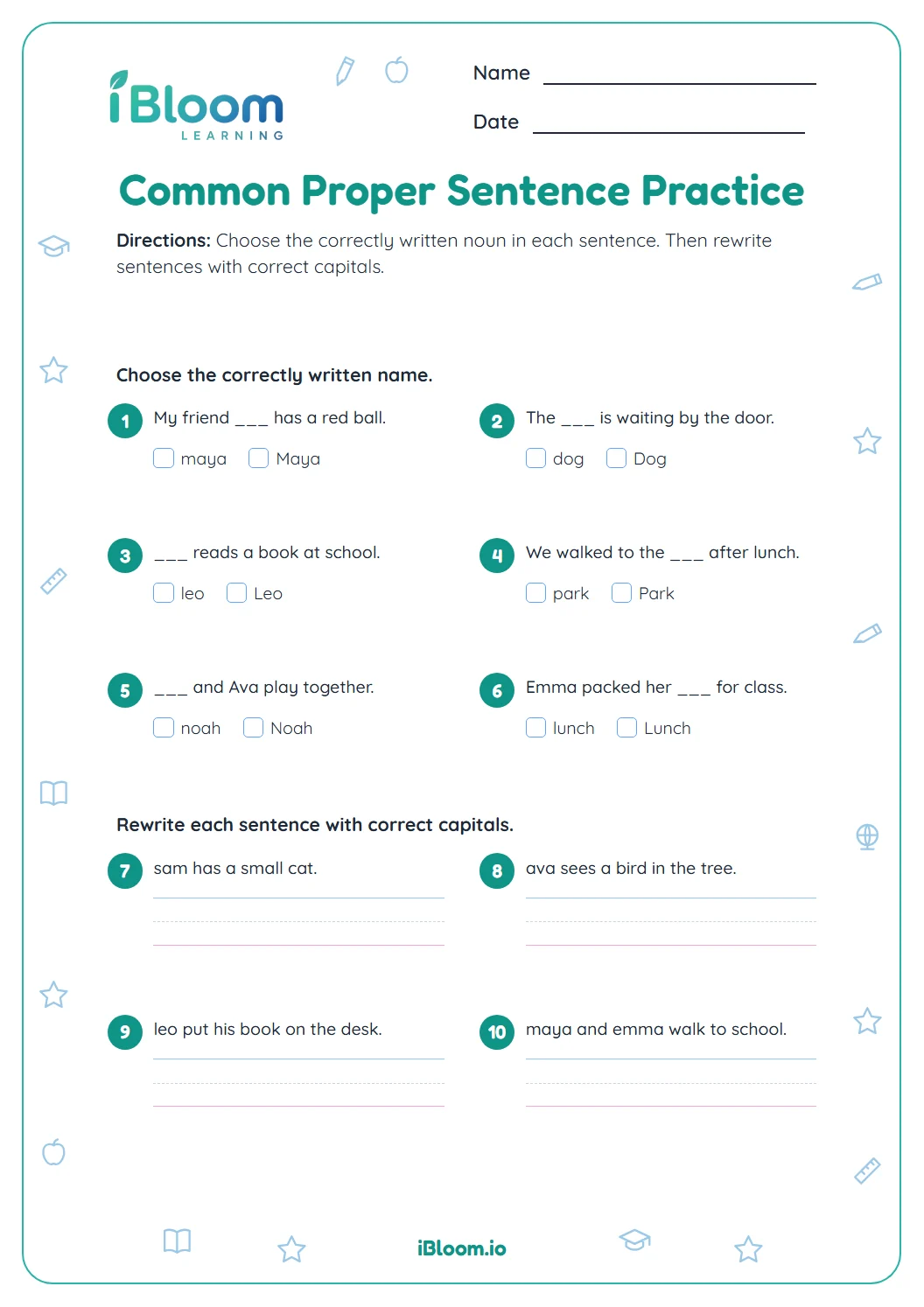
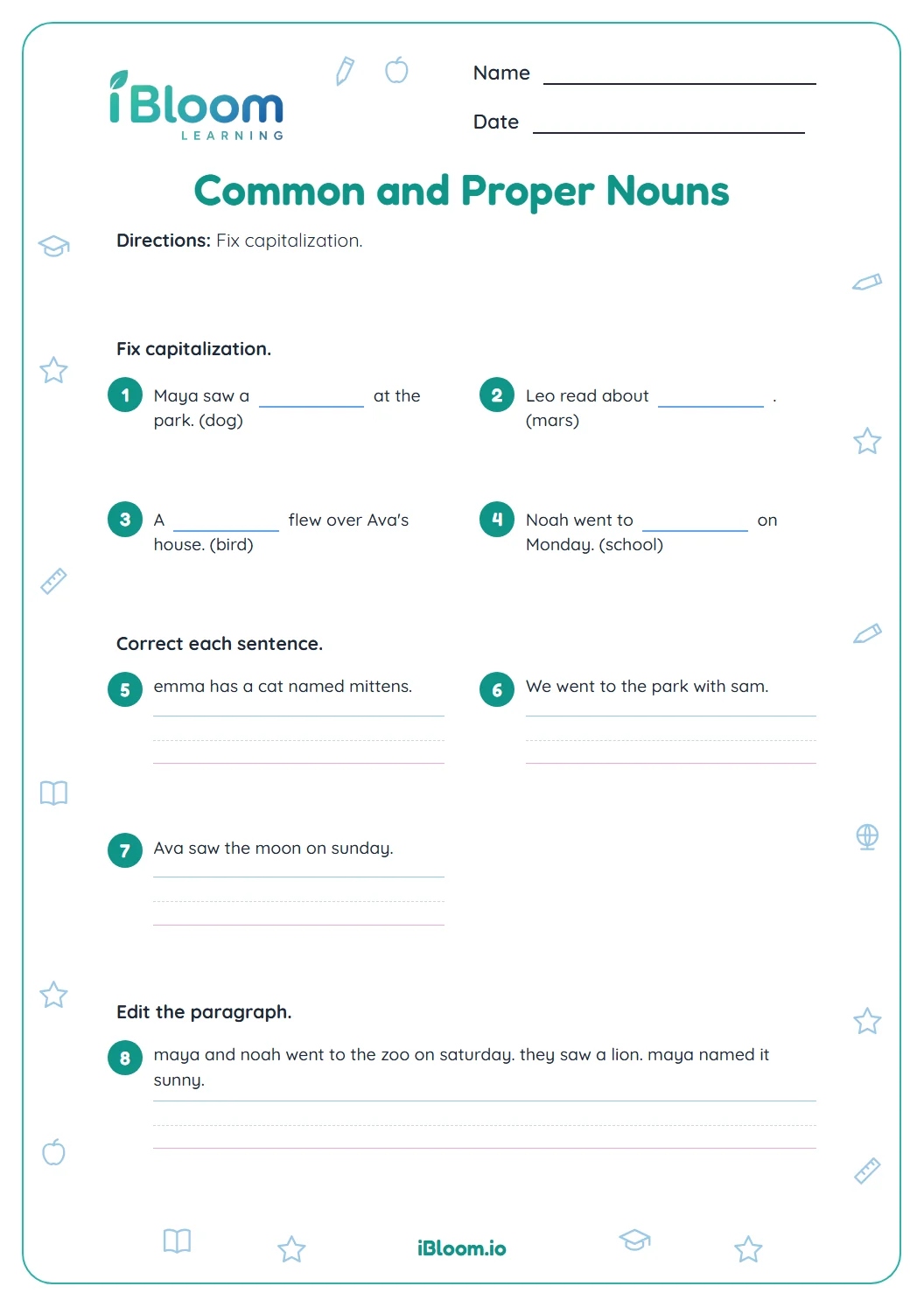
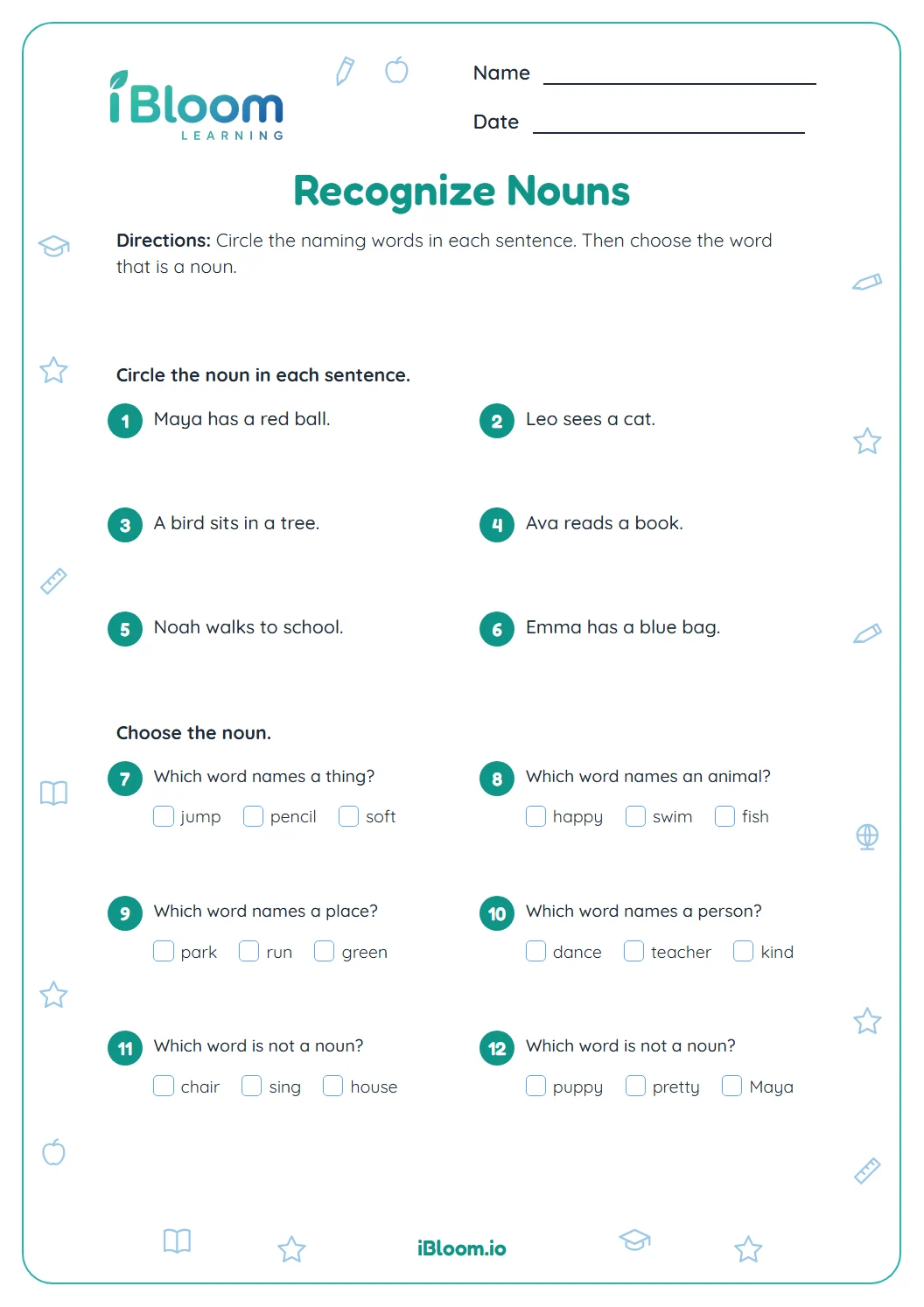
This Grade 1 worksheet gives children focused practice capitalizing proper nouns in sentences. They choose correctly written sentences, complete blanks with people’s names and place names, and edit or write short sentences using capital letters. The 14 questions move from spotting a capital to using names independently. A separate answer key lists selected answers and sample sentences, so adults can check the capitalization while accepting children’s own appropriate sentences.
Aligned to L.1.2
How can you spot a person’s name?
A person’s name tells exactly who someone is, such as Maya or Leo. A place name identifies a specific place, such as Texas or Florida. Both kinds of proper nouns begin with a capital letter wherever they appear in a sentence.
- 1We saw maya.
- 2The name appears after the first word.
- 3Correct: We saw Maya.
Where does the capital letter go?
Capitalize the first letter of the name, not every letter. In “Noah and I play,” N is uppercase and the other letters in Noah are lowercase. Questions 7–10 add a name to a sentence frame.
How can children check their own name sentences?
Read the sentence and look for each person’s name. Check the first letter of every name, including a name that comes after “and.” The final questions invite children to write sentences; the key gives models while other sensible sentences using capitals are acceptable.
How to use this worksheet
- 1Read the whole sentence before choosing an answer.
- 2Find the person’s name, even if it is in the middle.
- 3Check that the first letter of the name is uppercase.
- 4Write only the first letter as a capital, then continue with lowercase letters.
- 5Read your own sentence once more and check every name.
Common mistakes and quick fixes
The mistake
Capitalizing only a name at the beginning of a sentence.
The fix
Names stay capitalized wherever they appear, as in “We saw Maya.”
The mistake
Writing every letter in a name as a capital.
The fix
Use a capital for the first letter and lowercase letters for the rest: Noah.
The mistake
Forgetting the second name in a sentence with “and.”
The fix
Check each person’s name separately: both Ava and Noah need capitals.
Common Core alignment
The worksheet practices capitalization of people’s names in simple sentences.
Use standard capitalization when writing names and sentences.
On this sheet: Children capitalize people’s names and place names in sentence choices, blanks, and short writing.
Show the official wordingHide the official wording
Demonstrate command of the conventions of standard English capitalization, punctuation, and spelling when writing.
What to practice next
Further reading
Questions parents and teachers ask
Why does a person’s name begin with a capital letter?
A proper noun names a specific person or place, and its first letter is capitalized. Maya, Leo, Texas, and Florida are examples used on this worksheet. The capital stays even when the name appears in the middle of a sentence, as in “We live in Texas.”
Do children capitalize every letter in a name?
No. Capitalize the first letter and write the rest in lowercase: Maya, not MAYA. Questions 7–10 ask children to use that pattern when adding a name to a sentence. Then they can read the sentence aloud and check the name again.
What if two names appear in one sentence?
Capitalize each proper noun in the sentence. In “Ava went to Florida,” A and F are uppercase because Ava and Florida name a specific person and place. Question 10 asks students to add the state name with its capital letter.
Are names capitalized in the middle of a sentence?
Yes. A person’s name keeps its capital wherever it appears. Question 5 contrasts “We saw Maya” with a version that begins Maya with a lowercase letter after the first word. This is a useful reminder that names keep their capitals in the middle of sentences.
Can my child write a different sentence from the answer key?
Yes. The key gives sample sentences for the open-ended items. A different sentence works if it follows the prompt, includes the requested names, and capitalizes every person’s and place’s name. The sample is a model, so the child’s wording may be different.
Is there an answer key?
Yes. The answer key shows the correct choices and sentence-fill answers, plus sample responses for the four writing questions. Use the samples to check capitalization while allowing other clear, appropriate sentences. Look for a capital at the start of each proper name.