


About this worksheet
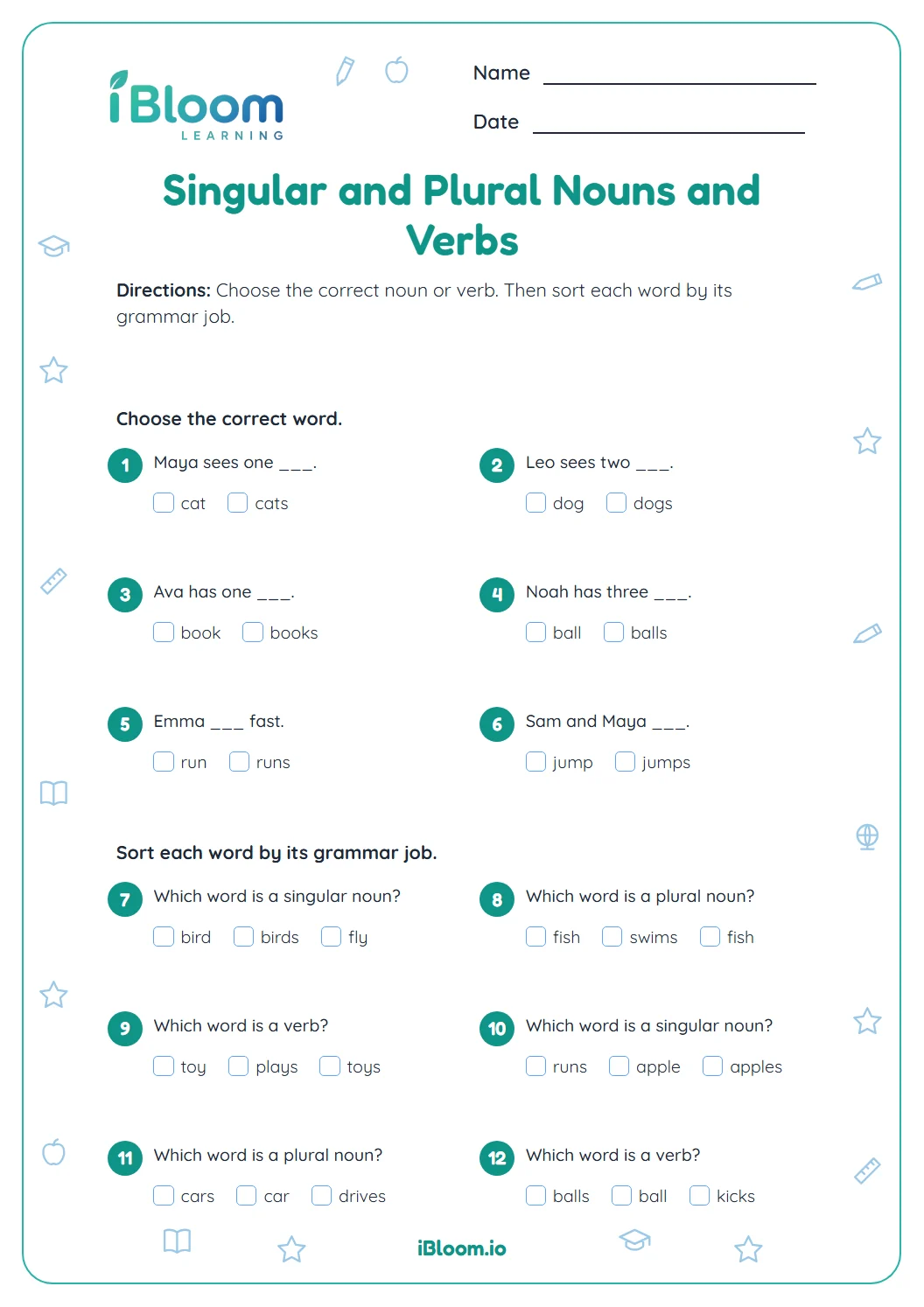
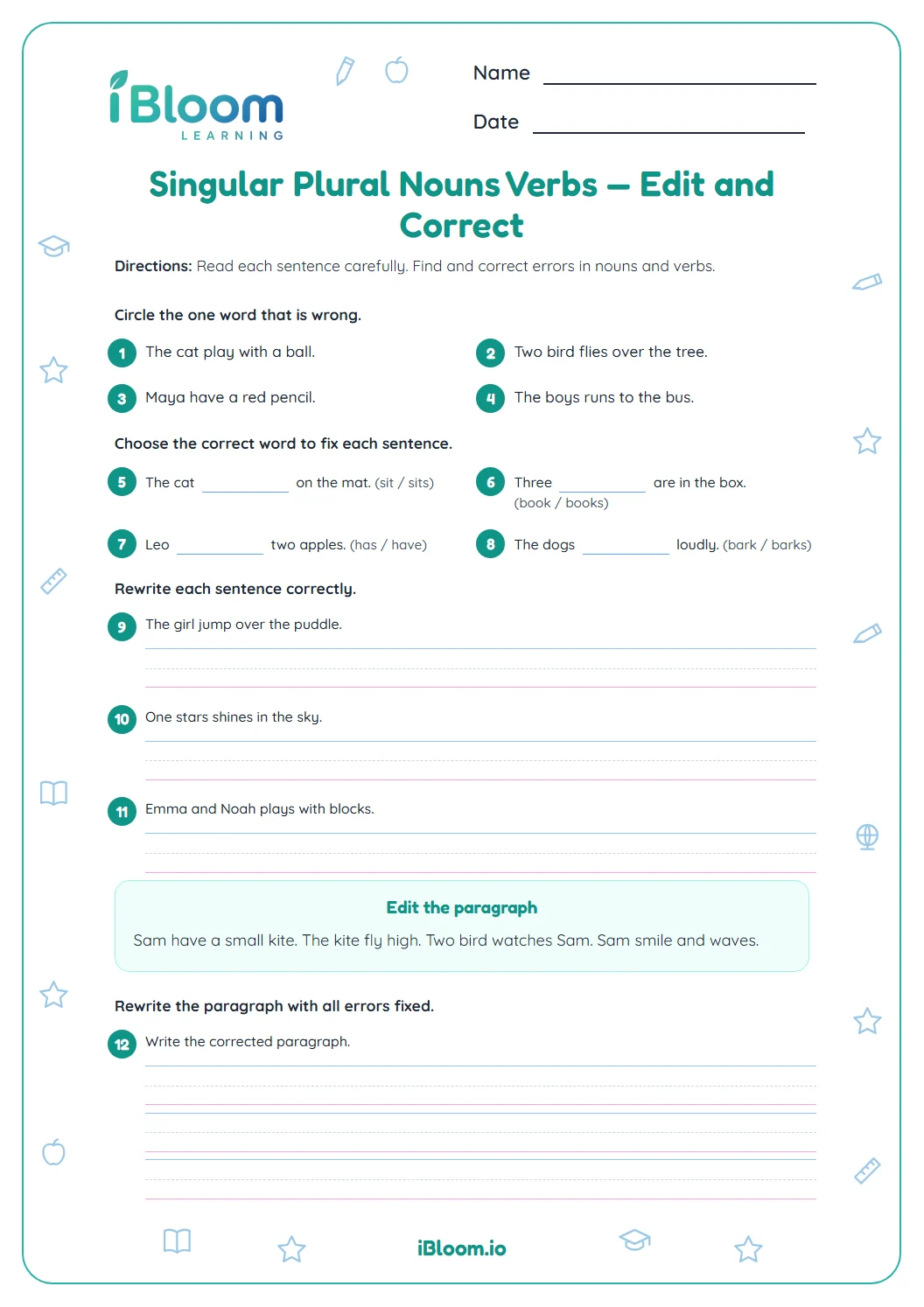
This free Grade 1 worksheet helps children match a singular or plural noun with the right present-tense verb. Part A uses one-or-more clues to complete noun blanks. Part B supplies two verb choices, and Part C gives a completed sentence as a guide for changing the subject from one to more than one, or back again. The 16 short sentences use familiar animals, people, and actions. The work practices Common Core L.1.1.c, using singular and plural nouns with matching verbs in basic sentences. A separate answer key supplies every missing word.
Aligned to L.1.1.c
What changes when one becomes more than one?
The noun and verb can both change. One dog runs becomes Two dogs run. The plural noun dogs gains s, while the verb run loses the s used with one dog. The box pair also shows that some plural nouns add es.
Read both sentences aloud while pointing to the subject. Keep attention on who is doing the action. The paired forms make the number clue clear.
- 1One ___ runs. Choose dog.
- 2Two ___ run. Choose dogs.
- 3One box is open; two boxes are open.
What help is built into each part?
Part A gives four noun blanks with two printed choices, including dog/dogs and box/boxes. Part B gives eight verb blanks with two choices. Number words and noun endings help children decide whether the subject names one or more than one.
Part C gives four sentence pairs. The completed first sentence supplies the action word, and the child changes its form to fit the new subject. The last pair uses buzz and buzzes: add es to buzz when one bee does the action.
How can children check a completed sentence?
First find the subject and say whether it names one or more than one. Then read the sentence with the selected verb. In The girls play after school, girls names more than one, so play fits.
If a child guesses by sound alone, return to a concrete pair such as one frog and two frogs. Say One frog jumps, then change only the number of frogs and ask for the matching action word.
How to use this worksheet
- 1Read One dog runs and Two dogs run aloud, pointing to both changed words.
- 2Use the number words in Part A to choose each noun.
- 3In Part B, name the subject before choosing the action word.
- 4For Part C, use the first sentence to find the action, then match it to the new subject.
- 5Check each missing word with the key and reread the complete sentence.
Mistakes to notice and how to help
The mistake
Writing “Two box are open” because the plural ending was missed.
The fix
The word two means more than one, so box becomes boxes. Reread “Two boxes are open.”
The mistake
Writing “Two cats sits” by adding s to both words.
The fix
Compare one cat sits with two cats sit; the noun and verb do different jobs.
The mistake
Writing “One bee buzz” after reading “Three bees buzz.”
The fix
One bee needs buzzes. Say the completed sentence together and point out the es ending.
Common Core alignment
Complete basic sentences with singular or plural nouns and matching verbs.
On this sheet: All three parts use one-or-more subjects to choose the noun or verb form that fits.
Show the official wordingHide the official wording
Use singular and plural nouns with matching verbs in basic sentences (e.g., He hops; We hop).
What to practice next
Make more practice
Further reading
Questions parents and teachers ask
What is the main skill on this worksheet?
The main skill is matching a singular or plural noun with its present-tense verb. Children first complete noun blanks, then choose matching verbs, then change verbs using sentence clues. The pairs make the difference visible: one dog runs, while two dogs run. This practices Common Core L.1.1.c.
Why does dogs have an s while run does not?
In “Two dogs run,” dogs names more than one animal, so the noun has a plural s. The verb run matches that plural subject. In “One dog runs,” the subject names one animal, and runs is the matching verb form. The sheet also shows box becoming boxes.
Can I read the sentences aloud to my first grader?
Yes. Read each sentence and both choices aloud, then let your child supply the missing word. Keep the one-or-more clue audible, especially words such as one, two, and three. After the child writes an answer, reread the full sentence together to connect the spoken pattern with the written words.
How do the last four questions provide guidance?
Each gives a complete sentence followed by a sentence with a different subject and a missing verb. For example, “One frog jumps” helps children finish “Two frogs ___.” They keep the same action but change the verb form. The final item practices buzzes after the model sentence uses buzz.
How should I respond to “One bee buzz”?
Help the child change buzz to buzzes. Say “Three bees buzz” and “One bee buzzes” side by side, pointing out that the second subject names one bee. The key lists buzzes for the last item. Children can then reread the complete pair to hear and see the change.