





About this worksheet
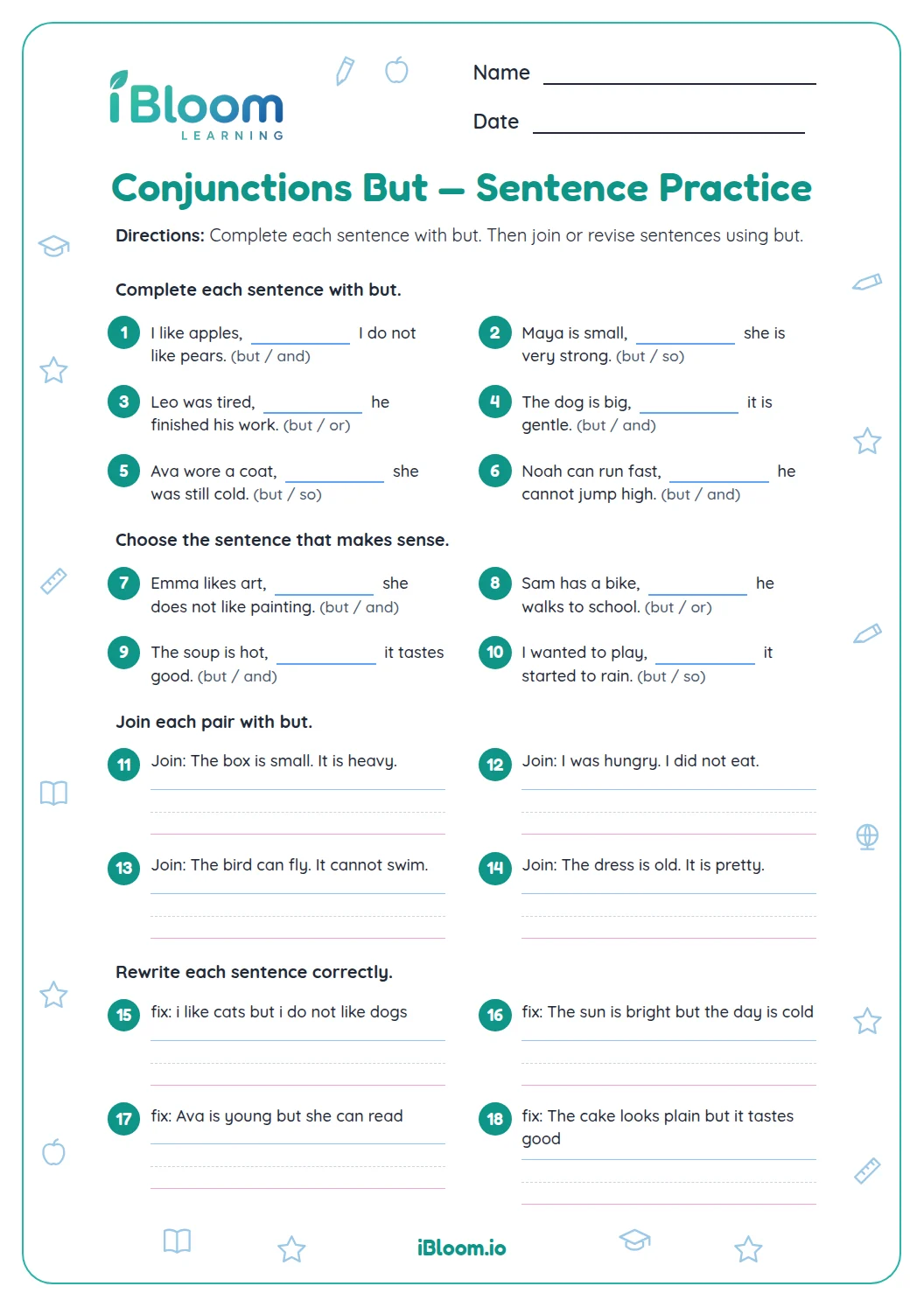
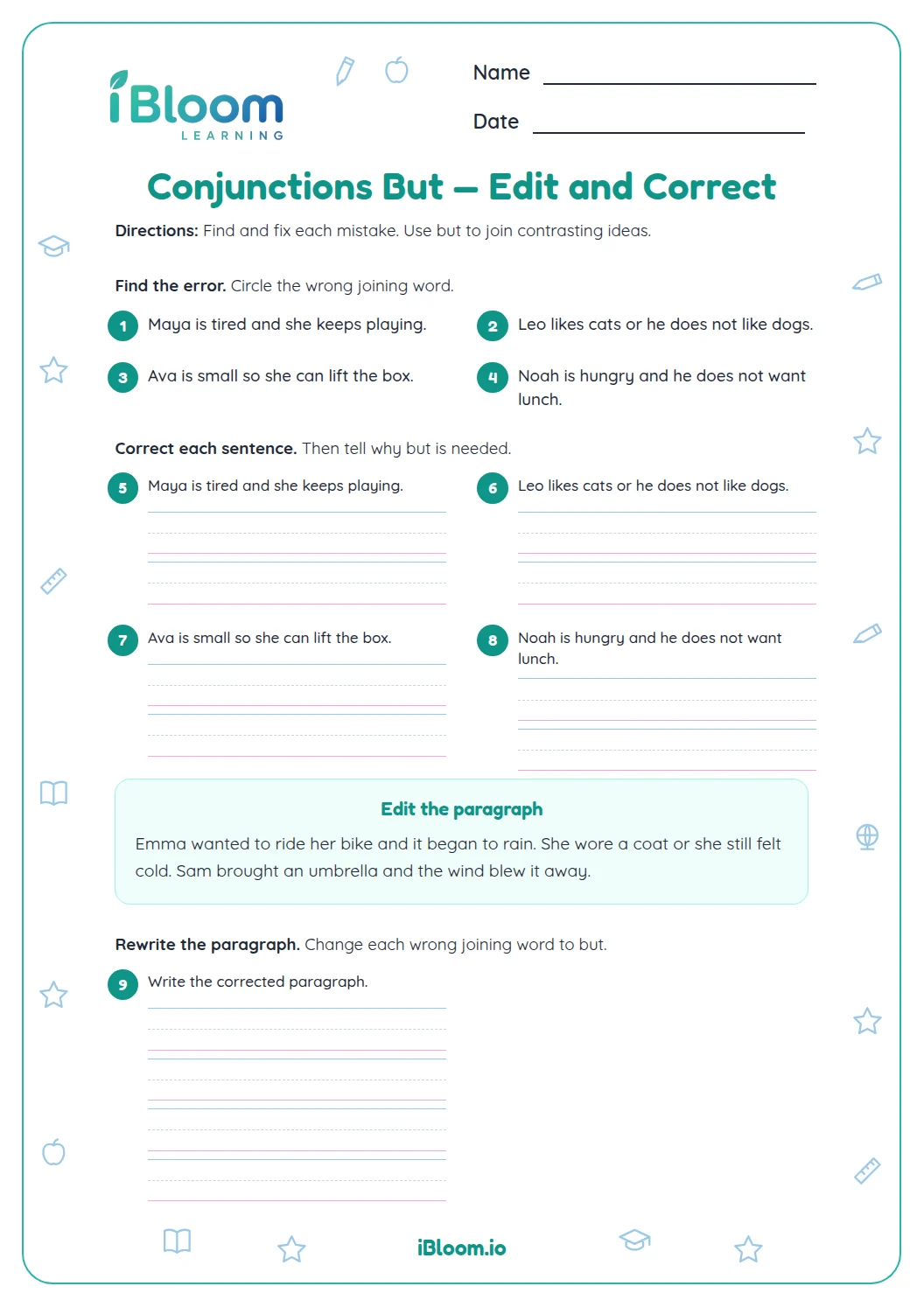
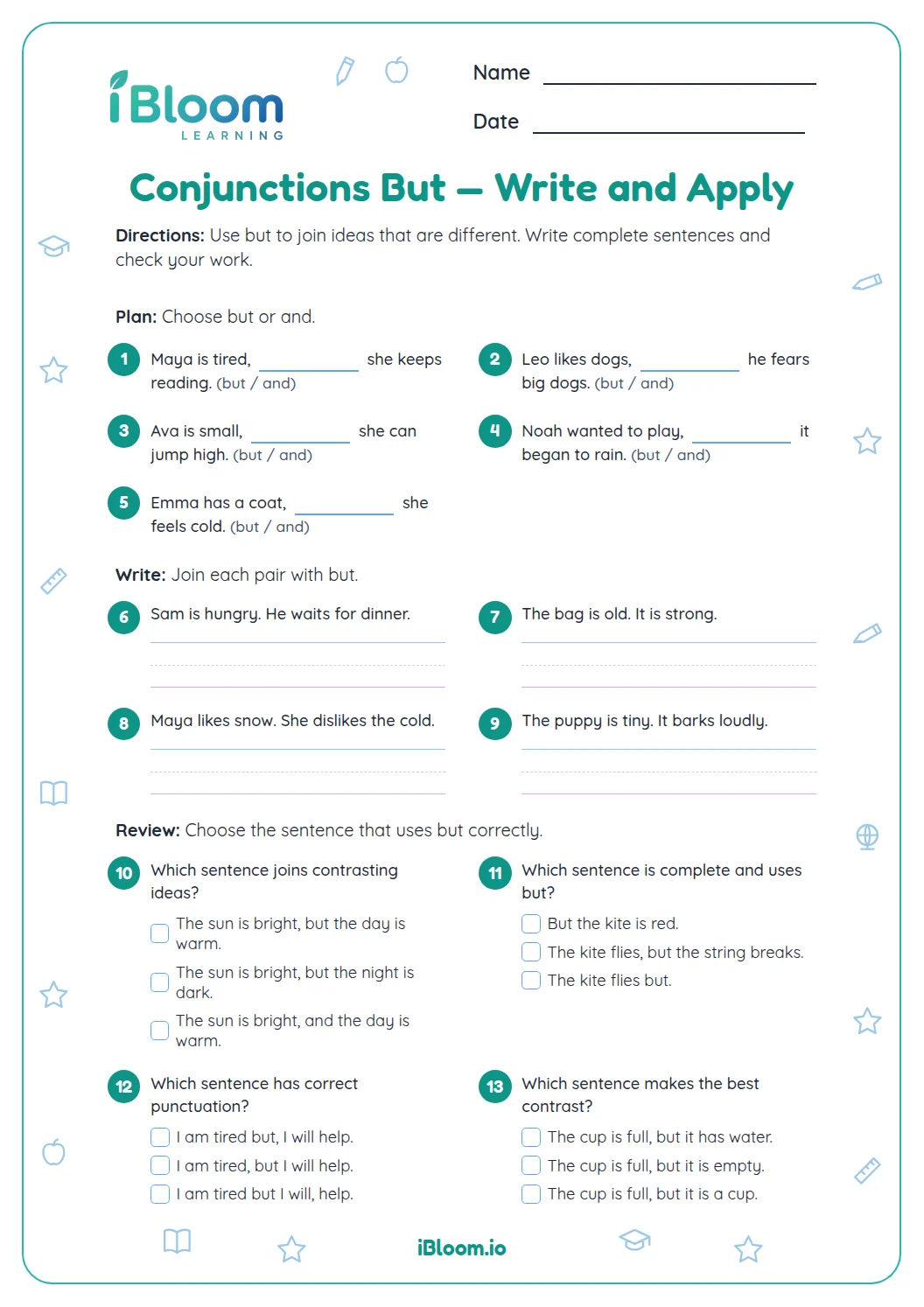
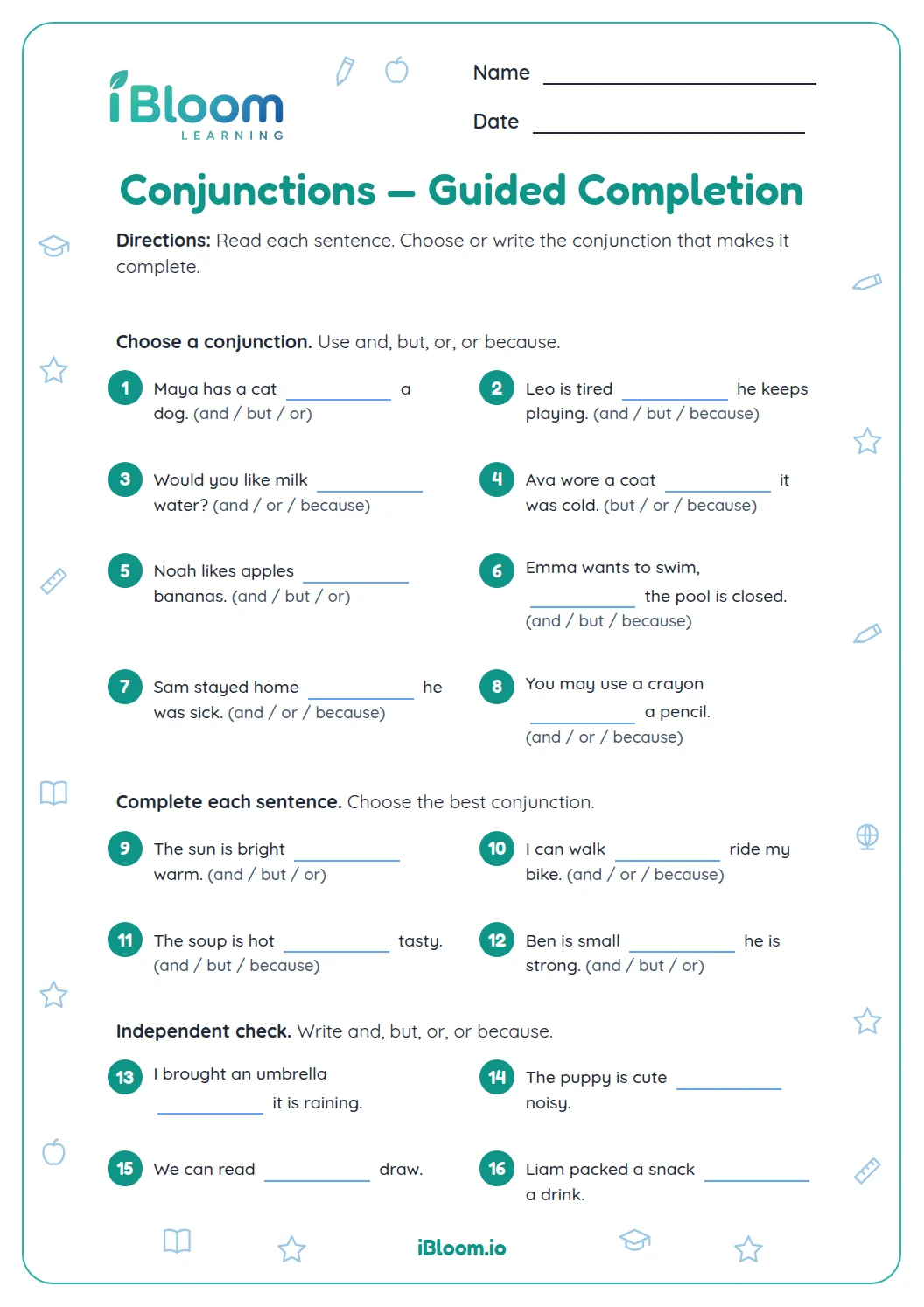
This free Grade 1 worksheet helps children use but to connect contrasting ideas. Part A has four choices of sentence endings. In Part B, children write but in four blanks and read the completed sentences. Part C asks them to join two pairs of ideas with but, then finish two sentence starters in their own words. The 12 tasks practice Common Core L.1.1g. An adult can read the prompts aloud while the child works. A separate key gives the fixed answers and sample endings for the two open responses.
Aligned to L.1.1g
How does but change the meaning of a sentence?
But prepares the reader for a contrast. The first part sets up an idea; the second changes what we might expect. A large box might seem heavy, so saying that it is very light gives a clear contrast.
Read each complete sentence aloud. Pause briefly at but and ask what changes in the second part.
- 1Question 2: The box looks big, but ___ .
- 2A big box might seem heavy.
- 3“It is very light” gives a different idea.
How do children practice writing but?
Part B leaves the joining word blank. Children write but and read the two connected ideas aloud. The soup smells good, but it is too hot to eat: the second idea explains why the child must wait.
Part C then gives two short sentences to join. For question 9, keep the first idea, replace its period with a comma and but, and continue with “the cat is small.” End the joined sentence with one period.
What counts as a good original ending?
Questions 11 and 12 ask for an original ending that completes the thought and gives a contrast. A flat tire gets in the way of riding a bike. A loud bark is an unexpected detail about a small puppy.
Other sensible endings are welcome. Check the meaning first, then help the child add a period and reread the complete sentence, including the printed beginning.
How to use this worksheet
- 1Read the first sentence aloud and pause at but.
- 2Try each offered ending and name the contrast.
- 3Complete the remaining three choices in Part A.
- 4Write but in the four Part B blanks and read each completed sentence.
- 5Join the two Part C sentence pairs, then say and write two original endings.
- 6Check fixed answers against the key and discuss the sample endings.
Mistakes to notice and fix
The mistake
Choosing “it is very large” after “The box looks big, but.”
The fix
Compare big and large: they express the same idea. Choose the ending that changes the expectation.
The mistake
Treating but as a word that can join any two unrelated facts.
The fix
Keep both ideas connected to the same situation, such as wanting to read and having no book.
The mistake
Writing an ending that repeats the starter, such as “it is tiny” for the small puppy.
The fix
Ask for something surprising about the puppy, such as a loud bark or great speed.
Common Core alignment
Use but to join two ideas that contrast.
On this sheet: Children select and write contrasting endings in sentences joined by but.
Show the official wordingHide the official wording
Use frequently occurring conjunctions (e.g., and, but, or, so, because).
What to practice next
Make more practice
Further reading
Questions parents and teachers ask
Does the child get to write the word but?
Yes, Part B has four blanks for but, and Part C asks children to use it when joining two pairs of ideas. Part A supplies the word so children can first hear the contrast. The final two prompts then invite original endings after a printed but.
Can I read the questions aloud?
Yes, an adult can read the sentences and options aloud. Keep the words visible so the child can follow along and choose an answer. Read all choices with the same expression, then ask which one makes the best contrast with the first part of the sentence.
Are there different answers for the last two questions?
Yes, the last two questions allow different sensible endings. A child might say the bike has a flat tire or that it is raining. For the small puppy, a loud bark is one possible contrast. The key gives samples, and each child’s ending should be checked for meaning.
Does a contrast have to use opposite words?
No, a contrast can describe an obstacle or an unexpected situation. Big and small are opposites in question 9, but wanting to read and being unable to find a book also create a contrast. Encourage children to explain the relationship instead of only looking for opposite words.
How much writing is on this worksheet?
Children choose four endings, write but in four blanks, join two sentence pairs, and write two original endings. The last four tasks provide space for sentence writing. Encourage the child to say each sentence aloud before writing, then check that the ideas contrast and the sentence ends with a period.