


About this worksheet
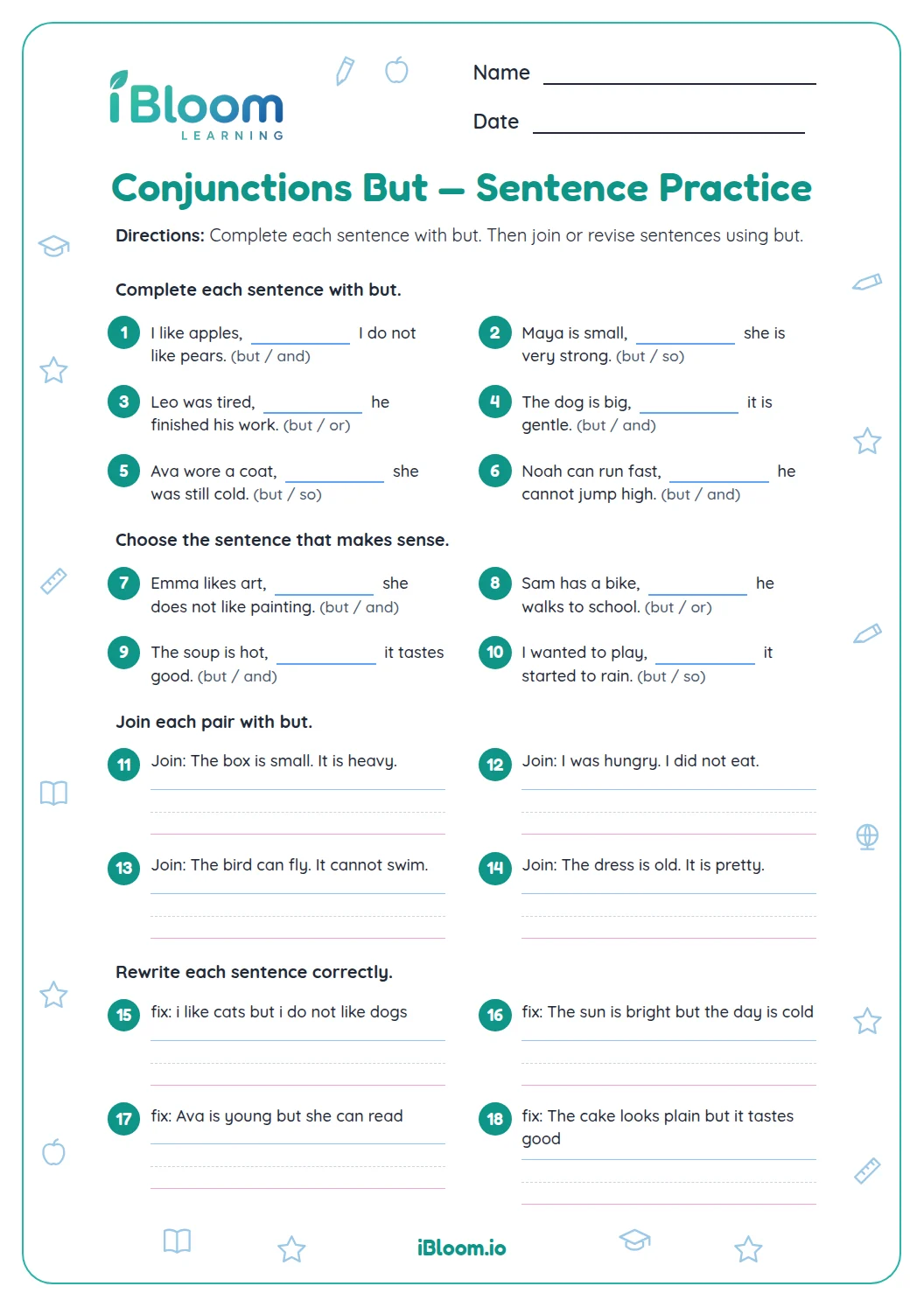
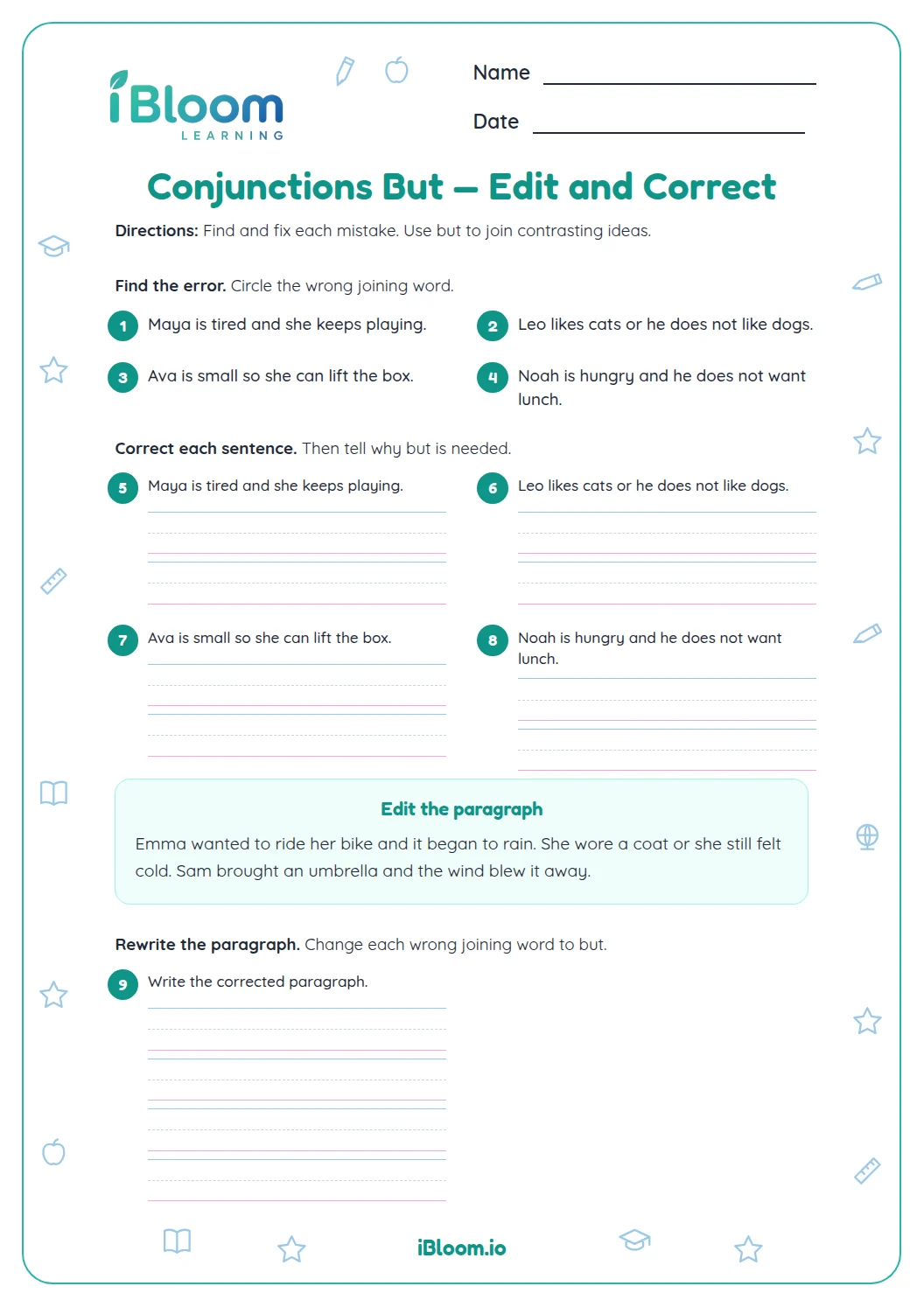
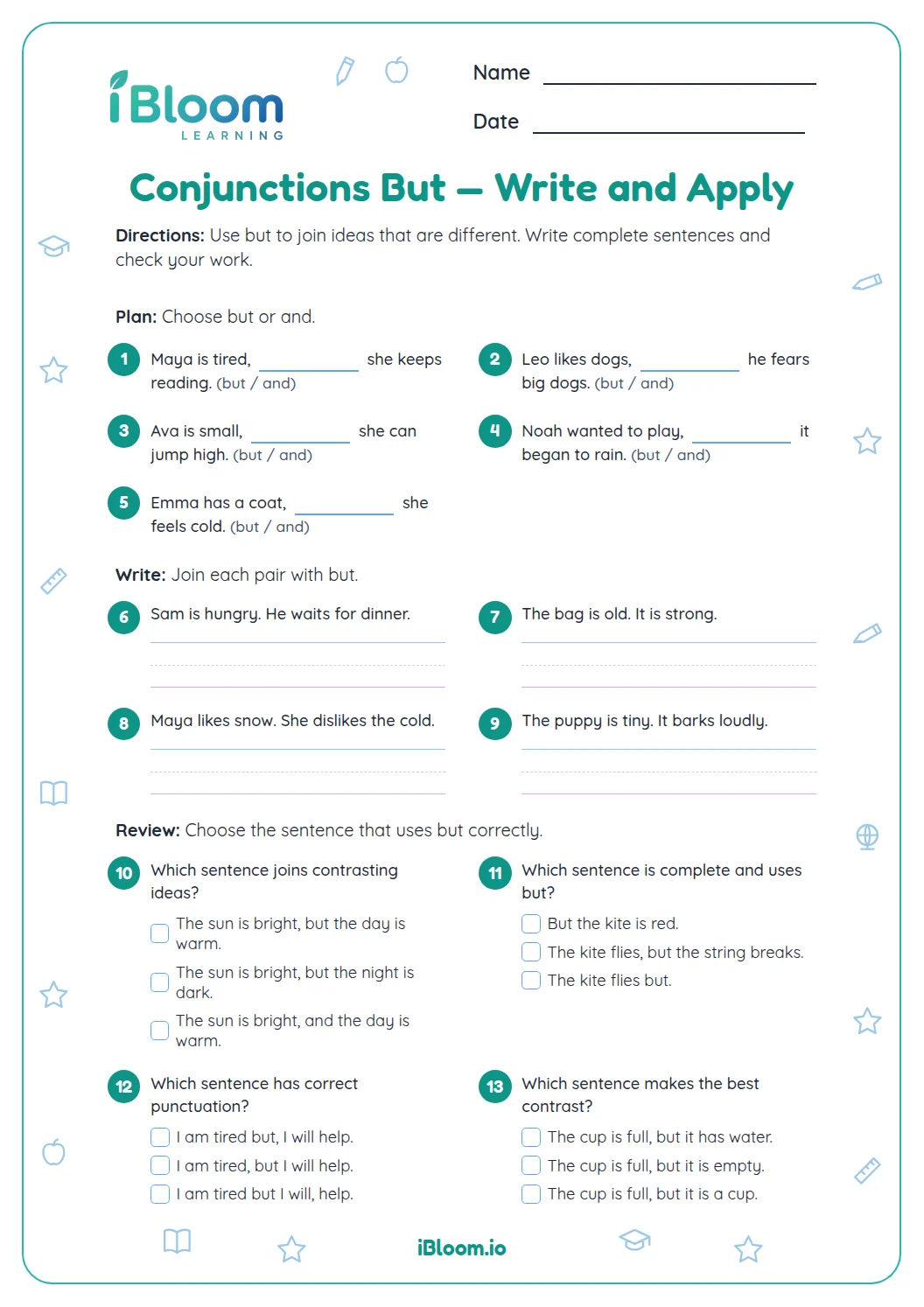
This Grade 1 worksheet focuses on but as a conjunction that connects contrasting ideas. Children choose sentence endings, recognize complete sentences using but, check punctuation, and complete one contrast sentence. The 14 questions use short familiar examples, followed by a separate answer key.
Aligned to CCSS L.1.1.g
What does but do in a sentence?
But joins ideas that differ or seem surprising together. “The puppy is small, but it can jump high” joins a small size with an unexpected ability.
A complete sentence on each side of but helps the reader understand both ideas. In this worksheet, the comma comes before but when it joins two complete sentences.
Where does the comma go?
Place a comma before but when it joins two complete ideas: “The room is dark, but we can see.” Read both sides aloud to check that each could stand as a sentence.
How to use this worksheet
- 1Read the direction at the start of each part before answering.
- 2Work through Part A first, then try the later parts independently.
- 3Use the separate answer key to review each response and talk through any missed item.
Common mistakes and quick fixes
The mistake
Using but to join ideas that simply add another detail.
The fix
Check that the two ideas differ or make an unexpected contrast.
The mistake
Leaving out the comma before but when joining two complete thoughts.
The fix
Read both sides; if each is a complete sentence, place a comma before but.
Curriculum alignment
This worksheet practices a foundational skill commonly taught in Grade 1.
Use frequently occurring conjunctions (e.g., and, but, or, so, because).
On this sheet: Parts A–C practice joining ideas with the conjunction but, with a final chance to edit and write a complete sentence.
Show the official wordingHide the official wording
Use frequently occurring conjunctions (e.g., and, but, or, so, because).
What to practice next
Make more practice
Further reading
Questions parents and teachers ask
What does the word but do?
But joins ideas that differ or create a contrast. In “The puppy is small, but it can jump high,” the second idea may surprise the reader because a small puppy can still jump high. Both sides give the reader a complete idea.
Does but always join opposites?
No. The ideas do not need to be exact opposites. They need to differ in a way that makes the sentence clearer or more interesting, such as a hat that looks funny but is still liked. Reading the full sentence aloud can help children hear that contrast.
When should a comma go before but?
When but joins two complete thoughts, place a comma before it. Read each side aloud: “The room is dark” and “we can see” can each work as a sentence, so the comma helps separate them. The comma gives the reader a small pause before the conjunction introduces the contrasting idea.
How can children check a sentence with but?
Ask whether both ideas are present and whether the conjunction shows a difference between them. Then check that the sentence has a capital at the beginning and a period at the end. This quick reread checks meaning and basic sentence conventions together.
How many questions are on the conjunctions page?
There are 14 questions in three parts. Children choose contrasting sentence endings, recognize how but connects ideas, check a comma, and complete one contrast sentence. The separate answer key lists correct choices and a model ending for the final sentence.