







About this worksheet
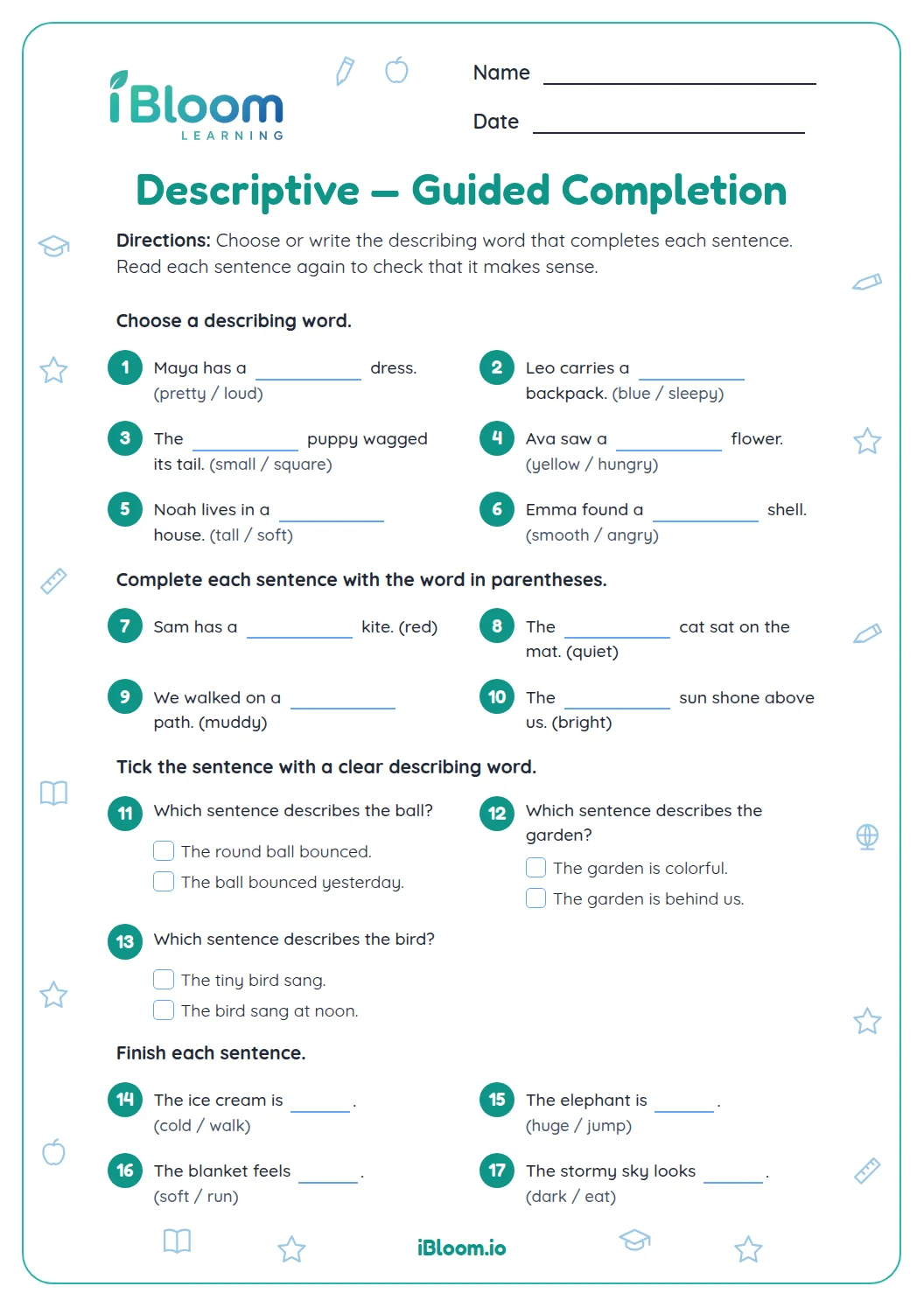
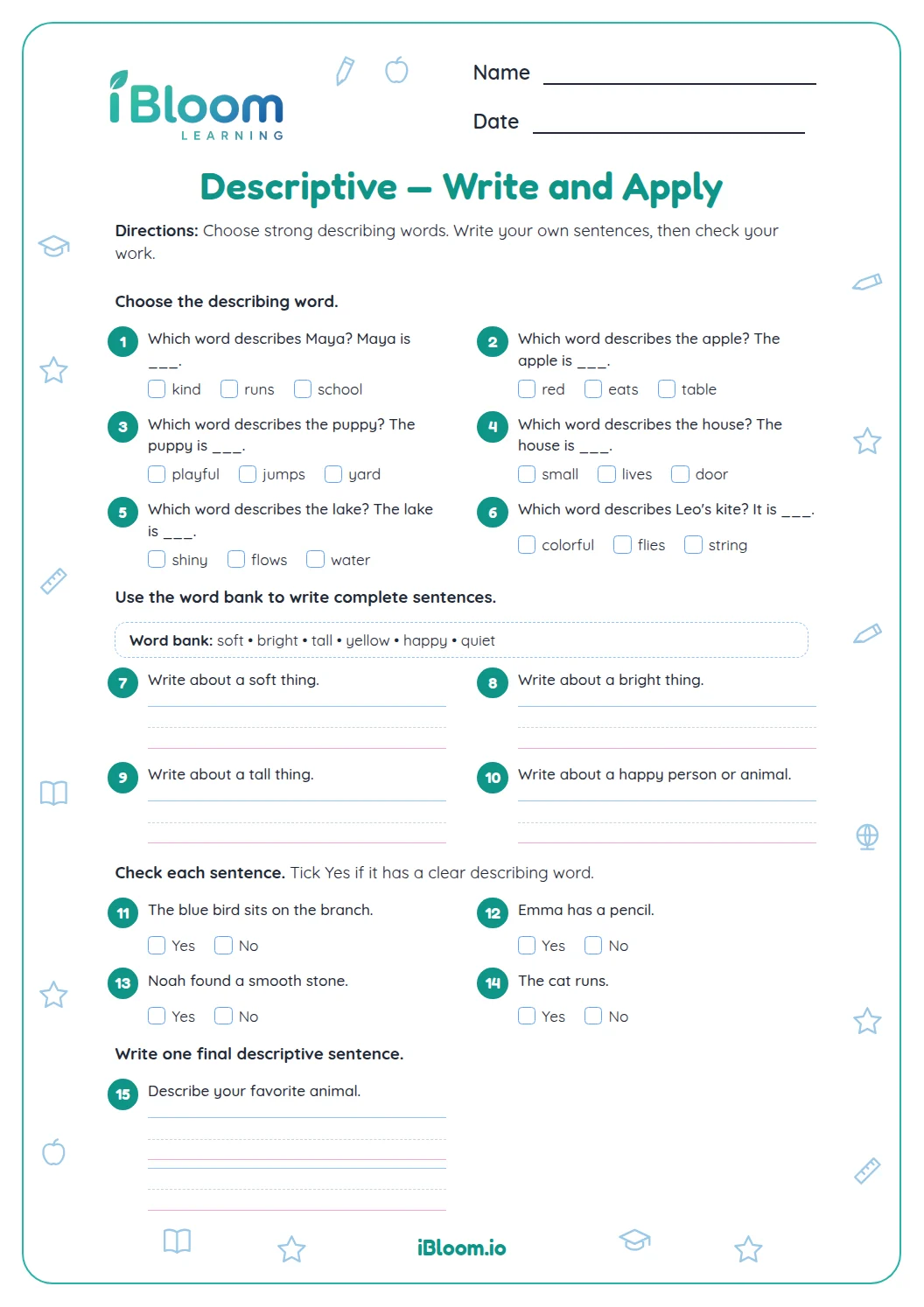
This Grade 1 printable combines two sentence skills: choosing an adjective that describes a noun, then checking sentence capitals and ending punctuation. It has 14 items and a separate answer key. In the first part, several describing words can make sense, so the key gives one suitable example.
Aligned to L.1.1.f and L.1.2
How can a child get started with descriptive words and sentence editing?
An adjective tells more about a noun. For “The ___ puppy naps on a rug,” a word such as “small” describes the puppy and completes the sentence. In the editing part, check that a sentence begins with a capital letter and ends with punctuation.
- 1The ___ puppy naps on a rug.
- 2One suitable answer: small
How does the practice build?
Later items ask learners to apply descriptive words and sentence editing in a fresh context. Encourage careful reading and a check of each answer before moving on.
How should we review the answer key?
Compare one response at a time with the key. For a missed answer, ask the child to explain the clue or step that changes the answer, then try a similar item again.
How to use the worksheet
- 1Read the sheet directions together.
- 2Complete the first item aloud as a warm-up.
- 3Let the learner work through the next part independently.
- 4Ask the learner to check a response using the skill clues.
- 5Use the answer key to review and revisit any missed item.
Common mistakes and quick fixes
The mistake
Choosing a word that does not describe the noun.
The fix
Ask what the person, place, or thing is like.
The mistake
Leaving the first word lowercase.
The fix
Capitalize the first word in a sentence.
The mistake
Ending a sentence without punctuation.
The fix
Add the end mark that fits the sentence.
Common Core alignment
This worksheet practices the listed Common Core skill.
Use frequently occurring adjectives to describe people, places, things, and events.
On this sheet: The first part asks learners to complete sentences with a describing adjective.
Show the official wordingHide the official wording
Use frequently occurring adjectives.
Use standard capitalization and punctuation when writing sentences.
On this sheet: The second part asks learners to choose sentences with an initial capital and end punctuation.
Show the official wordingHide the official wording
Demonstrate command of the conventions of standard English capitalization, punctuation, and spelling when writing.
What to practice next
Make more practice
Further reading
Questions parents and teachers ask
What skill does this worksheet practice?
It practices descriptive words and sentence editing with 14 printable questions. Children choose adjectives that tell more about a noun, then select sentences with correct capitals and end marks. The separate answer key supports a quick review after the child tries each part.
Is an answer key included?
Yes. A separate answer key page lists the answers for the worksheet. Use it after the learner has tried the questions, then discuss any answer that needs another look. For written work, accept a response that follows the prompt and uses relevant details.
How long will the worksheet take?
Plan for about 20 minutes, including time to read the directions and check the work. A child may need more or less time depending on familiarity with the skill. Pause between parts if that helps the learner stay focused and explain each answer.
Can I use this page at home?
Yes. Print the worksheet for home practice or use it in a classroom small group. Read the first direction together, then let the child complete the questions at a comfortable pace. The answer key is useful for checking work afterward.
What should I do when an answer is missed?
Ask the child to point to the clue or calculation that supports a different answer. Work through that step together, and then have the child complete the remaining questions independently. A short explanation can show whether the skill is becoming clearer.