

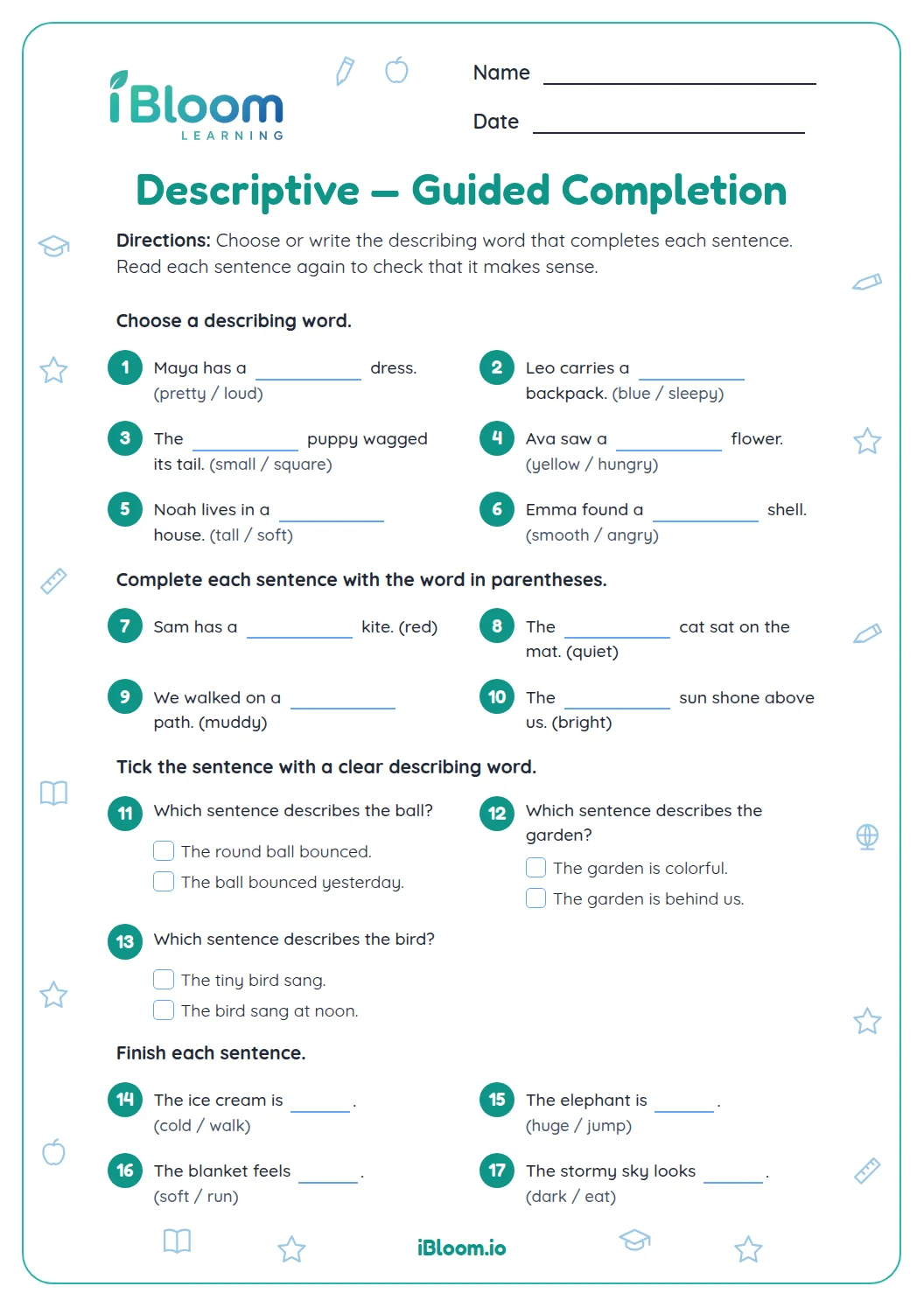
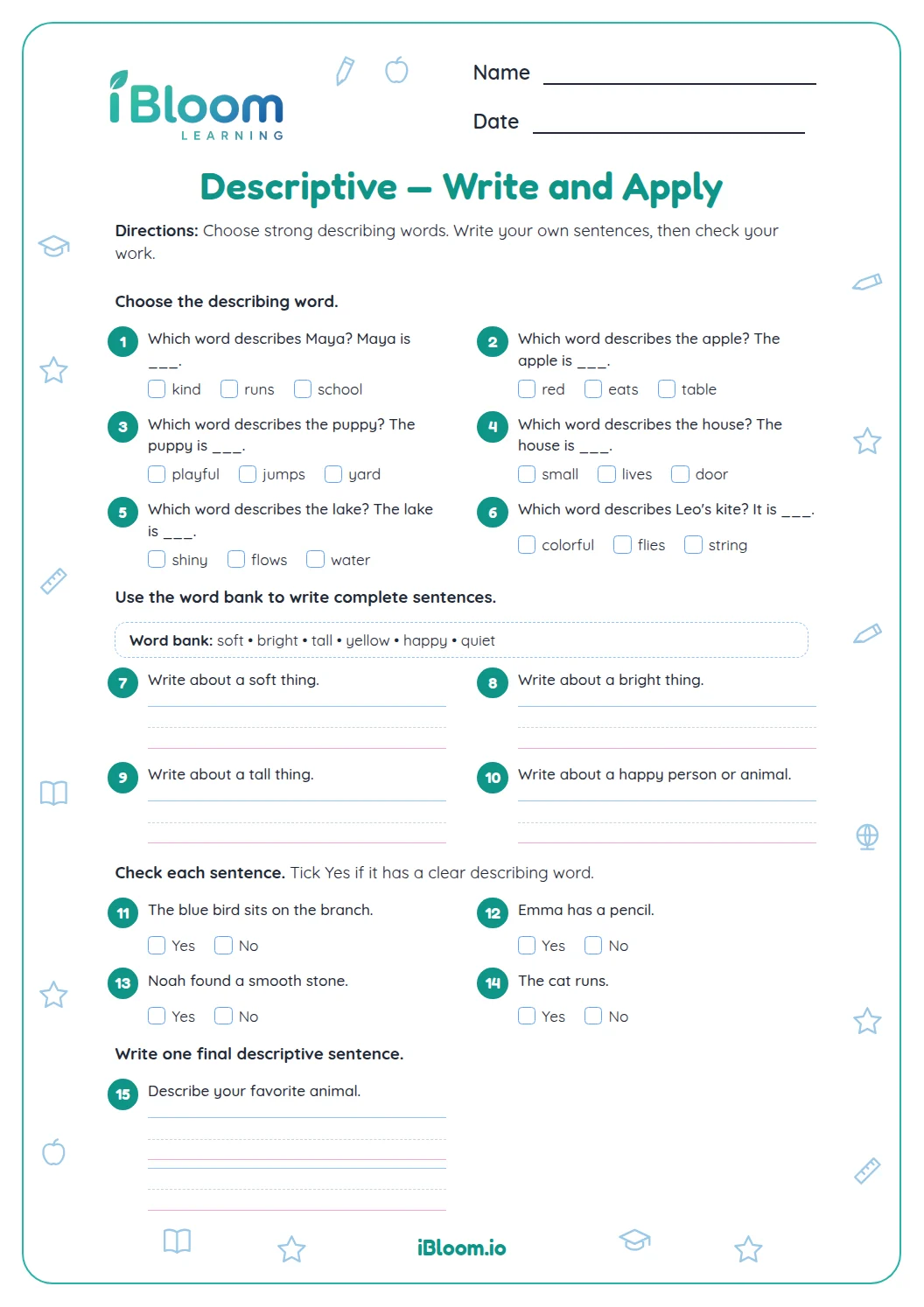


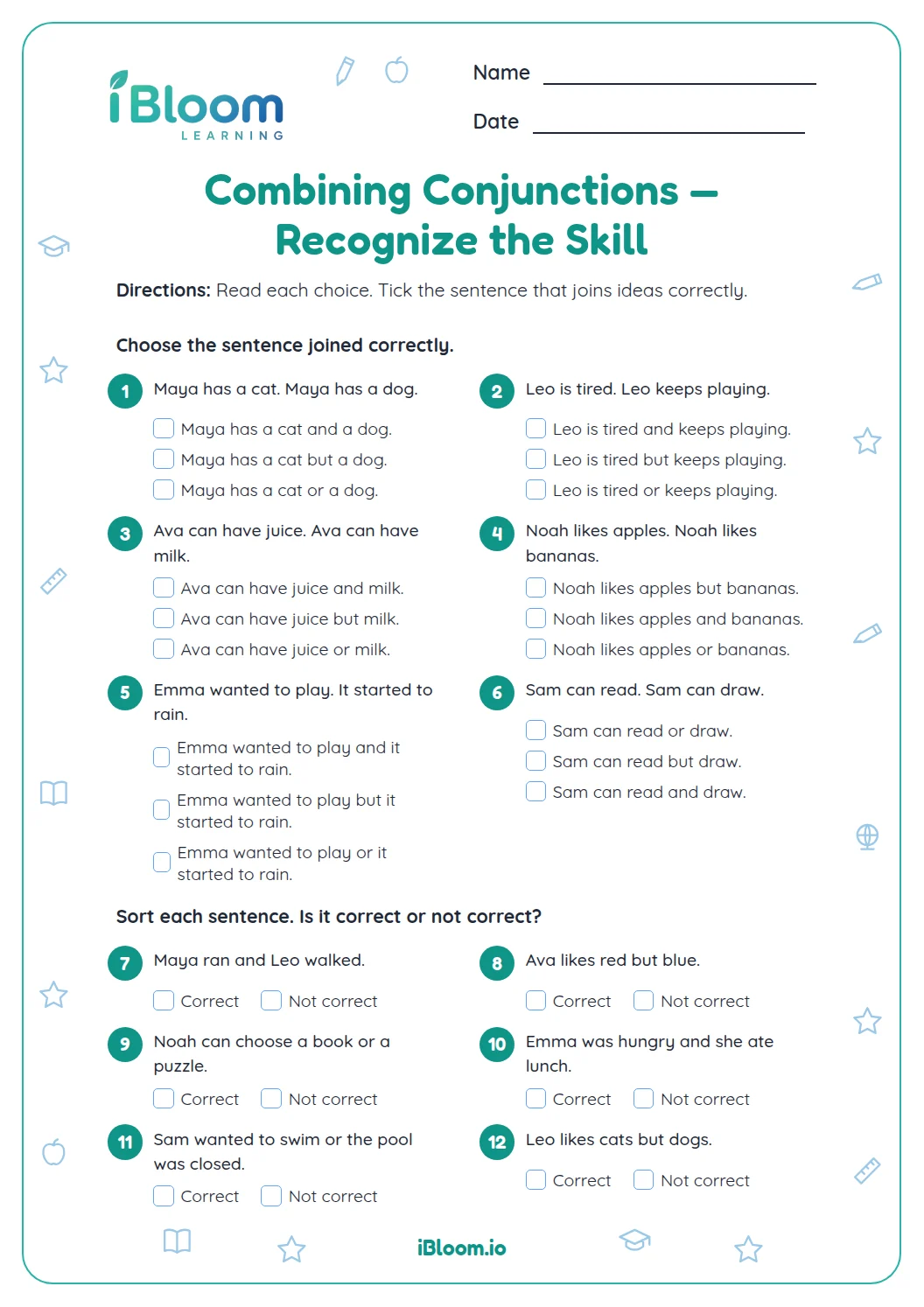
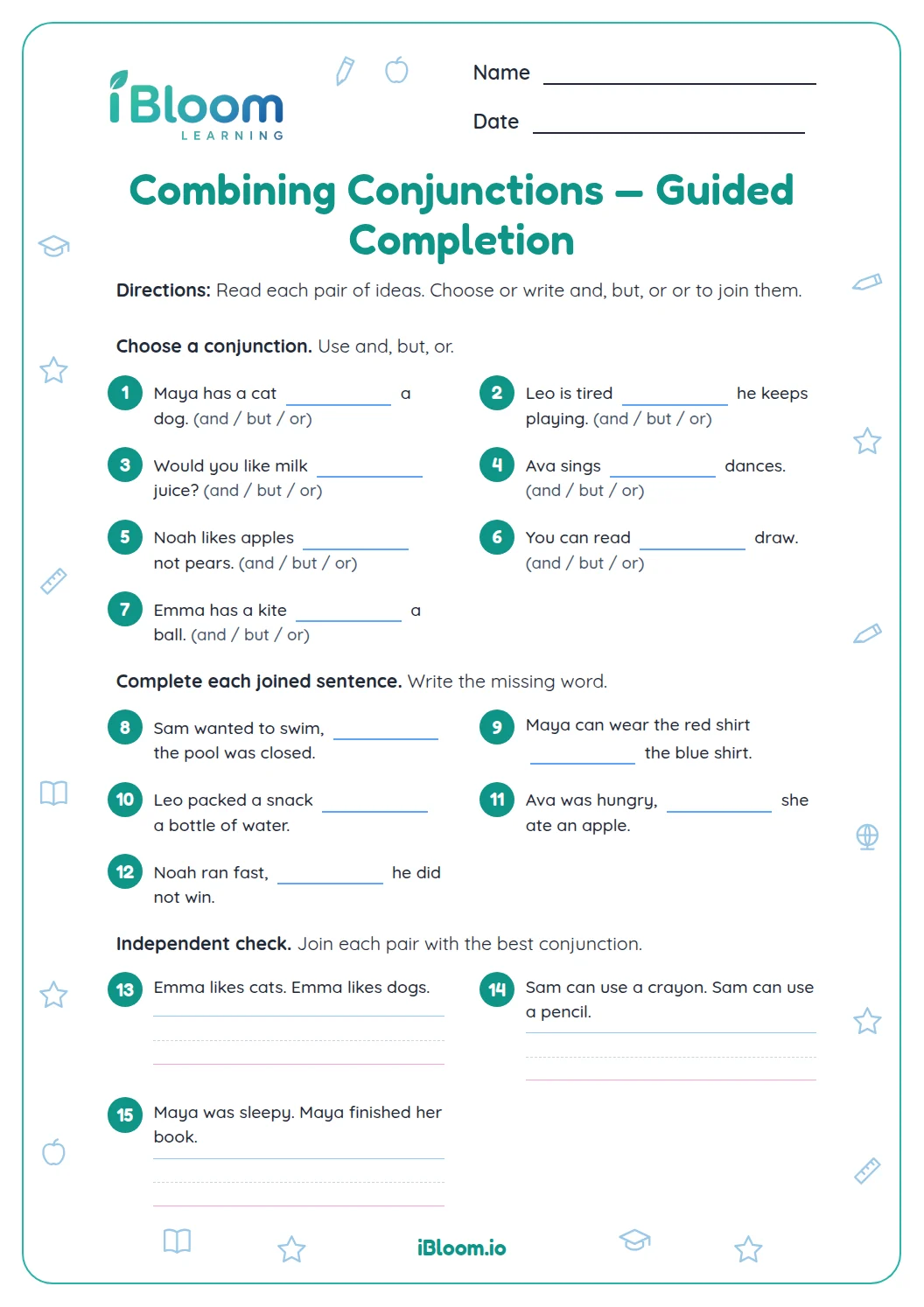




About this worksheet
This Grade 1 printable builds descriptive sentence writing in three steps: notice details, complete a sentence with a describing word, and write a complete description. The 14 questions include sentence choices, fill-in practice, and four writing prompts. It aligns with Common Core L.1.1f and includes a separate answer key with sample responses.
Aligned to L.1.1f
What makes a sentence descriptive?
A descriptive sentence gives a reader a detail about a person, place, animal, or thing. “The kite flew” tells what happened; “The red kite flew” adds a detail that helps a reader picture it.
The first part asks children to compare a complete sentence with a word-order mix-up and choose the sentence that describes.
How can one word add a detail?
An adjective is a describing word. It can tell what something looks, feels, tastes, or sounds like. In “The ___ puppy wagged its tail,” playful describes the puppy.
- 1The ___ puppy wagged its tail.
- 2Think of a word that tells about the puppy.
- 3playful describes the puppy.
- 4Answer: The playful puppy wagged its tail.
How do children write their own descriptions?
The last part gives a familiar subject and asks for a complete sentence. A child might describe a friendly dog by adding a detail about its fur, size, or sound. The sample key shows one answer; other clear descriptions are valid.
How to use this worksheet
- 1Read each pair aloud and choose the complete descriptive sentence.
- 2For a blank, say the noun and try a word that describes it.
- 3Read the completed sentence to check that it makes sense.
- 4For a writing prompt, think of one detail before writing.
- 5Check for a capital letter, spaces, and an ending mark.
Common mistakes and fixes
The mistake
Choosing a sentence that is incomplete or has mixed-up word order.
The fix
Read it aloud and check that it tells a complete idea.
The mistake
Adding a word that does not describe the noun.
The fix
Ask what the word tells about the person, place, or thing.
The mistake
Writing a label instead of a sentence.
The fix
Say the whole idea aloud and include who or what it is about.
Common Core alignment
Use an adjective to describe a person, place, thing, or animal.
On this sheet: Parts A and B identify and use common describing words.
Show the official wordingHide the official wording
Use frequently occurring adjectives.
What to practice next
Make more practice
Further reading
Questions parents and teachers ask
What is a descriptive sentence?
A descriptive sentence tells about a person, place, animal, or thing with details. In “The red kite flew,” red helps the reader picture the kite. This worksheet asks children to notice describing words, complete sentences with one detail, and write their own descriptions. Read the other sentences aloud and ask which word helps the reader picture the noun.
How many questions are on the worksheet?
There are 14 questions in three parts. Children choose descriptive sentences, fill six blanks with describing words, and write four original sentences. The answer key gives answers for the first two parts and sample responses for writing. A child can choose a different word if it makes a sensible, complete sentence.
Can more than one word fit a blank?
Yes, several describing words may make sense in some blanks. The key gives one possible answer, and a child’s different answer can work if it describes the noun and makes a complete sentence. For example, tiny describes size, while yellow describes color.
What does the first part practice?
Part A asks children to tell a descriptive complete sentence from a word-order mix-up. Reading each choice aloud can help a child hear whether it says a full idea and whether the describing word fits. Encourage the child to point to the describing word in each chosen sentence.
How can I help with the writing questions?
Ask the child to name the person or thing first, then think of one detail a reader could see, hear, feel, or taste. Have them say the whole sentence aloud before writing it, and check for a capital letter and ending mark. Give the child time to say an idea before writing it down.
Is an answer key included?
Yes. The answer key is a separate page. It lists the selected sentence and missing words, plus sample sentences for the open writing questions; children may give other sensible descriptions. The key models one possible answer for each open writing prompt.