





About this worksheet
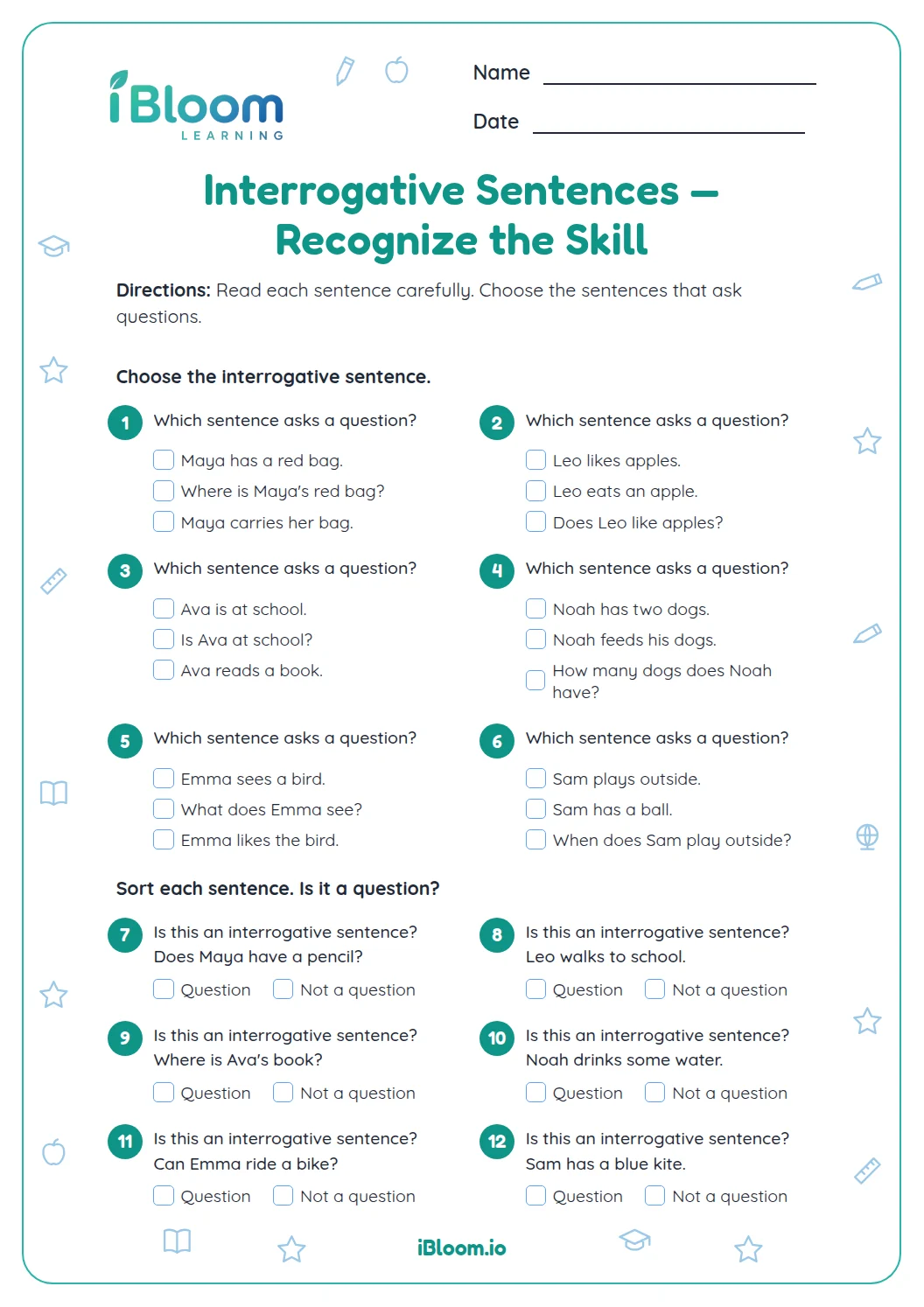
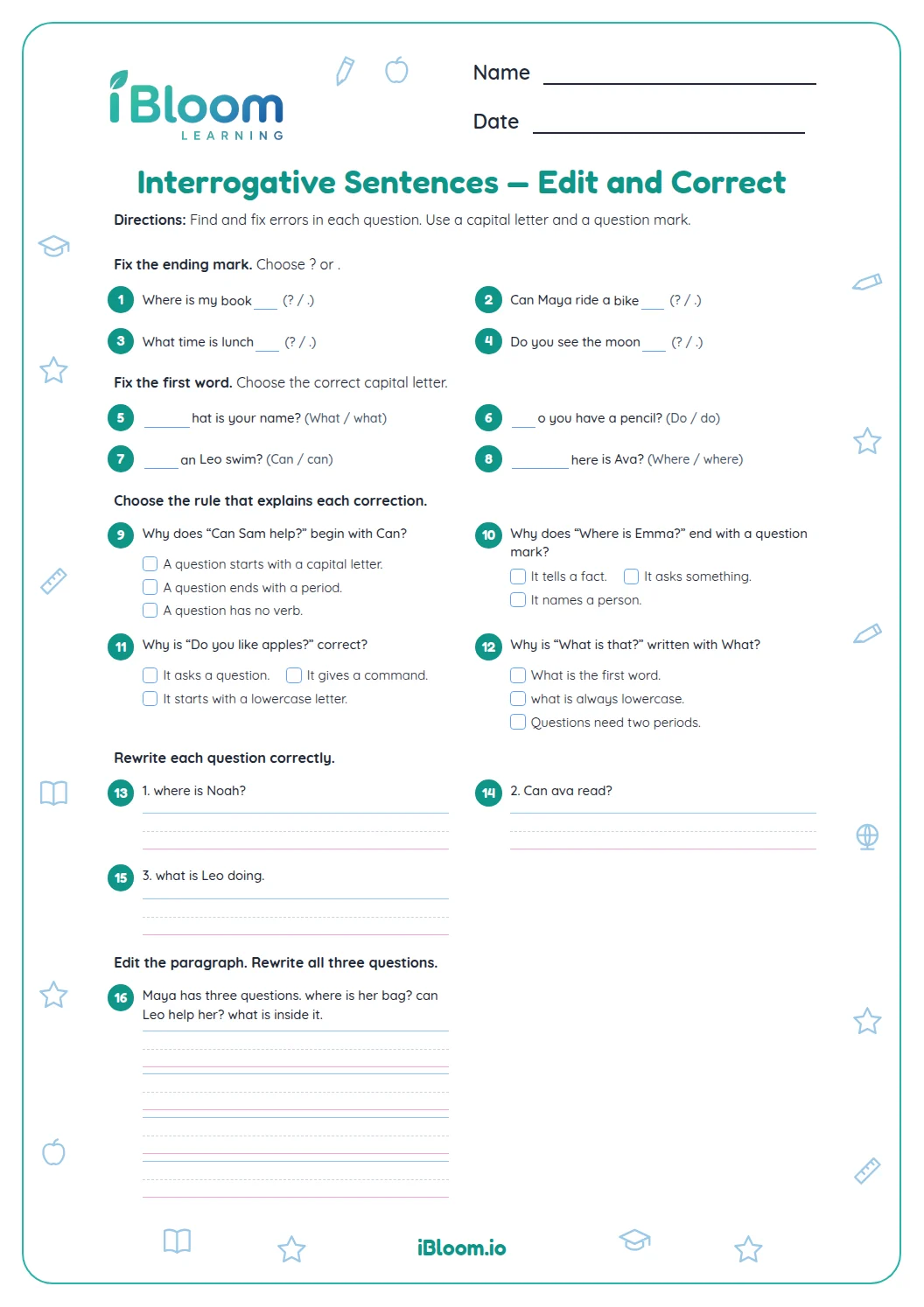
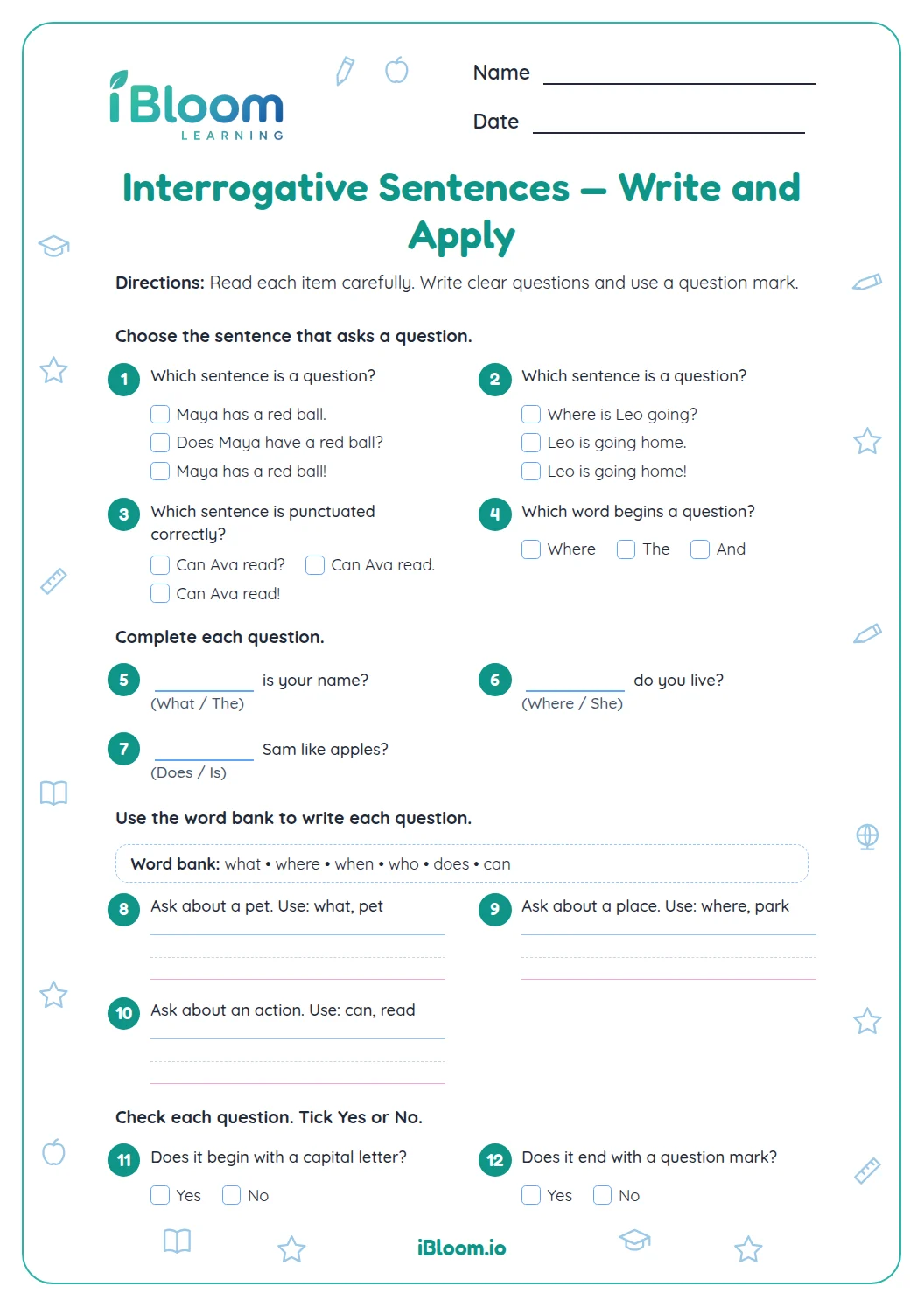
This Grade 1 printable practices interrogative sentences, or sentences that ask something. Children choose questions from sentence pairs, add a period or question mark to five sentences, and write a question beginning with “What.” The examples use familiar people, pets, and classroom objects. The worksheet connects sentence meaning to end punctuation and includes a separate answer key with a sample response for the open prompt.
Aligned to L.1.2b
How can you spot an interrogative sentence?
An interrogative sentence asks something. It may start with a question word, such as who or where, or with a helping verb, such as can. Read the sentence for meaning as well as looking at its end mark.
- 1Where is my hat?
- 2It asks where the hat is.
- 3Choose “Where is my hat?”
When should you add a question mark?
A complete question ends with a question mark. A sentence that tells something usually ends with a period. In Part B, read each sentence aloud and choose the mark that matches its meaning.
How can children write a clear question?
Part D asks for one question beginning with “What.” The key gives a sample; another complete question that follows the direction and ends with a question mark also works.
How to use this worksheet
- 1Read each choice aloud and listen for a sentence that asks something.
- 2For Part B, read the whole sentence before choosing an end mark.
- 3Use a capital letter at the beginning when rewriting a sentence.
- 4In Part C, choose a real topic and write a complete question.
- 5Reread each written question and check its final mark.
Common mistakes and quick fixes
The mistake
Treating every sentence with “?” as a question without reading its meaning.
The fix
Ask what information the speaker wants to know.
The mistake
Using a period after a question.
The fix
Read the sentence aloud and match the punctuation to the asking voice.
The mistake
Writing a question without a question mark.
The fix
Point to the final word, then add ? before checking the answer key.
Common Core alignment
This practice connects sentence meaning with the end mark that readers need.
Use a question mark at the end of a question.
On this sheet: Children identify questions and add question marks to complete sentences.
Show the official wordingHide the official wording
Use end punctuation for sentences.
What to practice next
Make more practice
Further reading
Questions parents and teachers ask
What is an interrogative sentence?
An interrogative sentence asks a question. It may begin with a question word such as where or who, or with a helping verb such as can or do. On this worksheet, children identify questions, correct end punctuation, and write new questions.
When does a question mark go?
Put a question mark at the end of a complete sentence that asks something. Part B asks children to edit sentences, so they need to decide what each sentence means before adding its ending mark. Have your child look for a question word or a helping verb, then reread the full sentence to confirm it is asking.
Are sample responses the only accepted answers?
The key gives one sample for the final prompt. Another complete question beginning with “What” and ending in a question mark is also correct. The response should ask a real question, include enough words to make sense, and use a capital letter at the beginning.
How many questions are on the worksheet?
There are 16 items across four worksheet parts: six sentence choices, five end-mark items, four more question choices, and one written question. The worksheet has two pages, followed by two answer-key pages. The final answer can vary as long as it follows the prompt.
What should I review if my child misses an item?
Ask whether the sentence asks or tells something, then match the punctuation to its meaning. For the final prompt, check that the response begins with “What,” asks a complete question, and ends with a question mark. Read it aloud to see whether it sounds complete.