






About this worksheet
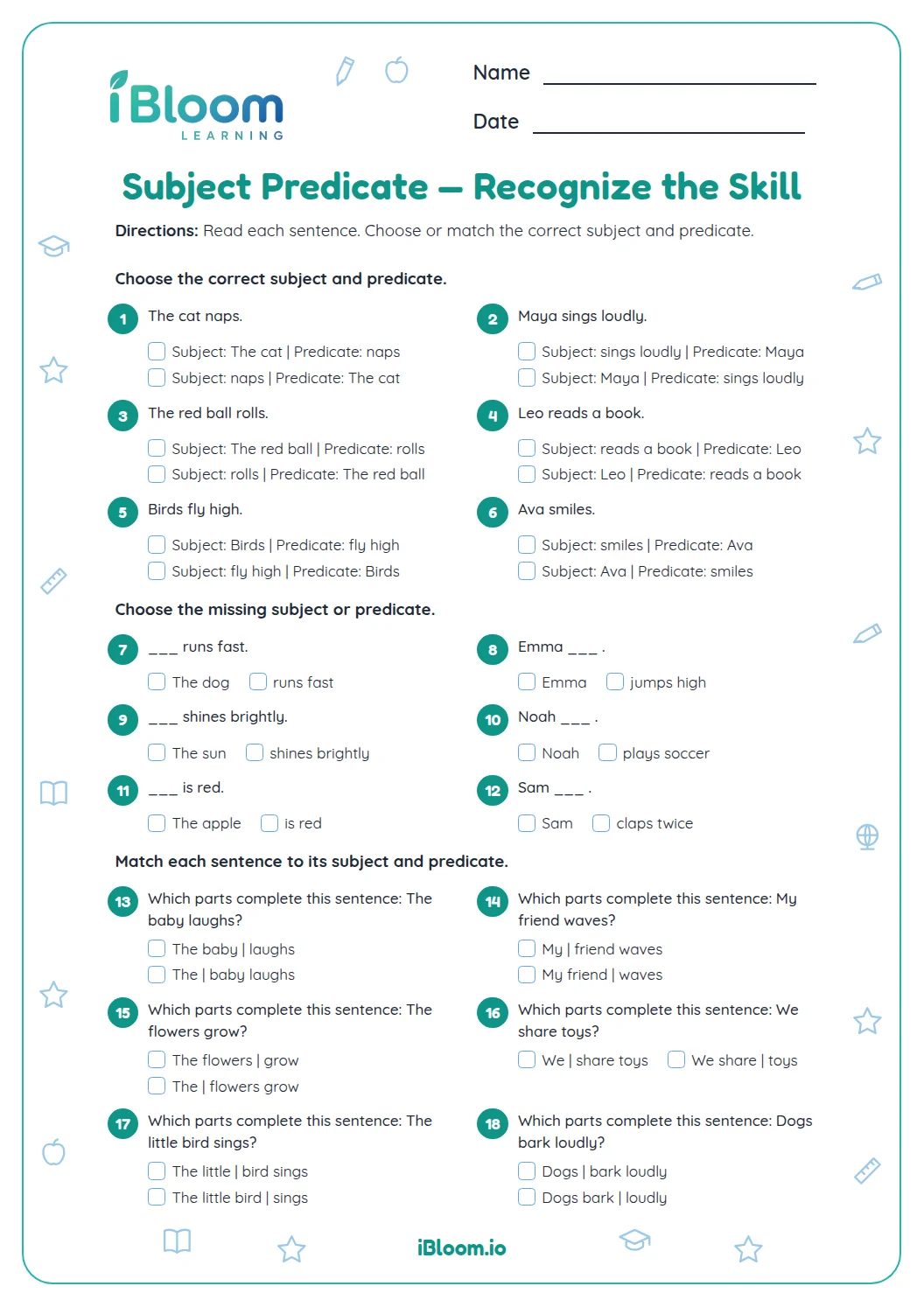
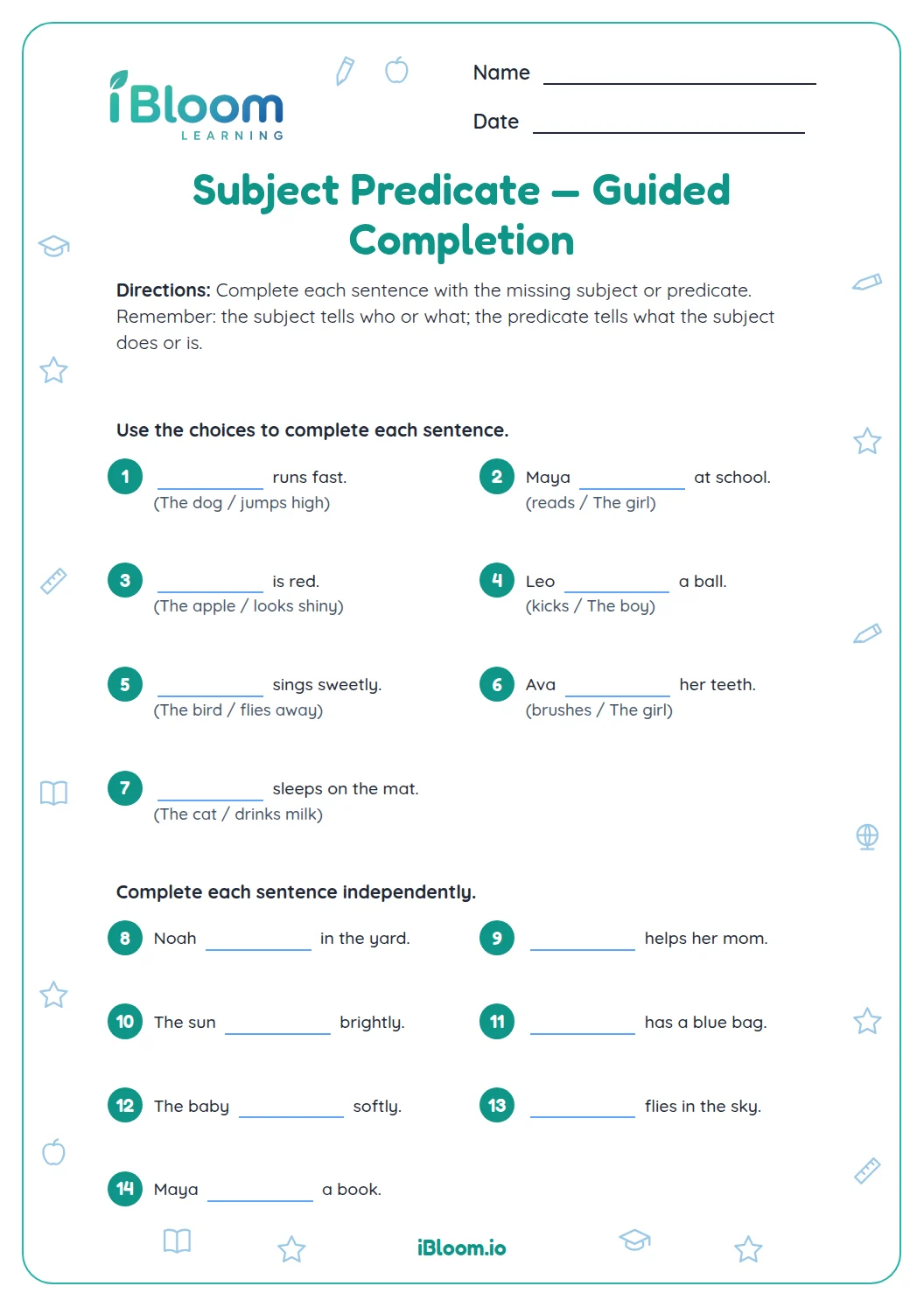
This two-page printable gives Grade 1 students 16 questions on subjects and predicates. Children identify the naming part, find the action or telling part, and complete sentence fragments with a sensible subject or predicate. The answer key includes sample completions for open responses.
Aligned to L.1.1.j
How do you find the subject?
Ask who or what the sentence tells about. In “Maya paints a picture,” the sentence is about Maya, so “Maya” is the subject. The subject may be one word or a group of words.
- 1“Three birds flew away.” → subject: Three birds
- 2Question 4 asks children to choose the naming part.
What does the predicate tell?
The predicate tells what the subject does or is. It includes a verb and may include details that complete the thought. For example, “chased a ball” tells what the puppy did.
- 1“The puppy chased a ball.” → predicate: chased a ball
How can you complete a sentence?
Read the words that are already there, then add the missing naming part or telling part. A good answer makes a complete thought and agrees with the rest of the sentence.
For “___ blooms in spring,” “A flower” is one fitting subject. “Rings at noon” would not fit the blank because it is an action part.
How can children check their answers?
Read the complete sentence aloud. Check that it says who or what the sentence is about and tells something about that subject. Open completions can vary while remaining correct.
How to use this worksheet
- 1Read the full sentence before choosing a part.
- 2Ask who or what the sentence tells about to locate its subject.
- 3Ask what the subject does or is to locate the predicate.
- 4For a blank, add words that make one complete, sensible thought.
- 5Read each finished sentence aloud and check that the parts fit.
Common mistakes and quick fixes
The mistake
Calling the first word the subject every time.
The fix
Ask what the whole sentence is about; the subject can be more than one word.
The mistake
Choosing only the verb as the predicate.
The fix
Include the words that complete what the subject does, such as “chased a ball.”
The mistake
Adding a subject or action that does not make sense with the other words.
The fix
Read the completed sentence aloud and check that it forms a sensible thought.
Common Core alignment
These sentence questions practice Grade 1 conventions for complete sentences.
Build and expand complete sentences with a clear subject and predicate.
On this sheet: Use frequently occurring prepositions and produce and expand complete simple and compound declarative, interrogative, imperative, and exclamatory sentences.
Show the official wordingHide the official wording
Produce and expand complete simple and compound declarative, interrogative, imperative, and exclamatory sentences.
What to practice next
Make more practice
Further reading
Questions parents and teachers ask
How many questions are on the worksheet?
There are 16 questions in three parts. The first eight ask children to identify subjects and predicates in complete sentences. The last eight ask them to supply a missing sentence part. The separate two-page key gives one possible completion for each open response.
What is a subject?
A subject names who or what a sentence tells about. In “Three birds flew away,” the subject is “Three birds.” This worksheet includes one-word subjects like “Maya” and groups like “Three birds,” so children should read the whole sentence before choosing.
What is a predicate?
A predicate tells what the subject does or is, including the verb and any words that finish the thought. In “The puppy chased a ball,” the predicate is “chased a ball.” The worksheet asks children to choose the full telling part.
Can more than one answer fit a completion?
Yes. A sentence can be completed in several sensible ways. For “___ blooms in spring,” “A flower” is one answer; another subject that blooms in spring can also work. The key shows a sample, so check that a child’s words form a complete thought.
How can I help if my child is unsure?
Read one sentence aloud and ask, “Who or what is this about?” Then ask, “What does that subject do or what is it?” For a blank, reread the sentence with the child’s proposed words and check that both parts fit together.
What can we practice next?
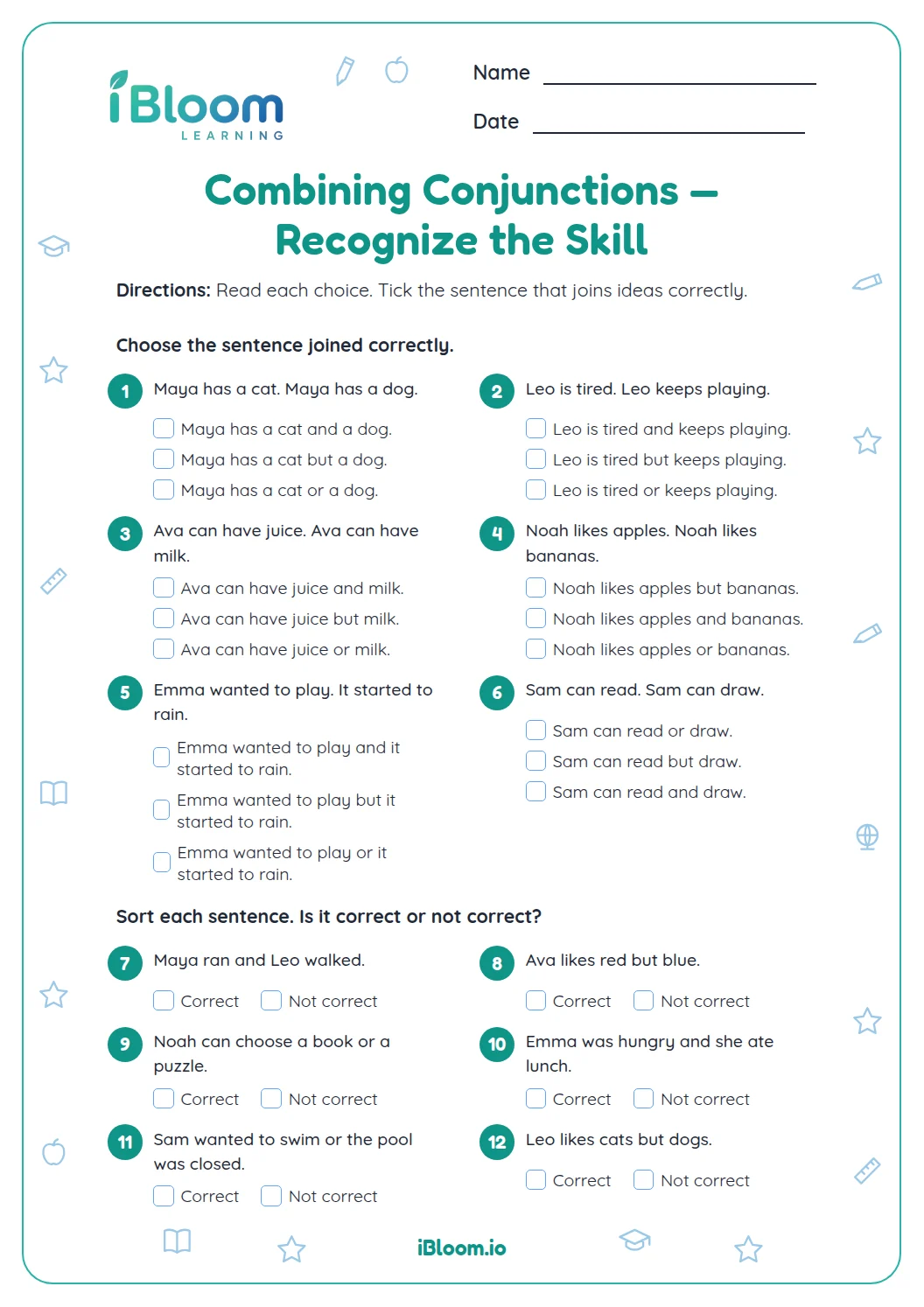
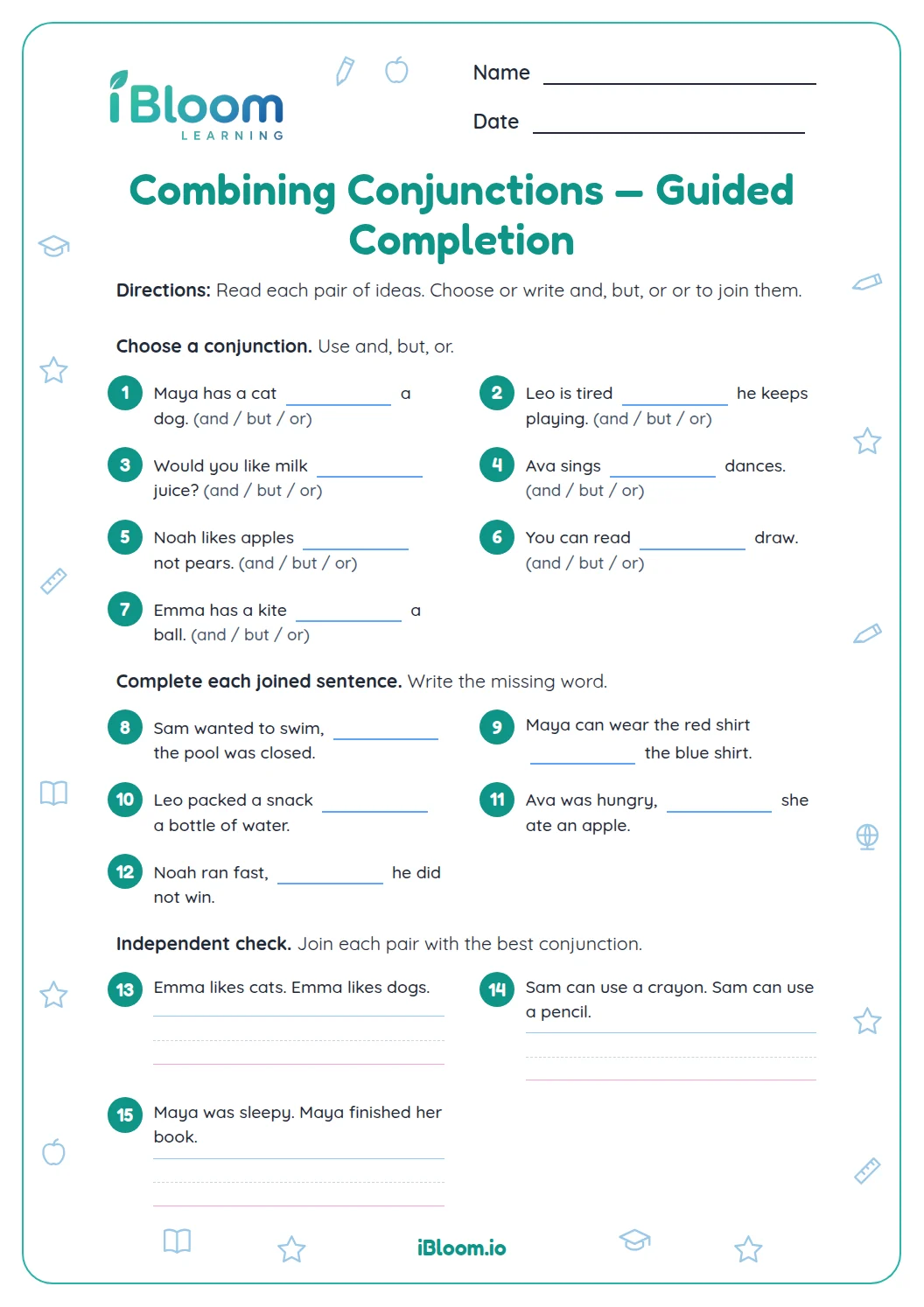
Have your child write a short sentence, then name its subject and predicate. For example, “The rabbit hops” has “The rabbit” as its subject and “hops” as its predicate. The linked sentence worksheets offer practice with sentence forms and combining ideas.