



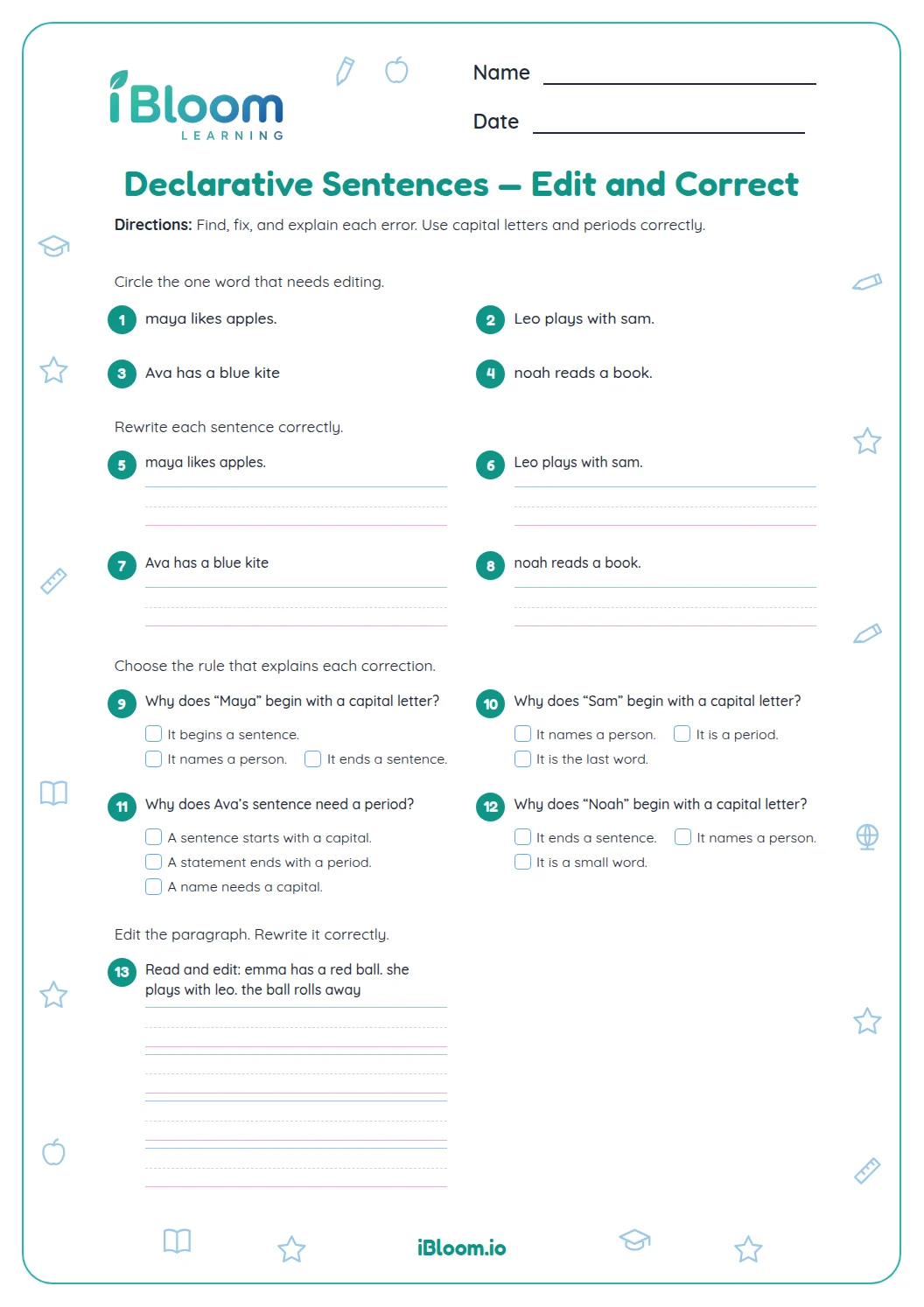


About this worksheet
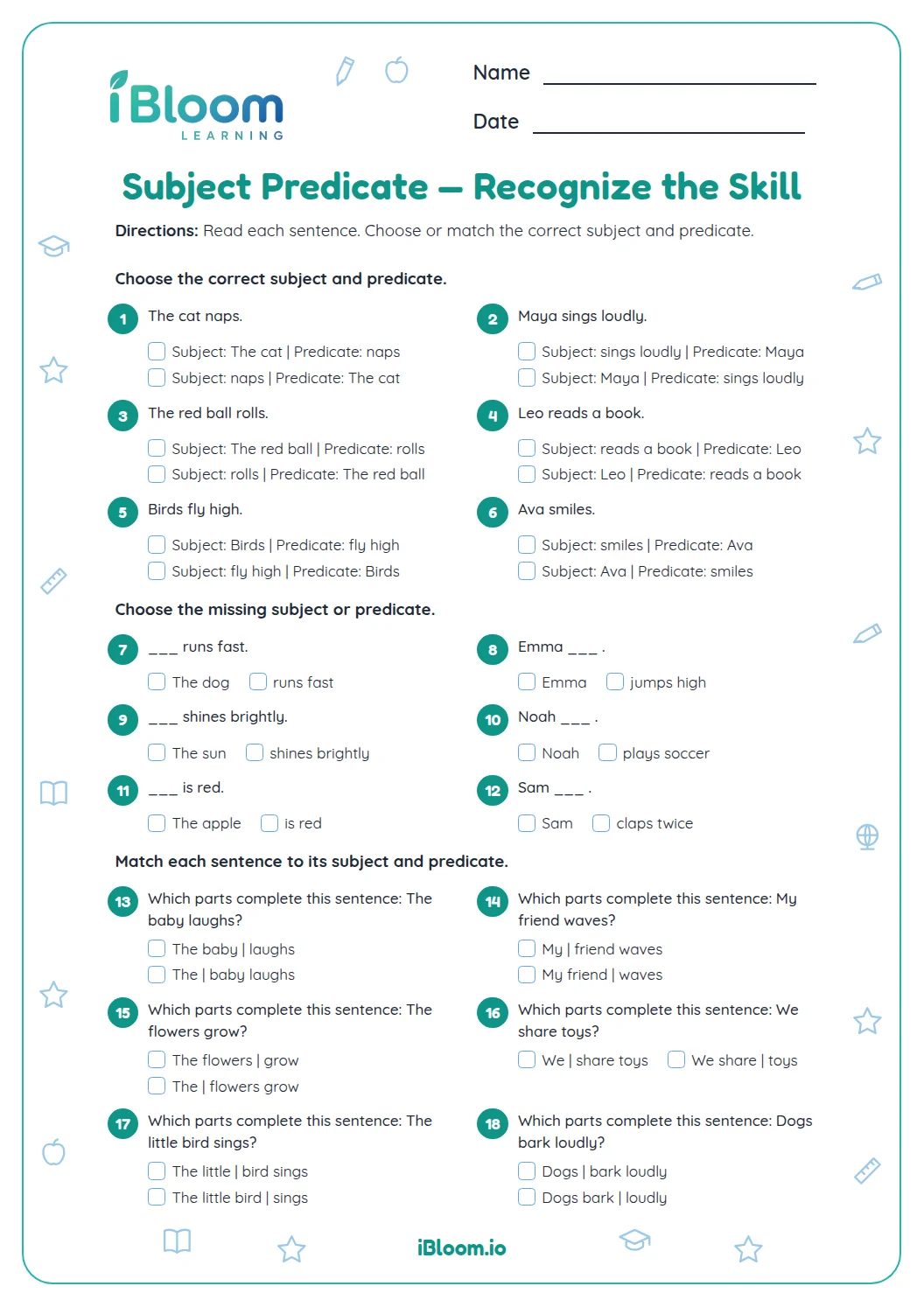
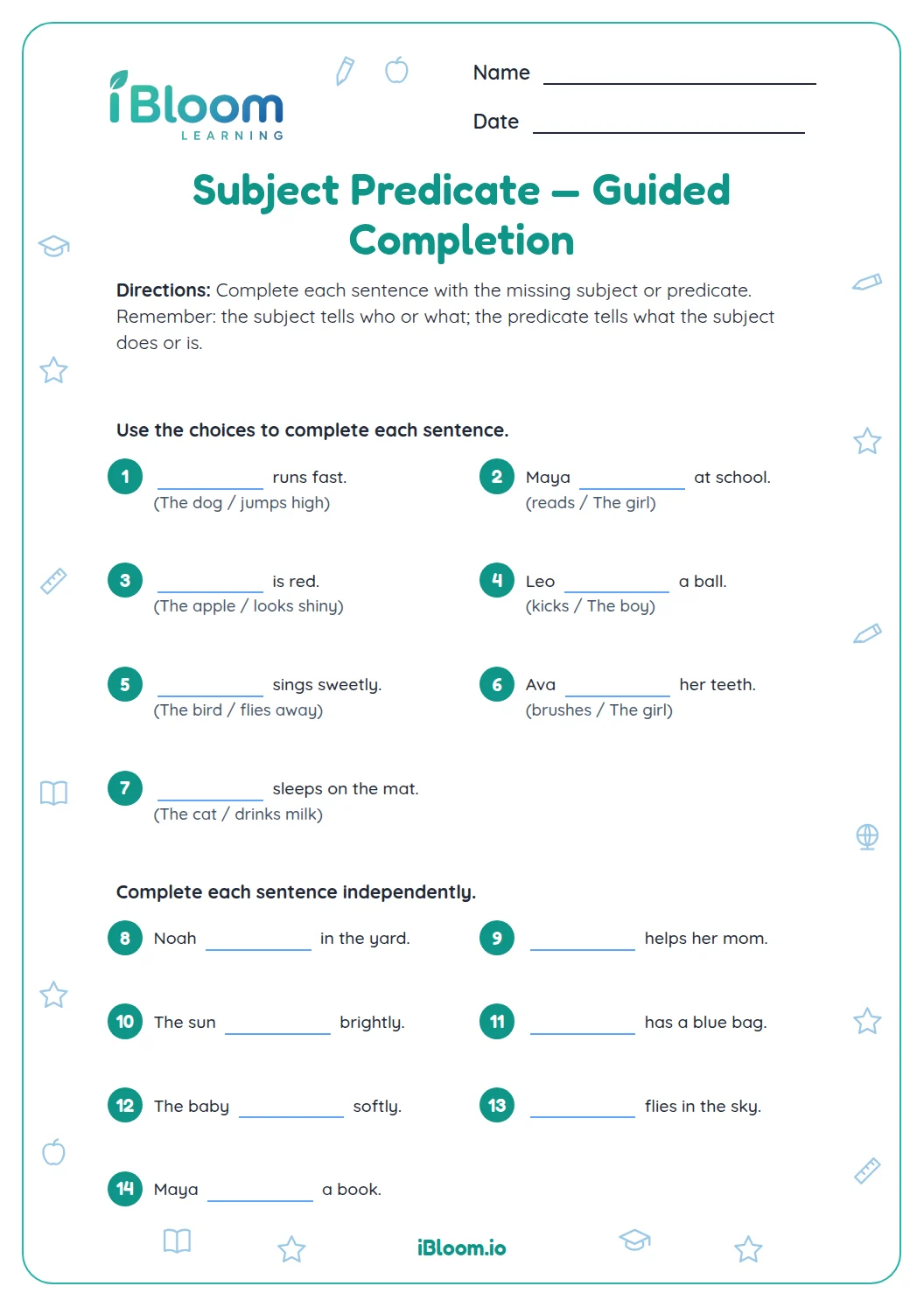
This Grade 1 grammar worksheet gives children 14 opportunities to work with subjects and predicates. Part A asks them to identify both parts in complete sentences. Part B has sentence blanks to complete with a fitting subject or predicate. It connects to CCSS L.1.1.j through sentence production and expansion. An answer key is included.
Aligned to L.1.1.j
How do you find the subject or predicate?
Part A alternates between identifying a subject and identifying a predicate. A subject names who or what a sentence is about; a predicate tells what the subject does or is.
- 1The puppy naps.
- 2Ask who or what the sentence is about.
- 3The puppy is the subject.
How can a missing subject or predicate finish a sentence?
Part B gives a sentence with one part missing. Read the words around the blank, then write a subject or predicate that makes a complete thought.
How can you check a complete sentence?
Read the filled-in sentence aloud. It should tell who or what the sentence is about and what that subject does or is.
How can you use this worksheet?
- 1Read the complete sentence before choosing.
- 2Ask who or what the sentence is about to find its subject.
- 3Ask what the subject does or is to find its predicate.
- 4For each blank, decide whether a subject or predicate is missing.
- 5Reread the completed sentence to check its meaning.
What mistakes can learners check?
The mistake
Calling the first word the subject every time.
The fix
Ask who or what the sentence is about; the subject may have more than one word.
The mistake
Choosing only the action word when the full predicate is requested.
The fix
Include the words that tell what the subject does or is.
The mistake
Writing a fragment in a sentence blank.
The fix
Read the subject and predicate together and check that the thought is complete.
Curriculum alignment
This page gives learners focused practice with the stated skill.
Produce and expand complete sentences in response to prompts.
On this sheet:
Show the official wordingHide the official wording
Produce and expand complete simple and compound declarative, interrogative, imperative, and exclamatory sentences in response to prompts.
What to practice next
Make more practice
Further reading
Questions parents and teachers ask
What is a subject in a sentence?
The subject tells who or what the sentence is about. In “The puppy naps,” the subject is “The puppy.” Part A asks learners to identify subjects in sentences, including subjects made of more than one word, such as “The red kite.”
What is a predicate in a sentence?
The predicate tells what the subject does or is. In “Maya paints a star,” the predicate is “paints a star.” Part A includes predicate questions, and Part B asks learners to complete sentences with a missing predicate or subject.
How many questions are on the worksheet?
There are 14 items in two parts. Seven multiple-choice items ask learners to identify a subject or predicate in a sentence. Seven sentence blanks invite a fitting missing part, and the answer key gives a model completion for each.
Can more than one answer fit a sentence blank?
Yes. Some blanks can take different subjects or predicates while still making a complete, sensible sentence. The key gives one model response; another answer can work if it completes the sentence and supplies the kind of part the prompt needs.
How can a child check whether a sentence is complete?
Read the sentence aloud and listen for a complete thought. It should name who or what the sentence is about and tell what that subject does or is. Then check that the completed sentence still makes sense as a whole.