






About this worksheet
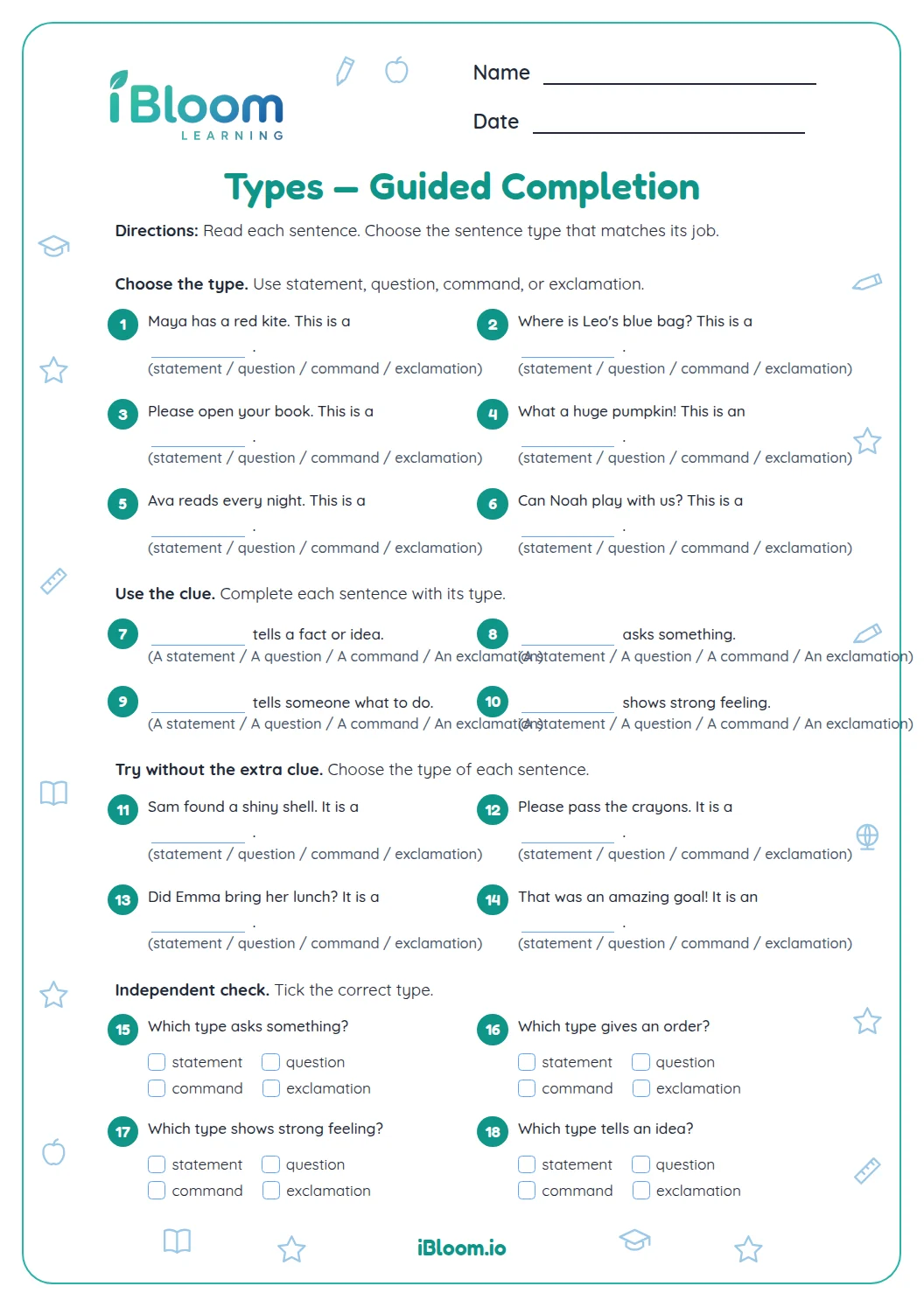
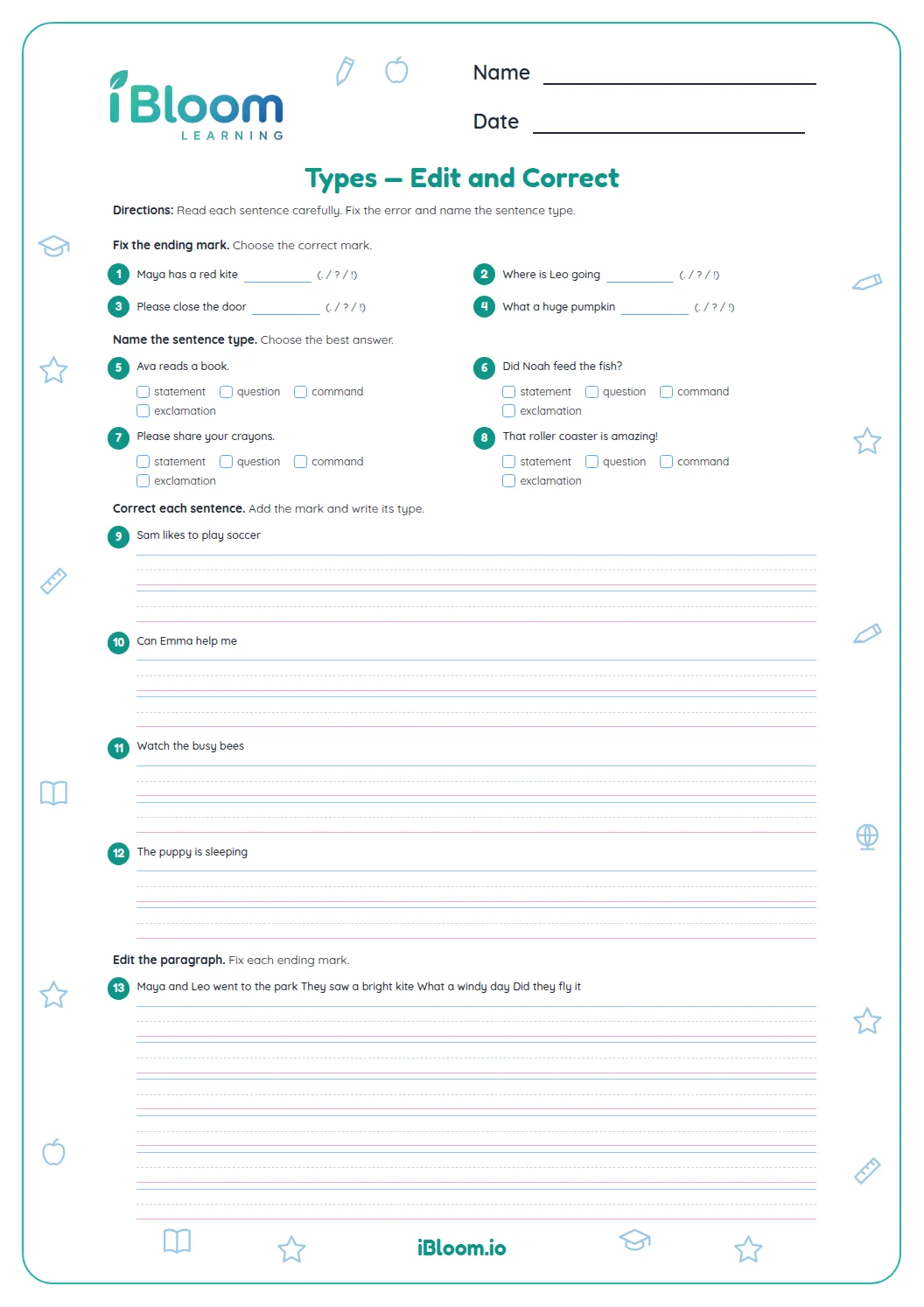
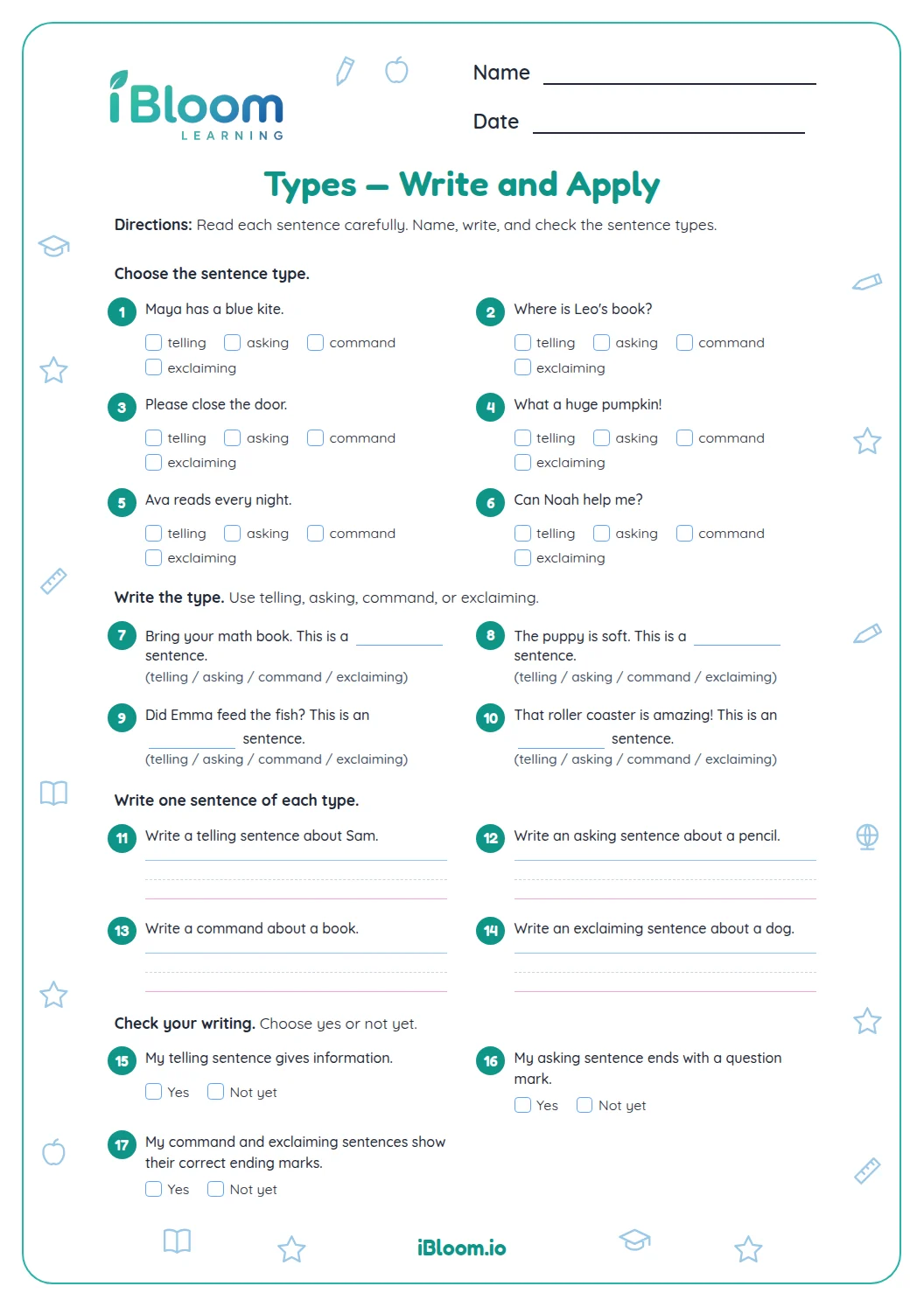
This Grade 1 language worksheet helps children tell four sentence types apart: statements, questions, commands, and exclamations. Students identify a sentence’s purpose, select matching punctuation, and write a complete statement. It includes 14 questions and a separate answer key with sample responses. The practice aligns with CCSS L.1.2.b.
Aligned to L.1.2.b
How does a sentence show its purpose?
Listen to what the words are doing. “The puppy is asleep.” tells something; “Where is my red hat?” asks. A command gives directions, while an exclamation shows a strong feeling.
- 1The puppy is asleep.
- 2It tells information, so it is a statement.
Which end mark belongs at the end?
A period usually ends a statement or command. A question mark ends a question, and an exclamation point can show excitement or surprise. Check both meaning and punctuation: a question mark alone does not make a sentence a question if the words do not ask anything.
How can a child write each type?
Start with a clear idea, then shape it to fit the purpose. Ask something for a question, give a polite direction for a command, or use an excited reaction for an exclamation. Begin with a capital letter and finish with matching punctuation.
How to use this worksheet
- 1Read the full sentence aloud.
- 2Ask whether it tells, asks, directs, or reacts.
- 3Use the end mark as a clue, but check the meaning too.
- 4For writing prompts, make a complete thought with a capital and end mark.
- 5Compare open responses with the sample answers; wording can vary.
Common mistakes and quick fixes
The mistake
Calling every sentence with an exclamation point a command.
The fix
A command tells someone to act; an exclamation shows a strong reaction.
The mistake
Using a question mark after a sentence that does not ask.
The fix
Read it aloud and check whether the speaker wants an answer.
The mistake
Writing a fragment instead of a full thought.
The fix
Include who or what the sentence is about and what happens.
Common Core alignment
This worksheet gives focused practice with the standard below.
Use a period, question mark, or exclamation point to end a sentence.
On this sheet: Learners choose end marks for sentence types and use punctuation in a written statement.
Show the official wordingHide the official wording
Use end punctuation for sentences.
What to practice next
Make more practice
Further reading
Questions parents and teachers ask
What are the four sentence types in first grade?
A statement tells something, a question asks, a command tells someone what to do, and an exclamation shows strong feeling. The 14 questions ask children to identify sentence purposes, select punctuation, and write a statement. The answer key includes a sample for the open response.
Is an answer key included?
Yes. The separate answer key includes responses for all 14 questions, including sample responses where wording may vary. Review it after the learner has tried each part, then revisit any item that needs another strategy. The key includes sample sentences for the open responses, and children may use different wording while keeping the same sentence type.
How many questions are on the sheet?
There are 14 questions in three parts: naming sentence types, writing a statement, and choosing or completing punctuation. Children see statements, questions, commands, and exclamations. The separate key lists the choices and gives a sample statement for question 11.
How can we use this for practice at home?
Ask the learner to read a sentence aloud and say whether it tells, asks, directs, or reacts. Then check the end mark. Question 11 asks for a statement about a park; “The park is green.” is one possible response, and other complete statements also work.
What should I do when an answer is incorrect?
Have the learner explain what the sentence is doing before checking its punctuation. For example, “Please feed the fish.” gives a direction, so it is a command. If an answer differs, compare the meaning and the end mark with the key.