







About this worksheet
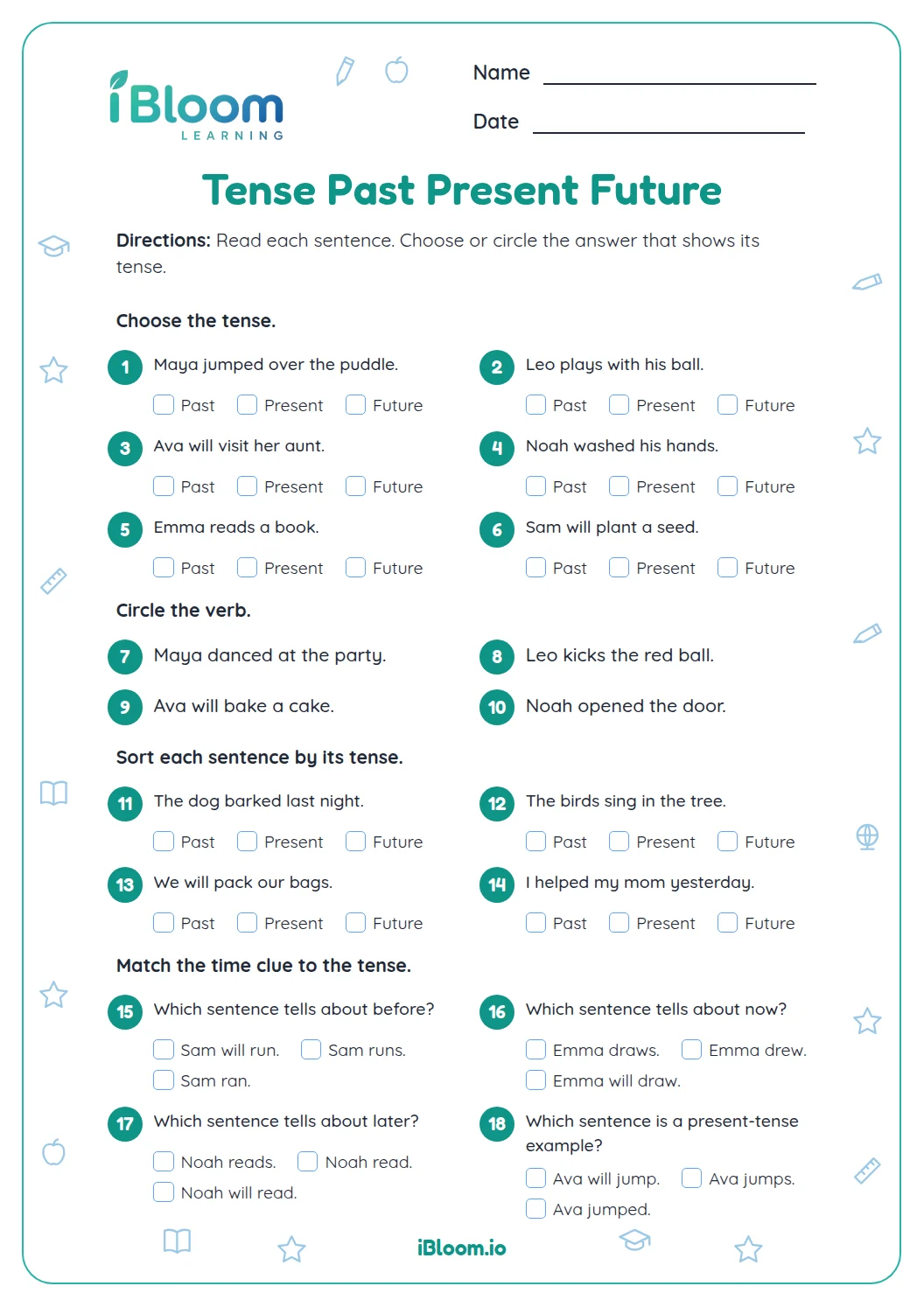
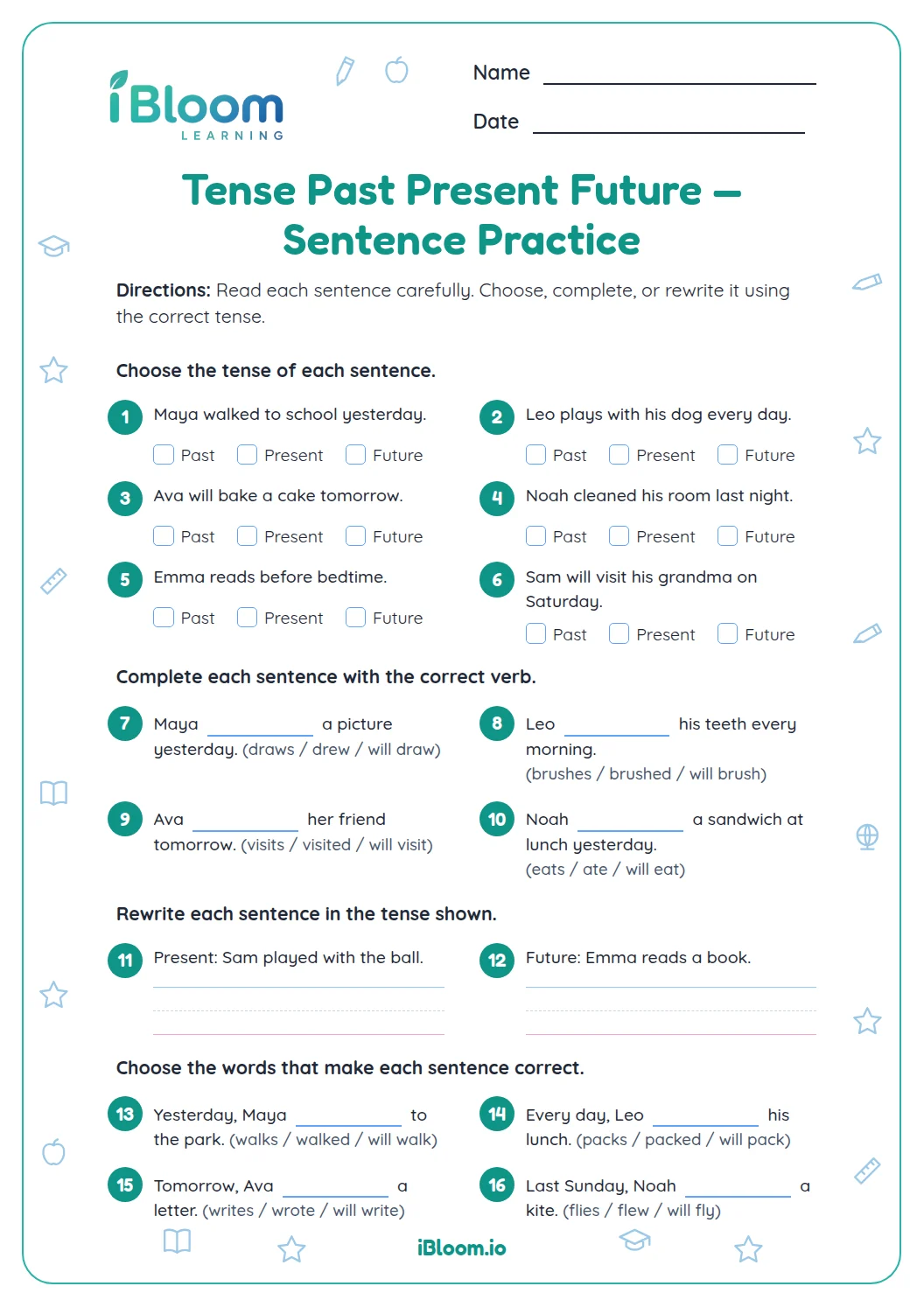
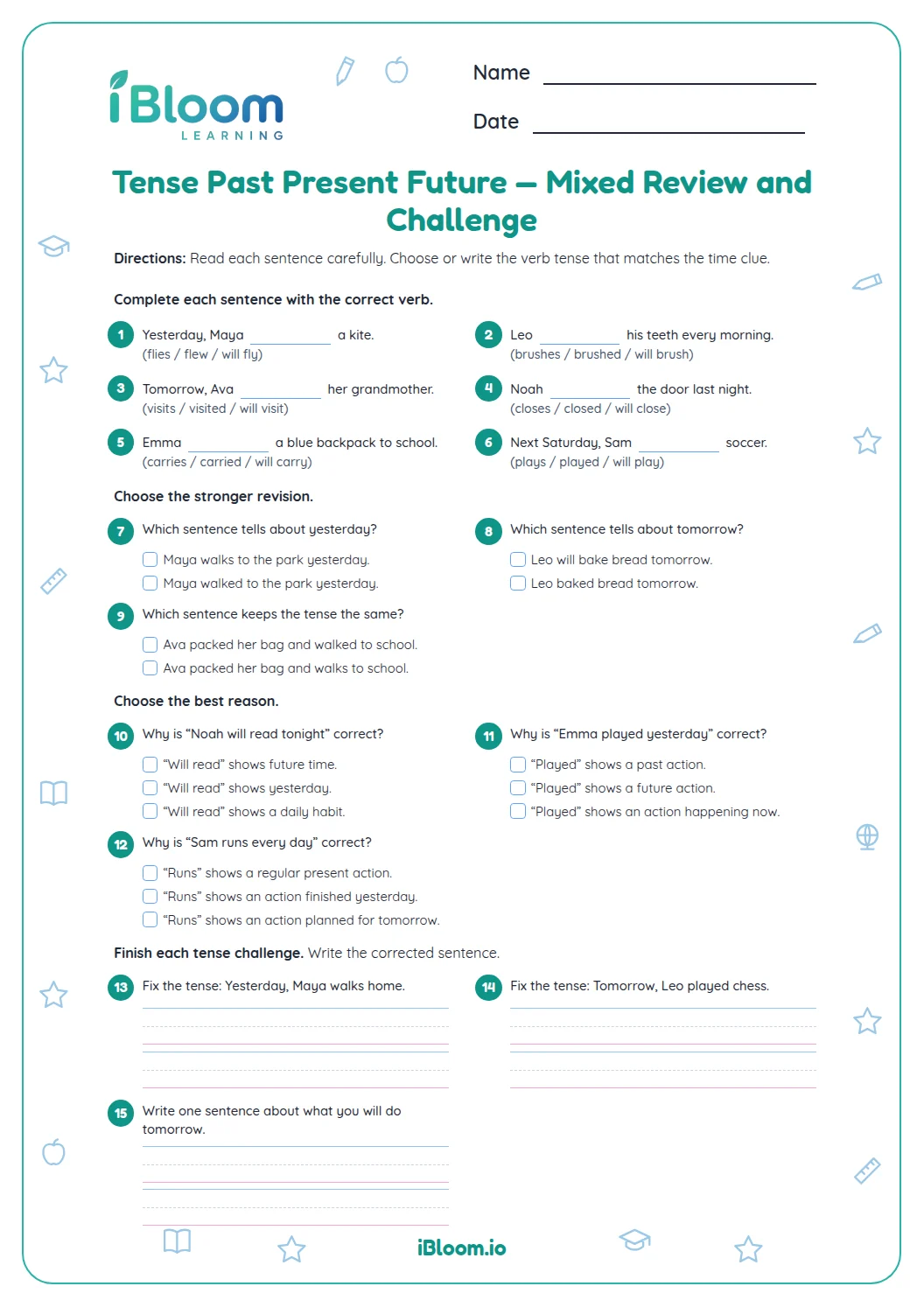
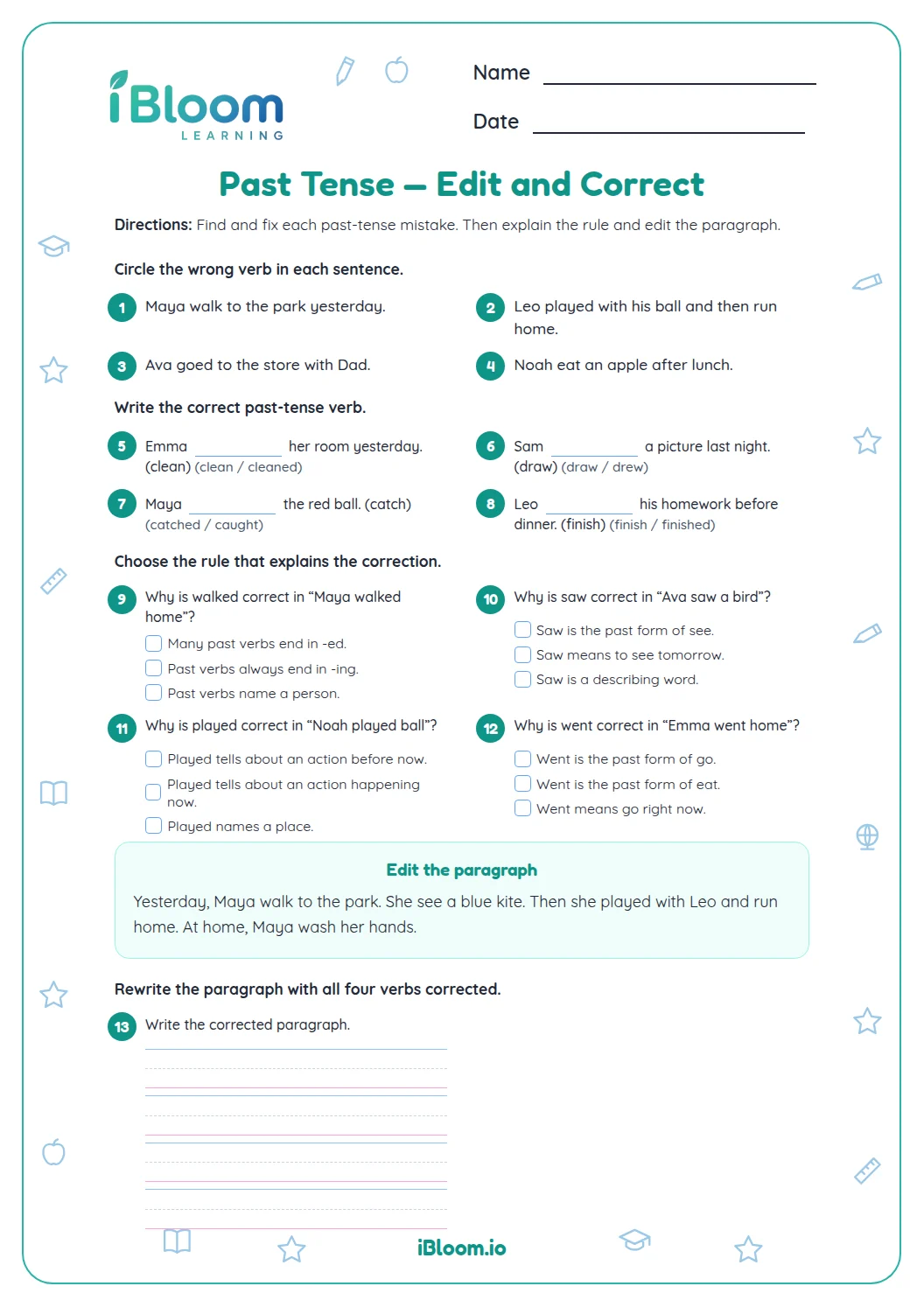
This printable Grade 1 worksheet gives students focused practice with past, present, and future verbs. Across two worksheet pages, 15 questions move from supported practice to independent use, followed by a separate two-page answer key. The prompts keep the practice centered on the named skill and give families and teachers a clear way to review answers.
Aligned to L.1.1.e
How does this sheet practice past, present, and future verbs?
The 15 questions use more than one format to revisit past, present, and future verbs. Read each part heading before starting so the response matches the task.
The answer key follows the worksheet and includes the target answers; written responses are labeled as samples when more than one sentence can work.
- 1Yesterday, Max ___ to the park.
- 2“Yesterday” signals past time, so “walked” completes the sentence.
How can an adult support the practice?
Ask the student to point to the clue, model, or word that supports an answer. For a missed item, reread the exact prompt and try it again before looking at the key.
How can students use the answer key?
Check answers after finishing a part. For an open response, compare the work with the skill requested; the sample in the key is one acceptable example, not the only possible wording.
How to use this worksheet
- 1Read the part heading and its direction.
- 2Complete each prompt before checking the key.
- 3Point to the clue or model that supports each answer.
- 4For written practice, reread the response for the target skill.
- 5Use the answer key to check and correct the work.
Common mistakes and quick fixes
The mistake
Using a present verb after “yesterday.”
The fix
Change the verb to show that the action already happened.
The mistake
Leaving out “will” for a future action.
The fix
Read the future sentence aloud with “will” before the action verb.
The mistake
Writing a phrase instead of a complete sentence.
The fix
Include who or what acted and a verb in the requested time.
Curriculum alignment
This worksheet supports practice with the listed Common Core skill.
Use verbs to convey past, present and future time.
On this sheet: Students identify and write verbs that place actions in past, present, or future time.
Show the official wordingHide the official wording
Use verbs to convey a sense of past, present, and future (e.g., Yesterday I walked home; Today I walk home; Tomorrow I will walk home).
What to practice next
Make more practice
Further reading
Questions parents and teachers ask
What tenses does the worksheet practice?
It practices past, present, and future verbs. Students first choose verbs that fit time clues, then complete sentences and write one original sentence in each tense. The separate key gives sample answers for the final writing prompts; another complete sentence that follows the requested tense can also be correct.
Which words signal past time?
Words such as “yesterday” and “last night” point to actions that already happened. On this sheet, “Mia ___ a kite yesterday” takes “flew.” Students can underline the time clue, then choose a verb that makes the sentence clear.
How is future time written on this sheet?
The future examples use “will” before the action verb, as in “We will water the garden later.” Students should write both words in a blank when the sentence needs them. Reading the completed sentence aloud can help check whether the time and verb agree.
Can students write a different sentence from the key?
Yes. The final three prompts ask students to create sentences about a ball, a book, and a game. The key provides one sample for each. Accept a different complete sentence when it uses a verb in the tense named by the prompt and stays on topic.
How many questions and pages are included?
There are 15 questions in three parts across two worksheet pages. The answer key takes two pages. The parts move from choosing a verb to completing sentences and writing original examples, so students practice recognition as well as use.