






About this worksheet
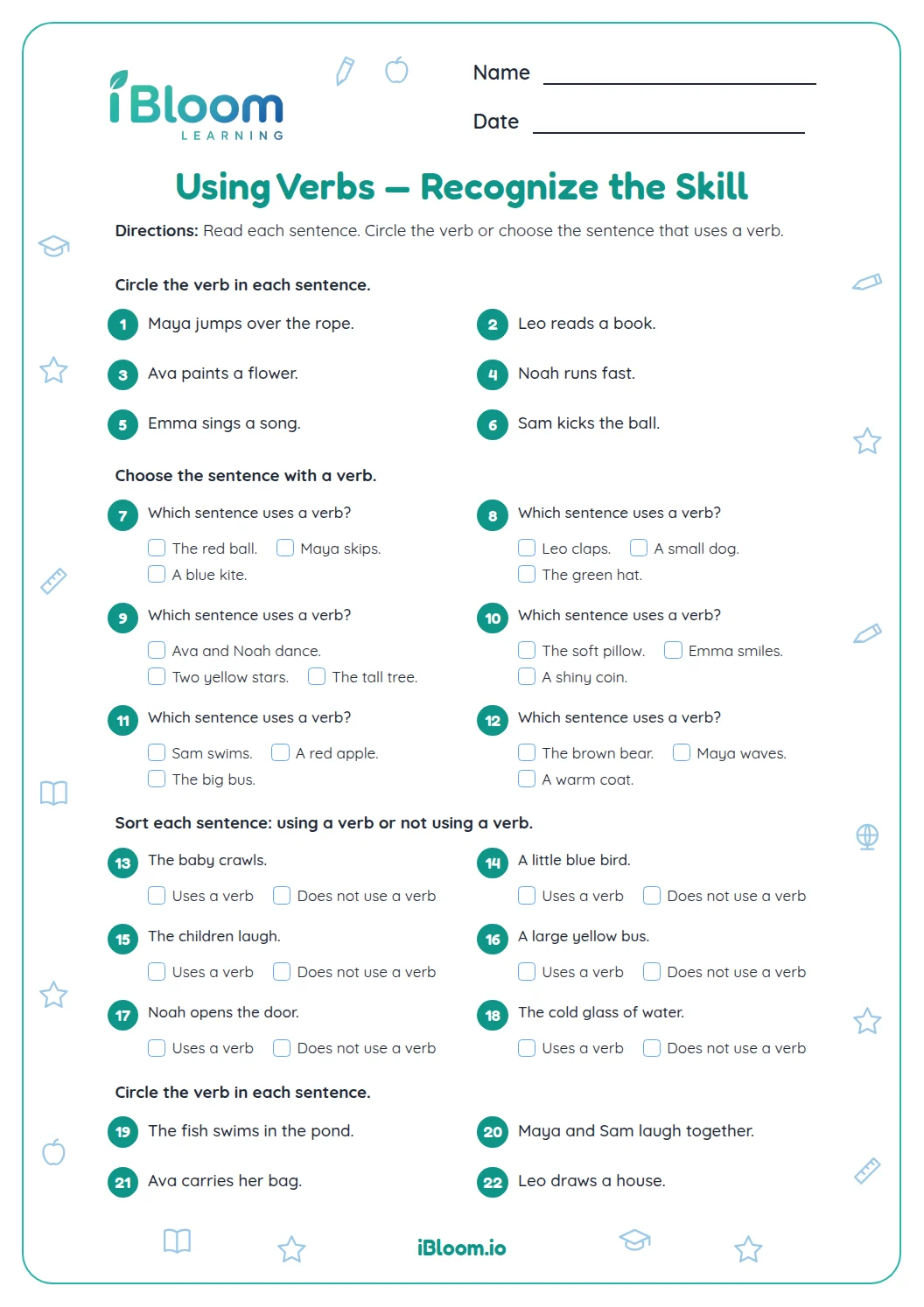
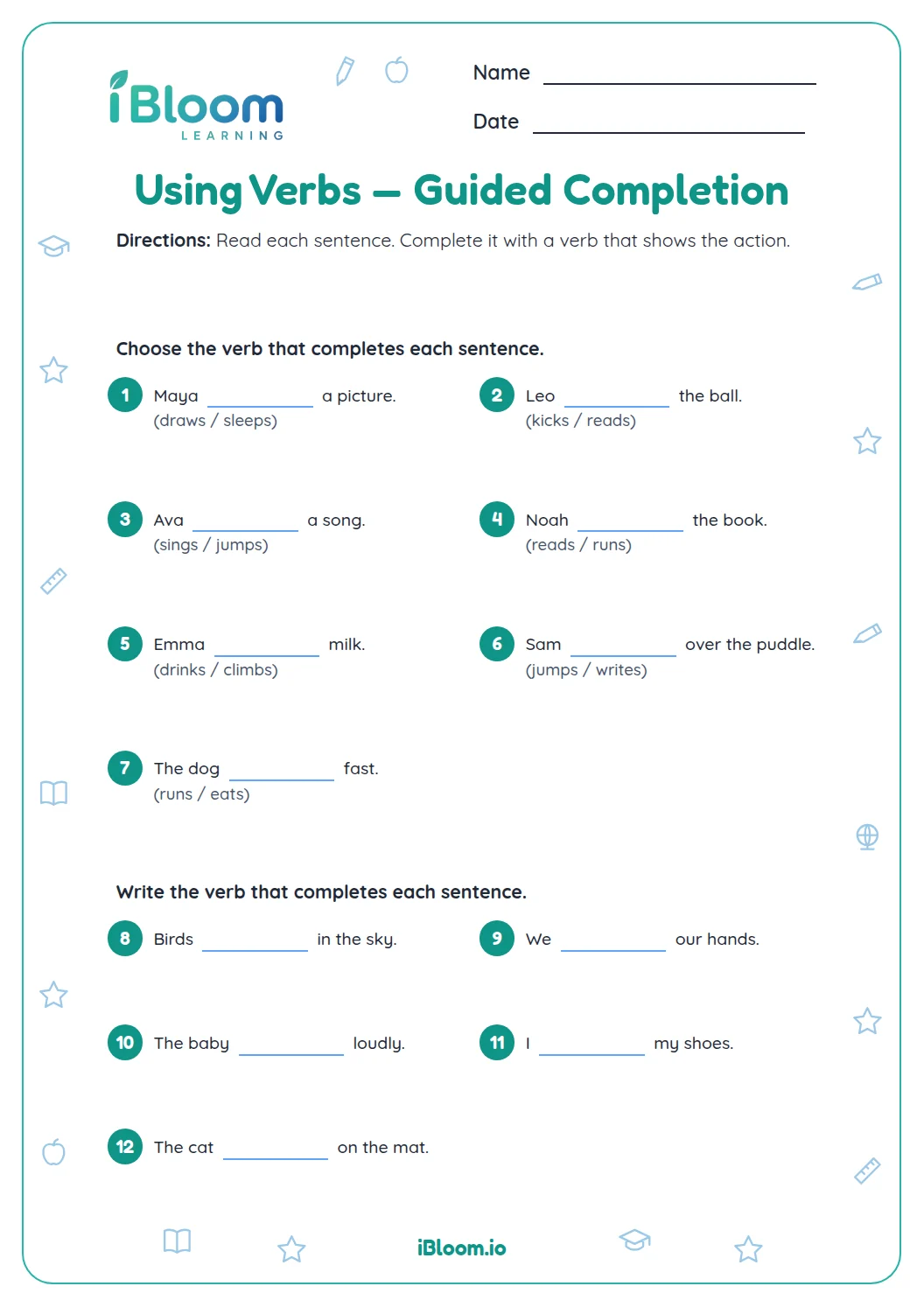
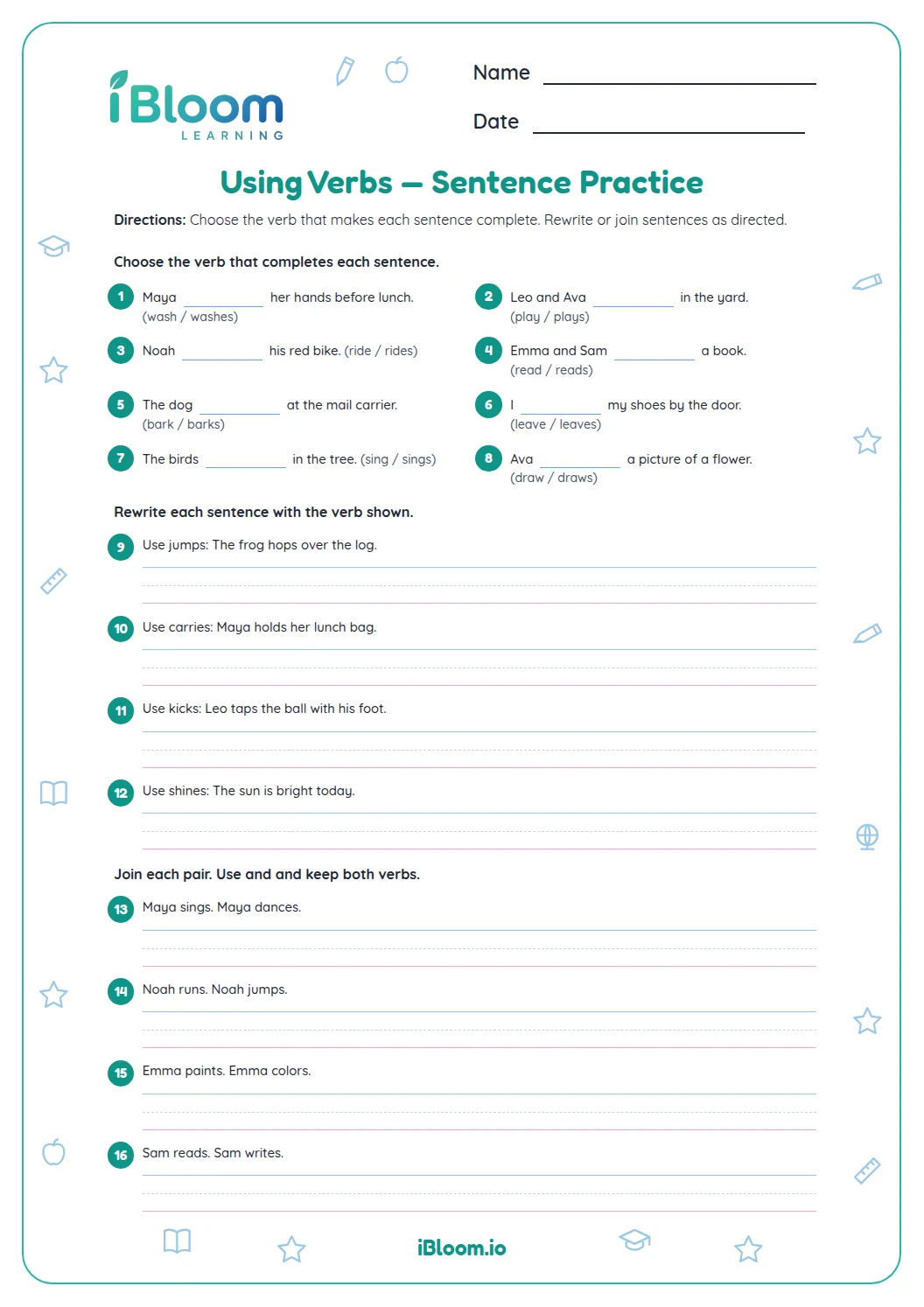
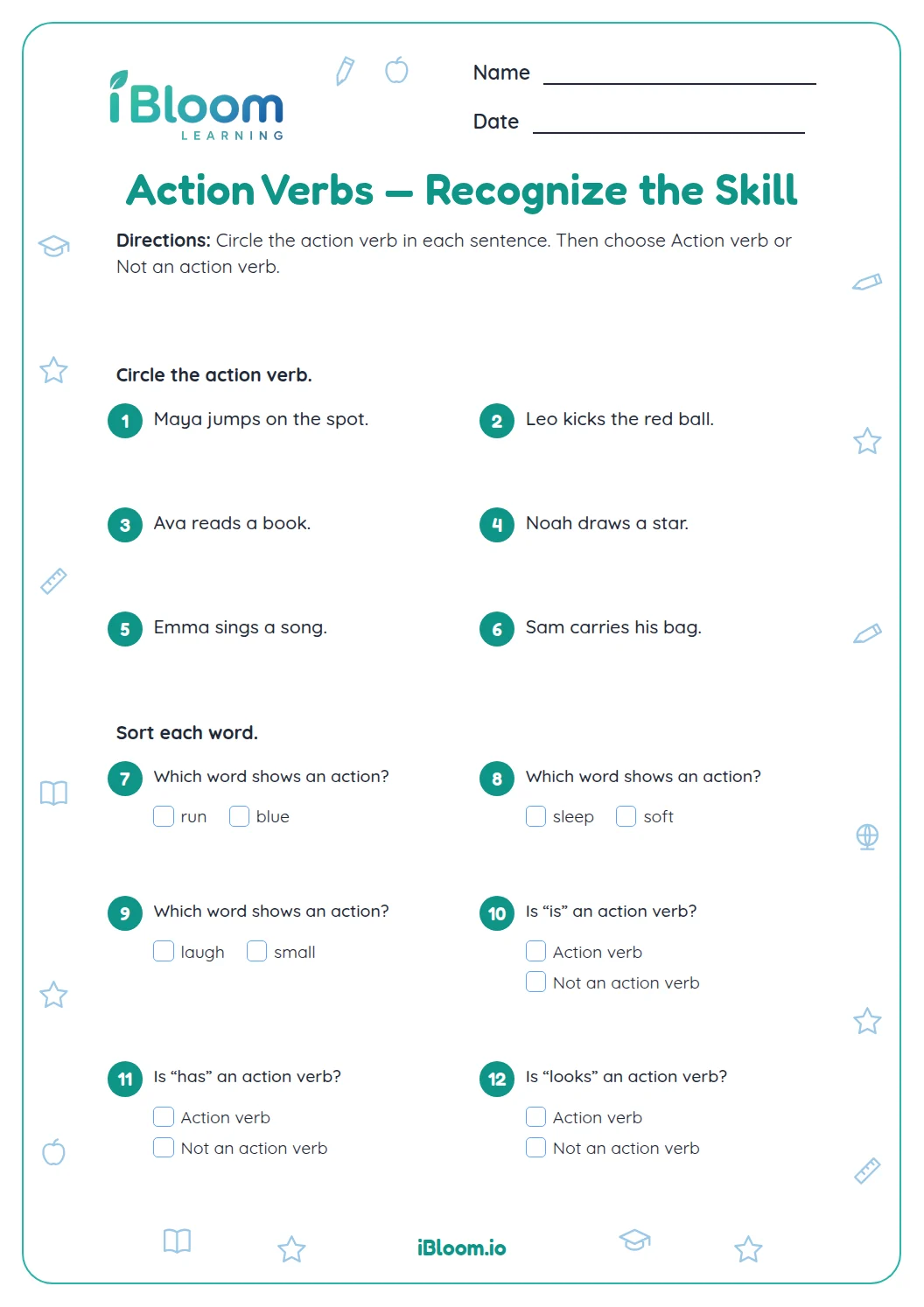
This Grade 1 printable moves from choosing action verbs to using them in complete sentences. Children pick verbs that fit six short sentences, use the whole sentence to complete six more, and write two sentences of their own with the verb underlined. The answer key gives intended choices and sample sentences; sensible alternatives can work when they make a clear, grammatical sentence.
What does a verb do in a sentence?
A verb can tell what a person, animal, or thing does. In “Mia ___ a song,” sings completes the thought and names Mia’s action. Part A asks children to choose a fitting action word for each sentence.
- 1Mia ___ a song. → Mia sings a song.
How does the sentence help choose a verb?
Part B adds context: “The frog can ___ over a log” calls for an action that can happen over a log. Children should read the complete sentence before settling on a word, and check that the verb form fits words such as can or will.
How can children use verbs in their own writing?
Part C asks for two complete sentences, one about a school action and one about an animal. The writer underlines the verb in each sentence. The key offers examples, but different clear sentences are welcome.
How to use this worksheet
- 1Read each sentence aloud and ask what action would make it complete.
- 2For Part A, choose a verb that makes sense with the subject.
- 3In Part B, use every clue in the sentence, including can or will.
- 4Write a complete sentence for each Part C prompt.
- 5Underline the action verb, then reread and compare with the answer key.
Common mistakes and quick fixes
The mistake
Choosing a word that names a thing, such as blue.
The fix
Ask what the subject does; an action word such as jumps answers that question.
The mistake
Leaving the verb in the wrong form after a helping word.
The fix
Read the phrase aloud: “can jump” and “will paint” use the base verb.
The mistake
Writing a fragment instead of a sentence.
The fix
Add who or what does the action, then reread the complete thought.
What to practice next
Make more practice
Questions parents and teachers ask
What is an action verb?
An action verb tells what someone or something does. In “The puppy runs fast,” runs names the puppy’s action. This worksheet starts with action words in short sentences, then asks children to write sentences and underline the verb they used.
Can a child use a different word from the answer key?
Yes, when the word makes a complete, sensible sentence and is an action verb. For “Birds ___ in the sky,” fly is the intended answer, but soar also works. The two writing prompts are open ended, so use the sample answers as models rather than the only acceptable wording.
What should the child write for the last two questions?
Question 13 asks for a complete sentence about a school action, with its verb underlined. Question 14 asks for a sentence about an animal and its action verb. For example, “The rabbit hops” works because hops tells what the rabbit does.
How can I explain the word “verb”?
Ask, “What does the person or animal do?” In “Dad stirs the soup,” stirs is the verb. Then try another sentence together and identify its action word. The worksheet reinforces that idea by asking children to complete sentences before using verbs in their own writing.
How long does the worksheet take?
Plan for about 15 minutes, depending on how much support the child wants with writing. The first two parts have 12 short sentence completions; the final two questions need original sentences. Children can say a sentence aloud before writing it and checking the key.