




About this worksheet
This Grade 1 printable gives children focused practice with uppercase M and lowercase m. The first part provides trace-and-copy models, followed by questions that identify M at the beginning, middle, or end of familiar words. Four final items ask students to write M or m to complete a word. The page practices printing uppercase and lowercase letters under CCSS L.1.1.a, and the separate answer key shows the target letters and words.
Aligned to L.1.1.a
How should children practice M and m?
Trace each model carefully, noticing the tall peaks of uppercase M and the smaller humps of lowercase m. Then copy the letter without tracing.
- 1M → trace and copy uppercase M
- 2m → trace and copy lowercase m
How can children spot M in a word?
Listen for the /m/ sound and check the letter’s position. Moon begins with m, while ham ends with m.
How do the missing-letter questions work?
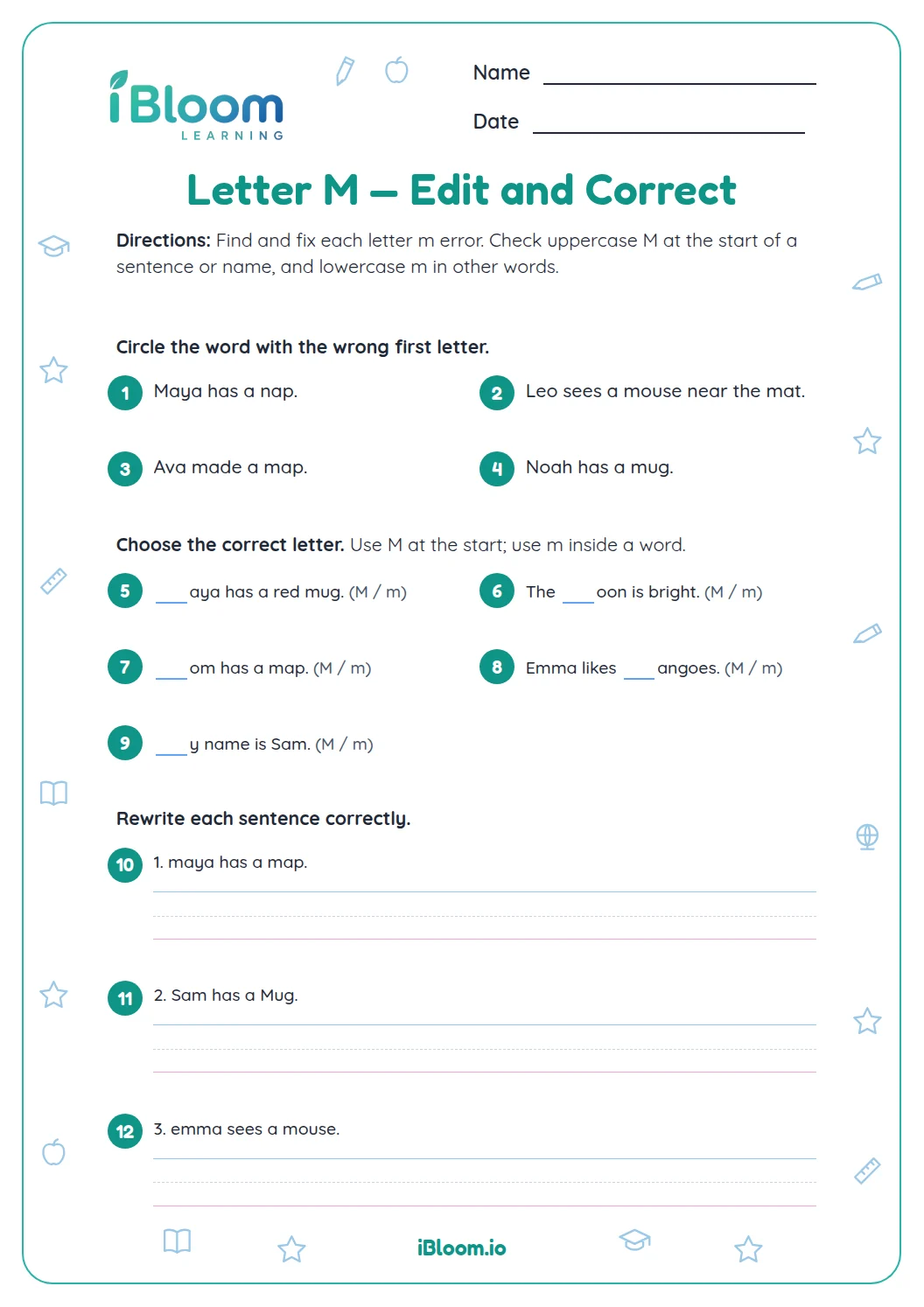
Say the whole word aloud, then write M or m in the blank. Use an uppercase letter at the start of a sentence only when the prompt requires it; the word itself uses lowercase.
What is a useful final check?
Compare the written letter with the model. Make sure uppercase M reaches the top line and lowercase m stays small.
How to use this worksheet
- 1Trace the model slowly from top to bottom.
- 2Copy the letter beside the model.
- 3Say each word aloud before choosing an answer.
- 4Look for the /m/ sound and its place in the word.
- 5Write M or m in each blank.
- 6Compare the forms with the answer key.
Common mistakes and quick fixes
The mistake
Using uppercase M in the middle of a word.
The fix
Use lowercase m in ordinary words such as lemon and ham.
The mistake
Confusing m with n.
The fix
Lowercase m has two humps; n has one.
The mistake
Starting uppercase M from the bottom.
The fix
Begin at the top line and form the two tall strokes before the center valley.
Common Core alignment
This practice connects the listed standard to the skill on the page.
Print the uppercase and lowercase letter M clearly.
On this sheet: Students trace and copy uppercase and lowercase M and identify the letter in words.
Show the official wordingHide the official wording
Print all upper- and lowercase letters.
What to practice next
Make more practice
Further reading
Questions parents and teachers ask
Does this page practice both M and m?
Yes. The tracing section includes uppercase M and lowercase m, and the word questions use both forms. Children see uppercase M at the start of sentence prompts and lowercase m inside ordinary words such as lemon, ham, and camel in the word tasks.
Which words are used for M practice?
The worksheet uses moon, map, milk, jam, camel, lemon, and ham. Students look for M at the beginning, middle, or end, then complete four words with the missing letter. Familiar words keep attention on the target letter and its sound.
How should a child trace the letters?
Start at the top of each model and follow its shape slowly. After tracing, copy the form once. Uppercase M reaches the top and bottom writing lines; lowercase m is shorter and has two rounded humps that fit between the middle and bottom lines.
How many questions are on the page?
There are 14 questions: two trace-and-copy items, eight letter or word choices, and four missing-letter words. A separate answer key shows each target letter or word so an adult can check the page quickly and discuss any missed item together.
How can I help if m and n look alike?
Compare the humps: lowercase m has two and lowercase n has one. Say a target word aloud and pronounce its first sound slowly, as in mmm-map, then find the matching printed letter. This sound and shape check can help separate the forms.