




About this worksheet
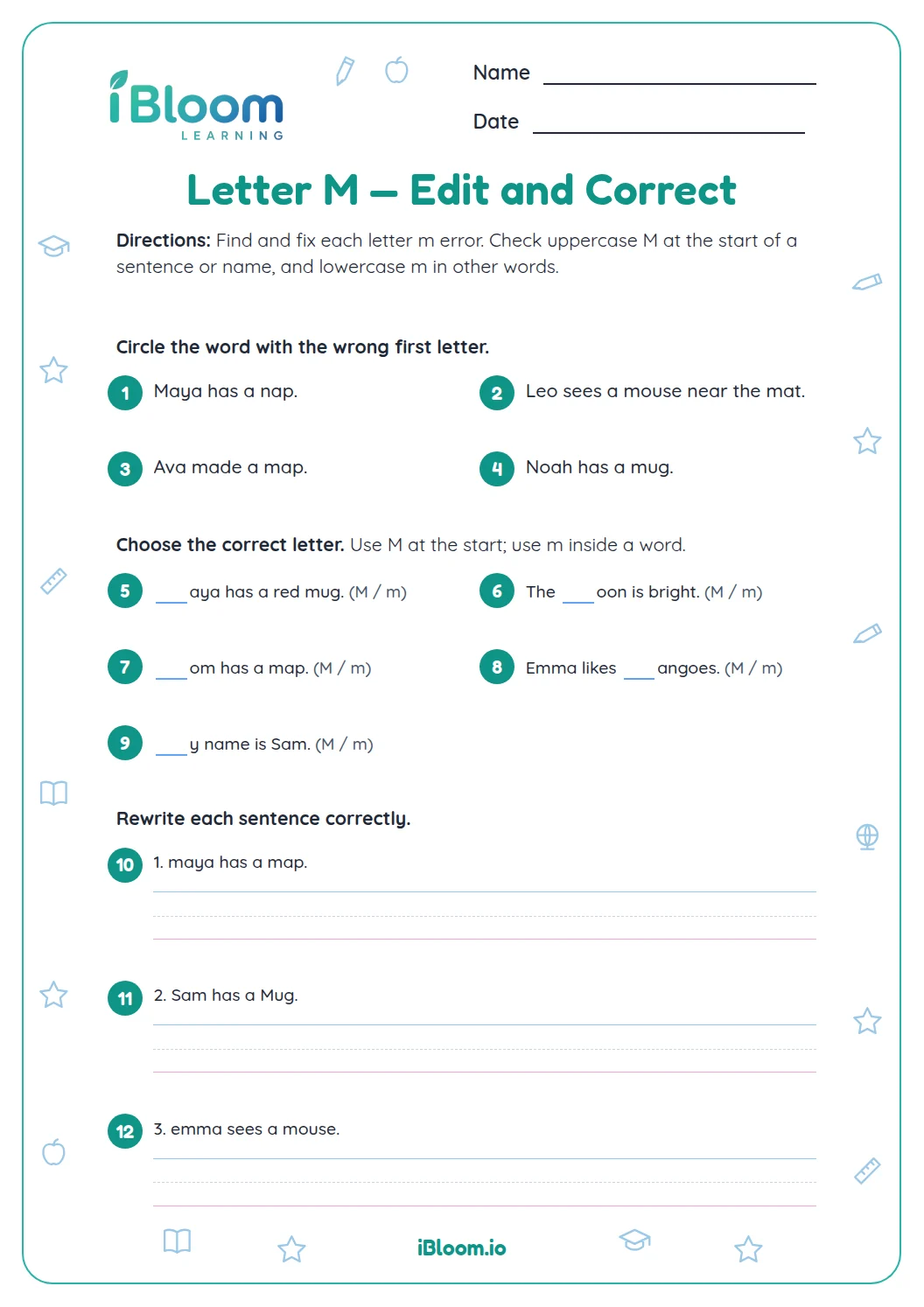
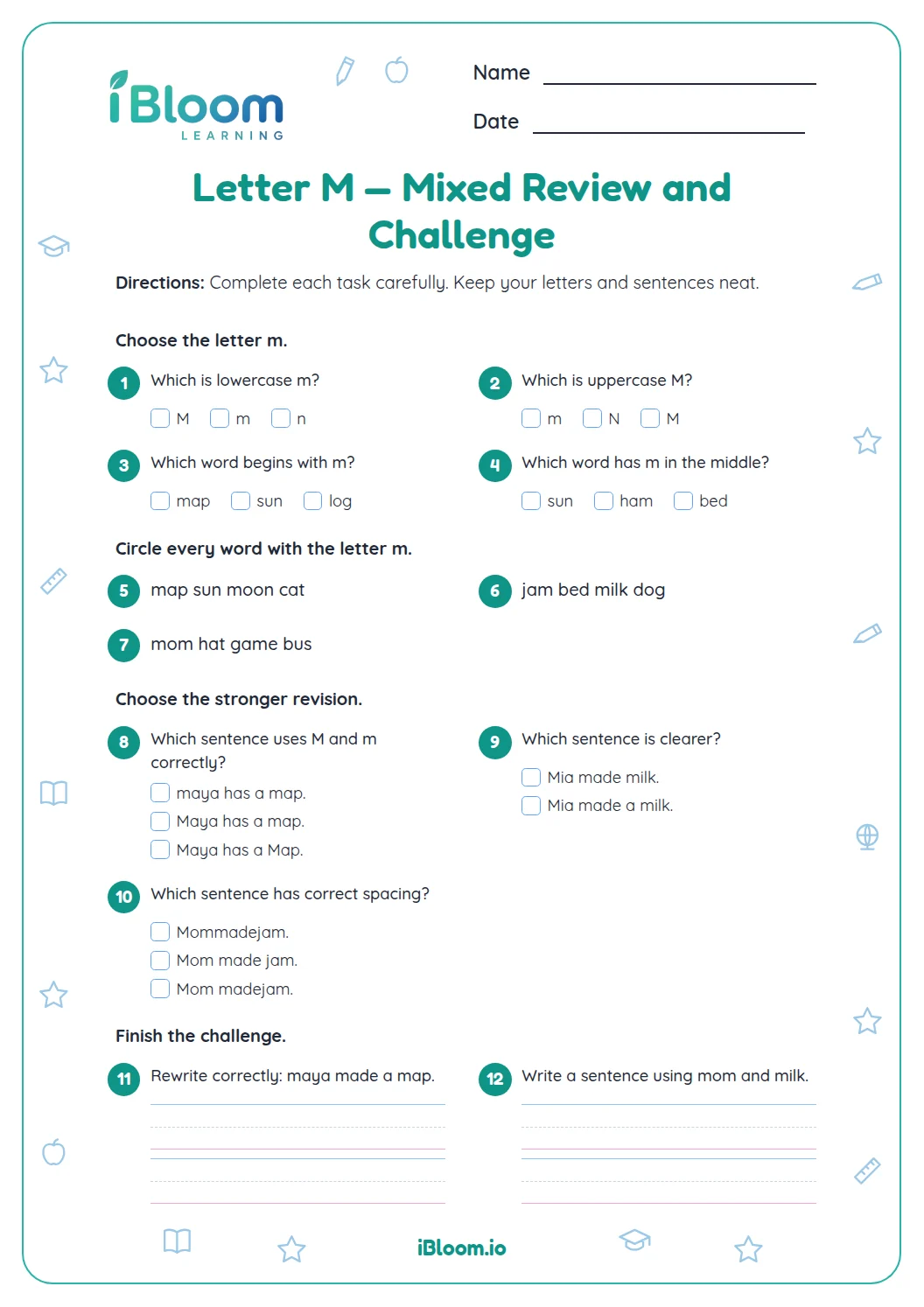
This free printable Grade 1 Letter M worksheet practices sentence writing with words such as Maya, map, mug, mouse, and milk. Part A has six sentences to complete. Part B asks children to choose three correctly written sentences. In Part C, they rewrite three sentences with capitals and periods; in Part D, they join three pairs using and. The fifteen tasks practice producing and expanding sentences and using end punctuation under Common Core L.1.1j and L.1.2b. A separate answer key gives the choices, corrections, and sample joined sentences.
Aligned to L.1.1j and L.1.2b
How do children choose a word that fits?
Read the whole sentence with each choice. “Sam can make a map” tells what Sam can do; “Sam can made a map” does not fit. Children can say the complete sentence before marking the word. An adult may read the choices aloud.
What should children fix when rewriting?
Keep the words in order, capitalize the first word and any person’s name, and add a period. Part B provides correct and incorrect examples before children make those corrections themselves in Part C.
- 1maya has a small mug
- 2Maya is a name and the first word: use M.
- 3Add a period after mug.
- 4Maya has a small mug.
How do children join two sentences with and?
Find what the two sentences share, then use and to join the remaining ideas. Maya has a map and Maya has a mug can become “Maya has a map and a mug.” The sentence needs only one final period.
For Sam, join the two actions: “Sam taps the drum and hums a song.” Accept other grammatical versions that keep both ideas. The key gives one sample for each pair.
How to use this worksheet
- 1Read each Part A sentence aloud with both word choices.
- 2Choose the Part B sentences with correct capitals and a period.
- 3Rewrite the three Part C sentences, preserving all their words.
- 4Join each Part D pair with and; keep both ideas.
- 5Read the finished sentences and check capitals, spaces, and periods.
Mistakes to notice and fix
The mistake
Choosing made after can in “Sam can ___ a map.”
The fix
Read both versions aloud. Can make tells what Sam is able to do.
The mistake
Leaving maya or sam lowercase when rewriting.
The fix
Capitalize a person’s name and the first word of the sentence.
The mistake
Keeping a period immediately before and in a joined sentence.
The fix
Read the joined ideas as one sentence, with one period at the end.
Curriculum alignment
Complete sentences and expand them by joining related ideas with and.
On this sheet: Children complete six sentences, rewrite three, and join three pairs into expanded sentences.
Show the official wordingHide the official wording
Produce and expand complete simple and compound declarative, interrogative, imperative, and exclamatory sentences in response to prompts.
Recognize and add periods at the ends of statements.
On this sheet: Parts B and C ask children to identify and write statements with end punctuation.
Show the official wordingHide the official wording
Use end punctuation for sentences.
What to practice next
Make more practice
Further reading
Questions parents and teachers ask
What kinds of sentence practice are included?
The fifteen questions include six word choices, three sentence choices, three corrections, and three sentence joins. Words such as Maya, map, mug, mouse, and milk keep M in view. Children move from choosing an answer to writing their own corrected and expanded sentences on the lines.
Does my child need to read every word alone?
No, an adult can read each sentence and both choices aloud. Ask the child to repeat the completed sentence before marking an answer. During rewriting, read the words together while the child decides where capitals and periods belong and prints the sentence with spaces between words.
What should children change in Part C?
Children should add the needed capitals and a final period while keeping the words in their original order. In question 10, maya becomes Maya because it is a name and starts the sentence. The corrected answer is “Maya has a small mug.” Check the spaces too.
Can a joined sentence differ from the answer key?
Yes, a joined sentence can differ if it uses and, keeps both ideas, and is grammatically complete. For example, “Maya has a map and a mug” combines the two objects without repeating Maya. The key gives sample answers; children should add a period to each finished sentence.
How should I check the finished worksheet?
Use the key for the nine choice questions, then read each of the six written responses. Check that corrections preserve every word and add capitals and a period. For joined sentences, check that both original ideas remain. Ask the child to read any unclear sentence aloud before revising it.