




About this worksheet
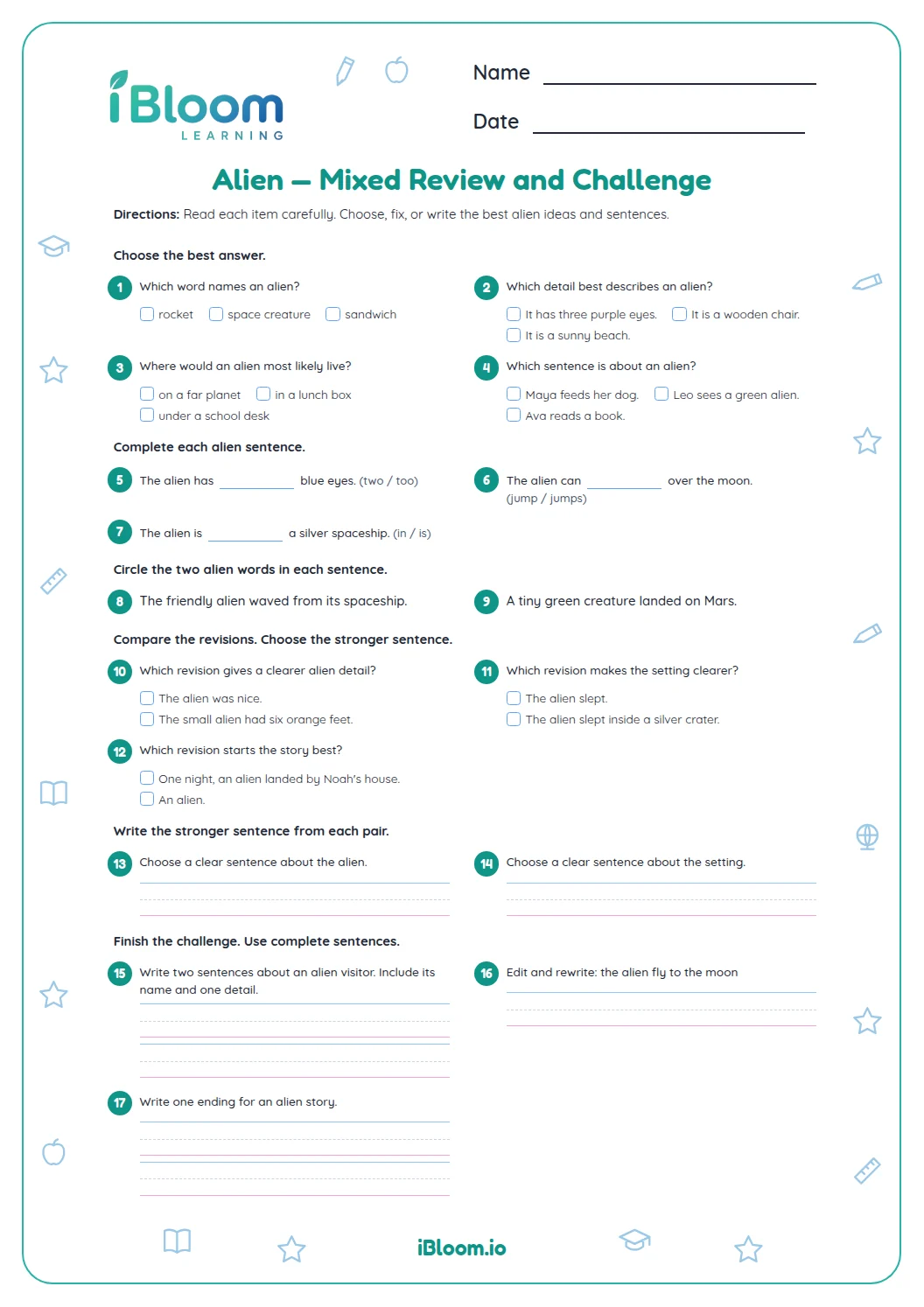
This free Grade 1 printable gives young writers a guided alien story to complete. Students choose who arrives and what happens, then fill short prompts with a name, place, greeting, time words, details and an ending. Parts A and B move from choosing story ideas to finishing connected sentences. The answer key includes sample answers for open prompts. This practice aligns with Common Core W.1.3, which asks first graders to recount sequenced events with details, time words and an ending.
Aligned to W.1.3
How can a first grader start the alien story?
Sixteen questions in two parts. Students choose five story details, then complete eleven connected prompts about the alien’s visit.
A child can use the choices as support, then add their own sensible details in the blank prompts.
- 1Question 1: “A green alien landed by the school.”
- 2This sentence introduces the character and the first event.
How do time words help a story make sense?
Words such as “then,” “after that” and “at last” tell the reader when events happen. The events still need to make sense: the alien arrives before the characters walk to the ship, and the goodbye comes near the end.
Question 16 asks students to arrange three events; the answer is 2, 1, 3 for the printed order.
What makes a satisfying story ending?
An ending shows what happens when the main event is over. In this story, Zog waves goodbye and leaves, and the narrator can tell how they feel. A final feeling sentence gives the reader a simple sense of closure.
The sample answers are short models. A different answer works when it fits the story and gives a complete thought.
How to use this worksheet
- 1Read the title and tell who the story is about.
- 2Complete Part A with a character, place and greeting.
- 3Use “then” and “after that” to put actions in order.
- 4Add a feeling, a sound or another detail to help the reader imagine the visit.
- 5Reread the ending to check that the story feels finished.
Common mistakes and quick fixes
The mistake
Writing events without saying when they happen.
The fix
Add a time word such as “then” or “at last.”
The mistake
Beginning with a feeling but not saying who arrived.
The fix
Name the alien or describe the landing in the first sentence.
The mistake
Ending with an event that does not finish the visit.
The fix
Show what the alien or narrator does as the story closes.
Common Core alignment
This guided story uses sequenced events, details, time words and closure.
Tell two or more events in order, add details and time words, and give the story an ending.
On this sheet:
Show the official wordingHide the official wording
Write narratives in which they recount two or more appropriately sequenced events, include some details regarding what happened, use temporal words to signal event order, and provide some sense of closure.
What to practice next
Make more practice
Further reading
Questions parents and teachers ask
Can my child write answers that differ from the key?
Yes. The key gives a suggested answer for each blank and a sample for the writing prompt. Another word or sentence can work if it completes the idea, fits Zog’s visit and makes sense with the events around it. A child might name a different garden detail.
What story skills does this page practice?
The page practices introducing a character, adding details, telling events in order, using a time word and giving the story an ending. Students choose story ideas, complete connected sentences and write one detail of their own about what Zog notices.
Does my child need to write a whole story alone?
The page guides most of the story with choices and sentence starters, then asks for one original sentence. Students add a name, place, greeting, action and feeling before writing a garden detail in their own words. An adult can read prompts aloud.
What are time words?
Time words tell when an event happens or which event comes next. “Then,” “After that” and “At last” help the reader follow the alien’s arrival, the characters’ shared activity and the goodbye. The time-word blank connects two events in story order.
How long does the worksheet take?
About 20 minutes is a reasonable estimate. Students can move quickly through the choices and blanks, while the story sentences and original garden detail may take longer. Read the completed story aloud together afterward to check that its events stay in order.
How can we extend the alien story?
Invite your child to tell what Zog sees on the way home or draw the ship and describe one detail aloud. The Future and New Ending prompts offer another chance to imagine what happens next and give a story a clear closing.