






About this worksheet
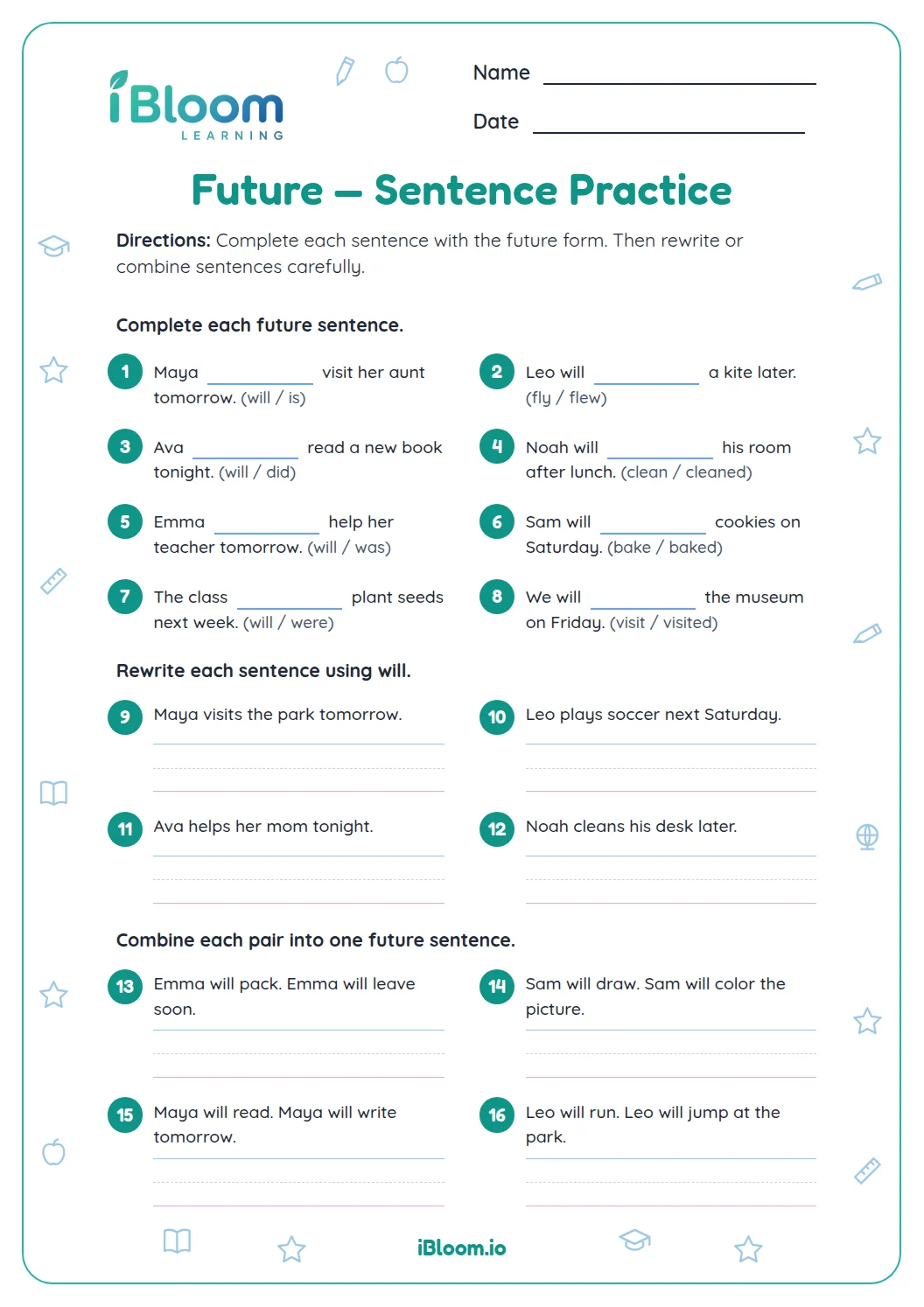
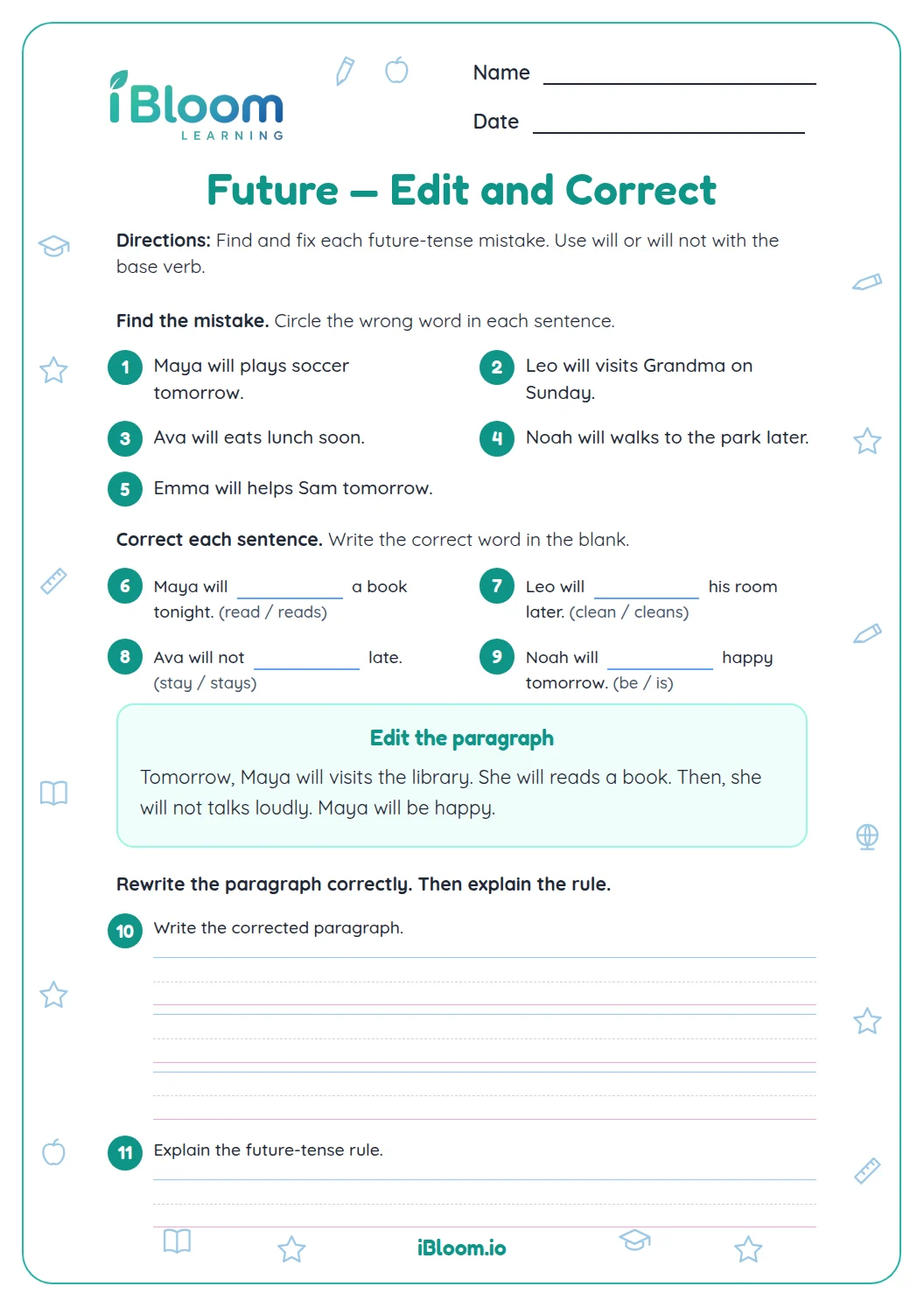
This free printable worksheet gives Grade 1 students practice checking a story ending before they call it finished. Every sentence is the last line of a small story, and each one has something to fix: a name that needs a capital letter, a verb that does not match the time words, or an end mark that does not fit. Children circle, choose and rewrite, then read the ending again. It practices Common Core L.1.2 and L.1.1e, and a separate answer key shows every correction.
Aligned to L.1.2 and L.1.1e
What does it mean to edit and correct a story ending?
Editing means reading a finished sentence again, slowly, to find what a careful writer would fix. On this sheet each sentence is the last line of a tiny story, such as "Then ben hugged his mom." or "Yesterday, noah find a lost dog." The ending is nearly right, which is what makes it good practice.
Practicing on sentences someone else wrote lets a child focus on the checks themselves, without feeling that their own story is being marked. Once the checks are familiar, they can run the same ones on the new endings they write.
What three checks help a first grader fix a sentence?
Teach the checks in the same order every time: capital letters, verb, end mark. Names and the first word of a sentence start with a capital. The verb has to match the time words, such as yesterday, every day or tomorrow. The last mark is a period for a telling sentence and a question mark for an asking sentence.
Part D uses all three at once. Question 12 starts as "mia and her dad flew the kite" with no end mark. The capital check changes mia to Mia, the verb check passes, and the end mark check adds a period.
- 1mia and her dad flew the kite
- 2Capital letters: mia becomes Mia
- 3Verb: flew is the past tense, so it stays
- 4End mark: a telling sentence needs a period
- 5Mia and her dad flew the kite.
How do time words help children choose the verb?
Part B puts a time word at the start of each sentence. Yesterday points to the past, so Sam saved the bird. Every day points to a habit in the present, so Mia plays with her kitten. Tomorrow points to the future, so Leo will see his new home.
Ask your child to point to the time word before choosing. The rewrite part uses the same clue: "Last night, Sam fix his bike" and "Yesterday, noah find a lost dog" both start with a past time word, so the verbs become fixed and found.
What is on this worksheet?
Fourteen questions on two pages, in four parts that move from circling to writing:
- Part A: 4 sentences, circle the word that needs a capital letter
- Part B: 3 sentences, choose the verb that matches the time word
- Part C: 4 sentences, choose a period or a question mark
- Part D: 3 sentences to rewrite with every mistake fixed
- A two-page answer key
How to use this worksheet at home or in class
- 1Read one ending aloud, including the mistake, and ask whether it sounds right.
- 2Teach the three checks: capital letters, verb, end mark. Say each one out loud as you run it.
- 3Do question 1 together, then let your child circle the capital letters in Part A alone.
- 4In Part B, have your child underline the time word before choosing the verb.
- 5In Part C, ask "Is this sentence telling or asking?" before picking a mark.
- 6Let your child rewrite the Part D sentences, then check them against the answer key one check at a time.
Common mistakes and quick fixes
The mistake
Fixing the capital letter but forgetting the end mark, so "mia and her dad flew the kite" becomes "Mia and her dad flew the kite".
The fix
Finish with the end mark check. Ask your child to touch the last word and say what comes after it.
The mistake
Adding -ed to every verb, so "noah find" becomes "Noah finded".
The fix
Say it aloud in a sentence about yesterday: "Yesterday, Noah found a lost dog." Some verbs, like find and fly, change their spelling instead of adding -ed.
The mistake
Ending an asking sentence with a period, as in "Did the puppy find its home."
The fix
Ask whether the sentence asks something. If someone could answer yes or no, it takes a question mark.
Common Core alignment
Most US states teach first grade writing with the Common Core standards or a close state version. These two language standards match the corrections on this sheet.
Capitalize names and end sentences with the right punctuation when writing.
On this sheet: Part A fixes capital letters on names and first words, and Part C chooses a period or a question mark.
Show the official wordingHide the official wording
Demonstrate command of the conventions of standard English capitalization, punctuation, and spelling when writing.
Use verbs that show past, present and future.
On this sheet: Part B matches saved, plays and will see to yesterday, every day and tomorrow, and Part D fixes two verbs.
Show the official wordingHide the official wording
Use verbs to convey a sense of past, present, and future (e.g., Yesterday I walked home; Today I walk home; Tomorrow I will walk home).
What to practice next
Make more practice
Further reading
Questions parents and teachers ask
What is a new ending in a Grade 1 writing prompt?
A new ending is the last sentence or two of a story, written after the child changes how the story finishes. On this sheet, each ending is already written and contains a mistake. Children fix the capital letters, the verb or the end mark so the ending is ready to share.
Why does the sheet use time words like yesterday and tomorrow?
Time words give first graders a clear clue for choosing a verb. Yesterday signals a past verb such as saved, every day signals a present verb such as plays, and tomorrow signals will plus a verb. Pointing to the time word first is quicker than guessing which verb sounds right.
When does a sentence need a question mark?
A sentence needs a question mark when it asks something, usually something a person could answer with yes or no. "Did the puppy find its home?" asks, so it takes a question mark. "The puppy found its home." tells, so it takes a period. Part C of the sheet practices exactly this choice.
Should first graders capitalize names and the first word?
Yes. Names of people, like Mia, Sam and Noah, always start with a capital letter, and so does the first word of every sentence. Part A circles lowercase names such as ben, mia and lee, and a sentence that starts with a lowercase word, so children see both rules together.
How can I help my child find mistakes in their own writing?
Have your child read the sentence aloud, touching each word, and stop at anything that sounds odd. Then run the three checks one at a time: capitals, verb, end mark. Fixing one kind of mistake per read is less tiring than hunting for everything at once.
Is there an answer key for this worksheet?
Yes. A separate two-page answer key shows the circled words in Part A, the verbs and end marks for Parts B and C, and the fully corrected sentences for Part D. You can print the worksheet by itself, keep the key for checking, or download both pages as a free PDF.