



About this worksheet
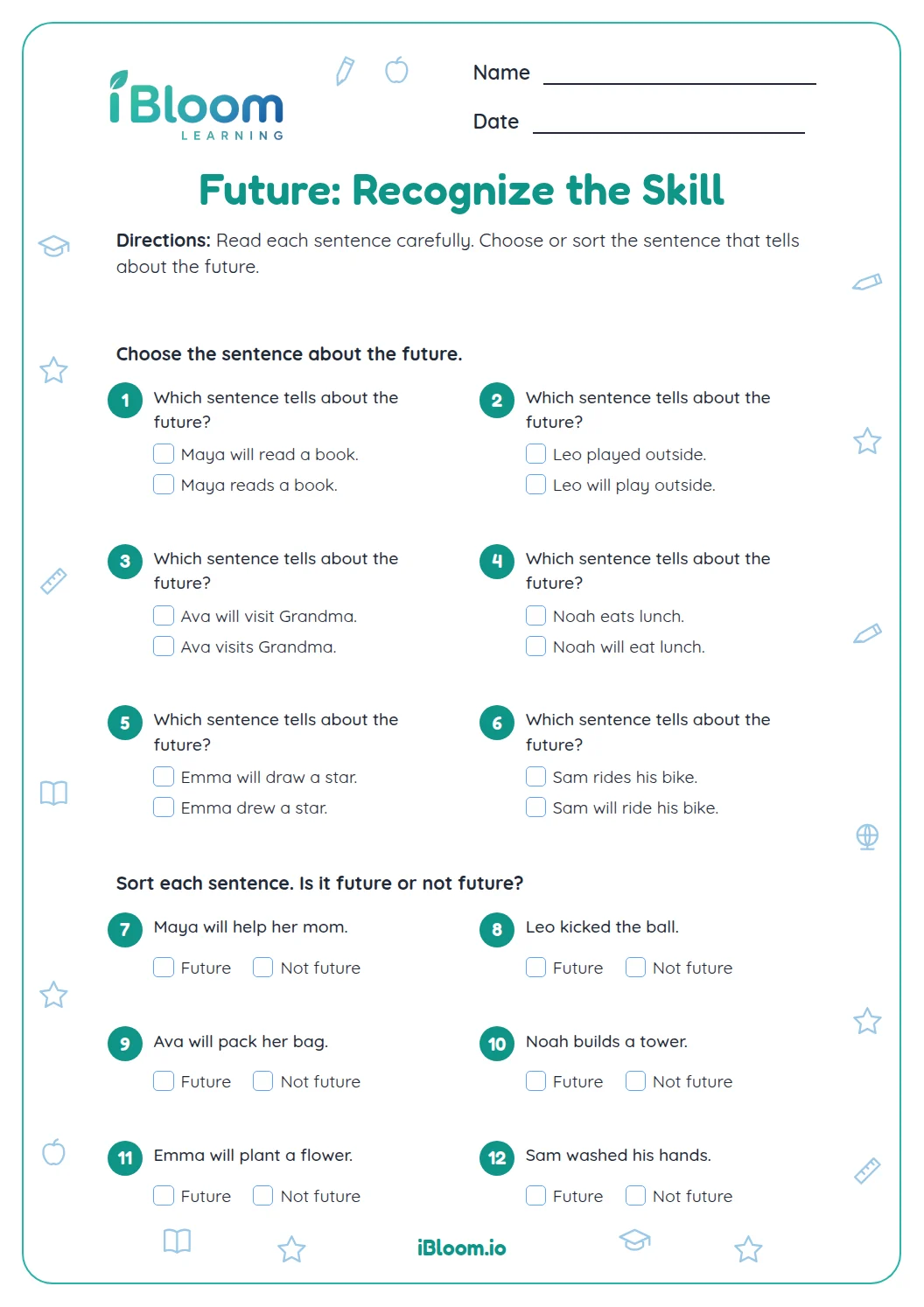
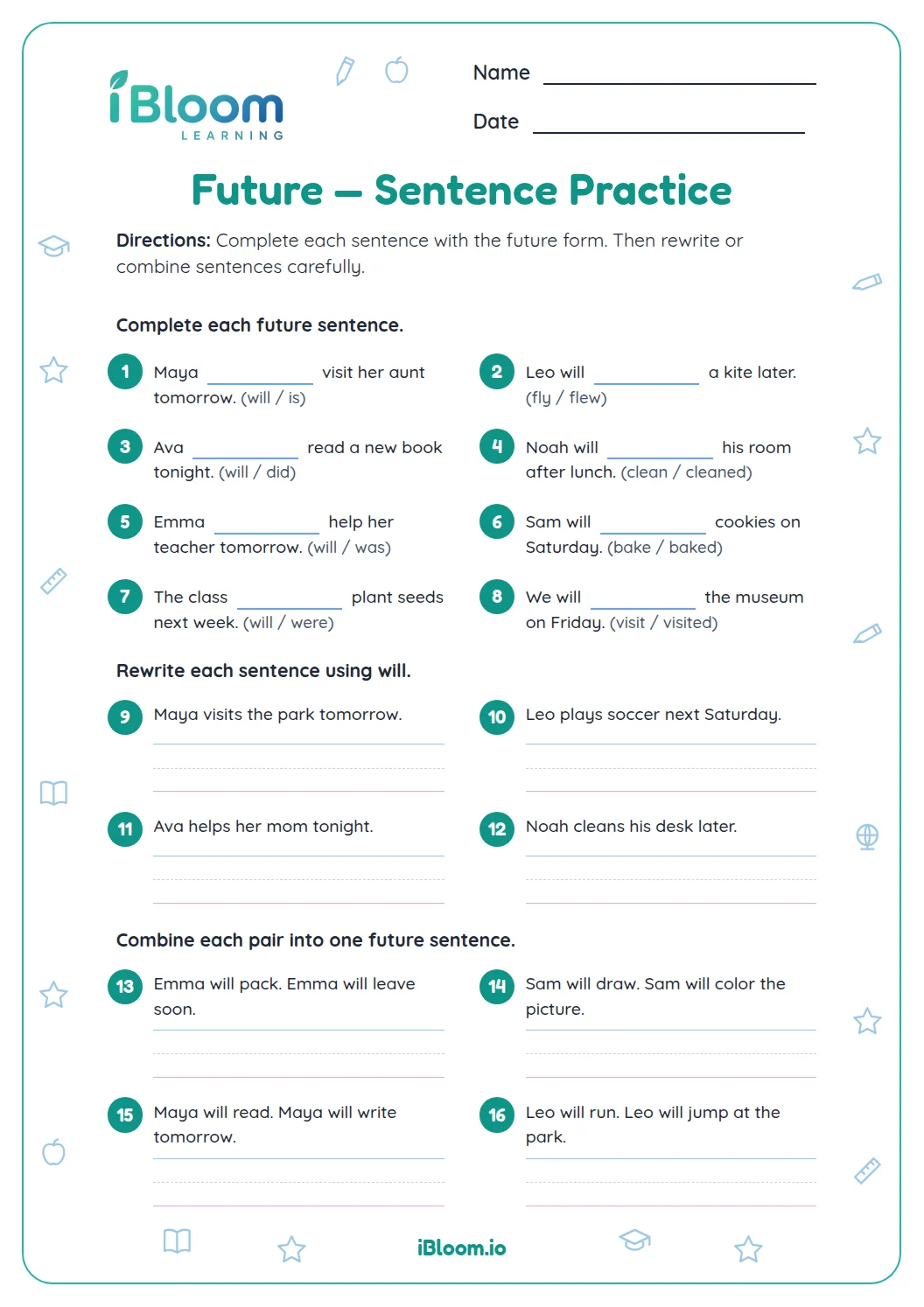
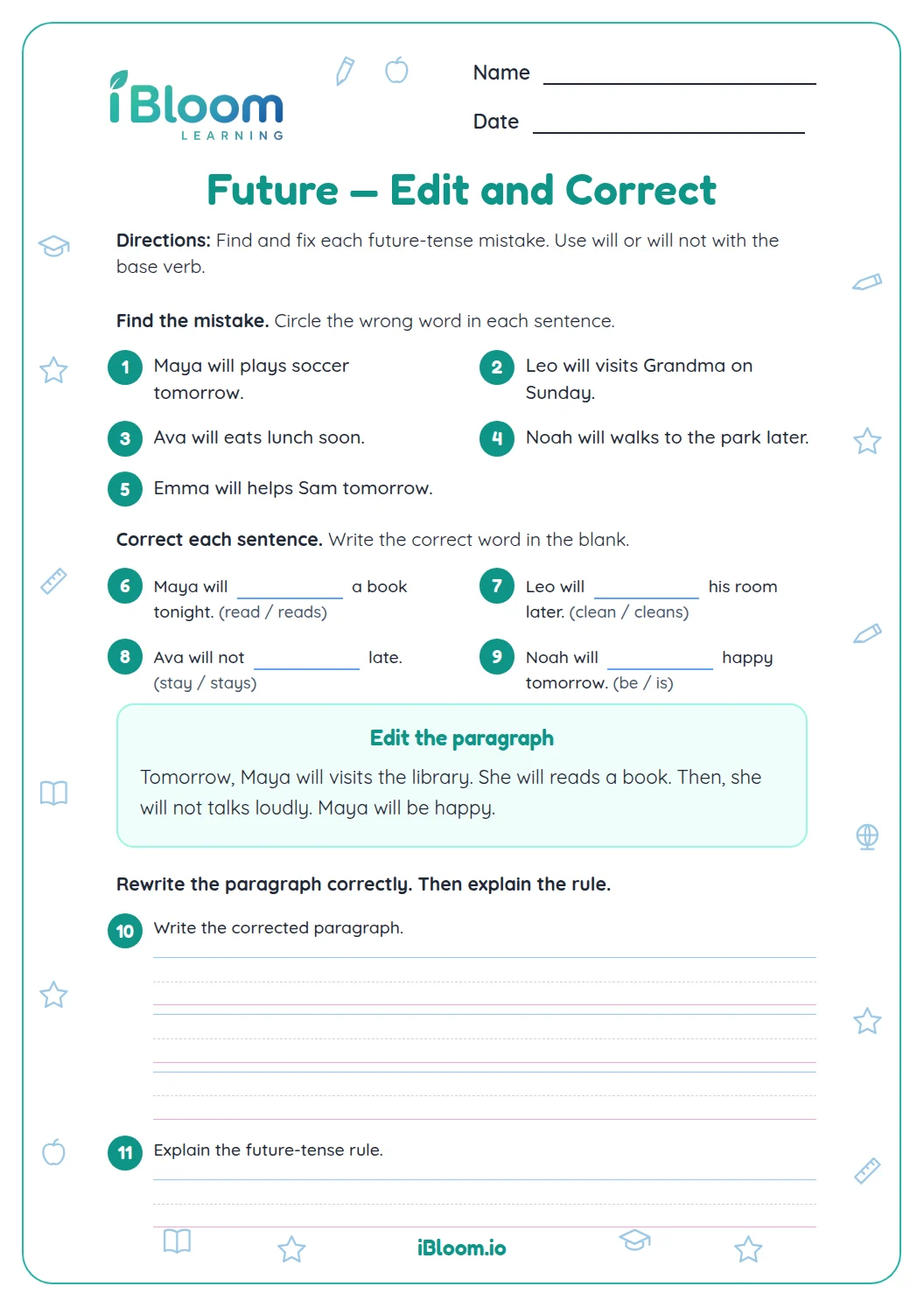
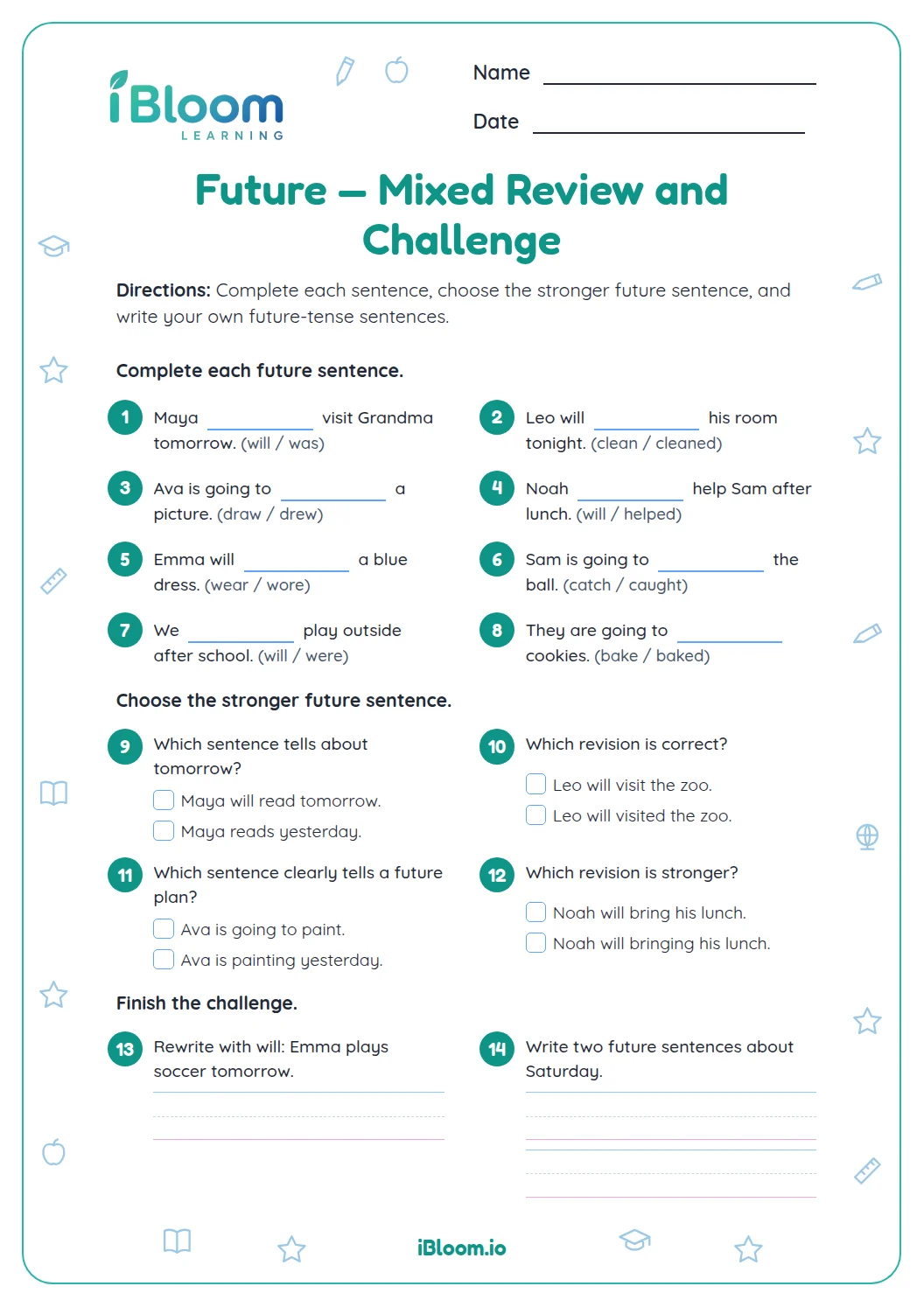
This Grade 1 worksheet practices future-tense verbs with will. Students first choose a correct future verb, then complete guided sentences with a base verb, and finally finish four sentence starters of their own. The sequence keeps the focus on will plus the base form while moving from choices to independent writing. It practices CCSS L.1.1.e, which includes using verbs to express future actions. A separate answer key gives the choice answers, completion verbs, and sample sentences.
Aligned to L.1.1.e
What verb pattern tells about the future?
Use will before the base verb to tell about an action that has not happened yet. The verb after will stays in its base form: will clean, will read, will play.
- 1Maya ___ the room tomorrow.
- 2Choose: will clean.
- 3After will, use clean, not cleans.
How can students complete each guided sentence?
The next six prompts provide three verb forms so students can choose the base form after will. Read the whole sentence to check both grammar and meaning.
How can students finish a future sentence?
The last four items give sentence starters for future actions. Finish each one as a complete sentence, keep will before the base verb, and reread to check the result.
How to complete the future sentences
- 1Look for the time clue, such as tomorrow or later.
- 2Find will or choose the option that includes will.
- 3Use the base form of the verb after will.
- 4Read the whole sentence aloud.
- 5Check that the action fits the sentence.
Common verb mistakes and quick fixes
The mistake
Adding s after will, as in “will cleans.”
The fix
Keep the verb in its base form: “will clean.”
The mistake
Using a past-tense verb after will.
The fix
Use the base verb after will, such as “will draw.”
The mistake
Missing will in a sentence about later.
The fix
Use the pattern will + base verb to show the future action.
Common Core alignment
This activity supports the stated Common Core writing goal.
Use verbs to tell whether an action happens in the past, present, or future.
On this sheet: Part A and Part B use will plus a base verb to name future actions.
Show the official wordingHide the official wording
Use verbs to convey a sense of past, present, and future (e.g., Yesterday I walked home; Today I walk home; Tomorrow I will walk home).
What to practice next
Make more practice
Further reading
Questions parents and teachers ask
How do you form a future-tense verb with will?
Put will before the base form of a verb. “Maya will clean the room tomorrow” is a future-tense sentence. The verb after will stays in its base form, so “will cleans” is not correct. The worksheet practices this pattern in choices and sentence completions.
Why does the verb after will stay in its base form?
The helping verb will carries the future meaning, so the next verb does not need an added ending. Use “will play,” “will read,” or “will go.” When a student sees “will plays,” cross out the s and read the sentence again.
What does Part A ask students to do?
Part A has six multiple-choice sentences. Students choose a future form that fits each sentence, such as “will clean” or “will drink.” The choices include common mix-ups so children can notice that will is followed by a base verb, not a verb with an added ending.
What happens in Part B?
After the six multiple-choice items, six guided completions each offer three verb forms. Students choose the base form that follows will. The final four prompts invite complete future-tense sentences, with sample responses in the answer key. This gives students a chance to write their own examples.
How can I help my child check an answer?
Ask the child to read the sentence aloud and listen for the pattern will plus a base verb. Then check whether the action fits the time clue and the rest of the sentence. A correct future form should sound complete and describe something that will happen later.