





About this worksheet
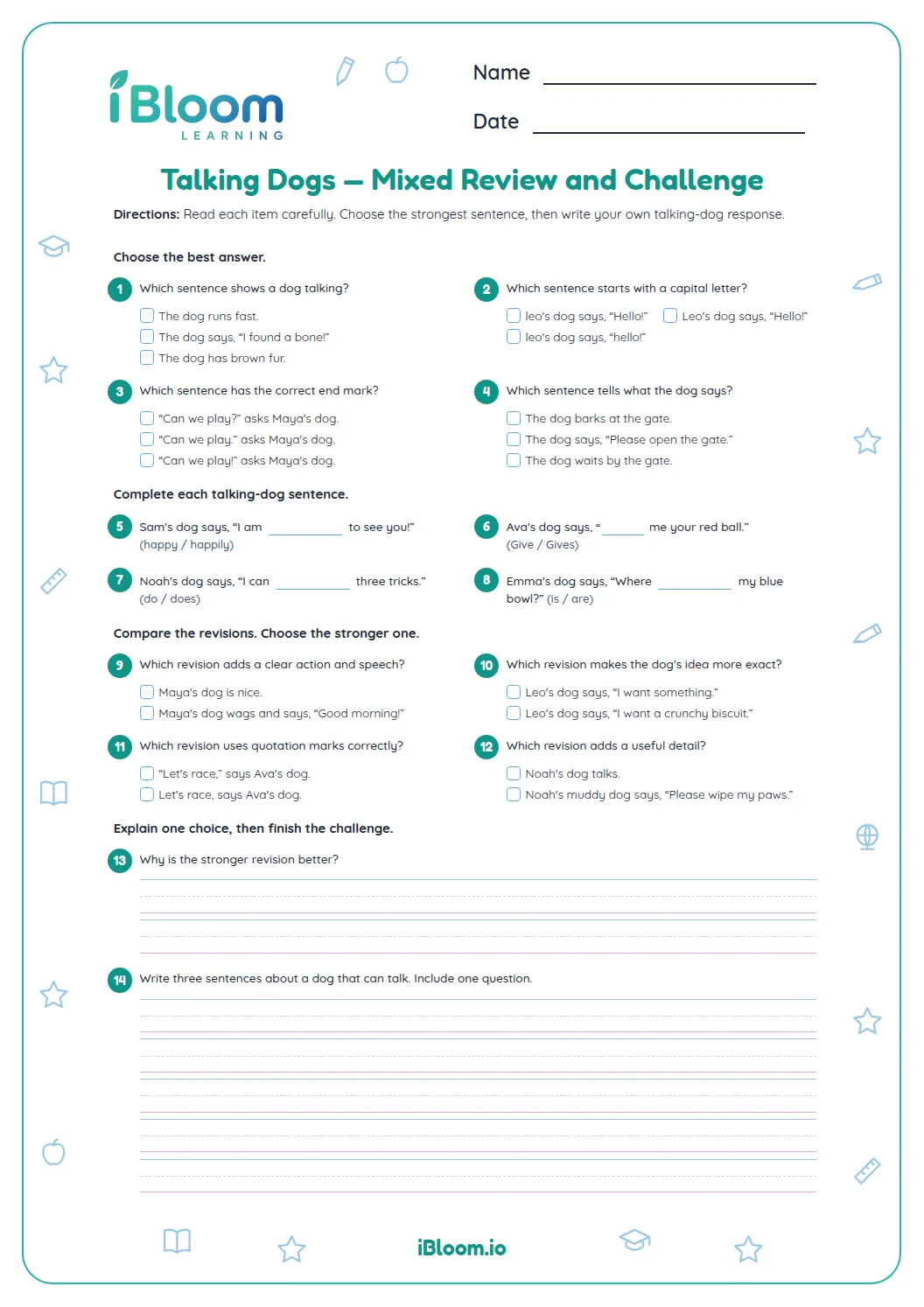
This free Grade 1 worksheet gives children practice building and revising sentences about talking dogs. Students choose complete sentences, check capitals, spaces, and end marks, then write and combine their own ideas. The page practices CCSS L.1.1.j and L.1.2.b, with 14 questions and a separate answer key.
Aligned to L.1.1.j and L.1.2.b
How can a child spot a complete sentence?
A complete sentence tells who or what and gives an action or thought. Part A contrasts complete sentences with word groups in a talking-dog theme. Children can read each choice aloud and listen for a complete idea.
- 1“My dog naps.” names the dog and tells what it does, so it is a complete sentence.
Which marks help a sentence make sense?
A capital begins a sentence, spaces separate its words, and an end mark shows whether it tells, asks, or exclaims. Part B practices these conventions with short dog sentences.
How can two ideas become one sentence?
In Part C, children finish a sentence and write their own talking-dog ideas. The last prompts bring back the old sheet’s combining practice: keep both ideas, remove repeated words, and join them into one clear sentence.
- 1The dogs ran. The dogs played. → The dogs ran and played.
How to use this worksheet
- 1Read each choice aloud and ask whether it gives a whole thought.
- 2Check the first letter and spaces between words.
- 3Listen to the sentence to decide whether it asks, tells, or exclaims.
- 4For the writing part, say the whole sentence before writing it.
- 5When joining two ideas, keep both actions and remove repeated words.
Common mistakes and quick fixes
The mistake
Choosing a word group such as “The brown dog” as a complete sentence.
The fix
Ask what the dog does; a complete thought needs an action or idea.
The mistake
Using a period after a question.
The fix
Read the sentence aloud and use a question mark when it asks something.
The mistake
Repeating the same subject when combining ideas.
The fix
Keep the subject once and join the actions: “The dogs ran and played.”
Curriculum alignment
This worksheet practices the following Common Core skill.
Write complete sentences for different purposes.
On this sheet: Parts A through C ask students to recognize and produce complete sentences for a prompt.
Show the official wordingHide the official wording
Produce and expand complete simple and compound declarative, interrogative, imperative, and exclamatory sentences in response to prompts.
Use end punctuation for sentences.
On this sheet: Part B practices period, question mark and exclamation point choices.
Show the official wordingHide the official wording
Use end punctuation for sentences.
What to practice next
Make more practice
Further reading
Questions parents and teachers ask
What is a complete sentence?
A complete sentence shares a whole thought, usually naming who or what and telling an action or idea. “My dog naps” is complete; “The brown dog” leaves the reader waiting to learn what the dog does next in the story.
Which end mark should a child use?
Use a period for a statement, a question mark for a question, and an exclamation point for a strong feeling or exclamation. Questions 6 and 7 let children choose the mark that matches the sentence they read aloud together first.
Does this worksheet include writing?
Yes. The last four questions ask children to finish a sentence, create a talking-dog sentence, and combine related ideas. They get practice composing sentences as well as recognizing complete sentences and basic conventions on the page in complete sentences together.
How can two short sentences be combined?
Keep the ideas that matter, remove repeated words, and join the actions when they belong together. For example, “The dogs ran. The dogs played.” can become “The dogs ran and played.” The final questions practice this kind of combining together.
How many questions and pages are included?
There are 14 questions across three parts. The printable worksheet is two pages, and the separate answer key is also two pages. Open-ended items include sample answers, so a child’s wording can differ while still forming a clear sentence independently.
How should an adult help without giving the answer?
Invite the child to read the sentence aloud and listen for a complete thought. For punctuation, ask whether the sentence tells, asks, or exclaims. For writing, ask the child to say the idea first, then check that the written sentence begins with a capital and ends with a mark.